Methicillin-resistant Staphylococcus aureus (MRSA): Nursing process (ADPIE)
Client Report0:00–0:28
Elias Moore, a 17-year-old African American male, who is on his school’s wrestling team who developed a red, painful sore on the upper left side of his thigh.
At first it looked like a spider bite, but the next day it began to swell and formed a bump filled with pus. He showed it to his mother who took him to the pediatrician’s office where he was diagnosed with community-acquired methicillin-resistant Staphylococcus aureus, also known as CA-MRSA.MRSA is a strain of Staphylococcus aureus, or staph for short.
Pathology0:28–4:32
It’s often referred to as a superbug due to its resistance to the widely-used beta lactam antibiotics such as penicillins, cephalosporins, and carbapenems.
This is because MRSA has the mecA gene that allows the bacteria to produce proteins that are more difficult for the medications to bind to, and it also codes for the beta lactamase enzyme which can break these medications down.
Unfortunately, due to the misuse and overuse of antibiotic treatment by both clinicians and patients, MRSA has become more common in recent years.
The two types are healthcare-associated MRSA, or HA-MRSA, and community-associated MRSA, or CA-MRSA. HA-MRSA infections are a leading cause of infection in hospitals due in part to the fact that it creates biofilms that colonize medical devices like catheters, endotracheal tubing, and surgical instruments.
On the other hand, CA-MRSA occurs when there’s been no exposure to the healthcare setting and it can affect healthy individuals.
CA-MRSA is primarily transmitted from direct or indirect contact and can either asymptomatically colonize or cause an active infection.
Risk factors for developing an active infection include chronic illnesses like kidney disease, diabetes, or malignancies; activities that could cause damage to the skin, like contact sports and intravenous drug use; living in crowded or unsanitary conditions like army barracks or prisons; and those with HIV or using immune suppressing medications like corticosteroids.
The infection occurs when immunosuppression or altered skin integrity allows the bacteria to bypass the body’s natural defenses and enter the tissue.
CA-MRSA typically presents as a localized skin and soft tissue infection, or SSTI. Single or multiple red bumps that resemble pimples or spider bites initially appear in areas of compromised skin integrity or in areas often covered with hair like the armpits, groin, or back of the neck.
Increased warmth, erythema, edema, tenderness, a palpable fluid-filled cavity, or purulent drainage may occur within the infected site.
Fever and lethargy are also commonly experienced at this time. If left untreated or poorly managed, these localized infections can quickly become systemic and result in sepsis, endocarditis, osteomyelitis, necrotizing pneumonia, and septic joints.CA-MRSA can be diagnosed through a variety of tests.
Cultures from suspected sources of infection, such as wound scraping, sputum, blood, or urine, can be collected for testing.
If the culture’s results remain inconclusive, the DNA polymerase chain reaction, or PCR, of MRSA is highly sensitive and currently considered the gold standard for determining infectious type.
To test for MRSA colonization and not active infection, DNA PCR of MRSA from a nares swab is often utilized. Treatment for MRSA involves quick initiation of antibiotic therapy.
HA-MRSA infections typically have more resistance to medications when compared to CA-MRSA. In fact it often resists non-beta lactam antibiotics, making it more difficult to treat.
Common oral antibiotics prescribed include trimethoprim/sulfamethoxazole, doxycycline or minocycline, clindamycin, linezolid or tedizolid, and delafloxacin.
Intravenous antibiotics may be initiated if the oral medications prove ineffective, if systemic infection occurs, or if the SSTI occurred near an implanted device.
In such cases, IV vancomycin is often the preferred drug among clinicians. However, new strains of vancomycin-resistant Staphylococcus aureus, known as VRSA, have become more common in recent years.
Assessment4:32–5:35
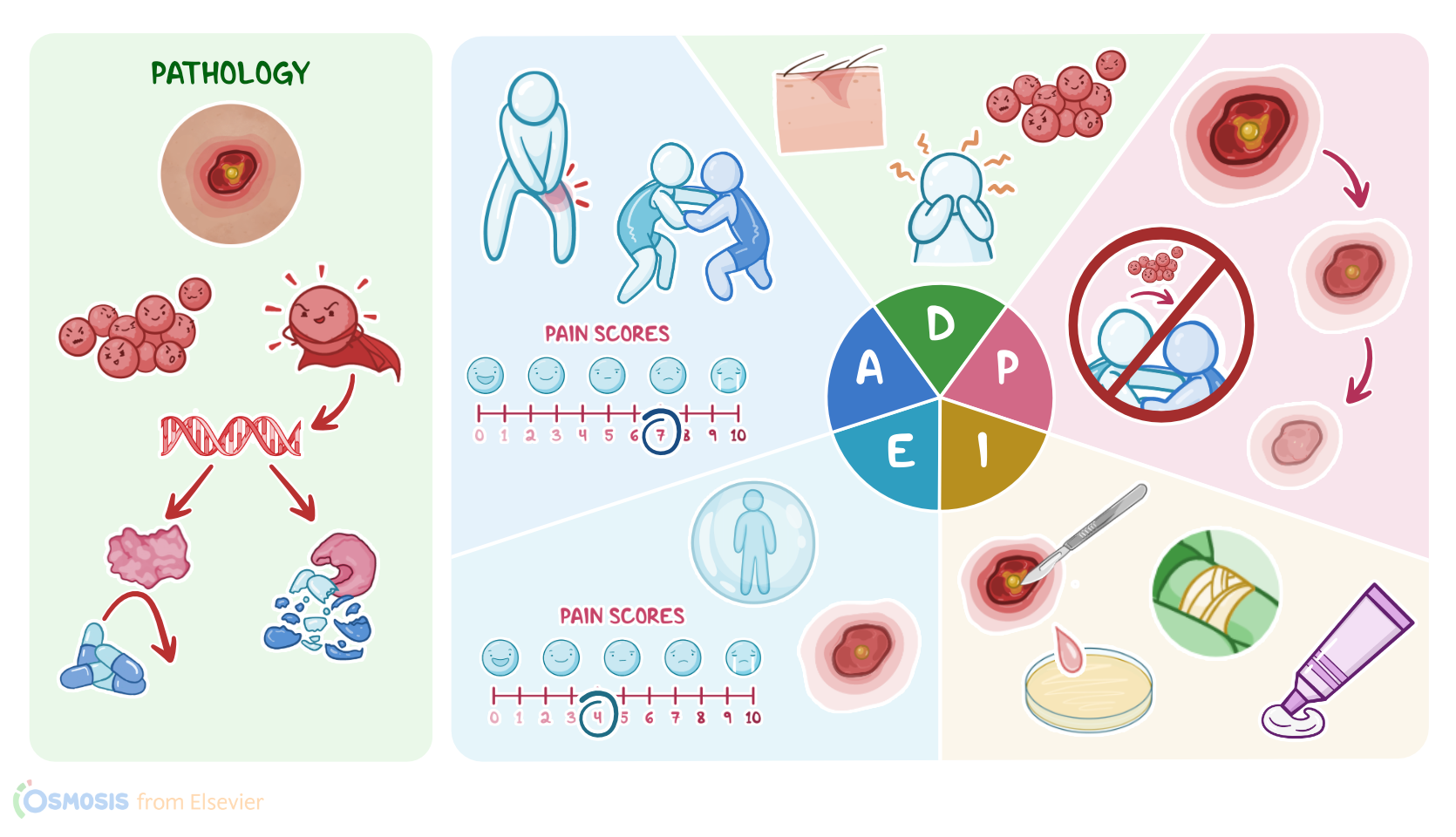
You begin your assessment by asking Elias how he’s feeling today. He tells you he feels fine except his leg is very painful and he worries it’s going to interfere with his wrestling practice.Elias’s vital signs are: temperature 98.6℉ or 37℃, heart rate is regular at 62 beats per minute, respirations 14 breaths per minute with clear lung sounds, blood pressure 118/70 mmHg, pain 7/10 located on his upper left thigh.
Assessment of his thigh reveals a 4 inch, or 10 cm, circular area of erythema and edema with a large raised pustule in the center.The skin around the wound is warm and tender to the touch.
You document your assessment and let Elias and his mother know the pediatrician will be in shortly.Based on the data you collected through your assessment, you create these nursing diagnoses: impaired skin integrity related to pustule formation, pain related to injury and inflammation, risk of infection related to increased environmental exposure to MRSA, anxiety related to missing sports activities.Next, you collaborate with Elias, his mother, and the pediatrician to plan some goals for his care.After completion of antibiotic therapy, the wound will have reduced erythema, edema, warmth, and pain; Elias’s anxiety will decrease as the infection clears with treatment; and Elias will take measures to prevent the spread of infection to other body parts, family members, and members of his wrestling team.
Diagnosis5:35–5:53
Planning5:53–6:16
Next, you implement the plan of care. You assist the pediatrician to incise and drain the wound, and you collect a sample to send to the lab for culture.
Implementation6:16–7:31
A topical antibiotic is applied and you dress the wound, and Elias is prescribed PO trimethoprim/sulfamethoxazole. You remind Elias and his mother the importance of taking the antibiotic as prescribed until all the capsules are gone.
You stress the importance of frequent handwashing with soap or alcohol-based sanitizer, to avoid touching the infected area and keeping the dressing clean and covered.
You also explain how staying hydrated and eating a high protein diet promotes wound healing. To control infection around the home, you stress the importance of frequent hand washing, showering with antibacterial soap, daily disinfection of commonly used surface areas, avoidance of sharing towels, and washing clothing and other items used by Elias in hot water.
To prevent spread to the rest of the wrestling team, you explain the importance of isolating from the rest of the team, and you review the criteria for returning to wrestling activity, including adherence to antibiotic therapy, no new skin infections and improvement of this wound at his nextOkay, let’s check back with Elias and evaluate how he’s doing.
After 10 days, no new skin infections have formed and assessment of his leg reveals a 2.5 inch, or 6.3 cm, circular area of erythema, and the raised pustule in the center has decreased in size, and a scant amount of exudate is noted.
Evaluation7:31–8:20
Elias states his current pain level is 4/10. His mother tells you the rest of the family has remained free of infections so far.
Elias says he has been watching wrestling practice on the sidelines and he is glad to know he is getting better and will be back to wrestling soon.
You are glad to see Elias is improving and you encourage him to continue adherence to infection control measures as his infection completely resolves and it is safe for him to return to wrestling practice.Alright, as a quick recap ....
Your assessment of Elias Moore revealed a circular area of erythema, edema, and tenderness along with a large raised pustule.
The priority nursing diagnosis were: impaired skin integrity, pain, risk of infection spread, and anxiety. Careful planning allowed you to create goals that addressed Elias’s current condition, and implementation of interventions allowed him to begin reaching these goals.
Summary8:20–8:54
And finally, you evaluated Elias’s progress toward resolution of infection and preventing further spread to his family and teammates.
a license current condition and implementation of interventions allowed him to begin reaching these goals. And finally you evaluated Elias as progress towards resolution of infection and preventing further spread
| METHICILLIN-RESISTANT STAPHYLOCOCCUS AUREUS (MRSA) | ||
| KEY POINTS | NOTES | |
| PATIENT REPORT |
| |
| PATHOPHYSIOLOGY |
| |
| DIAGNOSIS AND TREATMENT |
| |
| ASSESSMENT |
| |
| NURSING DIAGNOSES |
| |
| PLANNING |
| |
| IMPLEMENTATION |
| |
| EVALUATION |
| |
No notes for this video yet
Try adding a note below