Neonatal sepsis: Nursing

Neonatal sepsis: Nursing

Watch later

Watch later

Infection prevention and control - Precautions and personal protective equipment (PPE): Nursing skills
Urinary tract infections (UTIs): Nursing process (ADPIE)
Modes of infectious disease transmission
Epstein-Barr virus (Infectious mononucleosis)
Pneumonia
Wound healing
Palliative and hospice care: Nursing
Postoperative care: Nursing
Biology of cancer: Nursing
Biliary atresia: Nursing
Cholecystitis: Nursing
Cholelithiasis: Nursing
Colorectal cancer: Nursing
Diarrhea: Nursing
Diverticular disease: Nursing
Esophageal cancer: Nursing
Gastric cancer: Nursing
Hepatitis: Nursing
Inflammatory bowel disease - Crohn disease and ulcerative colitis: Nursing
Intestinal obstruction: Nursing
Irritable bowel syndrome (IBS): Nursing
Jaundice: Nursing
Laryngeal cancer: Nursing
Liver cancer: Nursing
Pancreatic cancer: Nursing
Esophageal atresia and tracheoesophageal fistula: Nursing
Geriatric considerations - Gastrointestinal: Nursing
Hirschsprung disease: Nursing
Hyperemesis gravidarum: Nursing
Necrotizing enterocolitis: Nursing
Omphalocele and gastroschisis: Nursing
Appendicitis: Nursing process (ADPIE)
Celiac disease: Nursing process (ADPIE)
Cirrhosis: Nursing process (ADPIE)
Gastroesophageal reflux disease (GERD): Nursing process (ADPIE)
Hiatal hernia: Nursing process (ADPIE)
Pancreatitis: Nursing process (ADPIE)
Peptic ulcer disease (PUD): Nursing process (ADPIE)
Antacids: Nursing pharmacology
Antidiarrheals: Nursing pharmacology
Antiemetics: Nursing pharmacology
Antispasmodics (GI): Nursing pharmacology
Gallstone-dissolving agents: Nursing pharmacology
Gastric mucosal protective agents: Nursing pharmacology
Histamine H2 antagonists: Nursing pharmacology
Laxatives: Nursing pharmacology
Medications for hepatic encephalopathy: Nursing pharmacology
Pancreatic enzyme replacements: Nursing pharmacology
Proton pump inhibitors (PPIs): Nursing pharmacology
Treatment for Helicobacter pylori: Nursing pharmacology
Weight loss medications: Nursing pharmacology
Bladder tumors: Nursing
Chronic kidney disease (CKD): Nursing
Dialysis care: Nursing
Epididymitis: Nursing
Glomerulonephritis: Nursing
Nephrotic syndrome: Nursing
Polycystic kidney disease (PKD): Nursing
Prostate cancer: Nursing
Pyelonephritis: Nursing
Renal and urinary calculi: Nursing
Renal cancer: Nursing
Testicular cancer: Nursing
Urinary retention: Nursing
Bladder exstrophy: Nursing
Circumcision: Nursing
Cryptorchidism: Nursing
Enuresis: Nursing
Geriatric considerations - Urinary: Nursing
Hypospadias and epispadias: Nursing
Acute kidney injury (AKI): Nursing process (ADPIE)
Benign prostatic hyperplasia (BPH): Nursing process (ADPIE)
Urinary incontinence - Stress: Nursing process (ADPIE)
Antispasmodics (GU): Nursing pharmacology
Cholinergic therapy (GU): Nursing pharmacology
Diuretics - Osmotic and carbonic anhydrase inhibitors: Nursing pharmacology
Diuretics - Thiazide, thiazide-like, loop, and potassium-sparing diuretics: Nursing pharmacology
Anemia - Aplastic: Nursing
Anemia - Iron-deficiency: Nursing
Anemia - Macrocytic: Nursing
Arterial blood gas (ABG) - Overview: Nursing
Arterial blood gas (ABG) - Metabolic acidosis: Nursing
Arterial blood gas (ABG) - Metabolic alkalosis: Nursing
Arterial blood gas (ABG) - Respiratory acidosis: Nursing
Arterial blood gas (ABG) - Respiratory alkalosis: Nursing
Blood cultures: Nursing
Cardiac biomarkers - Creatine kinase (CK): Nursing
Cardiac biomarkers - Troponin: Nursing
Coagulation studies - Partial thromboplastin time (PTT): Nursing
Complete blood count (CBC) - Hemoglobin and hematocrit: Nursing
Complete blood count (CBC) - Platelets: Nursing
Complete blood count (CBC) - Red blood cells (RBC): Nursing
Complete blood count (CBC) - White blood cells (WBC) and differential: Nursing
Complete metabolic panel (CMP) - Blood urea nitrogen (BUN) and creatinine (Cr): Nursing
Complete metabolic panel (CMP) - Chloride: Nursing
Complete metabolic panel (CMP) - Estimated glomerular filtration rate (eGFR): Nursing
Complete metabolic panel (CMP) - Glucose: Nursing
Complete metabolic panel (CMP) - Liver function tests (LFT): Nursing
Complete metabolic panel (CMP) - Potassium: Nursing
Complete metabolic panel (CMP) - Sodium: Nursing
Complete metabolic panel (CMP) - Total protein: Nursing
Disseminated intravascular coagulation (DIC): Nursing
Multiple myeloma: Nursing
Neutropenia: Nursing
Polycythemia: Nursing
Thalassemia: Nursing
Thrombocytopenia: Nursing
Leukemia: Nursing process (ADPIE)
Anticoagulants - Direct thrombin and factor Xa inhibitors: Nursing pharmacology
Anticoagulants - Heparin: Nursing pharmacology
Anticoagulants - Warfarin: Nursing pharmacology
Antihyperlipidemics - Bile acid sequestrants and cholesterol absorption inhibitors: Nursing pharmacology
Antihyperlipidemics - Fibrates: Nursing pharmacology
Antihyperlipidemics - Miscellaneous: Nursing pharmacology
Antihyperlipidemics - Statins: Nursing pharmacology
Antiplatelet agents: Nursing pharmacology
Blood products: Nursing pharmacology
Hematopoietic growth factors: Nursing pharmacology
Hemostatics: Nursing pharmacology
Iron preparations: Nursing pharmacology
Thrombolytics: Nursing pharmacology
Autoimmunity: Nursing
Human immunodeficiency virus (HIV) and acquired immunodeficiency syndrome (AIDS): Nursing
Hypersensitivity reactions - Type I: Nursing
Hypersensitivity reactions - Type II: Nursing
Hypersensitivity reactions - Type III: Nursing
Hypersensitivity reactions - Type IV: Nursing
Immune response - Adaptive: Nursing
Immune response - Innate: Nursing
Immunodeficiency disorders - Primary: Nursing
Immunodeficiency disorders - Secondary: Nursing
Inflammatory process: Nursing
Scleroderma: Nursing
Shock - Anaphylactic: Nursing
Sjögren syndrome: Nursing
Systemic lupus erythematosus (SLE): Nursing
Toxic shock syndrome (TSS): Nursing
Erythema infectiosum (Fifth disease): Nursing
Fever: Nursing
Infectious mononucleosis: Nursing
Mumps (Parotitis): Nursing
Neonatal sepsis: Nursing
Pertussis: Nursing
Poliomyelitis: Nursing
Postpartum infections: Nursing
Roseola (Exanthem subitum): Nursing
Rubella (German measles): Nursing
Rubeola (Measles): Nursing
Smallpox: Nursing
Zika virus: Nursing
Anaphylaxis: Nursing process (ADPIE)
Lyme disease: Nursing process (ADPIE)
Rheumatoid arthritis (RA): Nursing process (ADPIE)
Antirejection immunosuppressants: Nursing pharmacology
Biologic agents: Nursing pharmacology
Disease-modifying therapy for multiple sclerosis: Nursing pharmacology
Immunoglobulins: Nursing pharmacology
Immunomodulators: Nursing pharmacology
Immunosuppressants for autoimmune diseases: Nursing pharmacology
Non-biologic disease-modifying antirheumatic drug (DMARD) therapy: Nursing pharmacology
Vaccines: Nursing pharmacology
Acne: Nursing
Animal and snake bites: Nursing
Burn injury: Nursing
Cutaneous fungal infections: Nursing
Erysipelas and cellulitis: Nursing
Folliculitis, carbuncles, and furuncles: Nursing
Herpes simplex virus (HSV): Nursing
Herpes zoster: Nursing
Impetigo: Nursing
Insect stings and bites: Nursing
Pediculosis and scabies: Nursing
Psoriasis: Nursing
Rocky Mountain spotted fever (RMSF): Nursing
Skin cancer - Basal cell carcinoma, squamous cell carcinoma, and melanoma: Nursing
Urticaria: Nursing
Geriatric considerations - Integumentary: Nursing
Atopic dermatitis: Nursing process (ADPIE)
Frostbite: Nursing process (ADPIE)
Methicillin-resistant Staphylococcus aureus (MRSA): Nursing process (ADPIE)
Pressure injury: Nursing process (ADPIE)
Antibiotics - Topical: Nursing pharmacology
Antifungals - Topical: Nursing pharmacology
Corticosteroids - Topical: Nursing pharmacology
Debridement agents: Nursing pharmacology
Keratolytics: Nursing pharmacology
Medications for acne vulgaris: Nursing pharmacology
Osteoarthritis: Nursing
Osteomyelitis: Nursing
Osteoporosis: Nursing
Hip fractures: Nursing
Developmental dysplasia of the hip: Nursing
Acute compartment syndrome: Nursing process (ADPIE)
Fractures: Nursing process (ADPIE)
Gout: Nursing process (ADPIE)
Musculoskeletal injuries: Nursing process (ADPIE)
Buerger disease: Nursing
Raynaud phenomenon: Nursing
Peripheral arterial disease (PAD): Nursing process (ADPIE)
Peripheral venous disease (PVD): Nursing process (ADPIE)
Atelectasis: Nursing
Geriatric considerations - Respiratory: Nursing
Venous thromboembolism (VTE): Nursing process (ADPIE)
Asthma: Nursing process (ADPIE)
Bacterial pneumonia: Nursing process (ADPIE)
Bronchiolitis and respiratory syncytial virus (RSV): Nursing process (ADPIE)
Carbon monoxide poisoning: Nursing process (ADPIE)
Chronic obstructive pulmonary disease (COPD): Nursing process (ADPIE)
Epiglottitis: Nursing process (ADPIE)
Foreign body aspiration and upper airway obstruction: Nursing process (ADPIE)
Laryngotracheobronchitis (LTB) and croup: Nursing process (ADPIE)
Smoke inhalation injury: Nursing process (ADPIE)
Papulosquamous and inflammatory skin disorders: Pathology review

Notes

NEONATAL SEPSIS

KEY POINTS
NOTES
DEFINITION
  • Presence of bacteria in blood or bacterial meningitis presenting in first 30 days of life
    • Early-onset
    • Late-onset

PHYSIOLOGY
  • Newborn immune system
    • Immature 
    • Reacts slowly to invasion
    • Antibodies acquired from mother and breast milk
    • Blood brain barrier underdeveloped

CAUSES AND RISK FACTORS
  • Causes
    • Bacteria
    • Fungi
  • Risk factors
    • Fetal
      • Prematurity
      • Low birth weight
      • Admission to NICU
    • Maternal
      • Prolonged rupture of membranes
      • Chorioamnionitis
      • Vaginal colonization with group B strep

PATHOPHYSIOLOGY
  • Pathogen enters body
  • Pathogen evades immature immune system and enters bloodstream
  • Immune cells release pro-inflammatory cytokines
  • Widespread inflammation occurs
  • Complications
    • Septic shock
    • Disseminated intravascular coagulation
    • Multiple organ dysfunction syndrome
    • Chronic lung disease
    • Cerebral palsy
    • Impaired psychomotor and mental development
    • Neurodevelopment abnormalities

SIGNS AND SYMPTOMS
  • Intrapartum fetal tachycardia
  • Non-reassuring fetal heart rate patterns
  • Meconium-stained amniotic fluid
  • Low Apgar score
  • Lethargy
  • Decreased tone
  • Feeding difficulties
  • Temperature instability
  • Signs of respiratory distress
  • Apnea
  • Bradycardia
  • Hypotension
  • Meningitis

DIAGNOSIS
  • History
  • Physical assessment
  • Blood, urine, and cerebrospinal fluid cultures
  • Laboratory tests
  • X-ray

TREATMENT
  • Address underlying infection
  • Antibiotics
  • Supportive care

MANAGEMENT OF CARE
  • Goals of care
    • Assist in eliminating infection
    • Provide supportive care
    • Monitor for complications
    • Provide emotional support
  • Collect culture specimens
  • Administer medications as prescribed
  • Place in incubator or radiant warmer
  • Check temperature
  • Institute continuous cardiopulmonary monitoring
  • Monitor respiratory status
  • Adjust oxygen as indicated
  • Monitor intake, output, electrolytes, and glucose
  • Provide enteral or parenteral nutrition
  • Provide therapeutic environment
  • Use positioning devices
  • Assess pain
  • Notify HCP
    • Hypotension
    • Decreased peripheral pulses
    • Cyanosis
    • Jaundice
    • Petechiae or purpura
    • Oozing from blood draws
    • Decreased urine output
  • Acknowledge caregiver anxiety
  • Address questions and concerns

PATIENT AND FAMILY TEACHING
  • Explain condition, plan of care, and how to safely administer medications
  • Encourage caregivers to interact and visit baby
  • Teach about infection prevention 
  • Instruction on how to recognize baby's cues
  • Recommend caregivers take infant CPR
  • Keep all follow-up appointments
  • Ensure caregivers understand use of home equipment and medications
  • Evaluate car seat before discharge
  • Teach about immunizations
  • How to reduce risk of SIDS
  • Notify HCP
    • Fever
    • Yellowing of skin
    • Difficulty feeding
    • Any concerns
  • Seek emergency care
    • Trouble breathing
    • Seizure

Transcript

Watch video only

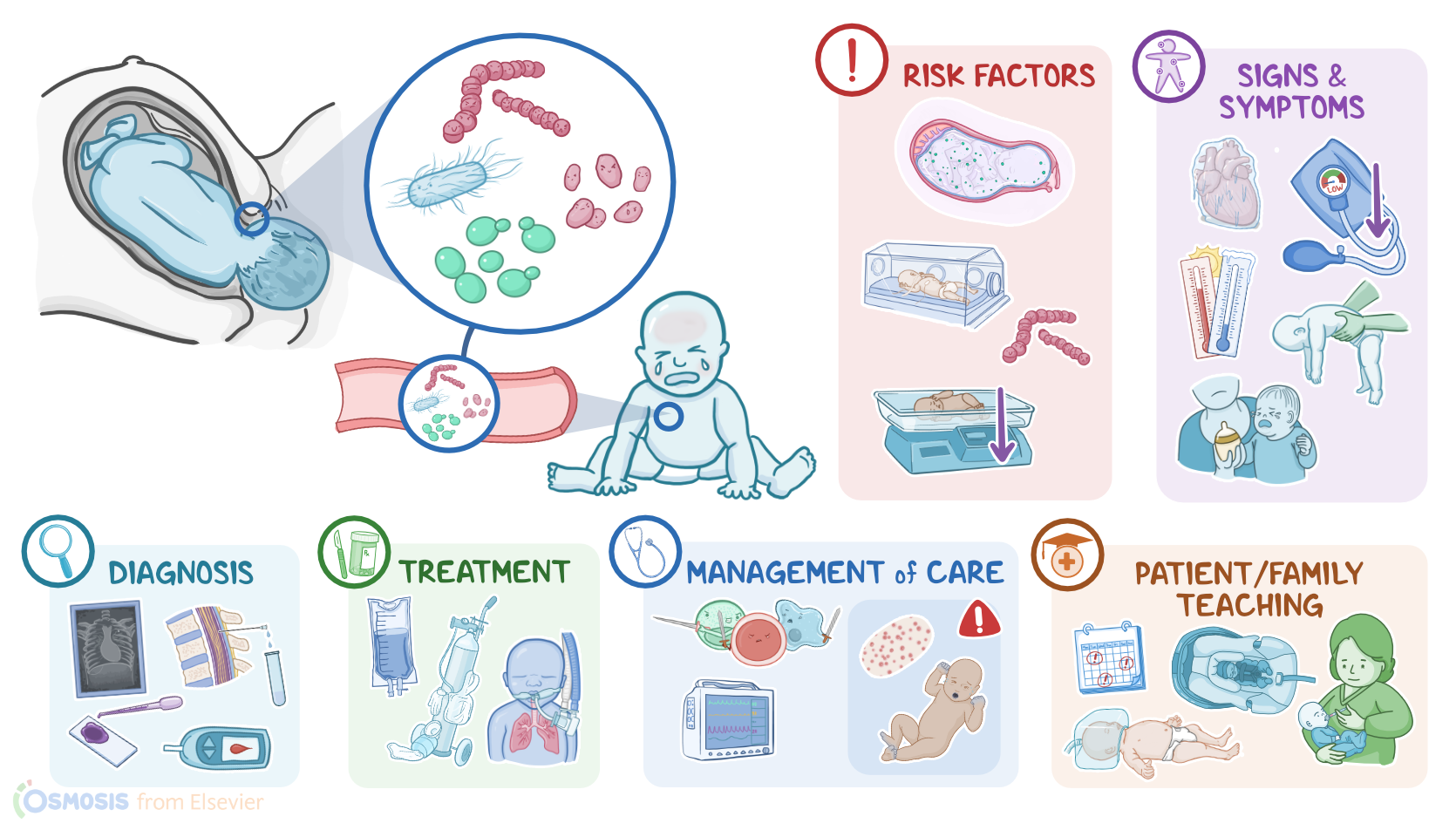
Neonatal sepsis refers to the presence of bacteria in the blood or bacterial meningitis presenting in the first 30 days of life. It is classified as early-onset and late-onset sepsis. Early-onset sepsis occurs during the first three days of life, and is caused by exposure to a pathogen during the intrapartum period; while late-onset sepsis occurs after the first week of life, and is caused by pathogens that are acquired postnatally.

Now, let’s quickly review the immune system of newborns. During the first six months of life, the immune system is immature, meaning that it reacts more slowly to an invasion when compared to older children. Because the infant’s immune system isn’t fully developed, they depend on the few antibodies acquired from the mother during the intrauterine life and from breast milk. These offer some protection but are too few to keep infections localized, so there’s a higher risk of infections spreading quickly throughout the body. Additionally, the newborn’s blood-brain barrier is underdeveloped, and that makes it easier for pathogens to enter the central nervous system and cause meningitis.

Now, neonatal sepsis is most commonly caused by bacteria from the mother’s genitourinary tract that infects the infant during delivery. The most common ones include group-B Streptococcus, Streptococcus pyogenes, Escherichia coli, Listeria monocytogenes, Haemophilus influenzae , Enterobacter spp. Less commonly, sepsis can be caused by fungi, such as Candida albicans.

Risk factors for neonatal sepsis are grouped into fetal and maternal risk factors. Fetal risk factors include prematurity, low birth weight, and admission to the neonatal intensive care unit, or NICU for short. On the other hand, maternal risk factors include prolonged rupture of membranes that lasts 12 to 18 hours prior to delivery, in addition to chorioamnionitis, and vaginal colonization by group-B Streptococcus.

Alright, now the pathological process of neonatal sepsis starts when a pathogen, say some bacteria, enters the body. With the immune system still immature and the immunoglobulin levels at a lower level, there’s a higher risk that some bacteria will make it into the bloodstream. At this point, the bacteria and the toxin they release can activate immune cells to release proinflammatory cytokines, which trigger widespread inflammation. These bacteria and toxins can also find their way to various body organs, and cause impaired pulmonary, hepatic, and renal function.

Now, neonatal sepsis can lead to important acute complications, including septic shock, as well as disseminated intravascular coagulation, or DIC for short, and multiple organ dysfunction syndrome, or MODS for short. Neonatal sepsis can also cause long-term complications, such as chronic lung disease, cerebral palsy, impaired psychomotor and mental development, in addition to neurodevelopmental abnormalities, such as hearing and visual deficits.

Before birth, clinical manifestations of neonatal sepsis may include intrapartum fetal tachycardia, nonreassuring fetal heart rate patterns, and meconium stained amniotic fluid.

Clinical manifestations after birth can include an Apgar score of 6 or lower at 5 minutes; lethargy; decreased tone; feeding difficulties, including weak suck, poor feeding, and abdominal distension;

temperature instability; signs of respiratory distress, including tachypnea, nasal flaring, chest retractions, grunting, cyanosis; apnea accompanied by bradycardia; as well as hypotension.

In the case of meningitis, the neonate may also be irritable; have a full or bulging fontanelle; and can present with nuchal rigidity or seizures.

The diagnosis of neonatal sepsis starts with a history and physical examination, followed by cultures of the blood, urine and cerebrospinal fluid to identify the causative organism. Cerebrospinal fluid is also sent for Gram stain, and analysis of the fluid will show an elevated protein level, or low glucose level in the case of bacterial meningitis. In the meantime, a CBC with differential is performed, which typically shows an increased or decreased WBC count, as well as increased ratio of immature neutrophils to the mature ones, or I/T ratio. Another factor that points to sepsis is a decreased absolute neutrophil count, or ANC. Additional diagnostic tests may include chest X-ray, blood glucose levels, and CRP.

The treatment of neonatal sepsis aims at addressing the underlying infection. This can be done by administering intravenous broad-spectrum antibiotics, which should then be switched to a more specific antibiotic once the causative organism is identified. It’s also important to support the newborn with fluids, supplemental oxygen, and in severe cases, mechanical ventilation.

Alright, so let’s talk about the nursing care you’ll be providing for a newborn with neonatal sepsis. Your priority nursing goals are to assist in eliminating the causative organism, provide supportive care, monitor for complications, and provide emotional support.

Now, in order to provide treatments to eliminate the causative organism, you will need to first collect blood, urine, and cerebrospinal fluid specimens, as ordered, and send them to the lab for analysis and culture. Then, administer the prescribed IV fluids and antibiotics.

Also, institute measures to provide supportive care during treatment. Promote temperature stability by placing the infant in an incubator or radiant warmer with an abdominal skin temperature monitor, and check their temperature frequently.