Rubeola (Measles): Nursing

Notes

RUBEOLA (MEASLES)

KEY POINTS
NOTES
DEFINITION
  • Highly contagious viral exanthem

PHYSIOLOGY
  • Immune response
    • Virus enters body
    • Encounters antigen-presenting cells (APCs)
    • APCs digest virus into fragments
    • Fragments presented to T lymphocytes
    • T lymphocytes activate B lymphocytes
    • B lymphocytes produce antibodies

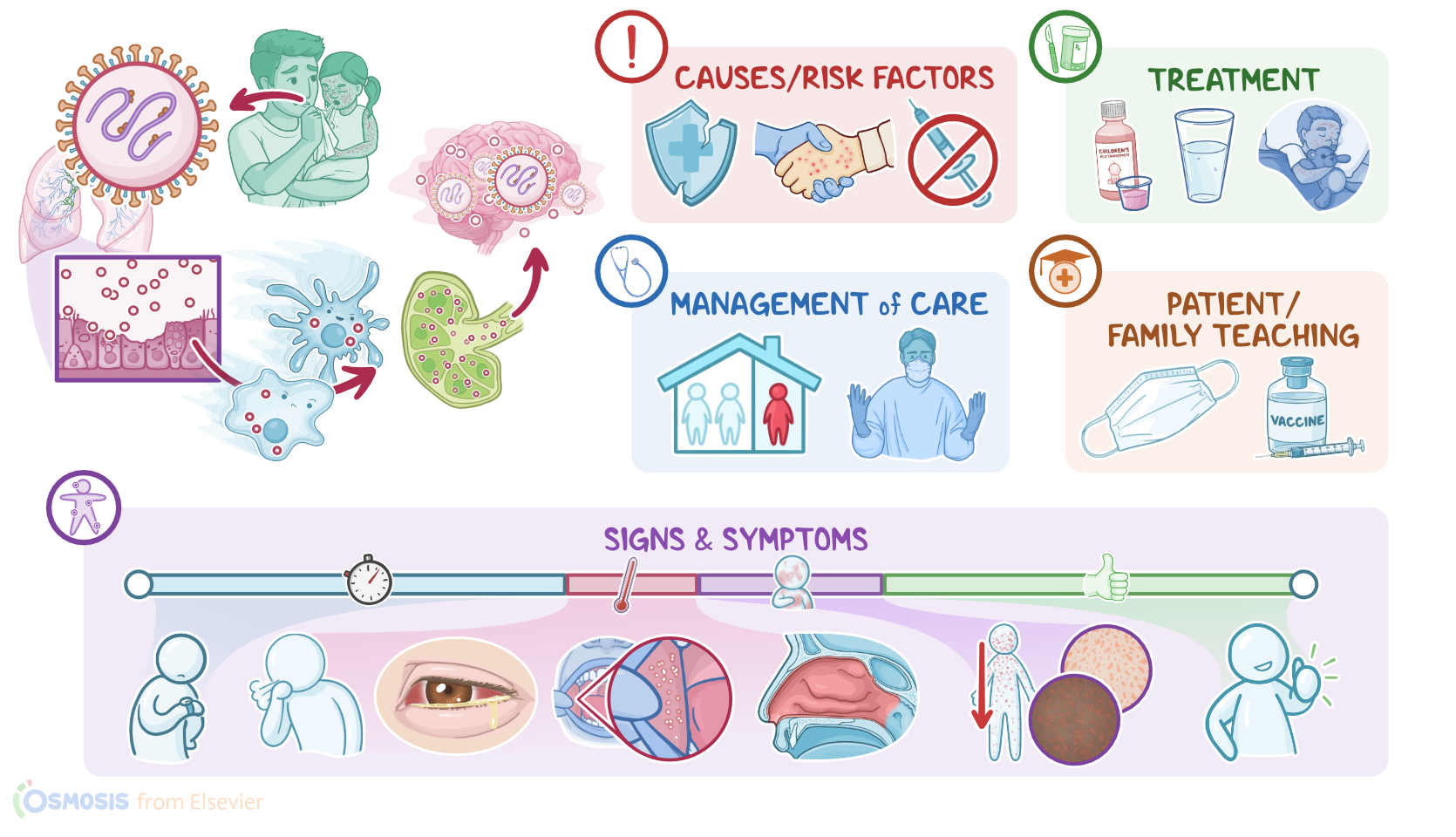
CAUSES AND RISK FACTORS
  • Causes
    • Measles virus
  • Risk factors
    • Immunodeficiency
    • Unvaccinated or undervaccinated
    • Contact with infected person
    • Pregnancy
    • Living or traveling to an endemic area

PATHOPHYSIOLOGY
  • Virus enters body
  • Infects epithelial cells of trachea and bronchi
  • Replicates within epithelial cells
  • New viral particles sent out of cell to spread to local tissue
  • Complications
    • Dehydration
    • Febrile seizures
    • Encephalitis
    • Blindness
    • Bacterial superinfections
    • Miscarriage
    • Intrauterine fetal death
    • Intrauterine growth restriction
    • Premature labor 
    • Subacute sclerosis panencephalitis

SIGNS AND SYMPTOMS
  • Prodromal phase
    • Cough
    • Conjunctivitis
    • Coryza
    • Koplik spots
  • Exanthem phase
    • Maculopapular rash
  • Recovery
    • Persistent cough

DIAGNOSIS
  • History
  • Physical assessment
  • Laboratory tests

TREATMENT
  • Supportive care
  • Vitamin A
  • Vaccination

MANAGEMENT OF CARE
  • Goals of care
    • Prevent spread
    • Manage symptoms
    • Monitor for complications
  • Place in airborne isolation and contact precautions
  • Dim lights
  • Provide warm saline to cleanse eyes
  • Cool-mist vaporizer
  • Apply skin ointment 
  • Encourage fluids
  • Provide quiet environment 
  • Monitor vital signs and lung sounds
  • Administer medications as prescribed
  • Watch temperature
  • Provide tepid baths
  • Institute seizure precautions
  • Monitor for secondary bacterial infections
    • Notify HCP
      • Signs of pneumonia 
  • Ensure case has been reported to local health department

PATIENT AND FAMILY TEACHING
  • Explain condition, plan of care, and how to safely administer medications
  • Reinforce infection control techniques
  • Stress importance of isolation from pregnant or immunocompromised individuals
  • Follow-up with HCP for vaccinations as needed
  • Use cool compresses and cool mist humidifier 
  • Avoid aspirin for fever
  • Offer fluids and healthy snacks
  • Encourage rest and quiet activities 
  • Return to school/daycare 5 days following resolution of rash
  • Notify HCP
    • Not improving
    • New or worsening symptoms

Transcript

Watch video only

Rubeola, also known as measles, is a highly contagious viral childhood exanthem caused by the measles virus, and it’s usually associated with a triad of cough; coryza, meaning the inflammation and swelling of the nasal mucosa; and conjunctivitis, followed by a rash that progresses from head to toe. Thanks to vaccination, there are fewer cases of measles, but in some parts of the world where the population is not immunized, outbreaks are still possible.

Let’s start by discussing the physiology of the immune response to a viral infection. After a foreign antigen, like a virus, enters the body, it runs into antigen-presenting cells, like macrophages and dendritic cells, by whom it is engulfed and digested into fragments. These antigen fragments are then presented on their surface and recognized by T helper cells, a type of T lymphocytes that activate B lymphocytes to produce antibodies against that antigen. Next, these antibodies bind to any affected cell that expresses the antigen on its surface, eventually enabling natural killer or NK cells and cytotoxic T cells to easily recognize and destroy them. Furthermore, these natural killer cells enhance the inflammatory response by producing cytokines that recruit neutrophils, macrophages, and mast cells.

Now, the cause of measles is measles virus, which is an RNA virus that belongs to the Morbillivirus genus and Paramyxoviridae family. Important risk factors for measles include immunodeficiency; being unvaccinated or undervaccinated; coming in contact with an infected person; vitamin A deficiency; pregnancy; and living or traveling to an endemic area.

Now moving on to pathology. Measles is an airborne virus, meaning it spreads via small virus-containing droplets that get flung in the air when an infected client coughs or sneezes. If another client breathes in these droplets, or they get in contact with infected surfaces and then touch their eyes or mouth, they can become infected. Once the virus enters the body, it quickly starts to infect the epithelial cells in the trachea or bronchi. Once inside the cell, the virus replicates, forming new viral particles, which are then sent out of the cells. Within days, the measles virus spreads through local tissue and is picked up by immune cells, like dendritic cells and alveolar macrophages, and carried from that local tissue in the lungs to the local lymph nodes. From there it continues to spread, eventually getting into the blood and spreading to more lung tissue, as well as other organs like the intestines and the brain. When it comes to complications of measles, these typically occur in young infants, malnourished or immunocompromised children, as well as pregnant clients. Now, complications include dehydration, febrile seizures, and, on rare occasions, encephalitis, which can lead to progressive loss of cognitive and motor function. In children with vitamin A deficiency, measles conjunctivitis can also occur, and it can progress to blindness in severe cases. In addition, measles can suppress the immune system for up to 6 weeks, and this can contribute to bacterial superinfections like otitis media and bacterial pneumonia.

On the other hand, if the virus spreads transplacentally, it can result in severe complications, such as miscarriage, intrauterine fetal death, intrauterine growth restriction, and premature labor.

Finally, a severe and often fatal complication for children under 2 years old is subacute sclerosing panencephalitis, or SSPE, which can develop as long as 7 to 10 years after infection. This is thought to be caused by a persistent measles virus infection, possibly due to an abnormal immune response or a mutated strain of the measles virus, which causes chronic inflammation of the entire brain. The symptoms of SSPE are initially pretty subtle like mood changes, but eventually become severe and dramatic, and can include seizures, coma, and, if left untreated, death.

Now, clinical manifestations of measles typically appear after an incubation period of 10 to 14 days, and they can be divided the prodromal, exanthem, and recovery phases.The prodromal phase typically lasts around 3 days, and starts with a high fever and the 3 Cs; cough, conjunctivitis, or inflammation and redness of the white part of the eye, and coryza, or swelling in the mucous membrane of the nose, essentially a stuffy nose. Then, 1-2 days later small bluish white spots often appear on the oral mucous membranes that look like salt grains on a wet background. These are called Koplik spots, and are commonly seen on the inside of the cheeks opposite the molars. Next is the exanthem phase, which is where a red, blotchy, maculopapular rash starts at the head and spreads to the extremities and down the trunk. This rash fades after about 4 days, and leads into the recovery phase which can last for another 10-14 days, with the final symptom usually being a persistent cough.

Diagnosis of measles is typically based on the client’s history and physical assessment, followed by detection of measles-specific IgM antibodies, which indicate current infection. Additionally, a PCR test can be used to detect viral RNA in the client’s respiratory secretions or blood.

The treatment of measles is mainly supportive, and is geared at reducing the symptoms; this includes rest, as well as medications like analgesics, antipyretics, such as acetaminophen. Intake of oral fluids should also be increased to avoid dehydration, especially in the case of fever and diarrhea. Some clients are also given vitamin A, like young children and the severely malnourished, which acts as an immunomodulator that boosts the antibody responses to measles and decreases the risk of serious complications. Finally, it’s important to note that measles can be prevented with the MMR vaccine, which protects against measles, mumps, and rubella.

Okay, let’s talk about the nursing care you’ll provide for a child with measles. Your priority goals of nursing care are to prevent the spread of infection, manage your client’s symptoms, and monitor for complications.

Key Takeaways

Rubeola, also known as measles, is a highly contagious viral infection caused by the measles virus. It spreads from person to person through coughing and sneezing. Risk factors for measles include immunodeficiency, being unvaccinated, vitamin A deficiency, pregnancy, and coming into contact with an infected person.

Symptoms of rubeola include cough, conjunctivitis, coryza, high fever, and a red rash that typically begins on the face and spreads to the rest of the body. Diagnosis of measles is typically based on the client's history and physical assessment, with the detection of measles-specific IgM antibodies for confirmation. Treatment for rubeola is supportive and may include bed rest, fluids, and fever-reducing medications. Vaccination is the best way to prevent rubeola.