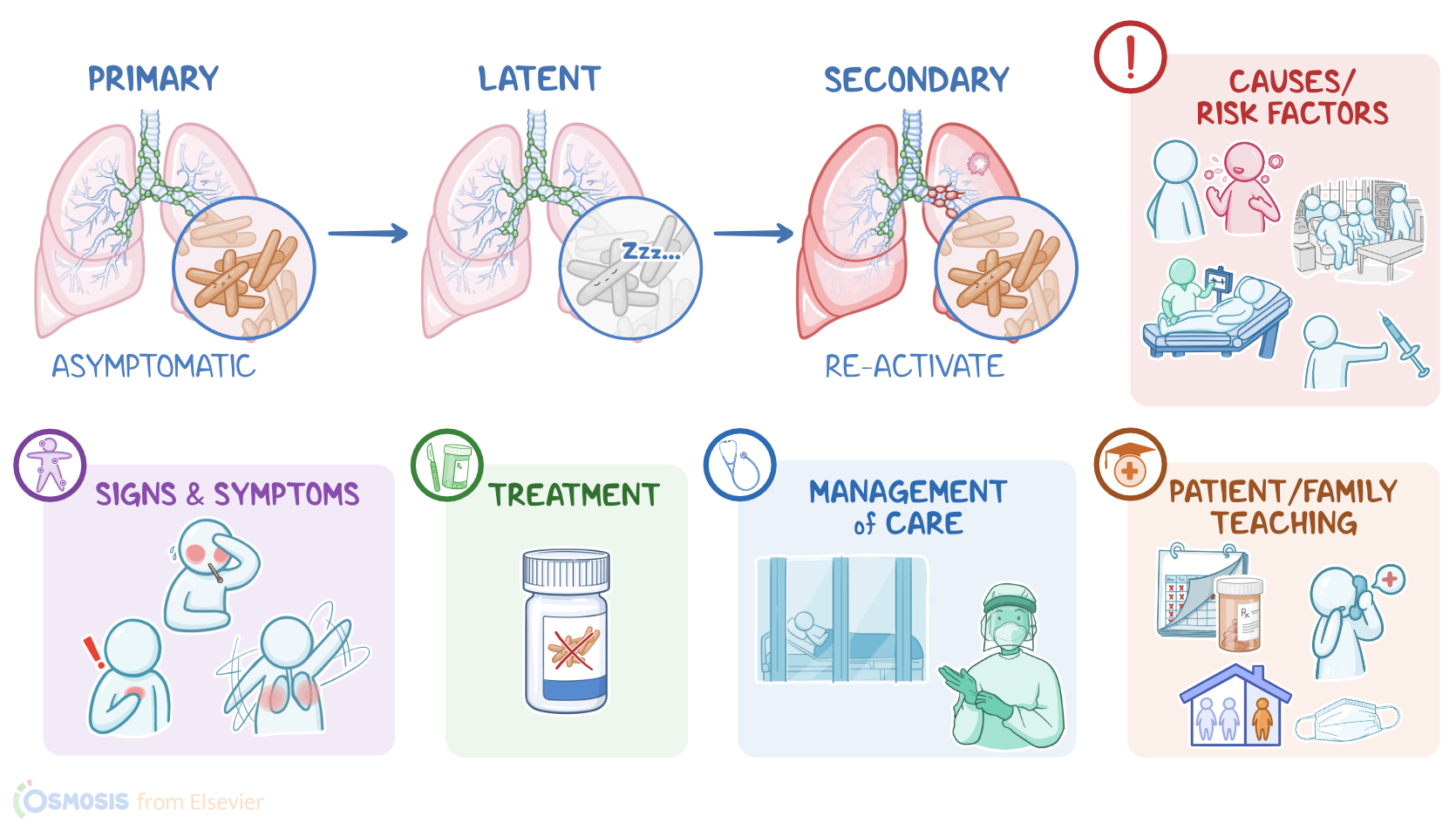
Definitions & Key takeaways

Tuberculosis (TB) is a chronic infectious disease caused by the bacterium Mycobacterium tuberculosis. It primarily affects the lungs but can also spread to other parts of the body. TB is transmitted through the air when an infected person coughs, sneezes, or talks, and another person inhales the bacteria.

People with active tuberculosis infections may experience flu-like symptoms, as well as chest pain, or even respiratory distress. Treatment for TB requires long-term antibiotics, often for 4 months to one year.

The goals of nursing care include improving the client's pulmonary function, providing supportive care during treatment, and preventing the spread of TB to others. Client and family teaching focuses on adherence to their medication regimen, infection control measures, and when to contact their healthcare provider.

Chapters:

Introduction0:00–0:15

Tuberculosis or TB for short is an infectious disease that primarily affects the respiratory tract, and is caused by Mycobacteria spp., such as Mycobacterium tuberculosis.Now, let’s quickly review the respiratory tract, which can be divided into two regions: the upper respiratory tract and lower respiratory tract.

Physiology0:15–1:02

The upper respiratory tract includes the nose, nasal cavity, the oral cavity, pharynx, epiglottis, larynx, and the upper part of the trachea; while the lower respiratory tract includes the lower part of trachea, and the lungs containing the bronchi, bronchioles, alveolar ducts, and finally the alveoli.
Alveoli are tiny air-filled sacs where most gas exchange occurs, so as we breathe, the inhaled oxygen moves from the alveolar sacs into the blood, while the carbon dioxide moves from the blood into the alveolar sacs to be exhaled.Now, TB is caused by Mycobacteria spp.

Causes & risk factors1:02–2:13

settling in the bronchioles and alveoli. The majority of TB cases are caused by Mycobacterium tuberculosis.
However, it can rarely be caused by Mycobacterium bovis, Mycobacterium africanum, and Mycobacterium microti. These bacteria are transmitted from person to person via respiratory droplets.
This happens when a person with active TB talks, sneezes, or coughs, spreading droplets that may then be inhaled by others nearby.
Risk factors for TB include close contact with an infected individual, as well as living in crowded areas, working in a healthcare facility, having limited access to healthcare, not being vaccinated, experiencing homeless, and alcohol or IV drug abuse.In addition, children and immunocompromised individuals are at higher risk for TB; these include clients with HIV, cancer, malnutrition, diabetes, elderly clients, or those taking immunosuppressant medications like corticosteroids.Now, there are various stages of TB infection.

Pathology2:13–3:56

Primary tuberculosis occurs when an individual is exposed to mycobacteria for the first time. These bacteria can make their way to the bronchioles and alveoli.
In children or immunocompromised clients, the immune system can’t contain the infection, so it spreads throughout the lungs, causing further damage and bronchopneumonia; this stage is called progressive primary tuberculosis.On the other hand, in immunocompetent individuals, the infection activates local macrophages that eat up and destroy the mycobacteria, forming small tuberculous caseating granulomas, called Ghon lesion or focus.
This leads to a stage called latent tuberculosis, where the granulomas can only contain the infection and prevent further damage, but mycobacteria are able to survive and remain dormant inside these granulomas, even for years.Finally, if the client’s immune system becomes compromised later on, mycobacteria can become reactivated, leading to secondary tuberculosis.
At this point, the infection may spread throughout the lungs, forming more Ghon lesions in addition to fibrocaseous cavities due to necrosis and destruction of lung tissue, causing bronchopneumonia.
In the worst cases, the infection in both secondary and progressive primary tuberculosis can spread via the bloodstream, causing bacteremia; as a result, TB can become widespread and infect almost every other tissue in the body, leading to miliary tuberculosis.
So, TB can be classified as pulmonary when it only affects the lungs, and extrapulmonary when it involves other parts of the body.Okay, so all these different TB stages have different clinical manifestations.

Clinical manifestations3:56–5:19

Generally, clients with primary TB are completely asymptomatic, or may have mild flu-like symptoms like fever, fatigue, malaise, night sweats, anorexia and unintentional weight loss, and a persistent cough.
In addition, some clients may experience dyspnea and hemoptysis. Latent TB is always completely asymptomatic, and clients at this stage are not contagious.
Now, clients experiencing secondary or primary progressive TB often have similar but more severe symptoms of primary TB, as well as chest pain, and can sometimes progress to pulmonary complications like pleural effusion or even respiratory failure.
Finally, miliary TB may cause additional symptoms and complications, depending on which organs are affected. Kidneys are commonly affected, resulting in sterile pyuria and hematuria, as well as dysuria and even flank pain.
It might also spread to the cervical lymph nodes causing painless lymphadenitis in the neck, also known as scrofula; as well as the meninges of the brain, causing meningitis; and the spinal vertebrae, causing Pott disease, characterized by pain, stiffness and even deformity.Now, diagnosis of TB begins with the client’s history and physical assessment.

Diagnosis5:19–8:29

Auscultation of the lungs may reveal bronchial breath sounds, crackles, or dullness with percussion over the affected areas.
This can be followed with screening tests for TB.The most common test is the purified protein derivative or PPD skin test, also known as a tuberculin skin test or the Mantoux test; where a mycobacterial protein called tuberculin is injected intradermally on the ventral surface of the forearm and then checked within 48 to 72 hours.
If the client has previously been exposed to TB, the immune system reacts to tuberculin and produces a small, localized skin reaction, which is considered a negative result; if the reaction creates induration, so a hardened raised area that is palpable, rather than just redness, the test is positive.
The induration should also be measured in millimeters. An induration that’s 15 millimeters or larger is considered positive in all clients; while an induration that’s 10 millimeters or larger is considered positive in clients from endemic countries, as well as those who live or work in high risk settings, those who abuse illicit drugs, or have underlying medical conditions that put them at higher risk, such as diabetes, and children.
Lastly, an induration that’s 5 millimeters or larger is considered positive in immunocompromised clients, such as those with HIV, as well as in clients who had recent contact with an infected person.However, a positive tuberculin test simply means the individual has been exposed to the TB bacteria at some point.
It doesn’t differentiate between active, latent or resolved infections, and there’s also the chance of false positive results in vaccinated clients.
On the other hand, clients who get a negative test result may get a two-step tuberculin skin test, meaning that a second test is performed after 7 days to rule out a false negative.
An alternative test is the interferon gamma release assay, or IGRA for short, which is a blood test that measures the amount of interferon-gamma released by T-lymphocytes when exposed to mycobacterial antigens, and is less likely to give false positive results.
If any of the two tests is positive and the client presents characteristic TB symptoms, the next step is a chest X-ray to confirm the diagnosis and look for signs of active TB like Ghon lesions.
If chest X-rays are positive, it’s important to collect three samples of sputum or bronchoalveolar lavage. These samples are sent to the lab for staining, culture, and nucleic acid amplification tests to look for evidence of acid fast mycobacteria.
Finally, a lung biopsy can be performed, which can reveal Ghon lesions.It’s important to keep in mind that all confirmed cases of TB, as well as all suspected cases awaiting diagnostic confirmation, must be reported to public health departments as required by law.Now, treatment for TB requires antibiotics for a prolonged period of time.

Treatment8:29–9:56

First-line treatment of active TB disease is typically done through a combination of antibiotics, called the RIPE regimen, which consists of rifampin, isoniazid, pyrazinamide, and ethambutol, given for 4 to 12 months; streptomycin can also be added to the initial regimen if necessary, otherwise it is considered as second-line monotherapy.
On the other hand, latent TB infection is typically treated using monotherapy with rifampin for 4 months, but some clients can be treated with a combination of antibiotics.
Drug-resistant strains of TB can be classified as multidrug-resistant, or MDR-TB, which has developed resistance to rifampin and isoniazid; and extensively drug-resistant or XDR-TB, which has also developed resistance to second-line antibiotics.
These TB strains can be treated with a combination of pretomanid, bedaquiline, and linezolid, for 6 months up to 2 years, as needed.Clients at high risk of developing the disease, such as in clients with HIV, may get prophylactic monotherapy with isoniazid.Finally, in certain countries other than the US, TB can be prevented with the Bacille Calmette-Guérin or BCG vaccine.Alright, let’s look at the nursing care you’ll be providing for a client with tuberculosis.
Your priority nursing goals are to improve the client’s pulmonary function, provide supportive care during treatment, and prevent the spread of TB to others.Now, when admitting your client for care in your unit, place them in a negative-pressure room and institute airborne isolation.

Management and care9:56–11:10

Be sure to don the appropriate PPE before assessing your client. Assist them to cover their mouth and nose with a tissue when coughing or sneezing, to dispose of the tissue in a plastic bag when finished, and wash their hands afterwards.
Also be sure to screen all visitors and ensure they are wearing the appropriate PPE during visits; and ensure the client is wearing a surgical mask when out of the room for hospital transport.
Assess your client’s vital signs, SpO2, and note their respiratory rate and effort, lung sounds, and oxygen saturation. Obtain sputum cultures and administer supplemental oxygen, as needed, as well as all prescribed medications.
Lastly, ensure your client’s case has been reported to the public health department. Alright, let’s move on to client and family teaching.
As you prepare your client for discharge home, begin by explaining what TB is, how it affects their body, and how it is spread.

General client and family teaching11:10–12:48

Then, let them know that the infection can be treated with a combination of medications. Stress the importance of taking their medications as directed, and completing their entire course of the medication regimen.
Recommend they participate in your facility’s directly observed or video observed treatment program, where they can take their medication while being observed by one of the nursing staff.
Also, let your client know they will need to follow-up monthly with their healthcare provider to monitor their progress and to check for medication side effects.
Remind your client that they can still pass the infection to others, so review infection control measures they should take during treatment, including cough etiquette, frequent handwashing, wearing a mask when in crowds, and practicing social distancing.
Recommend they minimize their contact with other household members by sleeping alone, as well as trying to spend time in the most ventilated areas of the home and outdoor spaces.
Then, encourage them to eat a balanced and nutritious diet, to get plenty of rest, and to take rest periods as needed. Advise them to avoid second-hand smoke, and if they smoke, provide them with resources to help them quit.
Lastly, instruct the client to contact their healthcare provider for any symptoms indicating their condition is worsening, such as shortness of breath, chest pain, fever, increased coughing, bloody sputum, worsening night sweats, or weight loss.Alright, as a quick recap… Tuberculosis is an infectious disease that primarily affects the respiratory tract and can be categorized as primary, latent, or secondary.
Primary TB occurs the first time a client is exposed to Mycobacterium tuberculosis. In clients with healthy immune systems, the mycobacteria are sealed off into small granulomas in the lungs, leaving the client asymptomatic with latent TB.

Review12:48–13:51

If the client’s immune system becomes compromised later, the mycobacteria can reactivate and cause a secondary TB. Clients with active tuberculosis infections may experience flu-like symptoms, as well as chest pain, or even respiratory distress.
Treatment for TB requires long term antibiotics, often for 4 months to one year. Goals of nursing care include improving the client’s pulmonary function, providing supportive care during treatment, and preventing the spread of TB to others.
Client and family teaching focuses on adherence to their medication regimen, infection control measures, and when to contact their healthcare provider.
clients pulmonary function, providing supportive care during treatment and preventing the spread of TB to others client and family teaching focuses on Ed Sheeran's to their medication, regimen infection control.
Where's and when to contact their health-care
Tuberculosis (TB): Video, Causes, and Symptoms | Osmosis