Zika virus: Nursing
Zika virus: Nursing
Watch later
Watch later
Notes
| ZIKA VIRUS INFECTION | ||
| KEY POINTS | NOTES | |
| DEFINITION |
| |
| PHYSIOLOGY |
| |
| CAUSES AND RISK FACTORS |
| |
| PATHOPHYSIOLOGY |
| |
| SIGNS AND SYMPTOMS |
| |
| DIAGNOSIS |
| |
| TREATMENT |
| |
| MANAGEMENT OF CARE |
| |
| PATIENT AND FAMILY TEACHING |
| |
Transcript
Content Reviewers
Contributors
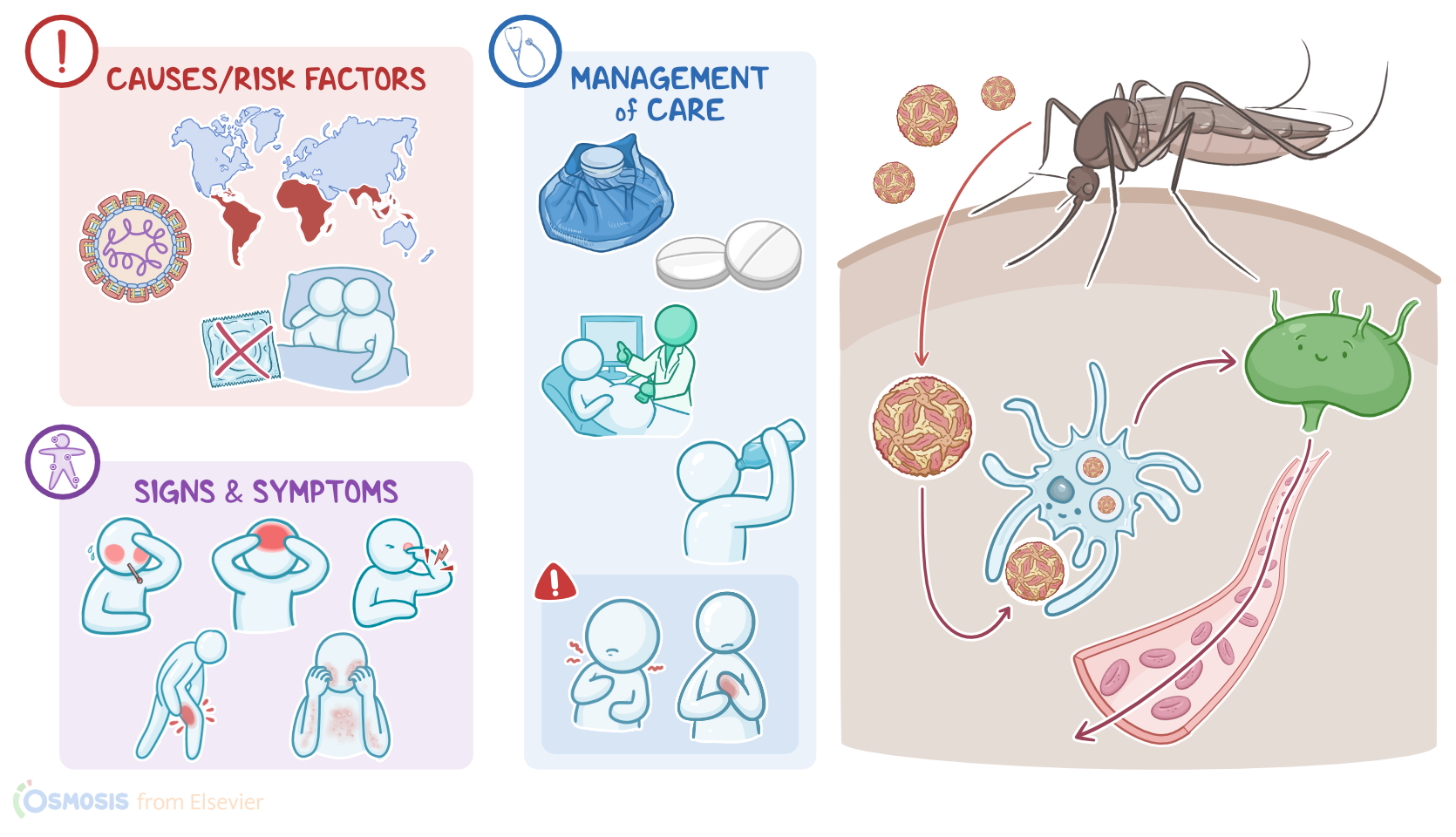
Zika fever, also known as Zika disease, Zika infection, or just Zika, is an infectious disease caused by the Zika virus. This is a vector-borne infection that is transmitted by the bite of an infected Aedes mosquito.
Let’s start by discussing the physiology of the immune system, which is subdivided into innate and adaptive immunity. Innate immunity consists of natural barriers, like skin and mucous membranes; natural killer cells, which help fight virus-infected and tumor cells; and phagocytes, such as macrophages, neutrophils, and dendritic cells.
When a pathogen breaches the natural barriers and enters the body, the innate immune system reacts quickly. Some of the first cells on the scene are macrophages and neutrophils, which directly fight the pathogen. At the same time, they also secrete small molecules called cytokines to increase the permeability of local blood vessels and message other immune cells that there’s an active fight in the body. Additionally, cytokines induce the production of acute inflammatory proteins and cause systemic effects, such as fever.
Simultaneously, dendritic cells engulf and digest the pathogen, eventually presenting small fragments of it on their surface. At this point, the adaptive immune system, which relies on B and T cells, can come to the rescue. Specifically, T helper cells recognize these fragments and help activate B cells, which eventually produce antibodies.
These antibodies circulate throughout the body and bind to affected cells that express the antigen on their surface, thereby enabling NK cells and cytotoxic T cells to recognize and destroy them.
The cause of Zika fever is the Zika virus, which is a small single-stranded RNA virus that belongs to the Flaviviridae family.
The most important risk factor for getting Zika fever is traveling to or living in endemic parts of the world where Zika fever is highly present. These include Central and South America, the Caribbean, Africa, as well as south and southeast Asia and the Pacific region. Historically, it looks like the Zika virus has also been transmitted through mosquito bites in continental United States regions, like Florida and Texas. Finally, since the Zika virus can also be passed through sexual intercourse, another important risk factor is having unprotected sex with individuals who live in or have returned from a high-risk region.
Now, let’s switch gears and move on to pathology. Once an infected Aedes mosquito bites a person, the virus infects the skin and starts to replicate. As the virus replicates, it’s picked up by the surrounding dendritic cells, which then travel to regional lymph nodes. But here, the infection is not contained, instead, the virus enters the bloodstream and spreads throughout the body.
Now, the most important complication of Zika infection is congenital Zika syndrome, which occurs in pregnant clients when the virus crosses the placenta and infects the fetus. Newborns with congenital Zika syndrome typically present with microcephaly or an abnormally small head; vision, hearing, and cognitive deficits; as well as seizures.
On the other hand, adults and older children can develop neurologic complications, such as Guillain Barre syndrome, which is an autoimmune condition associated with the destruction of peripheral nerves; myelitis, or inflammation of the spinal cord; and finally, meningoencephalitis, which refers to the inflammation of the meninges and brain.
Clinical manifestations of Zika fever are usually mild and self-limiting, and include fever; headache; eye redness, pain behind the eyeballs; pruritic rash as well as muscle and joint pain. Diagnosis of Zika fever is typically based on the client’s history, and physical assessment, followed by PCR testing, and serology. PCR testing is used to detect viral RNA in clients who have experienced symptoms for less than 2 weeks. On the flip side, serology is used to detect specific antibodies against the Zika virus in clients who have experienced symptoms for more than 2 weeks.
Additionally, pregnant clients, who were at risk or exposed to a Zika virus, require ultrasound checkups to detect possible fetal abnormalities, such as growth restriction and microcephaly.
As far as the treatment goes, there’s no cure for Zika fever. Usually, treatment includes supportive care, such as rest, hydration, and the use of medications like analgesics and antipyretics. Of note, aspirin as well as other NSAIDs, like ibuprofen, should be avoided until dengue fever, an infection with similar presentation, has been ruled out. That’s because using NSAIDs in dengue infections can increase the risk of hemorrhage.
Okay, now let’s talk about the nursing care you’ll be providing for a client infected with Zika. Your priority nursing goals are to reduce fever and pain, prevent dehydration, and monitor for complications.
Key Takeaways
Zika virus is a mosquito-borne virus that is typically transmitted by the Aedes mosquito. It can also be transmitted through sexual contact and from mother to child during pregnancy. Most people infected with the Zika virus do not develop symptoms, but some may experience muscle and joint pain, headaches, conjunctivitis, rash, and red eyes. In rare cases, the virus can cause more severe complications, including Guillain-Barre syndrome and birth defects in babies born to infected mothers.
Diagnosis begins with the client's history and physical assessment and is confirmed by PCR testing and serology. Treatment usually just involves treating the symptoms, things like getting plenty of rest, drinking fluids to prevent dehydration, and taking medicine like acetaminophen to help reduce pain and fever. The goals of nursing care are to reduce fever and pain, prevent dehydration, and monitor for complications. Client and family education centers on preventing future infections, specific care for pregnant clients, self-care at home, and when to contact the healthcare provider.