
Today’s USMLE® Step 1 question of the day features a 47-year-old patient with abdominal discomfort and short-term weight gain. Which conditions is the patient at an increased risk of developing? Let’s find out!
A 47-year-old woman comes to the office because of weight gain and abdominal discomfort. The patient reports mild, diffuse abdominal discomfort for the past week and a weight gain of 10 lbs (4.5 kg) over the past month. She does not have nausea, vomiting, constipation, or diarrhea. The patient is a truck driver and has not seen a physician in years. She drinks a 6-pack of beer per night. Temperature is 36.9°C (98.5°F), pulse is 92/min, respirations are 14/min, and blood pressure is 108/68 mmHg. Physical examination shows jaundice, hepatosplenomegaly, a flapping hand tremor on wrist extension, and a positive fluid wave. The hepatic venous pressure gradient is 14 mmHg.
The patient is at increased risk of developing which of the following secondary to her current condition?
A. Splenic vein thrombosis
B. Unilateral left-sided ankle swelling
C. Rectal varices
D. Varicocele
E. Mallory-Weiss tear
Scroll down for the correct answer!
The correct answer to today’s USMLE® Step 1 Question is…
C. Rectal varices
Correct: See Main Explanation.
Incorrect Answer Explanations
A. Splenic vein thrombosis
Incorrect: While portal hypertension can cause blood to back up into the spleen leading to congestive splenomegaly (enlarged spleen), splenic vein thrombosis is most commonly associated with pancreatic inflammation.
B. Unilateral left-sided ankle swelling
Incorrect: Unilateral lower-extremity swelling suggests localized venous obstruction (such as deep venous thrombosis), while portal hypertension more commonly causes bilateral lower-extremity edema.
D. Varicocele
Incorrect: Varicoceles are caused by dilation of the pampiniform plexus, often due to impaired drainage of the left gonadal vein. They are associated with nutcracker syndrome or renal vein compression and are not part of the portal venous system.
E. Mallory-Weiss tear
Incorrect: Mallory-Weiss tears are mucosal lacerations near the gastroesophageal junction caused by forceful retching or vomiting. In contrast, the upper gastrointestinal bleeding seen in association with portal hypertension is due to bleeding esophageal varices.
Main Explanation
This patient’s presentation with ascites, jaundice, asterixis, hepatosplenomegaly, and an elevated hepatic venous pressure gradient is consistent with portal hypertension due to cirrhosis, most likely secondary to chronic alcohol use disorder.
Portal hypertension is defined as elevated pressure within the portal venous system due to increased resistance to portal blood flow. Clinically significant portal hypertension typically occurs when the hepatic venous pressure gradient exceeds 10–12 mmHg. It is most commonly caused by liver cirrhosis but can also be caused by vascular obstruction (e.g., portal vein thrombosis, Budd-Chiari syndrome, and schistosomiasis).
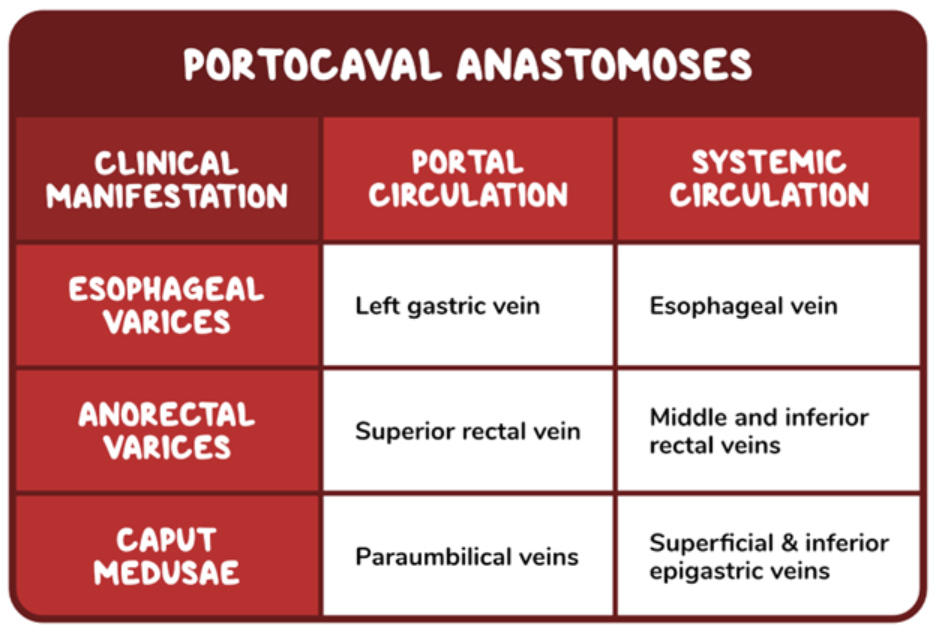
Portal hypertension leads to the formation of portosystemic shunts, which is when blood is diverted away from the portal venous system and backs up into systemic veins at the sites called portal-systemic anastomoses/portocaval anastomosis. These include:
- Lower esophagus: leading to esophageal varices
- In the rectum and anal canal: leading to anorectal varices (i.e. hemorrhoids)
- Veins of the anterior abdominal wall, which anastomose with the paraumbilical veins: leading to caput medusae
Major Takeaway
Portal hypertension develops when there is increased resistance to portal blood flow, most commonly due to cirrhosis. It can lead to the formation of portosystemic shunts at sites called portal-systemic anastomoses, resulting in esophageal varices, anorectal varices (hemorrhoids), and caput medusae.
Want to learn more about this topic?
Watch this Osmosis video: Portal hypertension
References
- García-Pagán, J. C., Gracia-Sancho, J., & Bosch, J. (2012). Functional aspects on the pathophysiology of portal hypertension in cirrhosis. Journal of hepatology, 57(2), 458-461.
- Portal hypertension. Jameson J, & Fauci A.S., & Kasper D.L., & Hauser S.L., & Longo D.L., & Loscalzo J(Eds.), (2020). Harrison’s Manual of Medicine, 20e. McGraw-Hill.

Want more USMLE® Step 1 practice questions? Try Osmosis from Elsevier today! Access your free trial and discover why millions of current and future clinicians and caregivers love learning by Osmosis.
Leave a Reply