
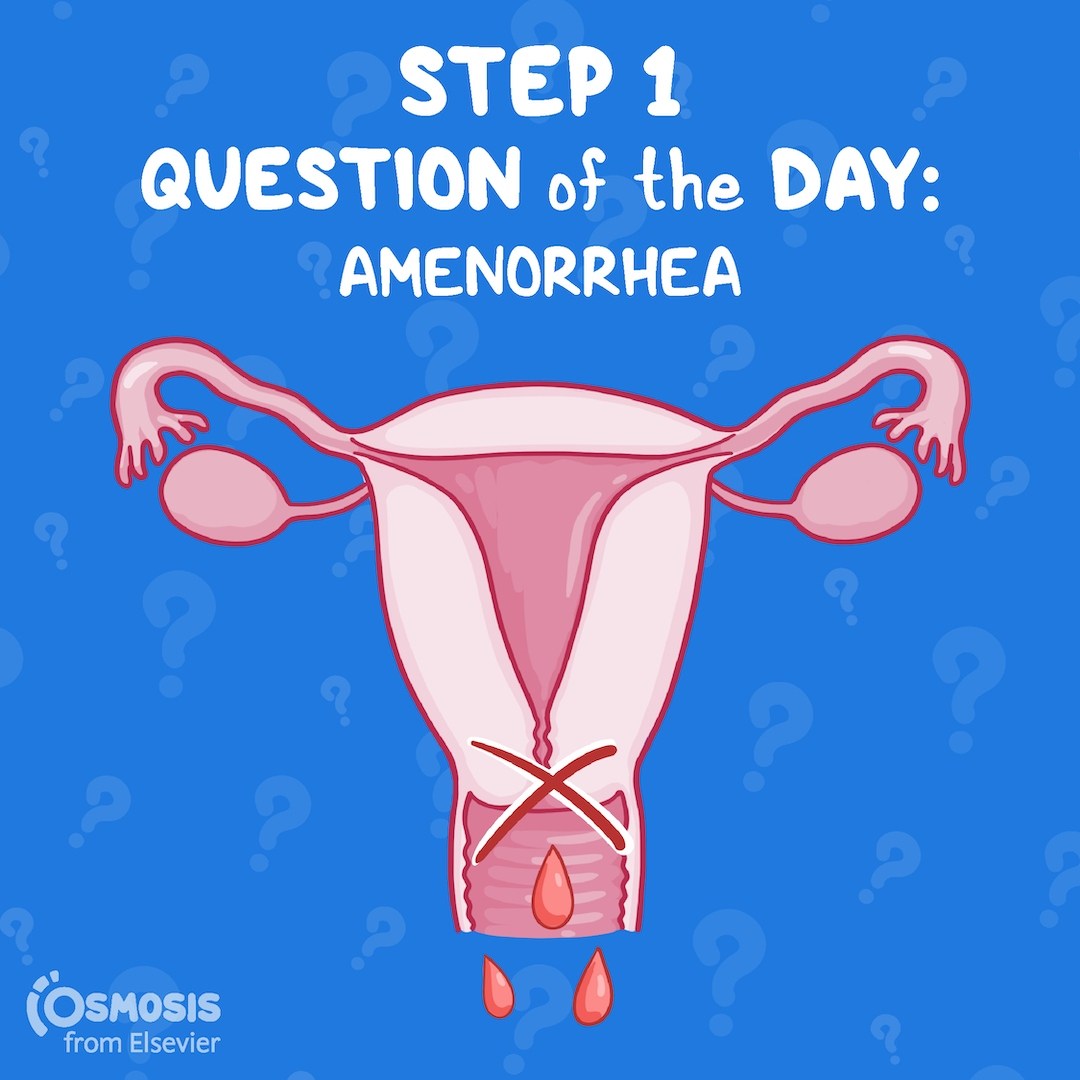
Today’s USMLE® Step 1 question of the day features a 55-year-old patient seeking an evaluation for amenorrhea, as well as headaches, night sweats, and pain during intercourse. What’s the underlying cause of her condition? Let’s find out!
A 55-year-old woman presents for evaluation of amenorrhea that has been ongoing for the past 12 months. She has also experienced dyspareunia, recurrent headaches, and infrequent episodes of night sweats. The patient is subsequently diagnosed with menopause.
Which of the following laboratory findings is most specific to this patient’s condition?
A. Increase in serum estrogen levels
B. Decrease in serum LH levels
C. Increase in serum FSH levels
D. Decrease in GnRH levels
E. Increase in testosterone levels
Scroll down for the correct answer!
The correct answer to today’s USMLE® Step 1 Question is…
C. Increase in serum FSH levels
Correct: See Main Explanation.
Incorrect Answer Explanations
A. Increase in serum estrogen levels
Incorrect: Menopause is associated with a decrease in serum estrogen production due to an age-related decline in ovarian follicular function.
B. Decrease in serum LH levels
Incorrect: Serum LH increases during menopause due to loss of negative feedback.
D. Decrease in GnRH levels
Incorrect: GnRH secretion increases during menopause due to loss of negative feedback.
E. Increase in testosterone levels
Incorrect: Testosterone levels decrease with menopause. However, estrogen levels drop by a greater amount in comparison, leading to an increased androgen-to-estrogen ratio.
Main Explanation
Menopause is the permanent cessation of menstruation due to loss of ovarian follicular function. It is diagnosed retrospectively after 12 months of amenorrhea. Menopause typically occurs around age 50 and is preceded by several years of hormonal and physical changes known as perimenopause.
During menopause, the age-linked decline in ovarian function leads to decreased levels of estrogen and inhibin production, resulting in loss of negative feedback on the hypothalamic-pituitary axis. This leads to increased secretion of both follicle-stimulating hormone (FSH) and luteinizing hormone (LH). Elevated FSH is a characteristic laboratory finding in menopause.
Common symptoms of menopause include hot flashes, night sweats, mood changes, headaches, and atrophic vaginitis (vaginal dryness, itchiness, and dyspareunia). Menopause is also associated with increased risk of osteoporosis and coronary artery disease.
Major Takeaway
Elevated FSH is a characteristic laboratory finding in menopause and results from loss of negative feedback due to declining ovarian hormone production (estrogen, inhibin).
Want to learn more about this topic?
Learn more about this condition: Menopause
References
- Jameson, J.L., Fauci, A.S., Kasper, D.L., et al. (2018) Harrison’s principles of internal medicine (20th ed.). New York, NY: McGraw Hill. ISBN: 978-1259644030.

Get your Osmosis from Elsevier free trial today to discover why millions of clinicians and caregivers love learning by Osmosis!
Leave a Reply