
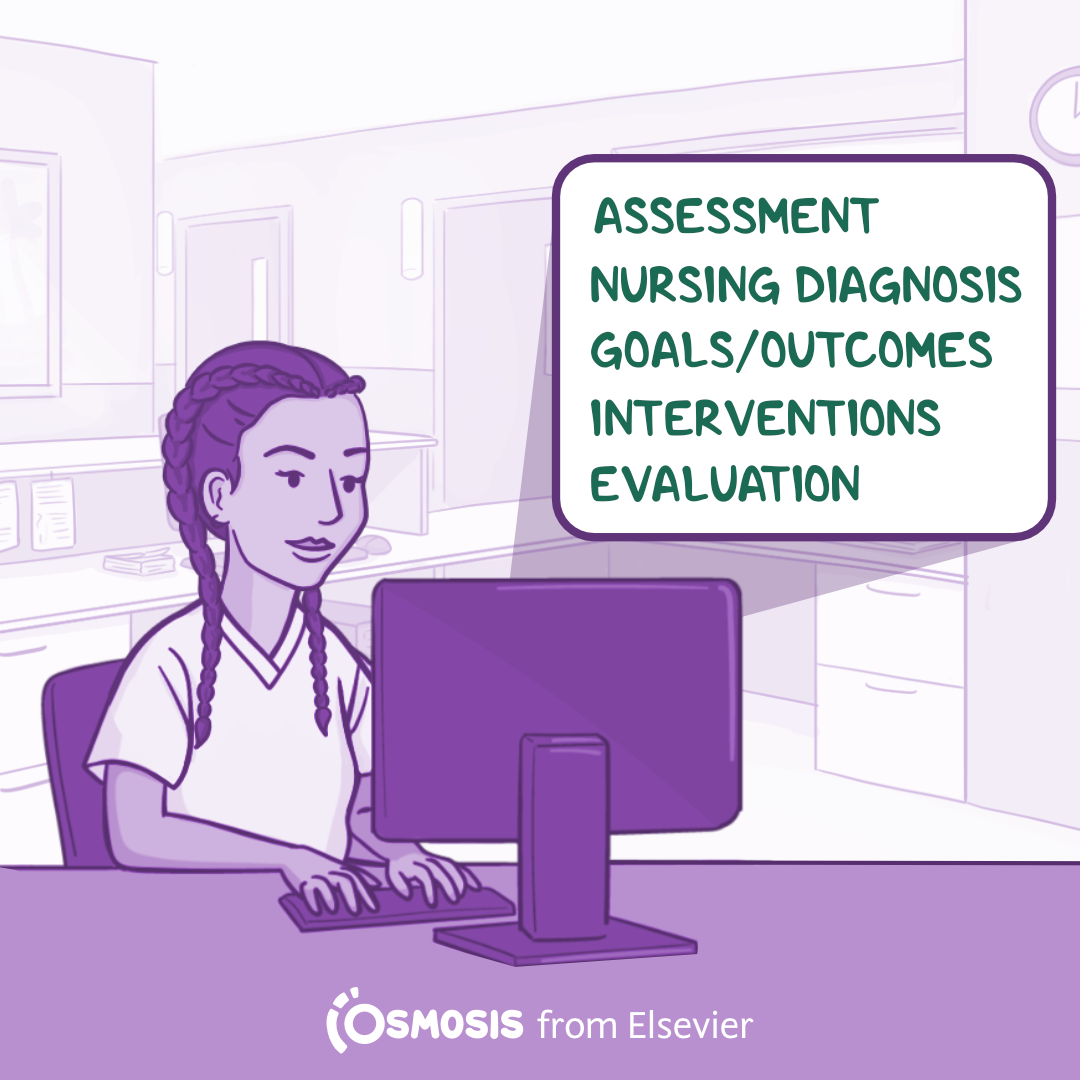
A nursing care plan is a structured, individualized guide developed by nurses to address a patient’s specific health needs once they’ve identified an actual or potential health-related problem, also known as a nursing diagnosis or clinical problem.
A well-written care plan supports continuity of care, patient safety, critical thinking, and professional accountability, which are all foundational skills for current and aspiring RNs.
Why Nursing Care Plans Matter
A care plan ensures you’re not just reacting, but leading in caregiving as you identify patient needs. A care plan helps you to:
- Prioritize nursing care based on subjective and objective assessment data
- Select evidence-based interventions that align with these priorities.
- Communicate your reasoning to the patient and care team
- Track patient progress and adapt care
- Document clearly and professionally
The ADPIE Framework
Most nursing care plans follow the five steps of the nursing process, Assessment, Diagnosis, Planning, Implementation, and Evaluation (ADPIE), as a foundational framework for clinical reasoning and documentation.

You’ll cycle through these steps as patient conditions shift and evolve.
Step 1: Assessment – Collect & Organize Data
A strong assessment is the foundation of every care plan. But first, it takes some time to become a clinical detective!
- Subjective data (e.g., what the patient, caretaker, or family reports)
- Objective data (e.g., vital signs, lab values, physical exam)
TIP: An easy way to remember the difference between subjective and objective data is to think of subjective data as what the patient or their caregiver says, and objective data as what you can observe.
When collecting data, use a structured approach, such as a head-to-toe assessment, or functional patterns that affect health, like nutrition, activity, and sleep. Review the patient’s health history, medications, labs, imaging results, along with environmental and psychosocial factors. Make sure to clearly document as much relevant information as you can, including the timing and source of information.
How to conduct a physical assessment ->
Step 2: Nursing Diagnosis – Interpret & Prioritize
It’s time to analyze your data. Formulate nursing diagnoses, including possible patient responses or risks you’ve identified with your nursing lens. Each diagnosis should include:
- Problem statement (what the issue is)
- Related factors/etiologies (why it’s happening)
- Defining characteristics/evidence (signs, symptoms)
Nurses develop nursing diagnoses by taking time to assess the patient data systematically and applying standardized frameworks like NANDA International (NANDA-I) and the International Classification for Nursing Practice (ICNP). Once identified, diagnoses are prioritized based on the clinical picture by using the ABCs (airway, breathing, circulation), safety considerations, urgency, or applying Maslow’s Hierarchy of Needs in nursing. This structured approach ensures that nurses provide safe, effective, and patient-centered care based on the most urgent and essential needs.

Step 3: Planning – Goals & Interventions
With diagnoses in hand, it’s time to make a care plan and set some goals! Every nursing diagnosis should list outcomes as SMART goals:
- Specific: Clearly define the goal
- Measurable: Includes related measurable data to track success
- Achievable: Realistic for the patient to achieve
- Relevant: Pertinent to the diagnosis
- Time-bound: Includes a time frame to achieve the goal
Choose interventions aligned with your goals, which will be a mix of:
- Independent (nurse-initiated)
- Dependent (provider ordered)
- Collaborative (team-based)
For example, this Stroke: Nursing Process (ADPIE) case:
- Nursing Diagnosis: Risk for Falls
- Goal: The patient will remain free of falls during hospitalization
- Interventions: Implement fall precautions, assist with ambulation, collaborate with physical therapy (PT), and adjust the environment to promote safety
Explore full example of the Nursing Process →
Step 4: Implementation – Carry Out the Plan
Now that you have a plan, it’s time to act. While implementing it, make sure to remain observant and responsive, as well as apply the following best practices:
- Prioritize safety (for example: by following the steps for safe medication administration, use sterile technique when needed)
- Delegate appropriately
- Document in real time, including what you did, when, and patient response
- Teach your patient and their family throughout the process
And remember, even the best plans fail without consistent, thoughtful execution.

Step 5: Evaluation – Measure & Revise
Finally, evaluate whether your interventions met the goals.
Ask and review:
- Did the actual outcomes match the expected outcomes?
- What data or feedback supports success or failure?
- Which interventions worked for this patient? Which did not?
- Do you need to revise the diagnosis, goals, or interventions?
- Return to the assessment if new data arises
For example: “Following interventions, the patient remained free of falls during this shift.”
Example: Nursing Care Plan Summary
| Nursing Diagnosis | SMART Goal / Outcome | Selected Interventions |
| Risk for Impaired Skin Integrity related to immobility | Patient will remain free from pressure injuries for 7 days | Reposition every 2 hours; use a pressure-relieving mattress; perform daily skin inspections; ensure adequate caloric and protein intake; apply moisture barrier creams |
Tips for Stronger Care Plans
- Think sequentially: assessment → diagnosis → planning → intervention → evaluation
- Make sure to use clear, measurable language
- Justify each intervention and make sure you’re clear on why you made that choice
- Personalize the plan for each patient, considering factors like their comorbidities, personal preferences, and cultural context
- Stay flexible; revise the plan as the patient’s condition evolves
How the Clinical Judgment Measurement Model (CJMM) Fits In
The National Council of State Boards of Nursing (NCSBN) developed the Clinical Judgment Measurement Model (CJMM), which aligns closely with the traditional ADPIE nursing process. It is a helpful framework designed for nurses to apply their clinical judgment skills and make decisions about patient care, while also recognizing that clinical decision-making is a complex and ongoing process. Layer 3 of the CJMM describes aspects of clinical decision making that closely align with the ADPIE process.
Here’s a breakdown of this CJMM layer and how it integrates with ADPIE:

Explore a case study using the CJMM to plan patient care ->
Supporting Better Patient Outcomes with Care Plans
A well-crafted nursing care plan is more than a form; it is a roadmap for safe, effective, and personalized patient care. By following the ADPIE framework, setting SMART goals, and selecting thoughtful interventions, RN students can strengthen clinical reasoning, improve patient outcomes, and confidently communicate their care decisions. Remember that care plans are dynamic; so, continually assess, implement, evaluate, and revise them to meet the evolving needs of your patients.
Key Takeaways
- Nursing care plans guide individualized, organized patient care using ADPIE steps.
- Assessment gathers subjective and objective data to identify patient needs.
- Nursing diagnoses prioritize problems using frameworks like NANDA-I and Maslow’s hierarchy.
- Planning sets SMART goals and selects independent, dependent, and collaborative interventions.
- Evaluation measures outcomes and revises the plan as patient conditions change.
Reviewers
- Maria Pfrommer, DNP, Ph.D., FNP-BC, RN, Director of Nursing Content
- Mary Roberts MSN, RN, Content Manager
- Lisa Miklush, PhD, RNC, CNS, Senior Content Editor
Resources & References
- Maslow’s Hierarchy of Needs in Nursing (Osmosis)
- Appendix A: Sample NANDA-I Diagnoses
- NIC Overview
- https://nursa.com/blog/nanda-nursing-diagnosis-list-examples
- https://www.ebsco.com/research-starters/consumer-health/gordons-functional-health-patterns
- Nursing Care Plan: Guide with Example & Writing Tips
- Gulanick M, Myers JL, Bowman-Woodall C, eds. Nursing Care Plans: Diagnoses, Interventions, & Outcomes. 11th ed. Elsevier; 2025. ISBN: 978-0-443-10527-2.
- https://nclex.com/clinical-judgment-measurement-model.page
- https://evolve.elsevier.com/education/wp-content/uploads/sites/2/2023/04/Advancing_Clinical_Judgment_in_the_Nursing_Classroom.pdf

Try Osmosis from Elsevier today! Get your free trial and find out why millions of current and future clinicians and caregivers love learning by Osmosis.


Leave a Reply