
Today’s USMLE® Step 1 question of the day focuses on how a contraceptive pill ingredient works to prevent pregnancy. What’s the answer? Let’s find out!
A 25-year-old woman presents to her gynecologist to discuss contraception. After being counseled on the different options, the patient opts for a contraceptive pill. The pill contains an active ingredient contraindicated in individuals with a history of thromboembolism or migraines with aura.
Which of the following best characterizes this active ingredient in preventing pregnancy?
A. Thinning of the endometrial lining
B. Upregulation of endometrial inflammatory response
C. Suppression of ovulation
D. Stimulation of GnRH release
E. Thickening of the cervical mucus
Scroll down for the correct answer!
The correct answer to today’s USMLE® Step 1 Question is…
C. Suppression of ovulation
Correct: See Main Explanation.
Incorrect Answer Explanations
A. Thinning of the endometrial lining
Incorrect: Progesterone is the component of oral contraceptive pills that prevents endometrial hyperplasia, thereby deterring embryonic implantation. Progesterone also promotes thickening of the cervical mucus, preventing sperm from entering the uterus and fertilizing an egg. However, the contraindications listed in the question stem are more consistent with estrogen, not progesterone.
B. Upregulation of endometrial inflammatory response
Incorrect: Intrauterine devices work primarily by inducing inflammation of the endometrium. This reaction results in sperm engulfed, immobilized, and destroyed by inflammatory cells. Intrauterine devices are contraindicated in individuals with uterine anomalies (e.g. fibroids), pelvic infection, or abnormal vaginal bleeding. However, they are not contraindicated in individuals with a history of thromboembolism or migraines.
D. Stimulation of GnRH release
Incorrect: Estrogen, an active ingredient in oral contraceptive pills, is contraindicated in individuals with a history of thromboembolism or migraines with aura. The exogenous estrogen within the pills will suppress GnRH release from the hypothalamus.
E. Thickening of the cervical mucus
Incorrect: Progesterone is the component of oral contraceptive pills that promotes thickening of the cervical mucus, preventing sperm from entering the uterus and fertilizing an egg. Progesterone also prevents endometrial hyperplasia, thereby deterring embryonic implantation. However, the contraindications listed in the question stem are more consistent with estrogen, not progesterone.
Main Explanation
This patient was likely prescribed a combined oral contraceptive pill. The medication contains two active ingredients, estrogen and progesterone, which help prevent ovulation.
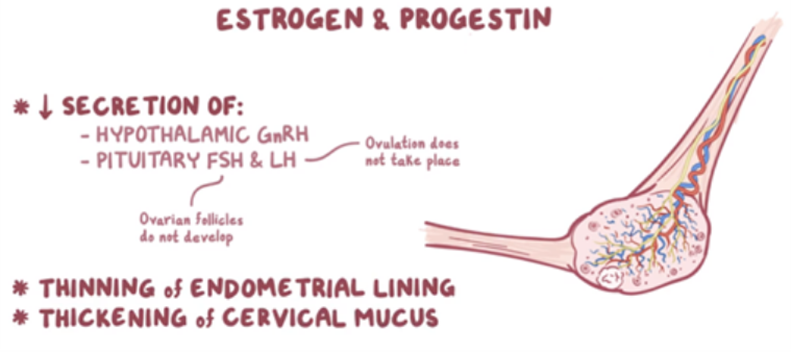
The estrogen suppresses the release of GnRH from the hypothalamus and the release of follicle-stimulating hormone (FSH) and luteinizing hormone (LH) from the anterior pituitary. Without these hormones, follicular development and ovulation are impaired.
The progesterone within combined contraceptives also prevents ovulation via a similar mechanism. Furthermore, progesterone promotes thickening of the cervical mucus, preventing sperm from entering the uterus and endometrial hyperplasia, which deters embryonic implantation.
Combined contraceptives are most frequently administered orally. However, they can also be administered via contraceptive patches and vaginal rings. Given the presence of estrogen in these medications, they are contraindicated in individuals with conditions including thromboembolism, coronary artery disease, or migraine with aura.
Major Takeaway
Combined contraceptives, which contain estrogen and progesterone, can be administered as a pill, patch, or vaginal ring. The estrogen and progesterone impair follicular development and ovulation.
Want to learn more about this topic?
Read this Osmosis high-yield note: Estrogens and antiestrogens
References
- Burgner, A., Hladunewich, M.A. (2020) Contraception, and CKD. Clinical Journal of the American Society of Nephrology. 15(4), 563-565. Doi: 10.2215/CJN.09770819.
- Callahan, T., Caughey, A.B. (2013) Blueprints obstetrics & gynecology (6th ed.). Philadelphia, PA: Lippincott Williams & Wilkins. ISBN: 978-1451117028.
- Cooper, D.B., Mahdy, H. (2021) “Oral contraceptive pills”. StatPearls [Internet]. Web Address: https://www.ncbi.nlm.nih.gov/books/NBK430882/.

Get your free trial and discover why millions of current and future clinicians and caregivers love learning with us.
Leave a Reply