
If you’ve ever memorized a condition perfectly, only to freeze when it shows up in a patient scenario, you’re not alone! Healthcare education is about so much more than simply remembering facts. No matter what your area of focus, you’re learning clinical reasoning skills, building mental models, and learning how to apply what you learn to care for real patients in real situations. When learning tools fall short, knowledge becomes fragmented, clinical reasoning takes longer to develop, and applying what you’ve learned to patient care becomes much more difficult.
That’s why choosing the right learning tool is crucial. Rather than prioritizing platforms with the most content or the fastest cramming features, take some time to focus on tools that promote the understanding of complex content, support your ongoing growth as a clinician, and actively shape your clinical thinking skills throughout training. While content-heavy or exam-focused tools may meet short-term needs, they often fall short for long-term clinical application.
Let’s start the process with a practical breakdown of what you actually need in a learning platform to study medicine effectively, now and throughout your career.
1. Clear Explanations to Build Understanding
Before you can diagnose, treat, or prioritize care, you need to understand how the human body works. You need a healthcare learning platform that can:
- Explain mechanisms, patterns, and cause-and-effect relationships.
- Help you build strong mental models of anatomy, physiology, and pathophysiology.
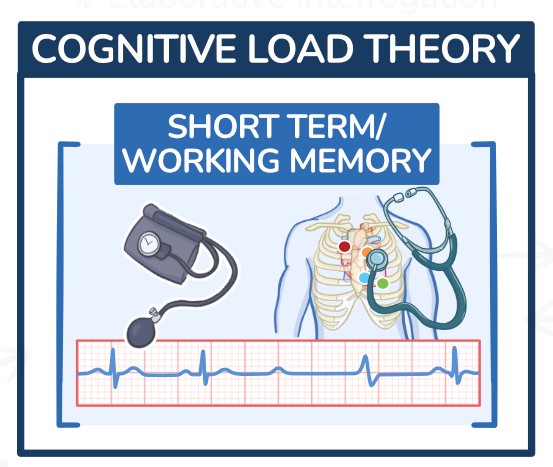
- Introduce complexity gradually rather than overwhelming you with too much information at once (also known as cognitive load).
When key concepts are clear, learning everything else becomes easier, including clinical reasoning, recall, and application. For example, understanding how insulin resistance develops makes it easier to connect the symptoms of type 2 diabetes, recall the underlying pathophysiology, and apply that knowledge when you’re making care management decisions.
2. Clinically Accurate, Scope-Appropriate Content
Core science is universal, but the clinical application depends on your role.
The best healthcare learning platforms:
- Stay aligned with current clinical guidelines.
- Emphasize what’s clinically relevant for your scope of practice.
An effective platform should make it easy for you to find and focus on high-yield concepts, streamlining your learning and eliminating unnecessary material so you can spend your time on what matters most.
You focus your limited study time on what actually matters for your role, without getting lost in unnecessary detail.
3. Explicit Support for Clinical Reasoning
Learning medicine isn’t just memorization. It’s about learning how to think.
Strong learning platforms help you:
- Practice clinical reasoning step-by-step.
- Work through patient scenarios in a structured way.
- Understand why decisions are made, not just what the correct answer is
- Recognize patterns and prioritize information under pressure.
For example, imagine reviewing heart failure. Instead of memorizing a list of symptoms, you see how preload, afterload, and contractility interact, and then apply that reasoning in a patient vignette.
These skills are essential across healthcare roles, from early recognition and escalation of care to patient diagnosis and care management.
4. A Structured, Integrated Learning Experience
Healthcare students are busy people. Between classes, labs, clinicals, and life, your study time is limited, and your cognitive load is already high.
Effective medical education platforms help learners by:
- Providing a clear learning structure and progression.
- Connecting videos, notes, flashcards, and practice questions in one place.
- Helping related concepts build on one another over time.
This kind of structure and content integration supports long-term learning and mirrors how medical knowledge is actually acquired.
Your learning feels connected and progressive, rather than fragmented and constantly starting over.
5. Multimodal Learning Tools That Work Together
Different tools serve different purposes, and many learners benefit from combining approaches. Traditional resources such as textbooks or in-person instruction often support initial understanding, while structured learning platforms can help reinforce, integrate, and apply knowledge over time.
The most effective platforms combine:
- Visual explanations like diagrams and animations
- Clear, concise text explanations
- Practice questions and retrieval-based learning
- Decision-making tools that show how concepts apply clinically
When multiple modalities work together, complex topics become more approachable and easier to remember. Research on healthcare learners using platforms such as Osmosis has highlighted the value of multimodal features, including video explanations with optional subtitles, which learners reported helped improve clarity and accessibility during study.
6. Built-In Learning Science, Not Just Buzzwords
Platforms that use evidence-based learning strategies benefit you by making your study time more productive and effective, supporting smarter, not harder, study habits.
Look for tools that apply:
- Spaced repetition to reinforce learning over time
- Retrieval practice to strengthen recall and application
- Interleaving to help distinguish between similar conditions
- Chunking to manage cognitive load
When these strategies are built into a learning platform, you don’t have to guess how to study. You can trust the system to guide you. Together, these elements support a learning cycle that builds understanding first, reinforces it through retrieval, and applies it in clinical contexts over time. The relative importance of these features may vary by role, region, and training stage, but the underlying principles remain consistent.
You learn more efficiently when proven strategies are built into how you study.
7. Personalization That Supports Long-Term Learner Growth
Everyone starts in a different place, and everyone has different knowledge gaps.
The best learning platforms:
- Identify weaknesses based on how you learn, not just test mistakes.
- Reinforce challenging topics over time.
- Balance short-term goals, such as upcoming exams, with long-term mastery.
This keeps learning cumulative instead of feeling like a constant reset.
8. Longitudinal Support Across Training Stages
Healthcare education builds year after year on foundational knowledge, expanding progressively in depth and scope.
Strong learning platforms:
- Support learners from foundational science through clinical training.
- Let you revisit concepts at increasing levels of complexity.
- Stay useful as you move closer to independent practice.
When your learning tools grow with you, your knowledge does too!
9. Flexible, Accessible Study Options
Healthcare students study wherever they can, whether that’s on commutes, between shifts, or in low-connectivity environments.
Helpful features include:
- Tools that fit unpredictable schedules
Consistency matters, and accessibility makes consistency possible.
10. Exam Preparation That Supports Real Clinical Practice
Exams are important, but patient care is the goal.
The most effective platforms:
- Build understanding first, then reinforce it with assessment.
- Use questions as learning tools, not just score generators.
- Emphasize clinical application alongside test performance.
Exam-focused or high-intensity review tools may support short-term goals, but they’re less effective on their own for developing long-term clinical reasoning. When evaluating a learning platform, learners should assess whether it explains mechanisms clearly, supports clinical reasoning, applies learning science, and remains useful across training stages.
You prepare for exams in a way that also strengthens clinical judgment, not just short-term recall.
Learning Medicine Is a Long Game
To study medicine effectively, you need more than a massive library of information, which can feel overwhelming. Learners need tools that support understanding, clinical reasoning, retention, and application over time.
The best learning platforms:
- Teach concepts clearly.
- Help you think clinically.
- Use proven learning science.
- Support you from your first lecture to real-world patient care.
When learning medicine is treated as a way of thinking, not just a test to pass, students are better prepared for both exams and the patients they’ll care for.
What the Right Learning Platform Makes Possible
Over time, the way you study begins to shape how you think clinically. Learners who thrive in healthcare are not those who memorize the fastest, but those who develop the ability to reason through complex problems and apply foundational concepts in real clinical situations. For this reason, effective learning platforms are designed to support more than exam preparation alone, placing emphasis on clinical reasoning and durable understanding throughout training and into professional practice. When learning tools evolve alongside the learner, they move beyond short term study support and contribute to long term clinical development.
We encourage you to choose carefully and to evaluate learning tools based on how well they support your study goals. Exploring different platforms, including Osmosis.org, can help you compare features, content quality, and alignment with your learning style.
Key Takeaways
- Understanding beats memorization: Effective medical learning starts with clear explanations that build mental models and support long-term clinical reasoning.
Clinical relevance matters more than content volume: High-yield, scope-appropriate material aligned with current guidelines saves time and improves patient care application.
Clinical reasoning must be taught explicitly: The best platforms show learners how to think through patient scenarios, not just what the correct answers are.
Learning science improves retention and efficiency: Spaced repetition, retrieval practice, and cognitive load management turn study time into durable knowledge.
Great platforms grow with learners over time: Longitudinal support, personalization, and flexible access help learners progress from foundational science to real-world practice.

Try Osmosis from Elsevier today! Access your free trial and discover why millions of current and future clinicians and caregivers love learning by Osmosis.
Leave a Reply