
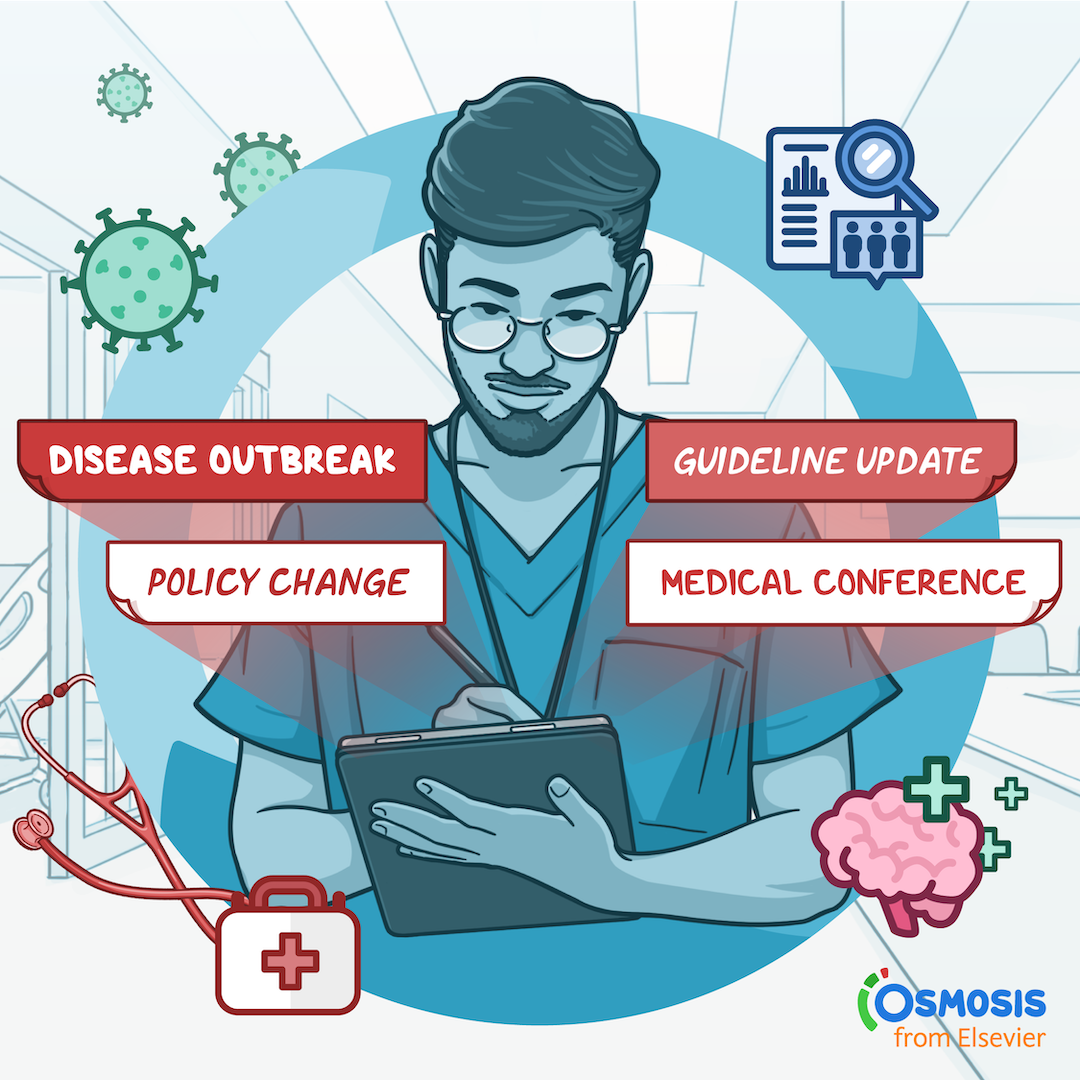
How do real-world health events shape learning behavior?
When tuberculosis outbreaks make national headlines, what do clinicians and caregivers do? They study tuberculosis. When new pneumonia guidelines are released, they revisit respiratory care. When healthcare policy changes, they brush up on the details. When presenters at major medical conferences unveil new research, they look for context.
While reviewing learner activity on the Osmosis platform, we noticed that moments of uncertainty often became moments of learning.
As outbreaks spread, guidelines change, and new research emerges, healthcare learners have repeatedly gravitated toward dependable medical education resources that help them understand the latest topic at the center of the conversation. Whether the catalyst was an infectious disease outbreak, a major guideline update, a healthcare policy shift, or a scientific breakthrough, learners consistently visited Osmosis seeking answers.
While a page visit can’t tell us exactly why someone arrived, the patterns we observed suggest that key healthcare events may influence what healthcare professionals choose to learn. Please note that for this analysis, “learner activity” refers to visits to educational content on the Osmosis platform.
When healthcare changes direction, learning follows.
When Outbreaks Happen, Osmosis Learners Follow
In early 2026, tuberculosis unexpectedly returned to the headlines. A high-profile outbreak in the Kansas City area sparked national coverage and renewed discussion about a disease that, while often overlooked in the US, continues to affect millions of people worldwide each year. As the story unfolded, healthcare professionals, educators, and learners were once again confronted with questions about transmission, diagnosis, treatment, and prevention.
During that period, tuberculosis-related learning activity on Osmosis increased by 54 times the norm. At the height of the surge, our TB-focused learning content attracted more than 4,000 learner visits in a single day.
A similar pattern appeared in 2025. What began as local outbreak coverage quickly became a broader public-health story when Los Angeles County launched a Hepatitis A response team while federal officials simultaneously investigated a separate multistate outbreak linked to contaminated food products.
Together, these events brought renewed attention to questions about transmission, vaccination, and prevention, with Hepatitis A-related learning activity increasing 261 times its typical level on the Osmosis platform.
Guidelines Don’t Just Change Healthcare Practice. They Change Learning.
In November 2025, the American Thoracic Society and the Infectious Diseases Society of America released their first major pneumonia guideline update since 2019. The update addressed topics clinicians encounter every day, including antibiotic selection, treatment duration, and respiratory care, making it one of the most consequential respiratory-care updates in years. In the weeks that followed, respiratory-related learning activity on Osmosis increased by as much as 359-fold.
The pattern suggests that when recommendations change, clinicians and students often return to foundational resources to understand not only what changed, but why.
Why does this happen?
Healthcare information spreads through news coverage, journals, professional societies, educators, social media, newsletters, institutional guidance, and peer discussions. As awareness grows, so do questions, and, often, confusion. Headlines can spark curiosity, but educational resources help turn that curiosity into understanding by providing the scientific, clinical, and evidence-based context behind the story.
Policy Changes Create Information Needs, Too
In early 2023, the White House announced the end of the COVID-19 national emergency, setting in motion a wave of changes across the healthcare system. Hospitals, nursing organizations, and healthcare leaders began preparing for the expiration of emergency-era waivers, updated documentation requirements, and shifts in care-delivery policies that had been in place for more than 3 years.
On April 5, 2023, COVID-related nursing content on Osmosis received 4,957 views in a single day, which was the largest surge observed in our analysis. Relative to its typical level of views, engagement on this topic surged 991 times higher than usual!
As healthcare entered a new chapter of the pandemic response, learners and professionals sought out the knowledge and context needed to navigate it.
Conferences Create Ripple Effects
At the 2026 American Academy of Neurology Annual Meeting, researchers presented more than 190 studies on multiple sclerosis, highlighting advances in emerging therapies, earlier diagnosis, symptom management, and more personalized approaches to care.
In the weeks following the meeting, multiple sclerosis learning activity spiked by 114 times its typical level, highlighting how scientific meetings can influence learning long after the conference ends.
What do surges in health-related media coverage mean for medical education?
In healthcare, rapidly understanding new information can influence everything from clinical decision-making to patient outcomes. New evidence, new diseases, new policies, and new treatment recommendations continually reshape the landscape of healthcare knowledge.
The patterns we observed reinforce something educators have long understood: when uncertainty increases, clinicians and caregivers seek out helpful explanations from trusted resources such as Osmosis.
The Moments That Shape Healthcare Also Shape Learning
What surprised us most wasn’t that healthcare professionals seek information when things change. It was how consistently those moments appeared to show up in learning behavior.
Whether the trigger was a tuberculosis outbreak, a new pneumonia guideline, the end of the COVID-19 national emergency, or emerging research on multiple sclerosis, the pattern repeated itself: as new questions emerged, learners gravitated toward the knowledge that could help them answer them.
Understanding these patterns can help educators, healthcare organizations, professional societies, and health systems better anticipate information needs when the healthcare landscape is changing rapidly. If moments of uncertainty reliably create moments of learning, then making trusted educational resources easier to find becomes more important than ever.
Healthcare will continue to evolve. New diseases will emerge. Guidelines will change. Research will challenge long-held assumptions.
If our analysis reveals anything, it’s that healthcare learners actively evolve with change!

Try Osmosis from Elsevier today! Get your free trial to find out why millions of clinicians and caregivers love learning by Osmosis.
Leave a Reply