
Today’s USMLE® Step 1 question of the day features a couple seeking genetic counseling regarding the likelihood of their child being born with sickle cell disease. What’s the answer to their question? Let’s find out!
A couple trying to conceive visits their physician for genetic counseling. The parents both have sickle cell trait and they are worried about the risk of their baby having sickle cell disease.
Assuming the population is in Hardy-Weinberg equilibrium, which of the following is the most likely probability that their child will have the disease?
A. 0%
B. 25%
C. 33%
D. 50%
E. 100%
Scroll down for the correct answer!
The correct answer to today’s USMLE® Step 1 Question is…
B. 25%
Correct: See Main Explanation.
Incorrect Answer Explanations
A. 0%
Incorrect: It would be zero percent if it was an X-linked recessive disease and only the father had the mutant allele. Sickle cell disease is an autosomal recessive disease.
C. 33%
Incorrect: The chance of this couple having a child with sickle cell disease would be 25% since it is an autosomal recessive condition.
D. 50%
**Incorrect: **It would be 50% if it was an autosomal dominant disease and only one of the parents had the mutant allele. Sickle cell disease is an autosomal recessive disease.
E. 100%
Incorrect: It would be 100% if the disease would exhibit a mitochondrial inheritance pattern and the mother had the mutant allele. Sickle cell disease is an autosomal recessive disease.
Main Explanation
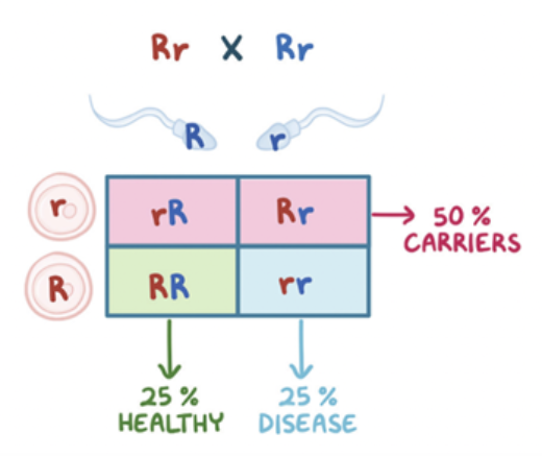
There are different types of modes of inheritance of diseases that are described by the Hardy-Weinberg equation. If a genetic disease mutation affects a recessive allele and it takes two mutant copies to cause a disease, it is called a recessive inheritance pattern. Autosomal recessive diseases (e.g., sickle cell disease, cystic fibrosis, etc.) only occur when a person has two recessive alleles (rr). Heterozygotes with only one mutant allele (Rr) are considered to be carriers of the disease, even though they don’t have the disease phenotype. This punnett square can be explained as follows:
- The two parents are carriers for sickle cell disease – they are both heterozygous Rr.
- They make gametes that have the normal R allele, or the recessive mutant r allele.
- So, their children have a 25% chance of ending up being homozygous dominant (RR), which means they don’t have sickle cell disease, and also are not carriers, so they are healthy.
- They also have a 25% chance of ending up being homozygous recessive (rr), which means they do have sickle cell disease.
Finally, they have a 50% chance of ending up being heterozygous carriers (Rr), just like their parents.
Major Takeaway
If a genetic disease mutation affects a recessive allele and it takes two mutant copies to cause a disease, it is called a recessive inheritance pattern. Autosomal recessive diseases (e.g., sickle cell disease, cystic fibrosis, etc.) only occur when a person has two recessive alleles (rr).
Want to learn more about this topic?
Watch this Osmosis video: Hardy-Weinberg equilibrium
References
- Gulani A, Weiler T. Genetics, Autosomal Recessive. [Updated 2021 May 8]. In: StatPearls [Internet]. Treasure Island (FL): StatPearls Publishing; 2021 Jan-. Available from: https://www.ncbi.nlm.nih.gov/books/NBK546620/

Want more practice questions? Get your free trial and discover why millions of clinicians and caregivers love learning by Osmosis.
Leave a Reply