
This week, we’re sharing another USMLE® Step 1-style practice question to test your knowledge of medical topics. Today’s case focuses on a 45-year-old woman experiencing voice changes after a thyroidectomy. Can you figure it out?
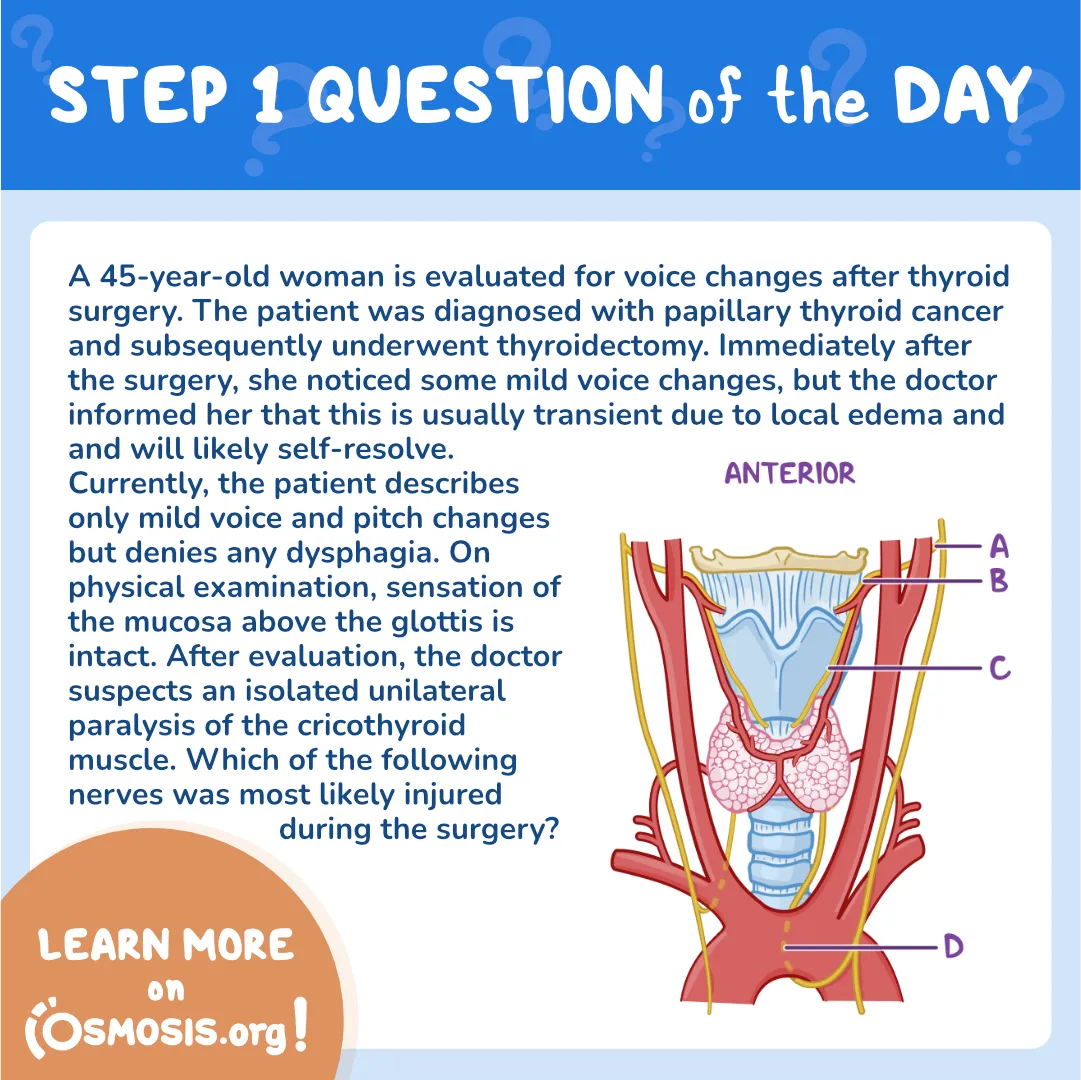
A 45-year-old woman is evaluated for voice changes after thyroid surgery. The patient was diagnosed with papillary thyroid cancer and subsequently underwent thyroidectomy. Immediately after the surgery, she noticed some mild voice changes, but the doctor informed her that this is usually transient due to local edema and will likely self-resolve. Currently, the patient describes only mild voice and pitch changes but denies any dysphagia. On physical examination, sensation of the mucosa above the glottis is intact. After evaluation, the doctor suspects an isolated unilateral paralysis of the cricothyroid muscle.
Which of the following nerves demonstrated in the picture below was most likely injured during the surgery?

A.
B.
C.
D.
Scroll down to find the answer!
→ Reinforce your understanding with more self-assessment items with Osmosis
The correct answer to today’s USMLE® Step 1 Question is…
C.
Before we get to the Main Explanation, let’s look at the incorrect answer explanations. Skip to the bottom if you want to see the correct answer right away!
Incorrect Answer Explanations
A.
Incorrect: A is the superior laryngeal nerve which splits into the internal and external laryngeal nerves. Injury in this location will result in both unilateral paralysis of the cricothyroid muscle (external laryngeal nerve) and sensation deficit (internal laryngeal nerve) above the vocal cord. The patient has intact sensation.
B.
Incorrect: B is the internal laryngeal nerve, a branch of the superior laryngeal nerve. Injury in that location will result in a sensory deficit above the vocal cord. The patient has intact sensation.
D.
Incorrect: D is the recurrent laryngeal nerve, a branch of the vagus nerve. Injury in this location will result in severe hoarseness and dysphagia due to paralysis of the posterior cricoarytenoid, lateral cricoarytenoid, oblique arytenoid, transverse arytenoid, and thyroarytenoid muscles. This patient has only mild symptoms, which favors another diagnosis.

Main Explanation
This patient has mild voice changes without dysphagia following thyroidectomy, which raises concern for iatrogenic nerve injury caused by surgery. Complications during thyroid surgery are common and may include hematoma/wound seroma, hypocalcemia due to hypoparathyroidism, hoarseness, voice changes, vocal cord paralysis, Horner syndrome, chyle fistula, tracheal and esophageal injuries, and dysphagia.

The laryngeal nerves are at risk for injury during thyroid surgery. The vagus nerve gives rise to a branch named the superior laryngeal nerve (SLN) about 4 cm above the carotid bifurcation. The SLN then divides into the internal laryngeal nerve and external laryngeal nerve. The internal branch supplies sensory innervation to the supraglottic region, whereas the external branch carries motor innervation to the cricothyroid muscle. Damage to the external branch may occur during ligation of the superior thyroid artery. External laryngeal nerve injury impairs the cricothyroid muscle, which is responsible for abduction and opening of the rima glottis by rotating the arytenoid cartilage laterally. Patients may experience vocal fatigue and subtle voice changes.
→ Learn more about the anatomy of the larynx and the trachea with Osmosis!
After branching into the SLN, the vagus nerves continue caudally and give rise to the recurrent laryngeal nerve (RLN). The RLN innervates all intrinsic muscles of the larynx except the cricothyroid as well as sensation below the vocal cord. These muscles function to adduct the vocal cords and close the rima glottis. RLN injury can occur during ligation of the inferior thyroid artery. Since the RLN innervates the majority of the intrinsic laryngeal muscles, its damage results in more severe symptoms. These include respiratory obstruction, hoarseness, inability to speak, and loss of sensation below the vocal cord.
Major Takeaway
- The superior laryngeal nerve and its branches can be injured during ligation of the superior thyroid artery.
- This results in loss of sensation to the supraglottic region (internal branch) and paralysis of the cricothyroid muscle (external branch).
- This will result in mild voice changes compared to recurrent laryngeal nerve injury, which innervates the majority of the intrinsic laryngeal muscles.
References
- Orestes, M. and Chhetri, D. (2020). Superior laryngeal nerve injury. [online] Available at: https://www.ncbi.nlm.nih.gov/pmc/articles/PMC4316678/#!po=70.8333 [Accessed 12 Jan. 2020]. doi: 10.1097/MOO.0000000000000097
- Rosato L, Avenia N, Bernante P, et al. Complications of thyroid surgery: analysis of a multicentric study on 14,934 patients operated on in Italy over 5 years. World J Surg 2004; 28:271.
- Dralle H, Sekulla C, Lorenz K, et al. Intraoperative monitoring of the recurrent laryngeal nerve in thyroid surgery. World J Surg 2008; 32:1358.

Want more USMLE® Step 1 practice questions? Try Osmosis from Elsevier today! Access your free trial and find out why millions of current and future clinicians and caregivers love learning by Osmosis.


Leave a Reply