Altered level of consciousness (LOC): Nursing
Definitions & Key takeaways
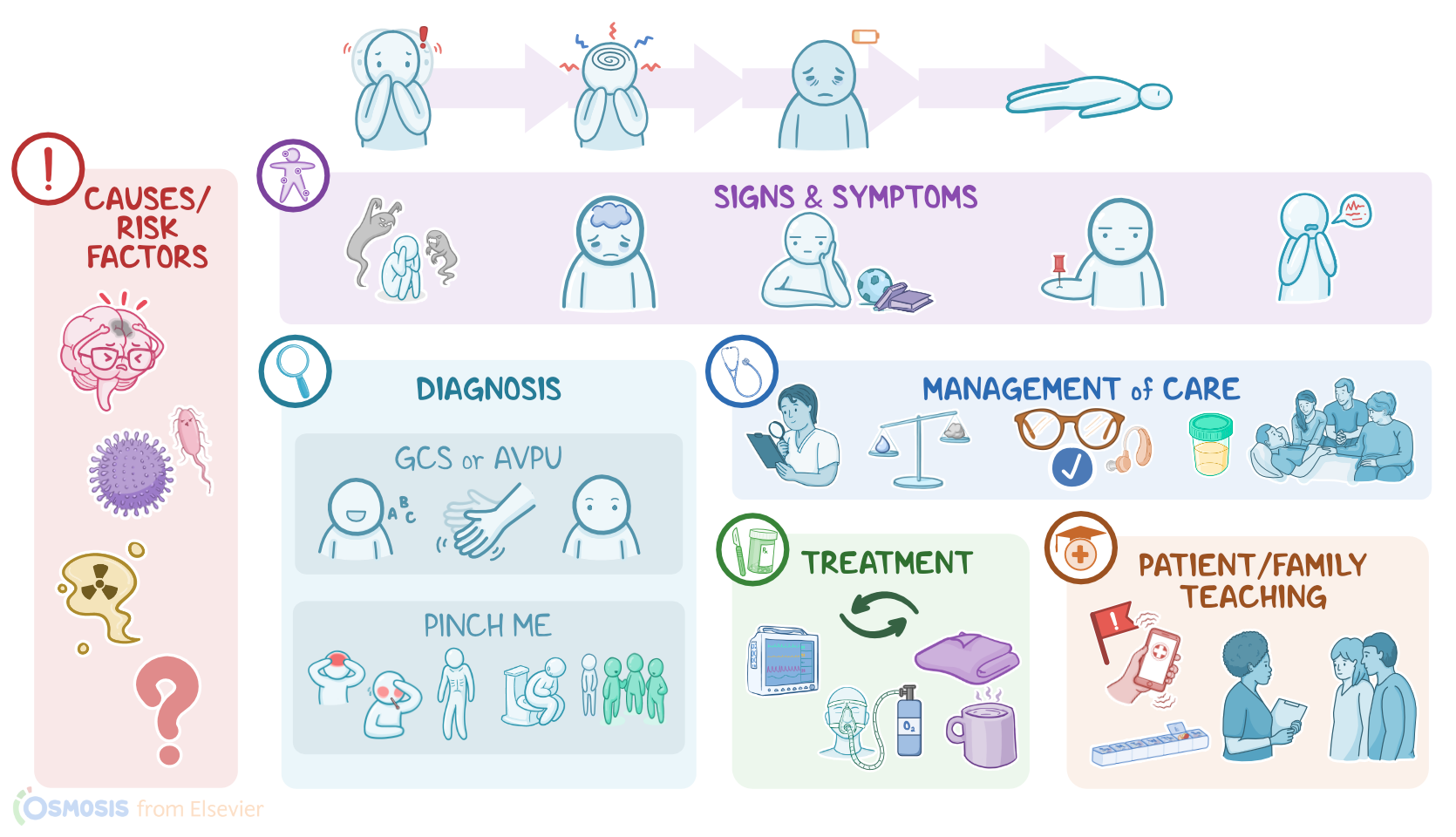
An altered level of consciousness (LOC) is a state in which a person experiences a change in their level of alertness and awareness. LOC can be caused by various factors such as illness, injury, or medication. Some symptoms that may indicate that someone is experiencing an altered level of consciousness include confusion, disorientation, delirium, lethargy, and coma. It's important to seek medical attention if someone is experiencing an altered level of consciousness, as this can be a sign of a serious health condition.
Introduction0:00–0:17
An altered level of consciousness is characterized as a decreased wakefulness, awareness, or alertness, and includes a range of categories like hyperalert, delirious, lethargic, and comatose.Now, let’s quickly review the physiology of consciousness.
Physiology0:17–0:51
Normal consciousness is composed of alertness and awareness while awake, as well as arousal or the ability to be woken up from sleep.
Consciousness and arousal are believed to be regulated by the reticular activating system, which is a network of neurons that’s located in the brainstem.
Normally, these neurons ultimately act by activating parts of the brain cortex involved in wakefulness, attention, behavior, and thinking.So, altered levels of consciousness can have many causes and risk factors, which can be broadly categorized as structural, metabolic, infectious, toxic, or other.
Causes & risk factors0:51–1:53
Structural causes include cerebral edema, increased intracranial pressure, stroke, or traumatic brain injury; while metabolic causes include dehydration, hypo- or hyperthermia, hypo- or hyperglycemia, hypo- or hypernatremia, hypoxia, hypercapnia, or uremic encephalopathy.
Infectious causes include meningitis, encephalitis, or sepsis. Toxic causes include carbon monoxide, alcohol, or medications, such as opiates, salicylates, barbiturates or benzodiazepines.
Lastly, other causes include syncope, seizures, sleep deprivation, serious illness, sensory impairment, or intense pain.
The underlying pathology leading to an altered level of consciousness depends on the cause. Some cases seem to be associated with dysfunction or damage of the reticular activating system; while other cases seem to result from direct dysfunction or damage to the brain, as well as reduced delivery of oxygen or glucose.
Pathology1:53–2:25
Ultimately, neural activity is disrupted, leading to impaired wakefulness and attention, and sometimes even altered behavior and thinking.So the typical clinical manifestations may have gradual or sudden onset, and include clouded consciousness and confusion.
Clinical manifestations2:25–3:28
The client may also appear disoriented or speak incoherently. Some clients may present with delirium, which is characterized by mental confusion, disorientation, as well as hypo- or hyperactivity, and even hallucinations.Alternatively, the client may become lethargic, feeling fatigued, sleepy, or sluggish.
If a client begins to have obtundation, their interest in their surroundings may decrease, as well as their stimulus response time, which is defined as the quickness or their response to a given stimulus.
Some cases may progress to stupor, where the client becomes primarily unresponsive, only arousing after repeated stimulation.
Finally, clients that progress into a coma can become completely unresponsive and unarousable. Diagnosis begins with the client’s history and physical assessment, which includes a thorough neurological exam.
Diagnosis3:28–5:13
The client’s level of consciousness in response to stimuli is assessed with the Glasgow Coma Scale, or GCS for short, which evaluates verbal, motor, and eye-opening responses.
In the urgent care setting, a quicker exam to assess the client’s level of consciousness is the AVPU assessment, which rates the client as either Alert, Verbally responsive, Painfully responsive, or Unresponsive.
In addition, the pupils in both eyes should be assessed for size, shape, and symmetry; and if the client is awake, orientation should be checked by asking their name, what day it is, and if they know where they are and why.If the client presents with delirium, they should be assessed for potential causes.
These can be summarized with the mnemonic PINCH ME, which stands for Pain, Infection, Nutritional deficiency, Constipation, Hydration deficit or dehydration, Medications like opioids or benzodiazepines, and Environmental factors like isolation, decreased sensory stimulation, and unfamiliar places.Additionally, laboratory tests are often performed, including a complete blood count, comprehensive metabolic panel, and toxicology screening.
Imaging, such as X-rays and CT scans can help assess for brain injury or damage. In severe cases, cerebral spinal fluid can be collected to assess for infections like acute meningitis.Treatment for clients with an altered level of consciousness varies depending on the cause and severity, so the main goal is to identify any reversible cause as quickly as possible.
Treatment5:13–5:57
Treatment often includes an empiric reversal agent, commonly dextrose and, in the case of opioid overdoses, naloxone. Less commonly, flumazenil can be given to reverse the sedative effects of benzodiazepines.
Additionally, some clients may require supplemental oxygen therapy and cardiac monitoring; and clients with hypothermia require warming with blankets or warm fluids, which can be given intravenously, or in some cases orally if the client is awake.Alright, let’s look at the nursing care you’ll be providing for a client with an altered level of consciousness such as delirium.
Management and care5:57–8:11
For most clients, nursing goals of care include close monitoring of cognitive and physical status, eliminating precipitating factors, and providing supportive measures during recovery.
Begin by instituting fall precautions to ensure your client’s safety. Be sure to monitor them at least hourly, and use the Modified Early Warning system, or MEWS score to report to the healthcare provider concerning changes in temperature, respiratory rate, heart rate, systolic blood pressure, urine output, and level of consciousness.Collaborate with the healthcare provider to identify and eliminate any precipitating factors.
Decrease or eliminate medications that could contribute to delirium. Then review their most recent laboratory test results, and correct any fluid, electrolyte, or acid-base imbalances.
In addition, collect a urine sample and send it to the lab for urinalysis and culture. Report to the healthcare provider if the results indicate a urinary tract infection is present, and administer the prescribed antibiotics.Assist your client by providing comfort measures and administering the prescribed pain medications, as needed.
In addition, maintain a quiet, restful environment; decrease unnecessary stimulation; assess their orientation to person, place, time, and situation; and reorient them as needed.
If your client has a visual or hearing impairment, ensure they have their glasses and hearing aid in place, as needed. Lastly, encourage family members to spend time with your client.Finally, institute measures to protect your client from problems related to immobility, including position changes, deep breathing and coughing, hygiene, and skin care.
Okay, moving on to client and family teaching. Begin by explaining to family members or caregivers about altered level of consciousness such as delirium and why it occurs.
General client and family teaching8:11–8:52
Reassure their family members that it is temporary and it can happen during hospitalization. Teach them about strategies to prevent disorientation by adhering to their prescribed medication and lifestyle regimen.
Lastly, encourage the client’s family or caregivers to notify the healthcare provider right away if they notice the client experiencing increased confusion or other changes in their level of consciousness.
Alright, as a quick recap… Altered level of consciousness is characterized as decreased wakefulness, awareness, or alertness.
Review8:52–10:01
Common causes include structural causes like or traumatic brain injury; metabolic causes like hypoxia or electrolyte imbalance; infectious causes like meningitis or sepsis; toxic causes like alcohol and some medications; or other causes, such as seizures or sensory impairment.
Diagnosis begins with the client’s history and physical assessment, which includes a thorough neurological exam and use of the GCS or AVPU.
Treatment usually varies depending on the cause, which should be reversed as soon as possible. Nursing management of an altered level of consciousness includes close monitoring of cognitive and physical status, eliminating precipitating factors, and providing supportive measures during recovery.
Client and family teaching focuses on reassuring them, preventing an altered level of consciousness from occurring or worsening, and learning when to contact the healthcare provider.
| ALTERED LEVEL OF CONSCIOUSNESS (LOC) | ||
| KEY POINTS | NOTES | |
| DEFINITION |
| |
| PHYSIOLOGY |
| |
| CAUSES AND RISK FACTORS |
| |
| PATHOPHYSIOLOGY |
| |
| SIGNS AND SYMPTOMS |
| |
| DIAGNOSIS |
| |
| TREATMENT |
| |
| MANAGEMENT OF CARE |
| |
| PATIENT AND FAMILY TEACHING |
| |
- "Evaluation of altered mental status - Differential diagnosis of symptoms" BMJ Best Practice US (2020)
- "Lewis’s medical-surgical nursing: Assessment and management of clinical problems" Elsevier (2020)
- "Medical-surgical nursing: Concepts for interprofessional collaborative care" Elsevier (2021)
- "Saunders Comprehensive Review for the NCLEX-RN Examination" Elsevier (2017)
- "Recovery from disorders of consciousness: mechanisms, prognosis and emerging therapies" Nature Reviews Neurology (2020)
- "Therapeutic interventions in patients with prolonged disorders of consciousness" The Lancet Neurology (2019)
- "Practice guideline update recommendations summary: Disorders of consciousness" Neurology (2018)
No notes for this video yet
Try adding a note below