Assessment - Postpartum: Nursing
Introduction0:00–0:29
The postpartum period, also known as the puerperium, or “the fourth stage of labor”, starts after delivery of the fetus and the placenta, and it extends through the first six weeks after birth.
During this period, the body gradually returns to its pre-pregnancy state. There are several complications that can arise during the postpartum period, and early diagnosis is essential for appropriate management of these conditions.
Okay, let’s start with some physiology. So, after delivery, the uterus tends to regress back to its normal size and resume its pre-pregnancy position by the sixth week, a process known as involution.
Physiology0:29–1:32
There are also some physiological changes that occur during pregnancy that begin to change back to pre-pregnancy levels in the postpartum period.
For example, during pregnancy there is increased blood plasma volume in relation to red blood cell mass. As a consequence, maternal hemoglobin and hematocrit are usually relatively low during pregnancy, since the same amount of red blood cells are circulating in a higher volume of blood.
After delivery, through increased diuresis or urine production, and increased diaphoresis or sweat production, blood volume returns to normal in about 6 to 12 weeks, and hemoglobin, and hematocrit levels normalize within 4 to 6 weeks.
Likewise, during pregnancy, plasma fibrinogen and other pro-coagulant factors increase, and they stay elevated until 4 to 6 weeks following delivery.
Now, there are some complications that can happen during the postpartum period, the main one being postpartum hemorrhage, meaning excessive blood loss following delivery.
Complications1:32–4:29
They can cause significant pain and discomfort, and large hematomas can cause hemodynamic instability and even hypovolemic shock.Lacerations, on the other hand, can affect the uterus, cervix, vagina and the perineum.
Perineal lacerations can be classified in 4 degrees. First degree lacerations are when the tear doesn’t go past the fourchette, which is where the two labia minora meet posteriorly.
Second degree lacerations extend past the fourchette, but they don’t involve the anal sphincter. Third degree lacerations may extend as far as the internal anal sphincter.
Finally, fourth degree lacerations reach all the way to the rectal mucosa. Next up, there are thromboembolic complications, like deep vein thrombosis, which is when a blood clot develops in one of the major veins, typically those of the lower leg.
This clot can then break off and get lodged in other vessels, which can cause potentially life-threatening complications like a pulmonary embolism.Now, infections can also occur during the postpartum period, and typically they only cause a fever, malaise and possibly tachycardia.
However, left untreated, the infection can progress to potentially life-threatening septic shock or disseminated intravascular coagulation.
Up next, there are placenta-related complications, like retained placenta, which is when the placental delivery takes more than 30 minutes; and placenta accreta, which is a type of retained placenta, where the placenta grows into the uterine wall, and can’t be removed manually.
The main problem with these conditions is that they can cause severe postpartum hemorrhage which can progress to hypovolemic shock.Finally, it’s worth mentioning that some hypertensive disorders of pregnancy, like preeclampsia and eclampsia, can also debut in the postpartum period.
Some common risk factors for developing postpartum complications include extremes of age, like teenage pregnancy, or age over 35; grand multiparity, meaning 5 or more previous deliveries; uterine overdistention, like with multiple gestation or polyhydramnios; preterm delivery and premature rupture of membranes; using certain medications, like tocolytics or oxytocin; previous uterine surgery, like a previous cesarean birth; or use of operative procedures during delivery, like cesarean birth, vacuum extraction and forceps use.
Postpartum complications also tend to be more common in individuals with preexisting health conditions, like diabetes or heart disease.
Each of these complications has its own clinical manifestations. Clients with vaginal or vulvar hematomas typically present with deep, severe pain and feelings of pressure that are not relieved by the usual pain-relief options.
Clinical manifestations4:29–5:36
With thromboembolic complications, most often there is a swollen, red, and painful lower leg; while a pulmonary embolism can cause dyspnea, cough or hemoptysis.
Infections typically present with fever and tachycardia, and there could be foul smelling vaginal discharge. Next, the main clinical findings with retained placenta include excessive bleeding and an inability of the uterus to contract.The diagnosis of postpartum complications starts with the client’s history and physical examination.
Diagnosis5:36–6:14
Common lab tests include a CBC, which can show low hemoglobin and hematocrit in case of hemorrhage; or high WBC count, with an infection.
Inflammatory markers, like CRP and ESR can also be elevated with an infection. A coagulation panel can also be done to look for abnormalities when suspecting a thromboembolic event.
Imaging studies, like a pelvic ultrasound, can help identify placental complications; while a CT scan of the chest can help identify or rule out a pulmonary embolism.
Treating postpartum complications depends on the type of the complication and addressing the underlying cause. If hemorrhage is severe enough, blood transfusions might be required.
Treatment6:14–6:55
Other options include uterotonic medications, incising and draining large hematomas; suturing lacerations; or removing the retained placental fragments from the uterine cavity.
More complex surgical procedures, like a hysterectomy, might be needed when there’s uterine bleeding that can’t be controlled with other measures.
Finally, when an infection is suspected, antibiotics are typically given and for thromboembolic events, medications like thrombolytics can be used to dissolve clots.
Alright, let’s look at the care you’ll be providing for a client during the postpartum period. Your priority goal is to monitor for complications associated with the postpartum period.
Nursing Postpartum Assessment6:55–14:12
Begin your assessment by monitoring your client’s vital signs in accordance with your facility’s protocol. Keep in mind that their pulse can be somewhat lower than normal at first, as their body compensates for the loss of the placenta, as well as a decrease in intra-abdominal pressure after delivery of the fetus.
Blood pressure can be a little lower due to the normal blood loss that occurs after delivery, or it may be slightly elevated due to emotional excitement.
Be sure to report a heart rate is more than 100 beats per minute or hypotension, as these may indicate hemorrhage. In addition, report an elevated blood pressure, such a 140/90 mmHg on 2 or more occasions, as this may indicate preeclampsia.
It can be normal for your client’s temperature to be as high as 100 ° F or 37.8 ° C due to dehydration and fatigue, but report if their temperature is persistently more than 100.4 ° F or 38 ° C, as this could be an indication of infection.
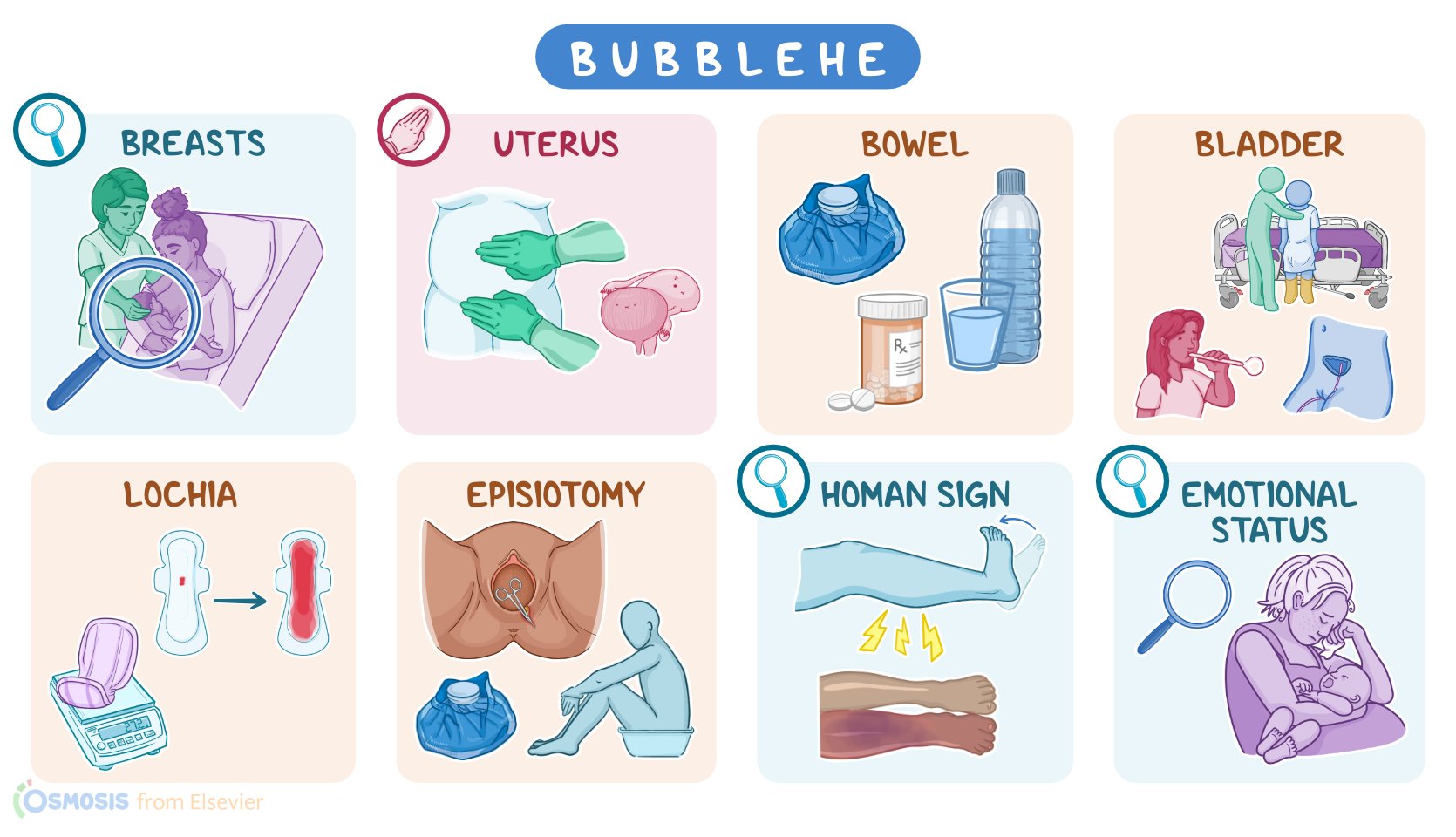
Lastly, ask your client about any pain they are experiencing, and administer the prescribed analgesics, as needed.Next, use the acronym BUBBLEHE to guide your next assessments.
B stands for breasts, so you’ll want to check both breasts, which are usually soft at this time. Colostrum can also be present.
If your client plans to breastfeed, assist with positioning their baby at the breast. If you notice potential problems like flat or retracted nipples, place a referral for a lactation consultant to provide additional support.
Palpate the uterine fundus, which should be firmly contracted and at midline. If it is soft, gently massage it until it contracts; and if it is not at midline, assist your client to empty her bladder, since a full bladder can interfere with uterine involution.
Now, remember that the uterine fundus should be palpated midway between the umbilicus and the symphysis pubis immediately after birth.
Then, as their muscles start to relax, it will rise up to the level of the umbilicus. After that, the uterus should descend at about 1 cm each day.
Findings to report include a soft, boggy uterus that does not remain firm with massage, or if it does not descend as expected.
Lastly, if your client had a cesarean birth, be sure to check their abdominal incision, which should be intact with minimal drainage.
B stands for bowel, which means you’ll assess for the return of bowel function, which typically slows down during the labor process or due to manipulation of the bowel during a cesarean birth.
In addition, your client could be reluctant to have a bowel movement if they had an episiotomy or a laceration. Apply ice to the perineum, as needed, and administer the prescribed analgesics.
Also assess their bowel sounds; promote bowel function by encouraging fluids and assisting with ambulation; and administer the prescribed stool softener.
Be sure to assist your client to the toilet the first time, since orthostatic hypotension is common due to hemodynamic changes in the early postpartum period.
Also keep in mind that due to postpartum diuresis, urine output is expected to temporarily increase. So, be sure to ask them if they are having any difficulty or pain emptying their bladder, and remember that your client could experience difficulty related to perineal trauma during delivery, or the effects of anesthesia.
Administering pain medications, or promoting relaxation of the perineal muscles by asking your client to blow bubbles through a straw can be helpful.
Report if the bladder is palpable; if your client is not able to empty their bladder; or if they frequently void small amounts.
Because a full bladder can interfere with uterine involution and increase the risk of hemorrhage, anticipate an order for straight catheterization.
L is for lochia, which is the vaginal discharge created as the superficial layer of the decidua basalis is sloughed off after delivery.
Check the color, amount, odor, and for the presence of clots. Normally, lochia is initially dark red, called lochia rubra; after 3 to 4 days it starts to become lighter in color, at which time it’s called lochia serosa; then after about day 10, it takes on a white or yellowish color, and it’s called lochia alba.
The amount of lochia is tracked by counting the number of perineal pads your client uses, the amount of blood on them, which can be scant, light, moderate, or heavy; and by their weight.
When weighing a perineal pad, remember that 1 gram equals 1 mL. Assessment findings to report include a foul odor, which can indicate an infection; or if there are signs of hemorrhage, including if a pad is saturated in one hour; if the amount of blood equals 500 mL; or if numerous clots are present.
Continue to massage the uterus and administer the prescribed uterotonic medications.E is for episiotomy as well as the perineal lacerations.
These wounds will have been repaired in the delivery room, and appear clean, dry, and intact. Think of REEDA to recall the assessments you’ll need to do if your client had an episiotomy or laceration.
Report the presence of unusual Redness, Edema, Ecchymosis, Discharge, and if the wound edges are not Approximated, as well as if there’s excessive pain or tenderness, as these may indicate inflammation and infection.
Apply ice to the perineum for the first 24 hours, offer a sitz bath to reduce pain and swelling, and administer the prescribed antibiotics, if indicated.
H is for the Homan sign, which is a reminder to check for deep vein thrombosis or DVT for short, because your client’s coagulability remains elevated during the postpartum period; and, immobility during labor or cesarean birth can increase the risk as well.
To check that a Homan sign is present, assist your client into a supine position with their legs straight, grasp their foot, and gentilly dorsiflex each ankle.
Now, the Homan sign may not always indicate a DVT is present, so be sure to also examine the lower extremities, and report signs of DVT, including localized redness, heat, edema, tenderness, or a diminished pedal pulse; as well as a positive Homan sign.
Finally, E stands for emotional status which is focused on promoting parental confidence in self-care and care of their newborn.
Teach your client as you provide care, encourage them to learn about their newborn, and reinforce successful parenting behaviors.
Also assess the attachment process by observing interactions with their newborn. Report if you notice emotional lability, disinterest in the newborn, or if there are risk factors for impaired parenting such a lack of social support or resources; and be sure to make an urgent referral to your unit’s social services.
Alright, as a quick recap… During the postpartum period, the body gradually returns to its pre-pregnancy state. The main complications that can arise during this period are postpartum hemorrhage; injuries to the genital tract; infections; thromboembolic complications, and placental complications, like retained placenta or placenta accreta.
Review14:12–15:56
Infections typically present with fever and tachycardia. With deep vein thrombosis, most often there is a swollen, red, and painful lower leg; while pulmonary embolism can cause dyspnea, cough or hemoptysis.
The main clinical findings with retained placenta include excessive bleeding and an inability of the uterus to contract.Diagnosis relies on the history and physical examination, as well as lab work and sometimes imaging tests, while treatment involves supportive care as well as addressing the underlying cause.
Some surgical procedures, like incising and draining a hematoma, suturing a laceration, or even a hysterectomy, can also be used.
Other options include antibiotics or thrombolytics, depending on the complication. Nursing care is mainly focused on assessing complications, which can be remembered with the BUBBLEHE acronym.
This stands for Breasts, Uterus, Bladder, Bowel, Lochia, Episiotomy, Homan sign and Emotional status.
| ASSESSMENT - POSTPARTUM | ||
| KEY POINTS | NOTES | |
| DEFINITION |
| |
| PHYSIOLOGY |
| |
| COMPLICATIONS |
| |
| SIGNS AND SYMPTOMS |
| |
| DIAGNOSIS |
| |
| TREATMENT |
| |
| NURSING ASSESSMENT |
| |
No notes for this video yet
Try adding a note below