Biology of cancer: Nursing
Cancer is a group of malignant conditions characterized by uncontrolled and unchecked cell division and growth. Now, cancer can involve any organ in the body, with the most common ones being breast cancer, prostate cancer, lung cancer, and colorectal cancer, in addition to melanoma, leukemia, and lymphoma.
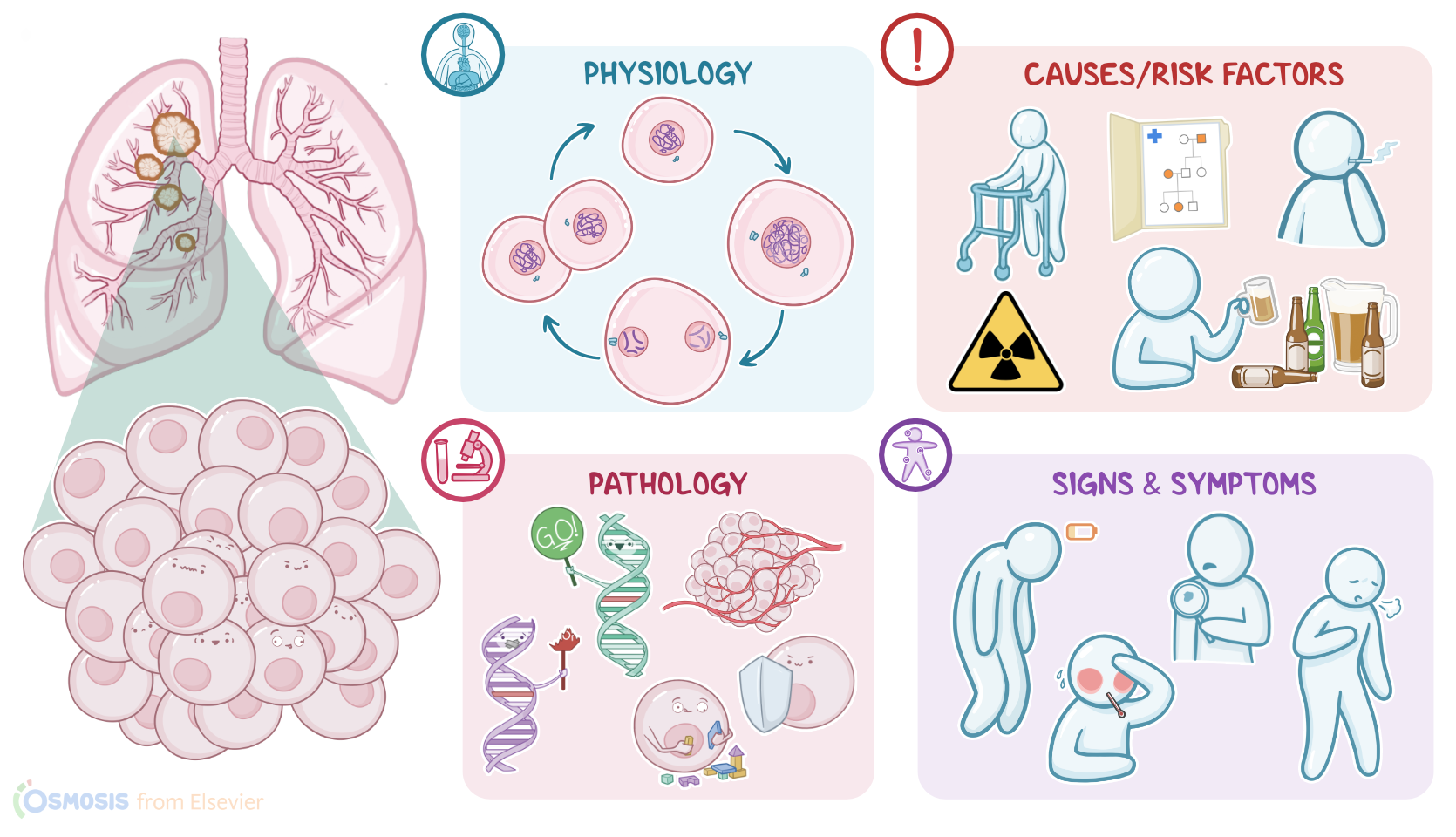
Now, let’s quickly review the physiology of cell division and growth, which takes place as a cell cycle in multiple phases: G1, S, G2, and M. During the G1 phase, the cell grows and prepares for DNA replication. In the S phase, the cell doubles its DNA content through DNA replication. This is followed by the G2 phase, during which the cell produces proteins and cellular components to be used in the next phase, called the M phase. Here, the cell divides through mitosis to produce two identical daughter cells.
Now, there are two types of genes that control the cell cycle, called tumor suppressor genes and proto-oncogenes. Tumor suppressor genes suppress uncontrolled cell division by preventing cells from entering the S phase; whereas proto-oncogenes stimulate cell division by encoding proteins involved in regulating the cell cycle.
Now, the main cause of cancer is gene mutation, or changes to the DNA sequence. These changes can be inherited from a parent, called germline mutations, or acquired throughout the client’s life, called somatic mutations. In addition, there’re epigenetic mutations, where tumor suppressor genes can be methylated and thus silenced, while proto-oncogenes can be unmethylated to activate their expression.
Mutations may arise due to a variety of risk factors. Non-modifiable risk factors include advanced age, in addition to personal or family history of cancer. On the other hand, modifiable risk factors include smoking, alcohol, obesity, excessive sun exposure, and certain occupations, as well as exposure to carcinogens, which are typically grouped into chemical, radiation, and viral carcinogens.
Chemical carcinogens include benzene, arsenic, and formaldehyde, whereas radiation carcinogens include ionizing and ultraviolet radiations. When it comes to viral carcinogens, these include Epstein-barr virus or EBV, human immunodeficiency virus or HIV, in addition to hepatitis B or HBV, and human papillomavirus or HPV.
Now, the pathology of cancer consists of three stages: initiation, promotion, and progression. In initiation, a mutation affects a tumor suppressor gene or a proto-oncogene. A mutation in a tumor suppressor gene causes the gene to lose its ability to suppress proliferation. On the other hand, a mutated proto-oncogene, now called an oncogene, allows the cell to proliferate uncontrollably.
Whatever the mutation is, it will pave the road for the next stage, called promotion. Here, the genetic mutations are accompanied by promoting factors, with the end result being loss of cell control by producing telomerase, which is an enzyme that maintains telomeres at the end of the cell’s chromosomes, preventing them from shortening to the point of causing cell death, and thus leads to reversible proliferation of cancer cells.
In the final stage of cancer pathology, called progression, the proliferating cells reach a critical mass, and new blood vessels develop via angiogenesis to supply it. With enough blood supply and no regulation, the cancer cells just keep proliferating, and here’s when cancer becomes clinically evident.
Overtime, cancer cells develop mechanisms to evade the immune system, start invading neighboring tissues, and may even spread to the nearby lymph nodes, or metastasize to distant organs.
So, in order to survive and proliferate, tumor cells must acquire a group of features, called the hallmarks of cancer. Several hallmarks have been described, which include sustaining proliferative signaling, evading growth suppressors, and resisting cell death, as well as invasion and metastasis, and alter energy metabolism and evading immune destruction.
| BIOLOGY OF CANCER | ||
| KEY POINTS | NOTES | |
| DEFINITION |
| |
| PHYSIOLOGY |
| |
| CAUSES AND RISK FACTORS |
| |
| PATHOPHYSIOLOGY |
| |
| SIGNS AND SYMPTOMS |
| |
No notes for this video yet
Try adding a note below