Dementia: Nursing
Dementia is a neurological condition, caused by structural changes in the brain, and characterized by a progressive decline in mental functions, including memory, thinking, language, behavior, mood, and personality.
There are several types of dementia and Alzheimer disease is by far the most common type, followed by vascular dementia, frontotemporal dementia, and Lewy body dementia.
Let’s start by looking at the anatomy and physiology of the brain, which has three main parts, called the cerebrum, which consists of the two cerebral hemispheres, the cerebellum, which sits down at the base of the skull, and the brainstem, which is located right in front of the cerebellum. Each of the cerebral hemispheres is made of the frontal lobe, parietal lobe, temporal lobe, and occipital lobe.
Zooming in, the cells that make up our brain are called neurons. They’re composed of a cell body, which contains all the cell’s organelles, and nerve fibers that extend out from the neuron cell body. These nerve fibers are either dendrites that receive signals from other neurons or axons that send signals along to other neurons. Neurons communicate with each other through neurotransmitters, such as glutamate, GABA, and dopamine.
Now, the brain is responsible for various mental functions, including memory, language, personality, visuospatial function, concentration, executive function, and praxis, which is the ability to carry out complex motor activities.
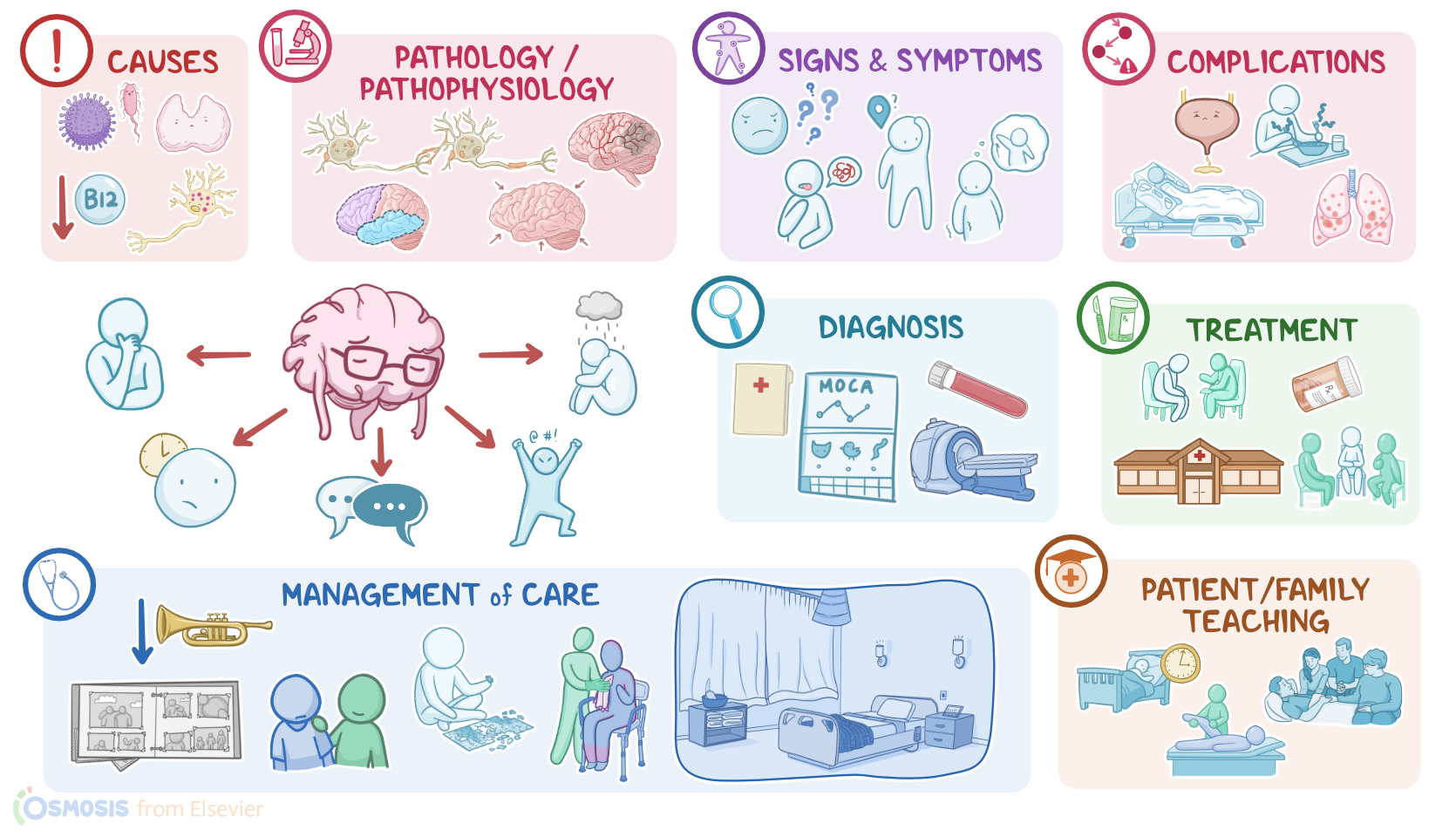
Okay, now, causes of dementia can be classified into reversible and irreversible ones. Reversible causes can be controlled and possibly cured with the right treatment. Some common examples of this include infectious conditions, like syphilis and HIV; dietary deficiencies, especially vitamin B12 deficiency; and hormone imbalances, such as thyroid problems. Irreversible causes cannot be cured and include Alzheimer disease, which is by far the most common cause of dementia; vascular dementia, which is the second most common cause; frontotemporal dementia; and Lewy body dementia. Finally, some dementia secondary to other conditions are also irreversible like Parkinson disease and Creutzfeldt-Jakob disease.
Starting with Alzheimer disease, there are abnormal protein deposits between both the neurons, called plaques, as well as inside the cells, called tangles, that get in the way of neuron-to-neuron signaling. And these neurons that don’t function properly may end up undergoing programmed cell death where they self-destruct.
The main risk factors for developing Alzheimer include advanced age; genetic predisposition, having a family history of Alzheimer disease, Down syndrome, and cardiovascular risk factors, such as hypertension, diabetes and abnormal lipid profile.
Next up is vascular dementia, where there’s a progressive loss of brain function caused by poor blood flow to the brain over a long period of time, typically as a result of atherosclerosis of the arteries supplying the brain. Now, factors that can increase the client's risk for vascular dementia include anything associated with atherosclerosis, like a past myocardial infarction; smoking; obesity; hypertension; diabetes; and a diet high in saturated fat.
Frontotemporal dementia refers to the atrophy of the frontal lobes that eventually progresses to the temporal lobes, with relative sparing of the parietal and occipital lobes. Finally, Lewy body dementia is caused by the aggregation of abnormal proteins known as Lewy bodies inside of neurons, which causes them to die. Next is pathology. So, regardless of the cause, as neurons die, the brain gradually atrophies, or shrinks, and its functions get seriously impaired.
Okay, moving on to clinical manifestations. Dementia typically has a gradual onset, lasts months to years, and progressively gets worse over time. Now, some behaviors commonly exhibited by clients with dementia include repeating conversations or actions and misplacing belongings; wandering and getting lost, which can increase the risk for a fall or injury; agnosia which is trouble identifying common objects or faces; and impaired executive functions meaning they can’t carrying out tasks that involves planning or multiple steps like grooming and cooking. They might also exhibit aphasia, or difficulty producing or understanding speech.
Other behaviors include apraxia, impaired ability to perform movements as desired; restlessness, or the constant need to move around or pace back and forth, sometimes to the point of exhaustion; rummaging or hiding things; agitation; and becoming angry, worried, embarrassed, or distressed, which may cause them to yell, swear, or even try to hit someone.
Some clients may also exhibit catastrophic reactions, meaning that they react excessively to something seemingly trivial; sundowning, meaning that symptoms of confusion or loss of orientation may intensify late in the afternoon or evening; as well as inappropriate sexual behavior. Communication and language problems can make it hard to think of common words.
Now, some behavior patterns are seen more often in certain forms of dementia than others. For example, delusions, which are false beliefs that the client might feel very strongly about so much so that they won’t change their mind even if they are given the evidence against it; as well as hallucinations, which can be any kind of sensation that’s not actually there, like hearing voices or commands or seeing people or lights; and are classically associated with Lewy body dementia. Abnormal motor behavior, like resting tremors, stiff and slow movements, and limited facial expressions similar to what’s seen in Parkinson's disease, is also common in clients with Lewy body dementia. Finally, depression is common in all types of dementia but especially in Alzheimer disease.
Now, as the disease progresses, clients with dementia can develop complications. They may become dependent on others for everyday activities. Additionally, mobility decreases, so they are unable to walk or sit up without assistance. Ultimately, this can progress to them becoming bed bound. Their ability to swallow food or fluids as well as communicate through language or facial expressions becomes limited or completely lost. Total urinary and fecal incontinence can also be expected at this point. These clients are also susceptible to respiratory and urinary tract infections, which may lead to serious illness or death.
Alright, now the diagnosis of dementia is typically based on the client’s history and physical assessment, followed by Montreal cognitive assessment or MOCA or the mini-mental status examination, or MMSE, to assess orientation, registration, recall, attention, and language.
Poor performance in these tests may suggest either delirium or dementia, so it’s important to differentiate between these two. Delirium is an emergency condition that also leads to a decline in various mental functions that occurs as a consequence of an underlying condition, like an infection, medication toxicity, a recent surgery, or serious illness. In contrast to dementia, it has a sudden onset, and signs and symptoms often fluctuate, meaning they come and go.
| DEMENTIA | ||
| KEY POINTS | NOTES | |
| DEFINITION |
| |
| PHYSIOLOGY |
| |
| CAUSES AND RISK FACTORS |
| |
| PATHOPHYSIOLOGY |
| |
| SIGNS AND SYMPTOMS |
| |
| DIAGNOSIS |
| |
| TREATMENT |
| |
| MANAGEMENT OF CARE |
| |
| PATIENT AND FAMILY TEACHING |
| |
No notes for this video yet
Try adding a note below