Flail chest: Nursing
Introduction0:00–0:19
Flail chest is a serious condition, often caused by severe blunt chest trauma. It occurs when multiple consecutive ribs are fractured, creating a separate, free floating section of ribs and connecting tissue that moves out of sync with the rest of the chest during breathing.
Physiology0:19–1:20
Now, the key muscles involved in breathing are the intercostal muscles, which are located between each set of ribs, and the diaphragm, which covers the whole bottom of the thoracic cage.
When a person inhales the diaphragm contracts, moving downward and the intercostal muscles contract to move the rib cage out.
This increases the volume while decreasing pressure in the thoracic cavity. The change in pressure pulls air down into the lungs.
In contrast, when a person exhales the diaphragm and intercostal muscles relax which decreases the volume, while increasing pressure in the thoracic cavity.
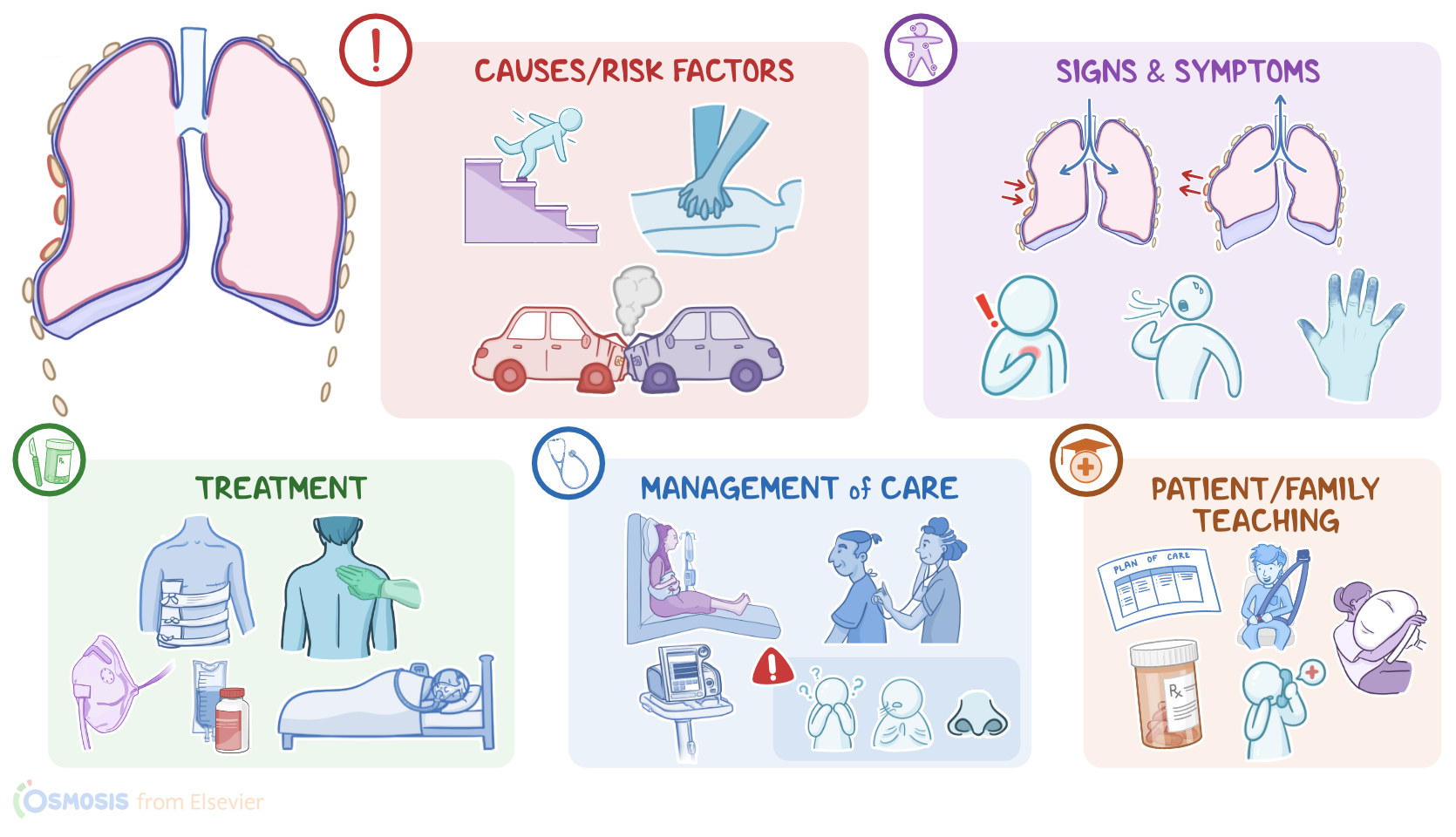
This makes air move out of the lungs.Now, the main cause of a flail chest is blunt trauma to the chest, which can be caused by falls, abuse, car crashes, crush injuries, or even cardiopulmonary resuscitation.Risk factors for a flail chest include modifiable ones, such as intoxication, and practicing contact sports; as well as non-modifiable ones, such as advanced age, and being assigned male sex at birth.Okay, now, the pathology of a flail chest begins when a blunt trauma causes three or more ribs to fracture in two or more places, or when there’s bilateral detachment of ribs from the sternum.
Causes & Risk factors1:20–1:20
Causes & Risk factors1:20–1:20
Causes & Risk factors1:20–1:47
Pathology1:47–4:09
This creates a segment of the ribs that is not mechanically attached to the rest of the chest wall, As a result of these two pathologies, the chest moves in a paradoxical or uncoordinated fashion.
This means that when the person breathes in, the chest wall expands, pulling outwards, but intrathoracic pressure becomes more negative, pulling the unattached segment inwards.
On the other hand, when the person breathes out, the chest wall contracts, pulling inwards, but intrathoracic pressure becomes more positive, which pushes the separated section outwards.
Damage to the thoracic wall also prevents the lungs from expanding fully which impairs respiration. In addition,the intercostal muscles pull on the broken rib segment during breathing which causes severe pain and further impairs breathing.
Now, flail chest is also associated with several complications, the most common of which is pulmonary contusion, or injury of the lung parenchyma.
This can cause atelectasis or collapse of the alveoli in the lung. These collapsed alveoli can’t participate in gas exchange, causing shunting, so blood doesn't become oxygenated as it moves through the lungs.
This can result in acute, refractory hypoxemia, meaning that the client’s oxygenation does not improve even when they receive higher concentrations of oxygen; and ultimately, clients develop acute respiratory distress syndrome, or ARDS.
Since clients with flail chest have trouble breathing or coughing up airway secretions, they are also at an increased risk of developing pneumonia.
Another complication is pneumothorax, which is when there’s air in the pleural cavity, and that doesn’t allow the lung on that side to expand properly.
Finally, in severe cases, the broken ribs can tear the aorta, damage the diaphragm, or injure internal organs like the spleen, liver, or kidneys.Typically, the clinical manifestations of flail chest include paradoxical breathing, along with pain at the sites of the fractures, which intensifies with breathing, moving, coughing, or even sneezing.
Clinical manifestations4:09–5:06
Some clients also splint, meaning that they take short, shallow, rapid breaths in an effort to limit chest movement and reduce pain.
In severe cases, they may also experience shortness of breath, cyanosis, and refractory hypoxemia. Additionally, clients can develop hemodynamic instability, which presents as hypotension, tachycardia, or arrhythmias.During auscultation of the chest, there are diminished breath sounds, and palpation of the chest typically reveals crepitus, which refers to crunching or grinding sounds, when the site of the fracture is moved.Diagnosis of flail chest begins with the client’s history and physical assessment, followed by imaging to confirm the diagnosis.
Diagnosis5:06–5:22
A CT scan of the chest is typically the preferred method, although an X-ray can also be used.Treatment of a flail chest initially involves splinting or applying direct pressure over the flail chest.
Treatment5:22–6:13
Supplemental oxygen, IV fluids, as well as pain management, including NSAIDs, opioids, acetaminophen, or nerve blocks, are also important.
Chest physiotherapy is also often used to prevent pneumonia. If the client’s condition worsens despite the initial treatment, ventilation with continuous positive airway pressure, or CPAP can be tried first.
If that doesn’t work, intubation and mechanical ventilation with positive end-expiratory pressure or PEEP, might be needed.
If this is still not enough, clients might also require surgical stabilization of the displaced ribs.Alright, when providing nursing care to a client with a flail chest, your priority goals of care are to maintain adequate oxygenation and ventilation, manage pain, and monitor for complications.
Management and care6:13–8:33
Begin by placing your client in a high-Fowler position, and splint the flail segment of their chest with a pillow or rolled blanket.
Then apply a pulse oximeter and administer high-flow humidified oxygen or insitute CPAP per facility protocol to keep their SPO2 at 94% or above.
Perform a focused pulmonary assessment, including rate, depth, ease of respiration, use of accessory muscles, breath sounds, oxygen saturation, color of skin and mucous membranes, and level of consciousness.
Assess their chest for paradoxical wall motion and palpate for crepitus. Then, examine their chest for injury, including bruising, and bleeding.
You may also notice a seatbelt sign which is bruising on the chest and abdomen caused by wearing a seatbelt during a car crash.
Finally, examine the rest of their body to identify other underlying injuries that may have occurred. Next, promote lung expansion and clearance of secretions by encouraging your client to take deep breaths, assist them to use an incentive spirometer every 1 to 2 hours as ordered while they are awake.
Remember to provide pain management as needed to help them make sufficient inspiratory effort, while avoiding sedation. Also ensure they maintain bed rest and limit activity to minimize oxygen demands.
Closely monitor their arterial blood gas values and vital capacity, or FVC, and report to the healthcare provider if they have a reduction in their FVC, respirations below 12 or above 20 breaths per minute, decreased SpO2, oxygenation does not improve even when they receive higher concentrations of oxygen, confusion, increased work of breathing such as nasal flaring or retractions, and be prepared to assist with mechanical ventilation if indicated.
Okay, let’s move on to client and family teaching. Begin by explaining that flail chest is a condition that’s due to chest injury and rib fractures that can affect their ability to breathe.
General client and family teaching8:33–9:10
Review their plan of care, and educate them about their prescribed medications. Let them know that it can take between 6 weeks to a year for them to fully recover, and that this varies depending on the severity of their injury.
Lastly, review safety precautions they can take to prevent future injury, such as wearing their seatbelt, ensuring they have working airbags, and not driving under the influence of drugs and alcohol.Alright, as a quick recap … Flail chest is when there’s a fracture of three or more consecutive ribs in at least two different places or when two ribs on both sides of the chest get detached from the sternum.
Review9:10–10:40
This causes paradoxical chest movement where the separated part of the chest moves in the opposite direction of the rest of the chest wall, which causes impaired ventilation.
The main cause is blunt trauma to the chest from things like falls, car crashes, and CPR. Clinical manifestations include paradoxical breathing; pain that intensifies with breathing, coughing, and moving; diminished breath sounds; and crepitus.
Severe cases can cause shortness of breath, cyanosis, refractory hypoxemia, and hemodynamic instability. Treatment initially involves splinting and applying pressure over the flail chest, and includes supplemental oxygen, IV fluids, pain management, and chest physiotherapy to prevent pneumonia.
Some clients may need ventilation with CPAP; intubation with mechanical ventilation with positive end-expiratory pressure; or surgical stabilization of the displaced ribs.
Your priority goals of nursing care are to maintain adequate oxygenation and ventilation, manage pain, and monitor for complications.
Client and family teaching focuses on understanding their condition and treatment plan, prevention of recurrence, and when to seek medical attention.
| FLAIL CHEST | ||
| KEY POINTS | NOTES | |
| DEFINITION |
| |
| PHYSIOLOGY |
| |
| CAUSES AND RISK FACTORS |
| |
| PATHOPHYSIOLOGY |
| |
| SIGNS AND SYMPTOMS |
| |
| DIAGNOSIS |
| |
| TREATMENT |
| |
| MANAGEMENT OF CARE |
| |
| PATIENT AND FAMILY TEACHING |
| |
No notes for this video yet
Try adding a note below