Lung cancer: Nursing
Introduction0:00–0:25
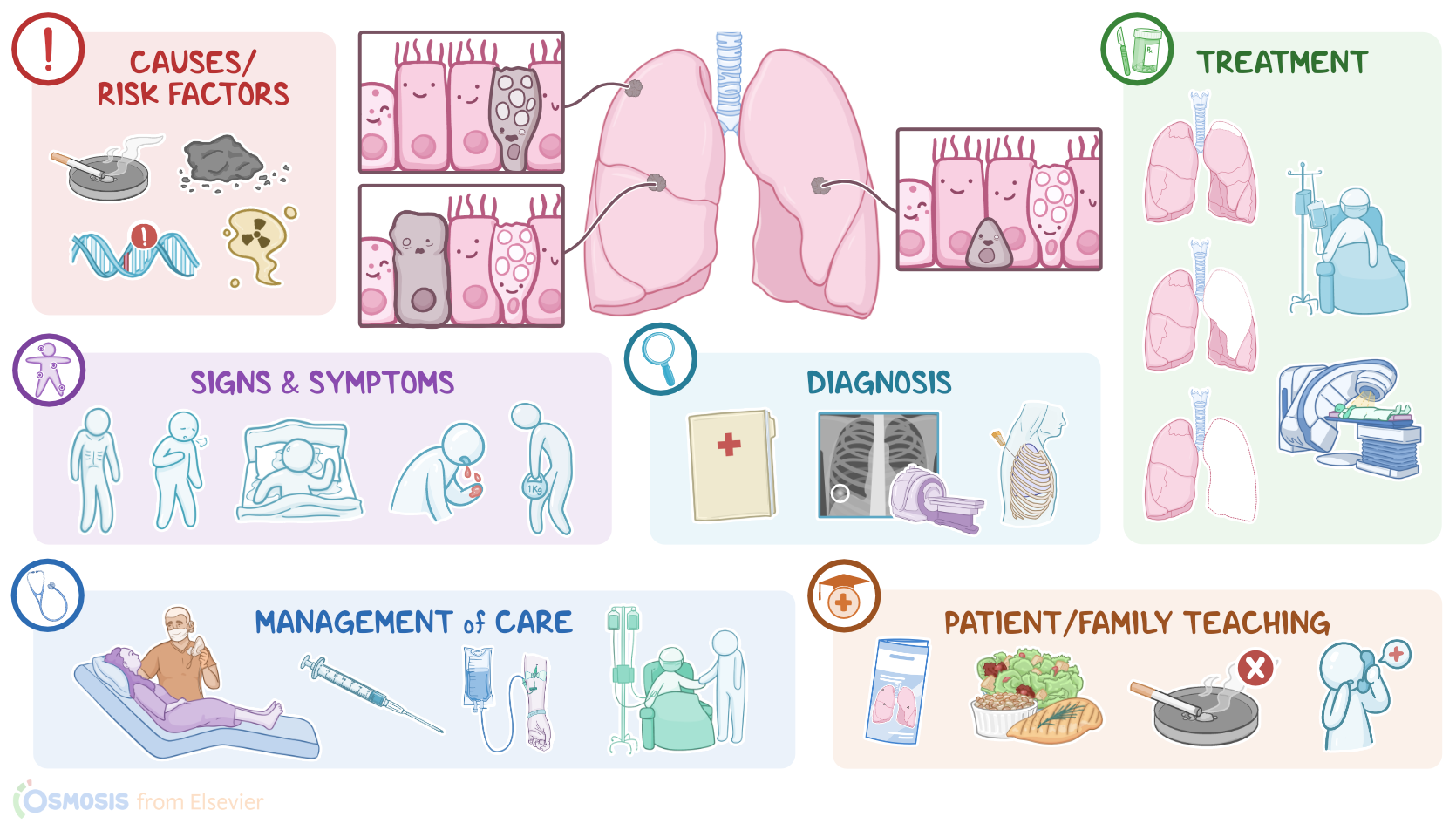
Lung cancer is a malignant tumor that primarily originates in the lungs or less frequently, can originate in another organ and spread to the lungs through metastasis.
Unfortunately, lung cancer is one of the most common and aggressive types of cancer. All right.
Now, the lungs are these paired organs in the chest containing a collection of tubes and passages called the airways, which include the bronchi.
Physiology0:25–1:31
Then the bronchioles, the alveolar ducts and finally, the alveoli, the airways are lined by several types of epithelial cells that serve multiple functions.
These include columnar epithelial cells that have hair like projections called cilia which work to sweep foreign particles and pathogens up and out of the airways.
Another type called goblet cells secrete mucin to moisten the airways and trap foreign pathogens. There are also club cells sometimes called clara cells that secrete glycosaminoglycans to protect the bronchioles and neuroendocrine cells that secrete hormones into the blood.
So, lung cancers occur when any of these epithelial cells acquire mutations which can arise due to a variety of risk factors.
Environmental risk factors include exposure to toxins like tobacco smoke, air pollution, asbestos, coal dust, radon gas or ionizing radiation.
There are also some genetic risk factors where few clients are genetically predisposed to develop lung cancer, even without the presence of environmental risk factors.
Causes & risk factors1:31–2:06
So, once an epithelial cell becomes mutated and cancerous, it starts dividing uncontrollably forming a tumor mass. As the tumor keeps growing, new blood vessels also develop via angiogenesis to supply it eventually, cancerous cells start invading neighboring tissues and may even spread to nearby lymph nodes or metastasize to distant organs such as the brain bones or liver.
Pathology2:06–3:36
Now, there are two main types of lung cancer, non small cell and small cell, non small cell lung cancers account for most lung cancers.
And there's different subtypes depending on the cell of origin. The most common one is adenocarcinoma, which usually develops at the periphery of the lung from the goblet cells.
Another quite common one is squamous cell carcinoma, which is usually centrally located in the lungs and originates from mutated columnar epithelial cells that become squamous epithelial cells.
On the other hand, small cell lung cancer accounts for the minority of lung cancers which are typically centrally located and originate from small immature neuroendocrine cells.
Now, the clinical manifestations of lung cancer vary based on the size and location of the tumor and whether or not it secretes hormones.
Initially, clients can be completely asymptomatic over time, the body mounts an immune response to fight the tumor off. So clients may start experiencing unintentional weight loss, fever, malaise and night sweats if the tumor grows enough to physically obstruct the airway.
It can cause dyspnea, wheezing and persistent cough. If tumor necrosis occurs or if cancer cells invade a blood vessel, individuals can experience hemoptysis.
Clinical manifestations3:36–6:43
While compression of nearby nerves can cause hoarseness and pain. Tumors that arise at the apex of the lungs are called pancoast tumors and can push up against blood vessels and nerves located in the region, compressing major blood vessels like the superior vena cava can prevent blood from draining from the head leading to facial swelling or puffiness.
While compressing the brachial plexus can cause shooting arm pain and weakness and compression of the cervical sympathetic chain can result in Horner syndrome, which presents as ptosis, miosis and facial anhidrosis.
Additionally, some tumors might be able to inappropriately secrete hormones. So the client may develop a paraneoplastic syndrome.
Squamous cells in lung cancers, sometimes secrete parathyroid hormone related peptide or PTHRP, which mimics parathyroid hormone or pth causing hypercalcemia, fatigue and muscle weakness.
On the other hand, small cell lung cancers may secrete anti diuretic hormone or A DH for short, as well as adrenocorticotropic hormone or ACTH.
A DH secretion can lead to syndrome of inappropriate antidiuretic hormone secretion or SI A DH for short, which results in hyponatremia and reduced urine output.
While ACTH secretion results in Cushing's syndrome. With symptoms like hyperglycemia, hypertension, skin hyperpigmentation, osteoporosis, weight gain, easy bruising and frequent infections from a weakened immune system.
Lastly, small cell lung cancers can also cause the production of antibodies against the neuromuscular junction, which results in Lambert Eaton syndrome causing muscle weakness.
Diagnosis of lung cancer involves history and physical assessment as well as additional diagnostic tests like imaging. In most cases, chest x rays show a parenchymal lesion like a poorly defined nodule called a coin lesion.
While ct scan can be used to stage the tumor by defining the location and look for lymph node involvement or metastasis.
Once a suspicious lesion is found on imaging, a biopsy is needed to confirm the diagnosis. Treatment for lung cancer depends on its aggressiveness and extension.
Small localized tumors can be treated with partial resection, which is when the affected lung area is surgically removed.
On the other hand, clients with larger tumors may require lobectomy or removal of the lung lobe containing the tumor and even pneumonectomy or surgical removal of the entire lung.
Also any involved nearby lymph nodes should be resected. In addition to surgery, clients can be treated with chemotherapy immunotherapy or radiotherapy.
Finally, metastatic lung cancers can't be surgically resected. So they are often treated with a combination of therapies as well as palliative care to decrease their symptoms and improve quality of life.
All right, let's look at the nursing care you'll provide to a client with lung cancer. Your priority.
Diagnosis6:43–7:20
Nursing goals are to optimize oxygenation and respiratory status as well as providing care related to treatments and providing comfort and emotional support to promote quality of life.
Begin by assessing your client's vital signs, including pulse oximetry, as well as their respiratory status, which includes breathing patterns and breath sounds, making note of flared nostrils and the use of accessory breathing muscles.
Also, be sure to assess for the presence of a cough as well as sputum quality and character and review the assigned tumor node metastasis or TNM classification of the tumor.
Treatment7:20–8:20
Be sure to report to the health care provider. If your client presents concerning assessment findings such as decreased or absent breath, sounds rapid or shallow breathing, stridor, asymmetric, diaphragmatic movement, cyanosis or hemoptysis, then assist your client into a Fowler position and provide supplemental oxygen as ordered.
Next, assess your client's pain, including the onset quality severity, location, aggravating or relieving factors and how frequently they experience pain, report to the health care provider.
If your client experiences any chest pain, especially occurring with inspiration or a feeling of fullness, tightness or pressure in the chest and be sure to provide comfort measures and administer the prescribed analgesics.
Management and care8:20–12:58
Now, if you're caring for a client after a partial surgical resection, lobectomy or pneumonectomy, implement routine postoperative interventions and monitor them closely for complications related to the procedure.
Be sure to monitor their respiratory status and ensure they have a patent airway and adequate ventilation report. Any concerning assessment findings that could indicate respiratory distress including a respiratory rate below 12 or above 20 breaths per minute, an oxygen saturation below 92% or tracheal deviation.
If your client has a chest tube in place, postoperatively, be sure to keep a close eye on the insertion site, drainage chamber and water seal chamber and report problems like a change in the drainage amount or color as well as the absence of tiding or bubbling.
Also immediately report this to the health care provider. If the chest tube becomes dislodged from your client's chest and cover the insertion site with sterile gauze.
Lastly immediately report if the chest tube becomes disconnected from the drainage system and place the end of the chest tube in a container of sterile water kept below the level of the chest.
All right, if your client is prescribed chemotherapy, administer the medication and assess them for side effects like nausea, vomiting and neutropenia.
Administer the prescribed antiemetics, provide comfort measures and institute neutropenic precautions for clients. Also receiving radiation, assess them for localized skin reactions and report to the health care provider.
If your assessment reveals manifestations of radiation induced esophagitis, including substernal pain, dysphasia, odynophagia or painful swallowing, be prepared to assist with administration of local anesthetics to decrease esophageal pain and to institute interventions to decrease irritation to the esophagus such as dietary modifications as well as administration of IV fluids, total parenteral nutrition or enteral feedings per gastrostomy tube as ordered to ensure adequate nutritional intake.
All right, let's move on to client and family teaching. First, provide information about the disease process and review.
The plan of care and potential side effects emphasize the importance of maintaining optimal nutrition during treatment. By consuming nutritionally dense foods that are high in protein.
Encourage your client to eat small frequent meals throughout the day including their favorite foods that meet the needed nutritional criteria.
Also remind your client to participate in physical activity is tolerated and to include rest periods in between activities as needed.
Lastly, stress the importance of smoking, cessation and living in a smoke free environment. Let your client know that they may need supplemental oxygen at home.
And that while using supplemental oxygen, they should avoid igniting any kind of open flame or being in the vicinity of lit candles, fireplaces or gas ovens while in use, provide signs for your client to post at the entrance of their home to alert others that oxygen is in use.
If your client has undergone a surgical intervention, encourage them to cough, take deep breaths and use the incentive spirometer every hour while awake in order to prevent atelectasis or pneumonia, also encourage them to take their prescribed analgesics and other medications as directed and advise them to follow up with their health care provider.
If they start to notice symptoms, that their condition is worsening, including increasing shortness of breath, coughing up blood and new or worsening chest pain.
Finally provide your client with resources for local support groups and reassure them that there are additional resources available to them, including home health care, palliative care, nutrition, counseling, physical therapy, psychosocial care and smoking, cessation resources as needed.
All right, it's a quick recap. Lung cancer is a common and aggressive type of malignant tumor that originates in the lungs or spreads to the lungs through metastasis.
Risk factors include exposure to toxins like tobacco smoke, coal radon gas, as well as having a genetic predisposition. The two main types of lung cancer are non small cell lung cancer, which is the most common type and small cell lung cancer.
General client and family teaching12:58–15:13
Clinical manifestations may include unintentional weight loss, fever, malaise night sweats, dyspnea, wheezing, persistent cough and hemoptysis, as well as the development of problems like paraneoplastic syndrome or Lambert Eaton syndrome.
Diagnosing lung cancer involves a history and physical assessment followed by chest x rays. CT scan and confirmation with biopsy.
Treatment depends on the cancer's aggressiveness and extension and can include surgery as well as chemotherapy, immunotherapy, radiotherapy and palliative care.
The priority goals of nursing care are to optimize oxygenation and respiratory status. Provide care related to treatments and provide comfort and emotional support.
To promote quality of life. Client and family education includes helping them understand their disease and treatment plan, how to manage side effects from the cancer and its treatments and when to contact their health care provider.
Review15:13–14:10
| LUNG CANCER | ||
| KEY POINTS | NOTES | |
| DEFINITION |
| |
| PHYSIOLOGY |
| |
| CAUSES AND RISK FACTORS |
| |
| PATHOPHYSIOLOGY |
| |
| SIGNS AND SYMPTOMS |
| |
| DIAGNOSIS |
| |
| TREATMENT |
| |
| MANAGEMENT OF CARE |
| |
| PATIENT AND FAMILY TEACHING |
| |
- "Core Curriculum for Oncology Nursing. 7th edition. " Elsevier (2023)
- "Cancer Progress and Priorities: Lung Cancer. Cancer Epidemiol " Biomarkers Prev. (2019;28(10):1563-1579. )
- "Harrison’s principles of internal medicine. ISBN 978-1264268504. " Mcgraw Hill. (2022)
- "Mosby's diagnostic and laboratory test Reference (15th ed). ISBN: 978-0-323-67519-2 " Elsevier (2021)
- "Current and Future Development in Lung Cancer Diagnosis. " Int J Mol Sci. (2021;22(16):8661. Published 2021 Aug 12. )
- "Small-cell lung cancer brain metastasis: From molecular mechanisms to diagnosis and treatment. Biochimica et biophysica acta. 1868(12), 166557." Molecular basis of disease (2022)
No notes for this video yet
Try adding a note below