Multiple gestation: Nursing
Introduction0:00–0:16
Multiple gestation or multifetal pregnancy describes pregnancy with more than one fetus at a time. The most common type of multiple gestation is twin pregnancy, meaning a pregnancy with two fetuses.
All right, now let’s quickly review the physiology of fertilization, starting with the ovaries, which are the paired female gonads.
Physiology0:16–1:22
Each month, they release one mature egg, also called oocyte, which is the female gamete. After leaving the ovaries, the egg enters the fallopian tube and reaches the widest part of it, called the ampulla of the fallopian tube.
This is where the few sperm that have made it this far after ejaculation surround the egg; and of them, a single sperm succeeds in entering the egg and fertilizing it, forming the zygote.
The zygote then makes its way through the fallopian tube in order to reach the uterus; and at the same time, it undergoes mitosis, meaning it divides over and over again into smaller cells called blastomeres.
When there are 32 blastomeres, the fetus is called a morula. At about day four after fertilization, a fluid cavity appears inside the morula to form the blastocyst, which contains an inner and outer group of cells.
About six or seven days after fertilization, the blastocyst reaches the uterus and implants in the inner lining of the uterus, called the endometrium.
Causes1:22–3:23
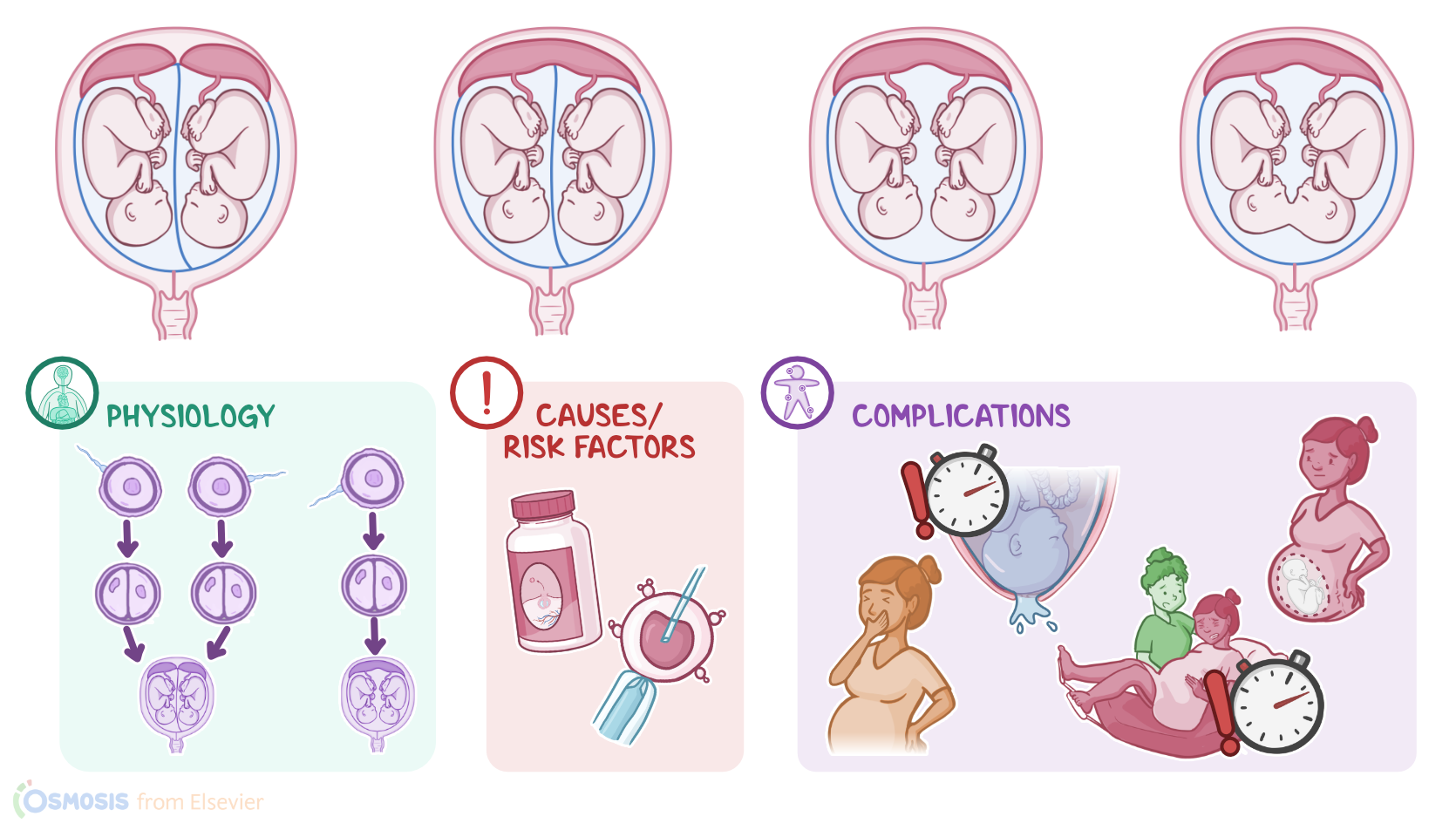
This gives rise to dizygotic twins, also called fraternal or non-identical twins; because the two zygotes develop individually.
Alternatively, multiple gestation can occur when the zygote divides into two separate zygotes shortly after fertilization.
This situation gives rise to monozygotic, also called identical twins. Now, multiple gestation differs between monozygotic and dizygotic twins.
With monozygotic twins, if the division of the zygote in two happens at the morula stage, that means each of the twins will have their own placenta and their own amniotic sac; so they are called dichorionic, diamniotic twins.
Alternatively, if the division happens at the blastocyst stage, there will be only one placenta and two amniotic sacs, so they’re called monochorionic diamniotic twins.
Additionally, if the division happens after implantation, there will be one placenta and one sac for both twins; so they’re called monochorionic monoamniotic twins.
Finally, if the division happens long after implantation, the twins will be physically connected to each other, called conjoined twins.
On the other hand, dizygotic twins implant at different sites in the endometrium and develop separately, each with their own placenta and amniotic sac.
The chances of a multiple gestation occuring are increased when using ovulation stimulation medications, such as clomiphene citrate and follicle stimulating hormone, as well as using assisted reproductive technologies, also known as in-vitro fertilization or IVF for short.
The chances of multiple gestation also increases if there’s a personal or family history of multiple gestations, advanced maternal age, Black race, in addition to high parity, meaning having had five or more pregnancies in the past.Multiple gestation can increase the risk of certain complications, these can be grouped into complications during pregnancy, complications related to delivery, and complications after delivery.
Pathology3:23–4:30
Complications during pregnancy include spontaneous abortion; premature rupture of membranes; preterm labor; anemia; hyperemesis gravidarum, meaning excessive nausea and vomiting; gestational hypertension and preeclampsia; intrauterine growth restriction; congenital anomalies; twin to twin transfusion syndrome, when there is a shared placenta, and one twin gives away more blood than it receives leading to malnourishment and oligohydramnios, which is a reduction in amniotic fluid, while the other twin receives too much blood, develops polyhydramnios or too much amniotic fluid, and can develop cardiac problems; as well as vanishing twin syndrome where there’s loss of one of the embryos.
Complications related to delivery include preterm birth. Finally, the main complications after delivery are postpartum hemorrhage and neonatal complications related to prematurity or growth restriction.
Clients with multiple gestation typically present with a uterus that is larger than expected for the dates of pregnancy.
Clinical manifestations4:30–4:49
Other signs and symptoms include excessive morning sickness, fetal movements that are felt on different parts of the abdomen at the same time, as well as excessive weight gain that is more apparent in the early stages of pregnancy.
The diagnosis of multiple gestation starts with the client’s history and physical assessment, followed by ultrasound. Some laboratory tests can also be useful, like multiple gestation will have higher levels of alpha fetoprotein or AFP, and human chorionic gonadotropin or hCG than single gestation.
Diagnosis4:49–5:09
The treatment of multiple gestation starts with referring the mother to a board-certified obstetrician as well as a perinatologist, which handles high risk pregnancies.
Treatment5:09–5:40
Multiple gestation is also more likely to require cesarean section for delivery, especially when there are more than 2 infants.
Treatment could also include administering tocolytic medications, which can suppress uterine contractions in cases of preterm labor, or corticosteroids to help with fetal lung maturation if preterm delivery is imminent.All right, as a quick recap ….
Review5:40–6:48
Multiple gestation is a pregnancy with two or more fetuses. This can happen when the ovaries release more than one egg, and each of them is fertilized by a different sperm, forming dizygotic twins; or when one fertilized ovum divides after fertilization, forming monozygotic twins.
The chances of a multiple gestation occurring increase when conception occurs following ovulation stimulation medications, such as clomiphene citrate and follicle stimulating hormone; as well as following assisted reproductive technologies.Multiple gestation can increase the risk of certain complications, which include spontaneous abortion, premature rupture of membranes, preterm labor and hyperemesis gravidarum, among others.
Clinical manifestations include a uterus that’s larger than expected for gestational age, as well as excessive morning sickness and fetal movements that are felt on different parts of the abdomen at the same time.
Diagnosis is usually made through ultrasound, and treatment focuses on preventing complications like preterm labor by using tocolytic medications; using corticosteroids for fetal lung maturation when preterm labor is imminent.
| MULTIPLE GESTATION | ||
| KEY POINTS | NOTES | |
| DEFINITION |
| |
| PHYSIOLOGY |
| |
| CAUSES AND RISK FACTORS |
| |
| PATHOPHYSIOLOGY |
| |
| SIGNS AND SYMPTOMS |
| |
| DIAGNOSIS |
| |
| TREATMENT |
| |
No notes for this video yet
Try adding a note below