Peripheral arterial disease (PAD): Nursing process (ADPIE)
Client Report0:00–0:38
Mike Craig is a 68 year old male client who was referred to the vascular clinic by his primary care provider or PCP. Mr.
Craig has a history of type 2 diabetes, hypertension, and dyslipidemia, and he's been experiencing intermittent leg pain in his lower legs while taking walks with his dog.
An ankle brachial index or ABI is performed which confirmed a diagnosis of peripheral artery disease or PAD. Peripheral arterial disease, or PAD for short, is the progressive narrowing of the arteries that supply peripheral tissues and organs, so basically all arteries except for the heart and brain.
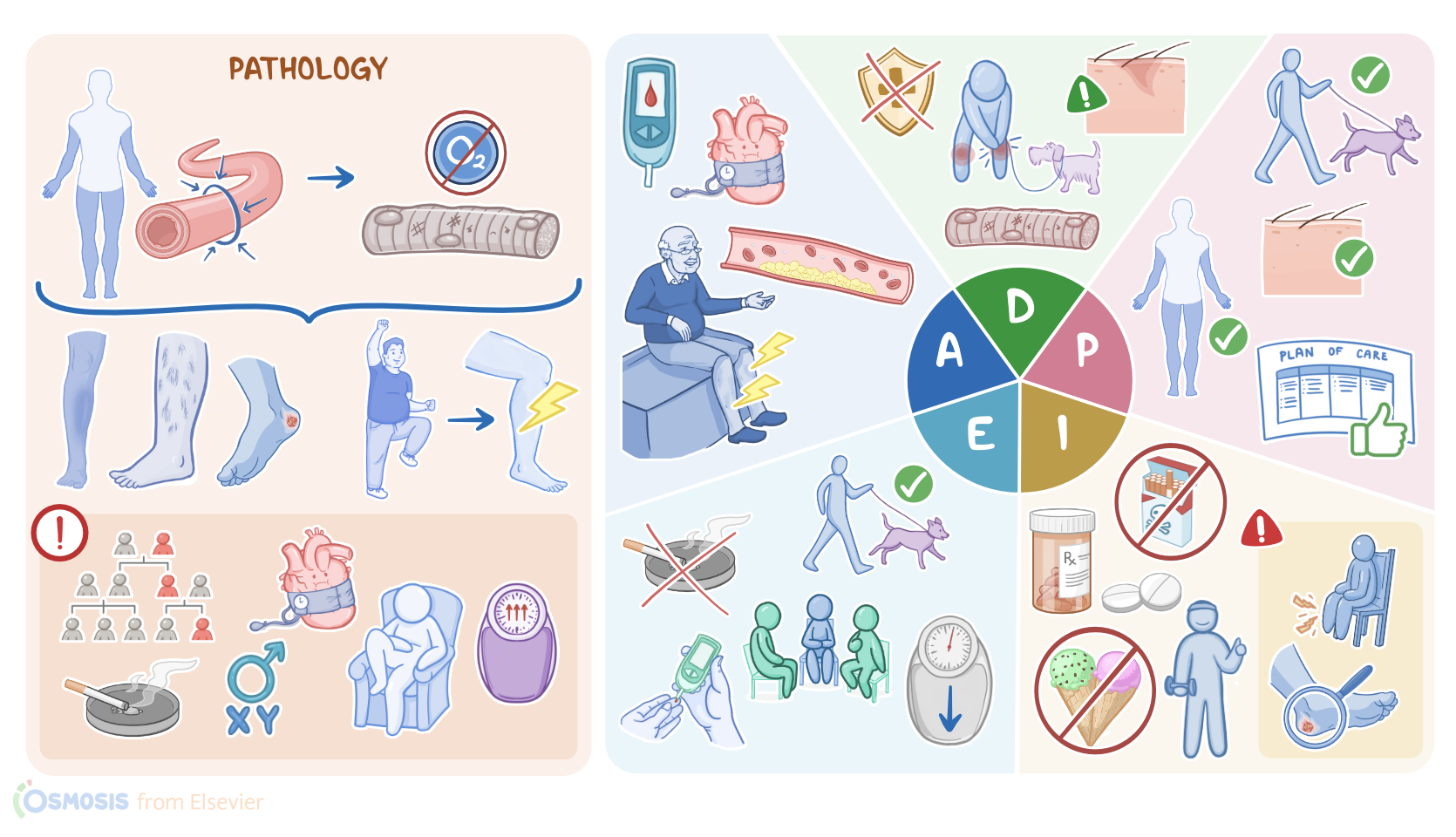
Pathology0:38–7:52
As a result, there is reduced blood supply to these tissues, which ultimately become ischemic. There are some factors that may put an individual at risk for PAD.
Non-modifiable risk factors include increasing age, male sex, and having a family history of PAD. On the other hand, modifiable risk factors include smoking, obesity, and having a sedentary life, as well as predisposing conditions like diabetes, dyslipidemia, and hypertension.
The most common cause of PAD is atherosclerosis, which is a build-up of fatty and fibrous material just under the inner lining of a blood vessel, forming a plaque.
This buildup usually happens over the course of years. Eventually, the lumen of the vessel becomes so narrow that it results in reduced perfusion to the tissue it tends to supply.
PAD can be worsened by an embolism. This happens when an embolus, which is a piece of blood clot or fatty deposit, breaks off from an atherosclerotic plaque from an upstream artery and gets lodged in a narrower peripheral artery blocking its blood flow.
Now, in most cases, PAD affects the arteries supplying the legs. When less blood gets to the muscle tissue in the legs, that tissue becomes ischemic, causing a type of cramping pain that is often referred to as intermittent claudication.
Initially though, when the client's at rest, there's enough blood to meet the tissue's demands, so they'll be asymptomatic.
But if the client starts walking or exercising, then the leg muscles start to work harder and demand more blood, which causes the claudication.
In addition, since the muscles aren't getting enough oxygen from blood, they'll switch from aerobic to anaerobic metabolism and the production of lactic acid, which will build up and contribute to the pain.
This is usually felt in the calves, but can also involve the feet, thighs, hips, or buttocks. Other signs and symptoms of PAD include paresthesia, which is described as tingling or numbness, as well as decreased or absent pulses, cool extremities, and atrophy of the muscles.
In addition, clients may present with hair thinning or loss over the affected skin area, as well as skin color changes, which may become pale or bluish, especially when the leg is elevated, which is called elevation pallor.
As the PAD worsens, clients may start experiencing claudication even at rest. The client often describes this as a continuous burning or pain in the forefoot and toes that gets worse when the legs are elevated and is relieved when they are lowered, like hanging the feet over the bed because gravity is working with the blood flow in this direction.
Likewise, the foot might turn red when it's lowered, which is called the pendent rubar. Ultimately, the reduced blood flow can lead to nerve damage, which results in peripheral neuropathy, where the client loses sensation in the affected tissue.
Diagnosis of PAD relies largely on the client's history and physical examination. A quick and non-invasive test is the ankle brachial index, or ABI for short, where BP is taken in the ankle and in the arm and then compared.
PAD is typically diagnosed if the systolic BP in the ankle divided by the systolic BP in the arm is less than 0.9. In general, claudication often occurs in clients with an ABI between 0.4 and 0.9.
So, for example, in the legs, it would be the iliac arteries. With PAD, the narrowed artery would make a whooshing sound called a bruoy.
Another test that can be done is a Doppler ultrasound, which is a way of visualizing blood flow. Rarely, an angiography might be needed to confirm the diagnosis by using X-rays and a contrast agent to assess the blood flow in the involved arteries.
Treatment of PAD often requires lifestyle changes that address the underlying risk factors. Clients should quit smoking, lose weight, adopt healthy eating habits, and exercise regularly, as well as managing any associated condition like diabetes and hypertension.
Some clients with PAD can also take certain medications to help reduce blood clotting, such as antiplatelet medications like aspirin or clopidogrel.
Clients who fail to respond to these treatments can be treated with revascularization to reestablish arterial blood flow.
OK, it is time to start your nursing assessment. When you enter the room, you find Mister Craig sitting comfortably in a chair.
Assessment7:52–10:41
You note his legs are hairless and ruddy. When asked about his leg pain, he tells you he gets severe aching cramps during walks and that his legs tire quickly.
He says his symptoms improve with rest, but the pain has gotten worse over the past year. He tells you that he smokes one pack of cigarettes each week and does not follow a specific diet, but says he does limit sweets because he has diabetes.
As you review Mr. Craig's medical record, you note his current medications are lisinopril, metformin, aspirin, and atorvastatin.
Next, you help Mister Craig onto the exam table. As he lies down, you notice his legs become pale.
You then palpate 3+ femoral pulses, 2+ popliteal pulses, 1+ posterior tibial pulses bilaterally, and 1+ dorsalis pedis pulses bilaterally.
His feet are cool and capillary refill is more than 3 seconds bilaterally. His toenails are thickened, but no areas of impaired skin integrity is noted.
His vital signs are temporal temperature 98.4 °F or 36.8 °C. Heart rate 78 BPM, respiratory rate 18 breaths per minute.
BP is 152/80 millimeters of mercury, pain is 0 out of 10, and SPO2, 97% on room air. His weight is 205 lbs and height is 5 ft 10 inches.
Looking at his diagnostic tests, you note that his hemoglobin A1C is 9.2%. Total cholesterol, 249 mg per deciliter, triglycerides, 160 mg per deciliter, LDL is 163 mg per deciliter, and HDL is 30 mg per deciliter.
Right ABI is 0.63, and left ABI is 0.58. You document your assessment findings and tell him the physician will be in shortly to see him and go over the results of his ABI.
Your nursing diagnoses include ineffective peripheral tissue perfusion related to vascular dysfunction, activity intolerance related to muscle pain and fatigue while walking, risk for impaired skin integrity related to insufficient perfusion to lower extremities, and ineffective health maintenance related to disease progression.
Diagnosis10:41–11:07
Planning11:07–11:40
Next, you collaborate with Mr. Craig and the interdisciplinary team to plan desired outcomes for Mr.
Craig's treatment. At his follow-up appointment in 6 months, he will report that he's able to take walks with his dog without pain.
He will have adequate tissue profusion and maintain intact skin on his lower extremities, and before leaving the clinic today, he will commit to lifestyle modifications and adherence to his treatment plan.
OK, now you are ready to implement the plan of care. First, you go over his medication list.
Implementation11:40–13:08
His physician has prescribed the phosphodiesterase inhibitor, Celestazol to help reduce his pain while walking, and the dose of lisinopril is increased to control his BP better.
In addition, he will continue to take aspirin, atorvastatin, and metformin as previously prescribed. Next, you explain how quitting smoking, keeping his blood glucose, BP, and cholesterol under control are important to help prevent the build-up of plaque in his arteries and will keep his symptoms from getting worse.
You review recommendations for regular exercise, and you stress the need to follow a diabetic diet. Next, you make an appointment with a diabetic educator to create an individualized plan to help manage his diabetes, and you refer him to a smoking cessation support group.
Finally, you teach him to check his lower extremities and feet each day for signs of skin breakdown, sores, or ulcers. And you advise him to call his physician right away if he notices a developing sore, if his leg pain worsens, or he develops pain at rest.
Then you make an appointment for his next visit in 6 months. 6 months later, Mr.
Evaluation13:08–14:42
Craig returns for his follow-up visit. He's excited to tell you he's able to take his dog on daily walks around the block without pain or fatigue.
He tells you he has been taking his medication as directed. And he says the structured exercise and nutritional guidance provided by the diabetic educator has helped him lose some weight, and he is now checking his glucose levels regularly.
He also proudly tells you he has been attending the smoking cessation support group, and he has not smoked in 3 months. Next, you review his laboratory results.
Great news. His hemoglobin A1C is now 8.4%.
Total cholesterol, 177 mg per deciliter, triglycerides, 99 mg per deciliter, LDL 95 mg per deciliter, and HDL 62 mg per deciliter.
His BP is 126/72 millimeters of mercury, and an assessment of his lower extremities and feet reveals intact skin. You encourage Mister Craig to keep up the good work, and that all his effort is making a tremendous difference.
Lastly, you make an appointment for his next visit and document your findings in his medical record. All right, as a quick recap, you have been caring for Mister Craig, who was referred to the vascular clinic for claudication.
Summary14:42–15:39
He was diagnosed with PAD, which is a progressive narrowing of the arteries that decreases the blood supply to the peripheral tissues resulting in ischemia.
Your nursing assessment reveals signs of decreased perfusion to his lower extremities and the need for improved management of his comorbidities.
Your nursing diagnoses include activity intolerance, risk for impaired skin integrity, and ineffective health maintenance.
You plan goals focused on preventing disease progression. Together with the interdisciplinary team, you implement and evaluate his response to treatment and adapt the plan of care as needed to promote his optimal health.
| PERIPHERAL ARTERIAL DISEASE (PAD) | ||
| KEY POINTS | NOTES | |
| PATIENT REPORT |
| |
| PATHOPHYSIOLOGY |
| |
| DIAGNOSIS AND TREATMENT |
| |
| ASSESSMENT |
| |
| NURSING DIAGNOSES |
| |
| PLANNING |
| |
| IMPLEMENTATION |
| |
| EVALUATION |
| |
- "Epidemiology and Risk of Amputation in Patients with Diabetes Mellitus and Peripheral Artery Disease" Arterioscler Thromb Vasc Biol (2020)
- "Evidence-Based Medical Management of Peripheral Artery Disease" Arterioscler Thromb Vasc Biol (2020)
- "Lower Extremity Peripheral Artery Disease: Contemporary Epidemiology, Management Gaps, and Future Directions: A Scientific Statement from the American Heart Association" Circulation (2021)
- "Antithrombotic Treatment for Peripheral Arterial Occlusive Disease" Dtsch Arztebl Int (2021)
- "Harrison’s Principles of Internal Medicine, 21st edition" McGraw Hill / Medical (2022)
- "Critical Care Nursing: Diagnosis and Management, 9th edition" Elsevier (2021)
- "Health Assessment for Nursing Practice, 7th edition" Elsevier (2021)
No notes for this video yet
Try adding a note below