Physiology of pain: Nursing
Introduction0:00–0:22
Pain is an unpleasant physical or emotional experience that occurs in response to actual or potential tissue damage. Depending on the cause and duration.
Pain can cause suffering and decreased quality of life. As a symptom, pain is one of the most common reasons that bring clients to healthcare facilities.
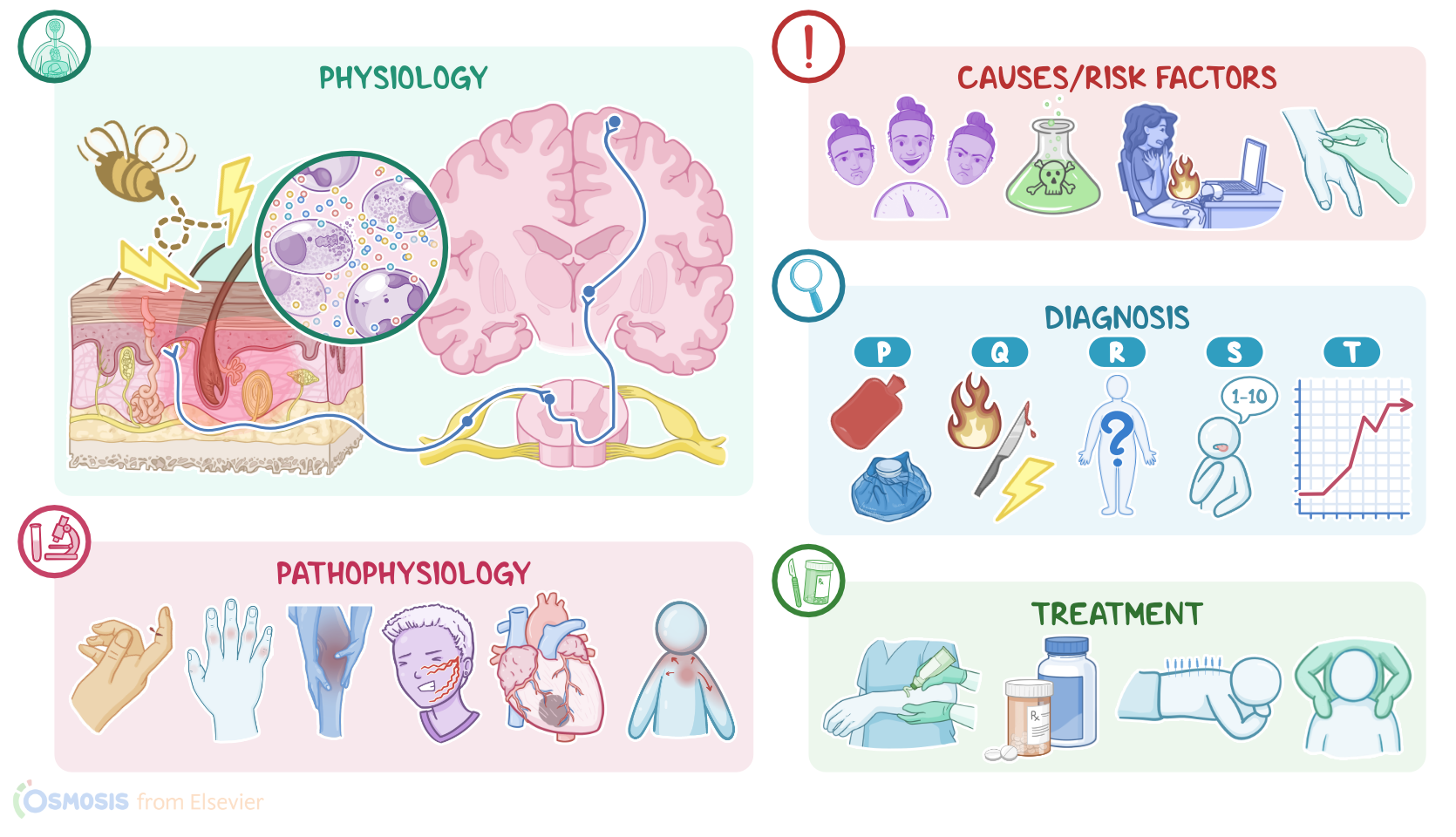
First, let's look at the 4 main mechanisms involved in the physiology of pain, which are transduction, transmission, perception, and modulation.
Normal physiology0:22–3:39
Transduction is the process through which a pain-inflicted stimulus is converted into a biological signal. This stimulus can be mechanical like pinching someone, chemical like a strong acid causing chemical damage to the skin, or thermal like spilling hot coffee on your lap.
Now these situations cause the damaged tissue and in the case of inflammation, nearby immune cells to release molecules that can trigger pain like serotonin, histamine, prostaglandins, bradykinin, and substance P.
These will activate special pain receptor cells called nociceptors and cause them to fire off an action potential. Think of this as a message that tissue injury has occurred.
Now after the action potential has been generated, the second step begins, which is transmission of the action potential from the site of injury to the cortex of the brain.
The nociceptors are 1st order neurons, and they relay the action potential to the dorsal horn of the spinal cord, where they synapse with the 2nd order neuron.
The 2nd order neuron carries the message up to the brain stem and thalamus, where they synapse with a 3rd order neuron. The 3rd order neuron is responsible for carrying the message to the cortex for processing.
Once the message reaches the cortex, specifically the somatosensory cortex, the next step called perception begins. This is where you consciously perceive pain and its characteristics like location, intensity, and what makes the pain better or worse.
Different regions of the somatosensory cortex. Correspond to different parts of the body, and those parts with more nociceptors like the face and hands take up a larger portion of the cortex, so you end up with a sensory homunculus mapped onto the somatosensory cortex.
Additionally, during pain perception, an emotional response is triggered, and this is often a negative emotion like anger or fear.
This is helpful since it leads to an immediate behavioral response where you move away from the stimuli that's causing the pain, for example, moving away from the person pinching you or wiping the hot coffee off your leg.
And finally, pain modulation refers to how the pain signal is altered along the nervous pathways thanks to the descending modulatory fibers that travel from the brain down to the spinal cord.
These can be stimulatory or inhibitory, depending on whether they release chemical signals that enhance the perception of pain or diminish it.
This allows factors like emotion to have a modulatory effect on pain. So for example, even though childbirth is an extremely painful event, in some cases, the pain is perceived as less intense because the birth giver feels that having a baby is positive and desired.
OK, now pathology wise, pain can be classified by its duration, such as acute and chronic pain, as well as by its type, into nociceptive, neuropathic, ischemic, and referred pain.
Acute pain has a sudden onset and is time limited, typically resolving within 3 months. This can be trauma like cutting your finger, a disease like kidney stones, an infection like a dental abscess, or acute ischemia like a heart attack.
Pathophysiology3:39–8:36
Symptoms of acute pain include manifestations of sympathetic nervous system stimulation like tachycardia, increased BP, sweating, or dilated pupils.
Acute pain is also typically well localized, and clients can usually pinpoint its location. Acute pain is unpleasant but useful because it can warn the person about potential or actual tissue damage.
Chronic pain, on the other hand, has a more gradual onset and is mainly caused by long-term or chronic disorders such as endometriosis, rheumatoid arthritis, or Crohn's disease, to name a few, and the pain lasts more than 6 months.
Chronic pain usually doesn't result in symptoms of sympathetic nervous system stimulation because it eventually becomes desensitized to the input from no susceptors.
Chronic pain can negatively impact the function of the affected tissue as well as the client's long-term psychological well-being and quality of life.
Next, let's look at the various types of pain. No susceptive pain focuses on what kind of tissue is damaged, and this can be either somatic or visceral.
Somatic pain typically comes from skin, bones, joints, and connective tissue. It usually has a throbbing or aching quality, and it's well localized, meaning a person can often pinpoint where the pain is coming from.
Common examples of somatic pain include pain from an arthritic knee or toothache. Visceral pain comes from organs like those in the gastrointestinal tract and can result from inflammation, ischemia, stretching, or occlusion.
Like with hepatitis, there's liver inflammation which makes the liver swell and distend the tissues surrounding it, and these respond by eliciting a pain signal.
In contrast to somatic pain, visceral pain is often diffuse and not well localized. There's also neuropathic pain which is caused by the damage or dysfunction of the somatosensory nervous system, and there's no actual stimulation of pain receptors.
Examples of neuropathic pain include diabetic neuropathy and trigeminal neuralgia, as well as nerve injury from surgery, trauma, tumor growth, and chemotherapy.
Neuropathic pain can be described as shooting, burning, stabbing, electric shock, numbness, and a pins and needles sensation.
Next, ischemic pain is caused by loss of blood flow to tissues. This is because when blood flow to tissues is reduced or completely lost, the tissue experiences hypoxia, which causes a release of inflammatory chemical mediators, including those that produce pain.
Symptoms produced by ischemic pain can be described as burning or aching, as with peripheral artery disease, while pain caused by occlusion of coronary arteries during a heart attack can also have a pressing quality.
Finally, referred pain is a type of pain that is felt in an area of the body different from the site where the pain originates.
This can happen because the area where the pain is referred to is supplied by the same spinal segment as the site of the pain.
For example, in addition to ischemic pain which is felt in the chest during a heart attack, it often radiates to the left shoulder and arm.
Now, response to pain is highly individual and unique, so different people can describe the pain differently. But any kind of uncontrolled pain can lead to a negative physiological, financial, psychological, and quality of life impact.
For example, prolonged pain can also affect the immune response, making a person more susceptible to infections. Additionally, pain can also cause immobility and delayed healing.
In hospitalized patients, prolonged pain can increase their length of stay, which increases the cost of hospitalization and decreases the client's income and productivity.
Finally, prolonged pain can interfere with family, work, and social life and interfere with activities of daily living, all of which can decrease the client's quality of life and have serious mental health consequences like hopelessness, fear, anger, anxiety, and depression.
OK, now diagnosis of pain starts with an assessment of the client's pain using a tool like OPQRST. O is for onset or how the pain begins or develops over time.
If it was sudden, gradual, or if it's related to an ongoing chronic problem. P is for provoking or palliating factors which can be determined by asking the client what makes the pain better or worse.
Q is for quality, which is how the pain feels in the client's own words. R is for region or radiation.
This is assessed by asking the client to point to where the pain is located and tell you whether it spreads to other areas of the body.
Diagnosis8:36–10:20
S is for severity or intensity, which is assessed using a pain rating scale such as rating pain on a scale from 0 to 10 with 0 being no pain and 10 being the worst pain ever.
Finally, T is for timing, which is assessed by asking if pain is better, worse, or the same as when it first started. Now there are a number of pain scales that can be used to assess the severity of the pain.
These scales can be numeric, and these are typically adequate for most adults, verbal or descriptive for those who prefer to use words, as well as picture-based or behavioral scales for children and clients who cannot verbally describe their pain.
Examples of pain scales include the Wong Baker Faces scale, which is useful for children and clients with cognitive or language barriers.
And the Flax scale, which can be used by nonverbal and preverbal clients. Once the pain is assessed, the next step is finding out what's causing the pain, which typically starts with the client's history and physical assessment.
Additional investigations like blood work or imaging tests can be done to identify the cause of the pain. Treatment of pain relies on both pharmacological and non-pharmacological options.
In the first category, common medications include non-opioid analgesics such as NSAIDs, acetaminophen, and aspirin, or opioid analgesics like codeine, hydromorphone, and morphine.
Some tricyclic antidepressants, selective serotonin reuptake inhibitors, and anti-epileptics can be used for pain management.
Other interventions can include topical analgesics and nerve blocks. Non-pharmacological treatment options include cutaneous stimulation like heat and cold application, pressure, vibration, therapeutic touch and massage, as well as music and art therapy and acupuncture.
Treatment10:20–11:15
A combination of non-pharmacological and pharmacological interventions can be used in order to improve pain control. All right, as a quick recap, the process of experiencing pain starts when a painful stimulus is transduced into a biological signal by a receptor cell called a nociceptor.
This is then transmitted up the spinal cord to the brain and is perceived consciously once it reaches the somatosensory cortex.
Along the way, there are modulatory fibers that can either diminish or enhance pain. Pain can be categorized in several ways.
Acute pain has a sudden onset and is time limited, typically resolving within 3 months, while chronic pain typically has a more gradual onset and lasts more than 6 months.
Review11:15–12:27
Next, no susceptive pain can be somatic, which occurs when there's tissue damage to the skin, bones, joints, and connective tissue, or visceral, when there's tissue damage to internal organs.
Neuropathic pain is caused by damage or dysfunction of the somatosensory nervous system itself. Ischemic pain occurs when there's tissue damage due to insufficient oxygen supply, and referred pain is when the pain is felt in a different location than where the tissue damage occurs.
When assessing pain, there are many useful tools like OPQRST that help you remember the key findings. O is for onset, P is for provoking or palliating factors.
Q is for quality. R is for region or radiation.
S is for severity and T is for timing. Treatment for pain includes pharmacological options like NSAID and opioids and non-pharmacological options like heat and cold applications and massages.
Both options are often used together to reduce pain.
| PHYSIOLOGY OF PAIN | ||
| KEY POINTS | NOTES | |
| DEFINITION |
| |
| PHYSIOLOGY |
| |
| PATHOPHYSIOLOGY |
| |
| DIAGNOSIS |
| |
| TREATMENT |
| |
No notes for this video yet
Try adding a note below