Raynaud phenomenon: Nursing
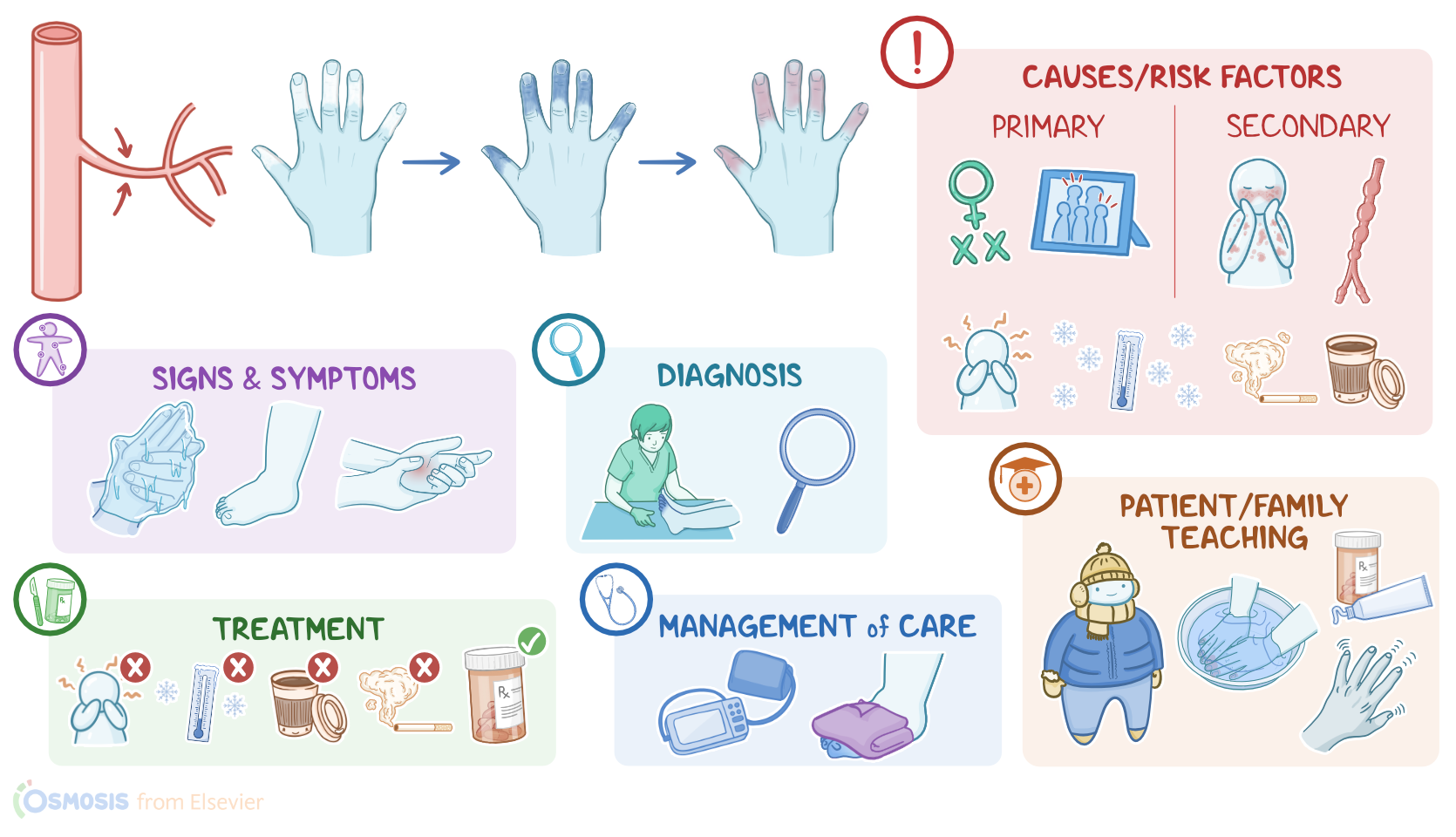
Raynaud phenomenon is a peripheral vascular condition characterized by vasoconstriction of arterioles near the skin, most often of the fingers and toes, which makes them turn white, then blue, and then red.Okay, now let’s quickly review some anatomy and physiology.
Normally, blood flows from large arteries into medium and then small arteries called arterioles, which in turn carry the blood to capillary beds.
All arterial vessels have three layers: from inside out, there’s the endothelium; then the media layer, which contains smooth muscle; and finally the adventitia layer, which has loose connective tissue, as well as vasa vasorum or vessels that supply the artery, and nervi vasorum or nerves that innervate the artery and help regulate vasoconstriction via contraction of the smooth muscle in the media layer.
Now, some nerves in the skin function as thermoreceptors, which sense changes in temperature and then send signals up through the spinal cord to the hypothalamus, which is at the base of the brain.
The hypothalamus serves as the body’s thermostat and coordinates the body’s response to temperature changes through the sympathetic and parasympathetic nervous systems.
Normally, there’s a lot of heat energy in the blood that gets lost from skin to the environment. So, when the hypothalamus gets the signal that we’re cold, it stimulates the sympathetic nervous system, which in turn signals the nervi vasorum to trigger vasoconstriction in certain body areas, such as the skin, resulting in a reduction of blood flow.
That shunts blood away from the skin and towards the body’s core or organs, where less heat energy is lost. On the other hand, when we’re hot, the hypothalamus stimulates the parasympathetic nervous system, which ultimately leads to vasodilation in skin to dissipate the heat.Now, Raynaud phenomenon is caused by abnormal and exaggerated vasoconstriction in skin.
When this occurs alone and is not associated with any other disease, it’s called primary Raynaud phenomenon or Raynaud disease.
Risk factors for primary Raynaud phenomenon include family history, clients assigned female at birth, pregnancy, cigarette smoking, as well as manual occupations that require lots of vibration, like using a jackhammer, or exposure to cold environments or heavy metals, like lead.
On the other hand, when there is an associated disease, it’s called secondary Raynaud phenomenon or Raynaud syndrome. This is often associated with autoimmune diseases, such as systemic lupus erythematosus, Sjögren's syndrome, or scleroderma; as well as vasculitides like Buerger’s disease, Takayasu’s arteritis, or cryoglobulinemia.Regardless of the type, the most common triggers are emotional stress and exposure to cold temperatures, but other potential triggers include nicotine and caffeine, as well as medications that affect the sympathetic nervous system like pseudoephedrine.Now when someone susceptible to Raynaud phenomenon experiences a trigger, it causes the nervi vasorum in the walls of arterioles to get overstimulated by the sympathetic nervous system, leading to exaggerated vasoconstriction that dramatically decreases blood flow to the skin.
If the vasoconstriction happens briefly or intermittently, it’s called a vasospasm. Initially, this vasospasm causes ischemia, or decreased blood supply.
This is followed by hypoxia, which is the low oxygen state of a tissue that occurs after prolonged ischemia. Finally, once the vasospasm ends, there's reactive hyperemia, where oxygenated blood is able to rush back into the skin.Most often, clients experience Raynaud phenomenon in their fingers and toes, but it can also occur in other areas, such as the skin of the face, lips, nose, or ears.
In addition, clients may present with coldness, numbness, tingling, and throbbing, aching pain, followed by swelling once blood returns.
Now, there are a few important differences between the primary and secondary Raynaud phenomenon. Primary Raynaud phenomenon usually affects the fingers and toes symmetrically, and the arterioles themselves typically remain undamaged, so the severity stays roughly constant over time.
In contrast, secondary Raynaud phenomenon usually affects fingers and toes asymmetrically, and there’s often underlying damage to the arterioles, resulting in progressive severity over time.
If the condition gets severe enough, it can even result in ischemic tissue damage. As a result, clients that have frequent, prolonged attacks may develop skin thickening and brittle nails, while severe cases may result in necrosis, leading to skin ulceration or even gangrene.The diagnosis of Raynaud phenomenon is usually based on history and physical assessment, followed by exploring for a possible trigger or associated disease.
In addition, nailfold capillary microscopy can be done to see whether finger capillaries are normal in appearance, which would be consistent with primary Raynaud phenomenon, or if they’re damaged, which would be consistent with secondary Raynaud phenomenon.
Regular monitoring for development of autoimmune diseases is also recommended.When treating a client with Raynaud phenomenon, the goals are to improve quality of life and to prevent ischemic tissue damage.
Initial treatment is typically focused on avoiding triggers. If this is not enough, the client can be given medications that help induce vasodilation, such as calcium channel blockers, phosphodiesterase-5 inhibitors, or topical nitrates.
Severe refractory cases may need a sympathectomy, where surgery is performed to cut the sympathetic nerve fibers supplying the affected areas.
Finally, necrotic areas may require surgical debridement or even amputation.Now, let’s talk about nursing care for a client with Raynaud phenomenon.
The priority goals of nursing care are to increase perfusion to the affected extremities, prevent tissue loss, manage pain, and improve the client’s quality of life.
First, assess your client’s extremities for adequate circulation by palpating their peripheral pulses, as well as making note of any color or temperature changes, swelling, or a client report of numbness, tingling, or reduced sensation.
Also, assess your client’s face, lips, nose, or ears for any circulatory changes, as well as their blood pressure. Then, apply a warm compress to the affected area, and be prepared to administer prescribed medications to help induce vasodilation.
Now, if the vasospasm persists despite treatment, or if you notice signs of ulcer formation or gangrene, be sure to report these findings to the healthcare provider.
Next, perform a pain assessment, asking about the onset, quality, severity, location, aggravating or relieving factors, as well as frequency.
Administer any prescribed analgesics, and monitor your client for a reduction in their pain level. Alright, let’s move on to client and family teaching.
Review with your client some strategies to help prevent vasoconstriction in the extremities, such as avoiding being out in cold and damp environments.
If they need to be outside in the cold, advise them to dress warmly by layering clothing and wearing warm socks, a hat, and either gloves or mittens.
Also remind them to try to avoid emotional stress. If needed, counsel them on smoking cessation and provide resources to help them quit smoking.
Also, encourage your client to avoid consuming caffeine. Lastly, instruct them that during an acute attack, they should induce vasodilation by either placing their hands under their armpits, applying warm compresses, or immersing their hands in warm water; remind them to avoid hot water in order to prevent heat-related tissue damage.
In addition, let them know that increasing circulation by wiggling their fingers or toes may also help, as well as rotating their arms in a windmill pattern.
Lastly, teach them how to safely self-administer any prescribed medications.Alright, as a quick recap… Raynaud phenomenon is a condition characterized by vasoconstriction of arterioles near the skin, most often in the fingers and toes.
Raynaud phenomenon can be classified as primary or secondary. Primary Raynaud phenomenon is when there is no associated disease, and risk factors include family history, being assigned female at birth, pregnancy, smoking, and exposure to cold environments or heavy metals.
Secondary Raynaud phenomenon is when there is an associated disease, such as systemic lupus erythematosus or Buerger’s disease.
For both primary and secondary Raynaud phenomenon, triggers such as cold environment and emotional stress cause the sympathetic nervous system to overstimulate the walls of the arterioles, causing exaggerated vasoconstriction.
As a result, clients can experience symptoms like numbness, tingling, and pain; as well as skin color changes, including blanching and pallor due to ischemia, followed by cyanosis due to hypoxia, and then reactive hyperemia when oxygenated blood is able to rush back into the skin.
Treatment is focused on avoiding triggers; if needed, vasodilating medications such as calcium channel blockers, sildenafil, and topical nitrates may be given.
Nursing care focuses on increasing perfusion to the affected extremities, preventing tissue loss, managing pain, and improving the client’s quality of life.
Client and family education involves teaching strategies to help prevent vasoconstriction, as well as self-administration of any prescribed medications.
may be given nursing care focuses on increasing perfusion to the effect of extremities preventing tissue, lost managing pain and improving the clients quality of life, client and family education, involves teaching strategies to help prevent vasoconstriction as well as self administration of any prescribed medications.
| RAYNAUD PHENOMENON | ||
| KEY POINTS | NOTES | |
| DEFINITION |
| |
| PHYSIOLOGY |
| |
| CAUSES AND RISK FACTORS |
| |
| PATHOPHYSIOLOGY |
| |
| SIGNS AND SYMPTOMS |
| |
| DIAGNOSIS |
| |
| TREATMENT |
| |
| MANAGEMENT OF CARE |
| |
| PATIENT AND FAMILY TEACHING |
| |
No notes for this video yet
Try adding a note below