Definitions & Key takeaways

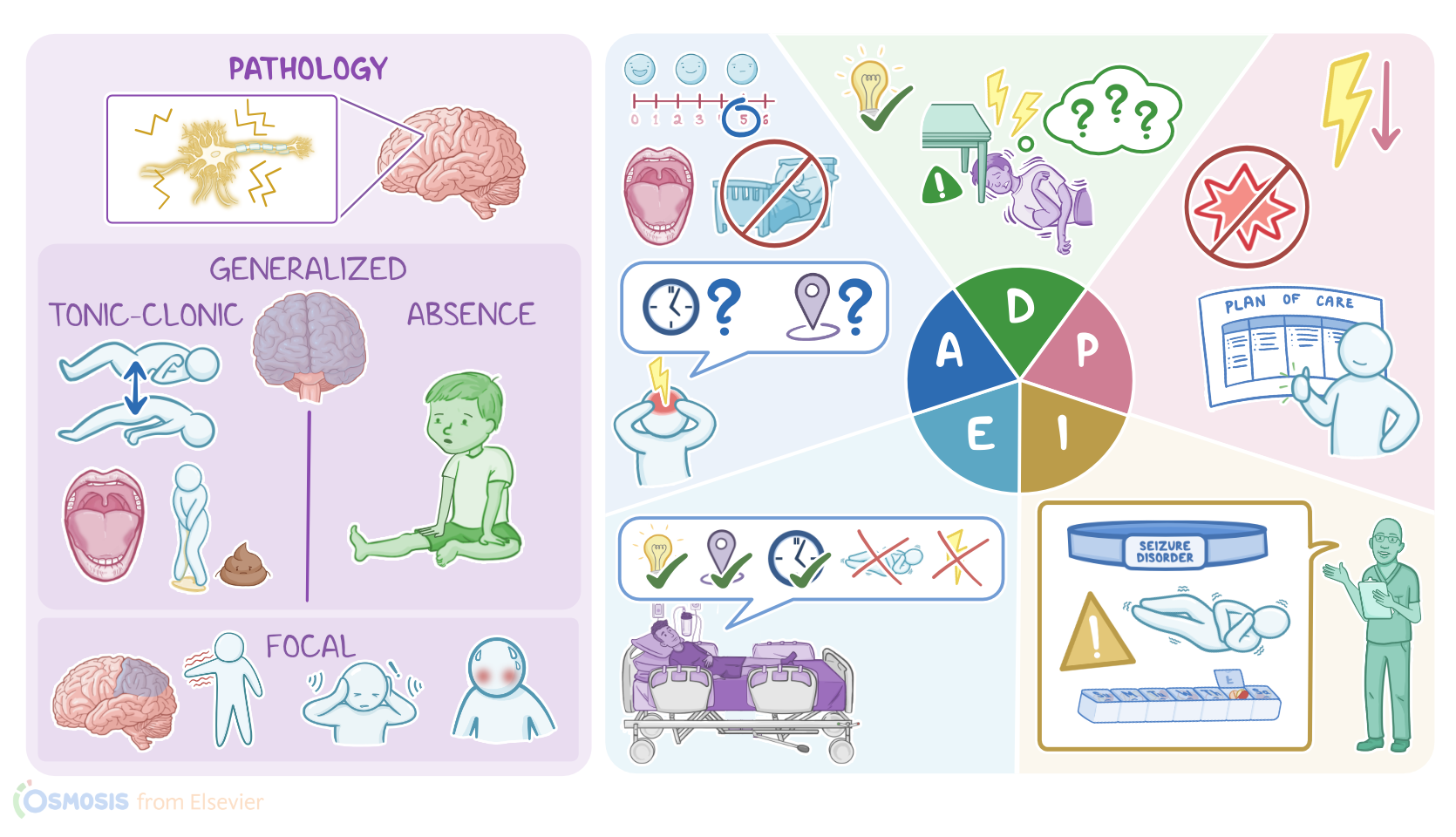
Seizure disorders may be due to epilepsy, which is a neurological condition characterized by recurrent convulsions that occur due to excessive electrical activity in the brain. Seizures can take many forms, with the most common being generalized tonic-clonic and absence seizures.

In generalized tonic-clonic seizures, people experience a tonic phase, where the muscles suddenly tense up, followed by the clonic phase, where muscles rapidly contract and relax. In absence of seizures which usually occur in children, there is a sudden, brief loss of consciousness without any change in the muscle tone.

The exact cause of epilepsy is often unknown, but it can be due to genetics, brain injury, infections, or developmental disorders, among other causes. The management of seizures involves anti-seizure medications like carbamazepine, phenytoin, and levetiracetam and supportive management.

Chapters:

Client Report0:00–0:35

Francisco Bernard is an 18-year-old male client who was brought to the emergency department, or ED, after his father witnessed him suddenly go rigid, lose consciousness, and fall to the floor.
His arms and legs immediately began to jerk rapidly, then slow and eventually stop. Afterwards, Francisco was confused and lethargic with no memory of what happened.Upon arrival in the ED Francisco was awake but disoriented.
He was transferred to the neurological unit where he was diagnosed with epilepsy. A seizure is a sudden event that occurs due to abnormal, excessive, and synchronous firing from neurons in the brain.

Pathology0:35–6:30

This manifests as a change in the client's level of consciousness, body movements, sensation, or autonomic functions, that usually last for a few seconds or minutes.
Seizures can be triggered by stress, tiredness, and lack of sleep. High fever, especially in young children, as well as infections like meningitis, encephalitis, or brain abscess, can also result in seizures.
Also, withdrawal of certain substances like alcohol, cocaine, benzodiazepines and barbiturates may cause seizures. During pregnancy, seizures can be provoked by eclampsia, which occurs in the setting of high blood pressure.
Now, epilepsy is when a client has two or more seizures separated by at least 24 hours. A very important risk factor for epilepsy is family history.
Epilepsy can also be caused by brain damage due to traumatic brain injury or stroke, as well as brain tumors. Other causes include congenital diseases like Sturge-Weber Syndrome, metabolic disorders like phenylketonuria, as well as neurodegenerative diseases such as Alzheimer’s disease.
In many cases, however, the cause of epilepsy is unknown.Right before having a seizure, clients may experience neurological symptoms called auras, which present with subtle muscle movements called automatisms, such as chewing, lip smacking, or rapid blinking.
Some clients may also report smelling unusual odors like kerosene, a rising sensation in the abdomen, an unusual taste, or even feelings of fear or déjà vu.Once the seizure begins, its symptoms depend on the part of the brain involved.
So, seizures are classified into two types: generalized and focal. Generalized seizures arise from both cerebral hemispheres at the same time, and almost always cause a sudden impairment of consciousness, along with motor symptoms that involve the whole body.
The most common subtypes are generalized tonic-clonic and absence seizures. In generalized tonic-clonic seizures, clients experience a tonic phase, where the muscles suddenly tense up, followed by the clonic phase, where muscles rapidly contract and relax.
Contraction of the jaw muscles may cause the client to bite on their tongue. Clients with tonic-clonic seizures may also develop urinary or fecal incontinence.
On the other hand, absence seizures usually occur in children, and they’re characterized by a sudden, brief loss of consciousness without any change in the muscle tone.
So, they could be sitting on their bed or talking to someone and suddenly “space out” or stare blankly into space for a few seconds.
Now, in contrast, focal or partial seizures arise from a specific area in one cerebral hemisphere, leading to symptoms that only involve part of the body.
Most often, focal seizures present with motor symptoms, as well as sensory symptoms like a burning or tingling sensation, or hearing or tasting something, and autonomic symptoms like sweating and flushing.
In addition, some clients with focal seizures may lose consciousness. Seizures may be followed by a postictal phase, during which the client’s consciousness is still impaired for minutes to hours, so they may seem sluggish and tired or even hard to wake up.Another phenomenon that can occur is Todd’s paralysis, which describes a temporary paralysis of the affected extremity.
Now, seizures may put the client at risk for physical injuries, such as head trauma, tongue bites, bone fractures, lacerations, and bruises.These clients are also more likely to develop psychiatric disorders such as depression and anxiety.
In addition, clients with epilepsy are often at higher risk of death, which could be due to trauma, suicide, or status epilepticus, which is a seizure that lasts longer than 5 minutes, resulting in permenant brain damage.
Some clients may experience sudden unexpected death in epilepsy, or SUDEP for short, which is when death occurs suddenly, unexpectedly, and for unknown reasons, even in a protected environment like a hospital.Okay, to diagnose epilepsy, the first step involves taking history and physical examination.
Information such as details about the nature of the seizure activity like when the seizure occurred, how long it lasted, what body parts were affected and any events that preceded the seizure.
A brain CT scan or MRI can be done to rule out brain tumors, while an electroencephalogram, or EEG, can be done by placing electrodes on the scalp to monitor the brain’s activity.
In addition, laboratory testing like a complete blood count, or CBC, is done to look for an underlying infection, electrolytes and liver function tests to identify any metabolic abnormalities, as well as toxicology screens to look for substances that could provoke seizures.
Additional tests can be performed based on suspicion, like a lumbar puncture if meningitis is suspected. Finally, if the client is currently on anti-seizure medications, the serum level of these medications should be measured to determine if it's within the therapeutic range.Now, it’s important to ensure that clients with epilepsy are in a safe and protected environment to prevent life-threatening injuries, so these clients are advised to avoid certain activities when they are alone like heights, swimming, and driving a vehicle alone.
Next, the client should be started on anti-seizure medications. For focal seizures, choices include carbamazepine, phenytoin and levetiracetam, while for generalized tonic-clonic seizure, valproic acid can be used, and for absence seizures, ethosuximide is usually the drug of choice.
Keep in mind that certain medications are contraindicated during pregnancy, such as valproic acid and carbamazepine. For these clients, the prefered anti-seizure medication is usually lamotrigine.As you enter the room, you begin your assessment by greeting Francisco, Mr.

Assessment6:30–8:02

Bernard and the transferring nurse, who informs you that upon arrival to his room, Francisco experienced another tonic-clonic seizure that lasted for 45 seconds.
Seizure precautions have been initiated which include placing the bed in the lowest position with the side rails padded, and setting up suction and oxygen equipment.
As Francisco starts to regain consciousness, he is alert and oriented to person, but disoriented to place, time, and situation.
He tells you he has a headache. You continue your assessment by taking his vital signs which are temperature 98.4 F or 36.9 C, heart rate 70 beats per minute and regular, respiratory rate 24 breaths per minute with clear lung sounds bilaterally, blood pressure 118/68 mmHg, SpO2 94% on room air, and his headache pain is rated 5/10.
You apply a nasal cannula and administer oxygen at 2 liters per minute. Upon further assessment, you notice a soft tissue laceration on his tongue.
Mr. Bernard tells you that Francisco hasn’t been sleeping well lately and is experiencing a lot of stress related to exams and college applications.
He goes on to say that both Francisco’s mother and aunt take medications for seizures. You check his recent diagnostic test results and note the results of the CT, EEG, CBC are normal, and the toxicology report is negative.Now you establish your nursing diagnoses for Francisco, which include risk for injury related to altered cognitive and motor function; acute confusion related to interrupted brain function; pain related to post-seizure effects; and readiness for enhanced knowledge related to new health maintenance regimen.Next, you collaborate with Francisco and the neurologist to develop goals for the plan of care.

Diagnosis8:02–8:20

Before discharge, Francisco’s seizure activity will be controlled, and he will be free from seizure-related injury, confusion and pain; he will demonstrate acceptance of his new diagnosis and verbalize his understanding of how to manage his condition.

Planning8:20–8:40

Now you are ready to implement the plan of care. First, you administer the ordered anticonvulsant valproic acid and the analgesic acetaminophen.
When Francisco is awake and alert, you teach him and Mr. Bernard about his new medication and possible side effects, and you explain the importance of taking his medication as directed.

Implementation8:40–9:27

Next, you discuss factors that could increase the risk of a seizure occurring, seizure warning signs, and you review what to do if a seizure occurs.
You stress the importance of wearing medical alert identification that will inform emergency care personnel about his condition.
During your shift, you continue to monitor Francisco for any changes to his status that require immediate notification of the neurologist, such as an altered level of consciousness or the occurrence of another seizure.The next day you are assigned to care for Francisco again, so you evaluate how he is doing so far.
Francisco had a good night of sleep and he is alert and oriented to person, place, time, and situation. He’s been seizure free and hasn't sustained any injuries.

Evaluation9:27–10:19

His pain rating is currently 0/10. His vital signs are temperature 98.9 F or 37.2 C, heart rate 68 beats per minute and regular, respiratory rate 18 breaths per minute with clear lung sounds bilaterally, blood pressure 120/70 mmHg, SpO2 98% on room air.
He tells you he’s been learning more about epilepsy and he understands how to manage his condition. Throughout your shift you evaluate the effectiveness of your interventions and adjust Francisco’s plan of care as needed.Alright, as a quick recap … Your client, Francisco, is an 18-year-old male who presented to the ED after experiencing a tonic-clonic seizure.
He was transferred to the neurological unit, where you assessed that he was stable but disorientated. Your nursing diagnoses included risk for injury; confusion; pain; and readiness for enhanced knowledge.

Summary10:19–11:01

The goals you planned were that he would be free from seizure-related injury, confusion, and pain, and that he would have the knowledge needed to manage his new diagnosis.
Along with the health care team, you work to implement interventions to achieve the goals of the plan of care. Throughout your shift you will continue to evaluate and revise your plan of care as needed.
the healthcare team. You work to implement interventions to achieve the goals of the plan of care throughout your shift.
You will continue to evaluate and revise your plan