Sickle cell disease: Nursing process (ADPIE)

1,665views

Sickle cell disease: Nursing process (ADPIE)

Acute Final

Acute Final

Endocrine system anatomy and physiology
Antepartum assessment - Fetus: Nursing
Assessment of gestational age: Nursing
Fetal circulation: Nursing
Fetal development: Nursing
Group B streptococcus (GBS) infection in pregnancy: Nursing
Hepatitis B virus (HBV) infection in pregnancy: Nursing
Hyperemesis gravidarum: Nursing
Large for gestational age (LGA) infant: Nursing
Preeclampsia and eclampsia: Nursing
Prenatal screening: Nursing
Placenta previa: Nursing process (ADPIE)
Placental abruption: Nursing process (ADPIE)
Birth-related procedures: Nursing
Cesarean birth: Nursing
Intrapartum assessment - Fetal heart rate patterns: Nursing
Intrapartum assessment - Uterine activity: Nursing
Premature rupture of membranes (PROM): Nursing
Shoulder dystocia: Nursing
Prolapsed umbilical cord: Nursing process (ADPIE)
Stages of labor: Nursing
Assessment - Postpartum: Nursing
Perinatal depression: Nursing
Physiology of lactation: Nursing
Postpartum infections: Nursing
Postpartum hemorrhage: Nursing
Biliary atresia: Nursing
Cleft lip and palate: Nursing
Congenital diaphragmatic hernia: Nursing
Congenital heart defects - Acyanotic: Nursing
Congenital heart defects - Cyanotic: Nursing
Esophageal atresia and tracheoesophageal fistula: Nursing
Craniosynostosis: Nursing
Hemolytic disease of the fetus and newborn: Nursing
Hyperbilirubinemia: Nursing process (ADPIE)
Infant of a diabetic mother (IDM): Nursing
Meconium aspiration syndrome: Nursing
Neonatal respiratory distress syndrome (NRDS): Nursing
Neonatal sepsis: Nursing
Neural tube defects: Nursing
Newborn adaptation to extrauterine life: Nursing
Persistent pulmonary hypertension of the newborn (PPHN): Nursing
Physical assessment - Neonate: Nursing
Small for gestational age (SGA) infant: Nursing
Postterm infant: Nursing
Thermoregulation - Neonate: Nursing
Arterial blood gas (ABG) - Overview: Nursing
Arterial blood gas (ABG) - Metabolic acidosis: Nursing
Arterial blood gas (ABG) - Metabolic alkalosis: Nursing
Arterial blood gas (ABG) - Respiratory acidosis: Nursing
Arterial blood gas (ABG) - Respiratory alkalosis: Nursing
Adrenal insufficiency (Addison disease): Nursing
Anemia - Iron-deficiency: Nursing
Anemia - Aplastic: Nursing
Anemia - Macrocytic: Nursing
Case study - Hypothyroidism: Nursing
Case study - Iron-deficiency anemia: Nursing
Case study - Sickle cell anemia: Nursing
Complete blood count (CBC) - Hemoglobin and hematocrit: Nursing
Complete blood count (CBC) - Red blood cells (RBC): Nursing
Complete blood count (CBC) - Platelets: Nursing
Complete metabolic panel (CMP) - Blood urea nitrogen (BUN) and creatinine (Cr): Nursing
Complete metabolic panel (CMP) - Estimated glomerular filtration rate (eGFR): Nursing
Complete metabolic panel (CMP) - Liver function tests (LFT): Nursing
Cushing syndrome and Cushing disease: Nursing
Hematopoietic growth factors: Nursing pharmacology
Hyperparathyroidism: Nursing
Hyperthyroidism: Nursing process (ADPIE)
Hypoparathyroidism: Nursing
Hyperpituitarism: Nursing
Hypopituitarism: Nursing
Hypothyroidism: Nursing process (ADPIE)
Medications affecting the parathyroid glands: Nursing pharmacology
Medications for growth hormone disorders: Nursing pharmacology
Medications for thyroid disorders: Nursing pharmacology
Neutropenia: Nursing
Polycythemia: Nursing
Thrombocytopenia: Nursing
Acute kidney injury (AKI): Nursing process (ADPIE)
Benign prostatic hyperplasia (BPH): Nursing process (ADPIE)
Case study - Cholecystitis: Nursing
Case study - Cirrhosis: Nursing
Case study - Chronic kidney disease (CKD): Nursing
Case study - Benign prostatic hyperplasia (BPH): Nursing
Case study - Gastroesophageal reflux disease (GERD): Nursing
Case study - Pediatric appendicitis: Nursing
Case study - Pyelonephritis: Nursing
Cholecystitis: Nursing
Cholelithiasis: Nursing
Chronic kidney disease (CKD): Nursing
Cirrhosis: Nursing process (ADPIE)
Diverticular disease: Nursing
Gastroesophageal reflux disease (GERD): Nursing process (ADPIE)
Hemolytic uremic syndrome: Nursing
Hirschsprung disease: Nursing
Intestinal obstruction: Nursing
Irritable bowel syndrome (IBS): Nursing
Nephrotic syndrome: Nursing
Pyloric stenosis: Nursing process (ADPIE)
Renal and urinary calculi: Nursing
Urinary incontinence - Stress: Nursing process (ADPIE)
Diabetes insipidus: Nursing process (ADPIE)
Dialysis care: Nursing
Case study - Diabetic ketoacidosis (DKA): Nursing
Case study - Pediatric diabetes mellitus type 1: Nursing
Diabetes mellitus (DM): Nursing process (ADPIE)
Hyperosmolar hyperglycemic state (HHS): Nursing process (ADPIE)
Diabetic ketoacidosis (DKA): Nursing process (ADPIE)
Case study - Epilepsy: Nursing
Case study - Head injury: Nursing
Epidural and subdural hematoma: Nursing
Case study - Stroke: Nursing
Hemorrhagic stroke - Intracranial hemorrhage (ICH) and subarachnoid hemorrhage (SAH): Nursing
Increased intracranial pressure (ICP): Nursing
Hydrocephalus: Nursing process (ADPIE)
Intracranial aneurysm: Nursing
Seizure disorder: Nursing process (ADPIE)
Stroke: Nursing process (ADPIE)
Jaundice: Nursing
Nutrition - Enteral: Nursing skills
Nutrition - Newborn: Nursing
Nutrition - Parenteral: Nursing skills
Phenylketonuria (PKU): Nursing
Arterial embolism: Nursing
Disseminated intravascular coagulation (DIC): Nursing
Hemophilia: Nursing process (ADPIE)
Acute respiratory distress syndrome (ARDS): Nursing
Asthma: Nursing process (ADPIE)
Atelectasis: Nursing
Bacterial pneumonia: Nursing process (ADPIE)
Bronchiolitis and respiratory syncytial virus (RSV): Nursing process (ADPIE)
Case study - Acute respiratory distress syndrome (ARDS): Nursing
Care of an intubated client: Nursing skills
Case study - Chronic obstructive pulmonary disease (COPD): Nursing
Case study - Impaired gas exchange: Nursing
Case study - Pediatric asthma: Nursing
Chest tube care: Nursing
Chronic obstructive pulmonary disease (COPD): Nursing process (ADPIE)
Cystic fibrosis: Nursing
Epiglottitis: Nursing process (ADPIE)
Flail chest: Nursing
Intraoperative care: Nursing
Pleural effusion: Nursing
Pneumothorax and hemothorax: Nursing
Pulmonary edema: Nursing
Smoke inhalation injury: Nursing process (ADPIE)
Tracheostomy: Nursing
Venous thromboembolism (VTE): Nursing process (ADPIE)
Arrhythmias - Asystole: Nursing
Arrhythmias - Atrial flutter (Aflutter): Nursing
Arrhythmias - Premature atrial contractions (PACs): Nursing
Arrhythmias - Heart blocks: Nursing
Arrhythmias - Atrial fibrillation (Afib): Nursing
Arrhythmias - Premature ventricular contractions (PVCs): Nursing
Arrhythmias - Sinus tachycardia and sinus bradycardia: Nursing
Arrhythmias - Supraventricular tachycardia (SVT): Nursing
Arrhythmias - Ventricular fibrillation (Vfib): Nursing
Arrhythmias - Ventricular tachycardia (Vtach): Nursing
Cardiac biomarkers - Troponin: Nursing
Case study - Acute coronary syndrome (ACS): Nursing
Case study - Atrial fibrillation (Afib): Nursing
Case study - Heart failure with reduced ejection fraction (HFrEF): Nursing
Case study - Deep vein thrombosis (DVT): Nursing
Case study - Hypertension: Nursing
Case study - Hypovolemic shock: Nursing
Coronary artery disease (CAD) and angina pectoris: Nursing process (ADPIE)
Electrocardiogram (ECG) - Normal sinus rhythm (NSR): Nursing
Heart defects that decrease pulmonary blood flow - Nursing considerations & client education: Nursing
Hypertension: Nursing process (ADPIE)
Left-sided heart failure: Nursing process (ADPIE)
Myocardial infarction (MI): Nursing process (ADPIE)
Pericardial effusion and cardiac tamponade: Nursing process (ADPIE)
Peripheral arterial disease (PAD): Nursing process (ADPIE)
Rheumatic heart disease: Nursing process (ADPIE)
Shock - Cardiogenic: Nursing
Shock - Neurogenic: Nursing
Shock - Obstructive: Nursing
Shock - Septic: Nursing
Sickle cell disease: Nursing process (ADPIE)
Valvular heart disease: Nursing

Notes

SICKLE CELL ANEMIA

KEY POINTS
NOTES
PATIENT REPORT
  • 24-year-old man
  • History sickle cell anemia
  • Sudden, severe pain in back, hands, and feet

PATHOPHYSIOLOGY
  • Sickle cell disease
    • Group of genetic conditions affecting hemoglobin that cause red blood cells to sickle
    • Cells become more fragile and are easily destroyed 
    • Sickled cells are less flexible and can occlude vessels leading to ischemia and necrosis
  • Red blood cells carry oxygen and contain hemoglobin A
  • Hemoglobin A contains two α-globin and two β-globin chains making them flexible
  • Causes
    • Mutation in HBB gene
  • Risk factors
    • Ancestors from sub-Saharan Africa, South America, Caribbean, and Central America
    • Mediterranean, Middle Eastern, Indian, and Asian descent 
  • Signs and symptoms
    • Fatigue
    • Pallor
    • Bone or joint pain
    • Swelling
    • Headaches
  • Complications
    • Avascular necrosis
    • Seizures
    • Stroke
    • Acute chest syndrome
    • Sickle cell nephropahy
    • Splenic infarct
    • Infection
    • Vision loss 

DIAGNOSIS AND TREATMENT
  • Diagnosis
    • DNA testing 
    • Routine newborn screening
  • Treatment
    • Oxygen
    • Fluids
    • Folic acid
    • Analgesics
    • Antibiotics 
    • Hydroxyurea
    • Vaccination

ASSESSMENT
  • Tired
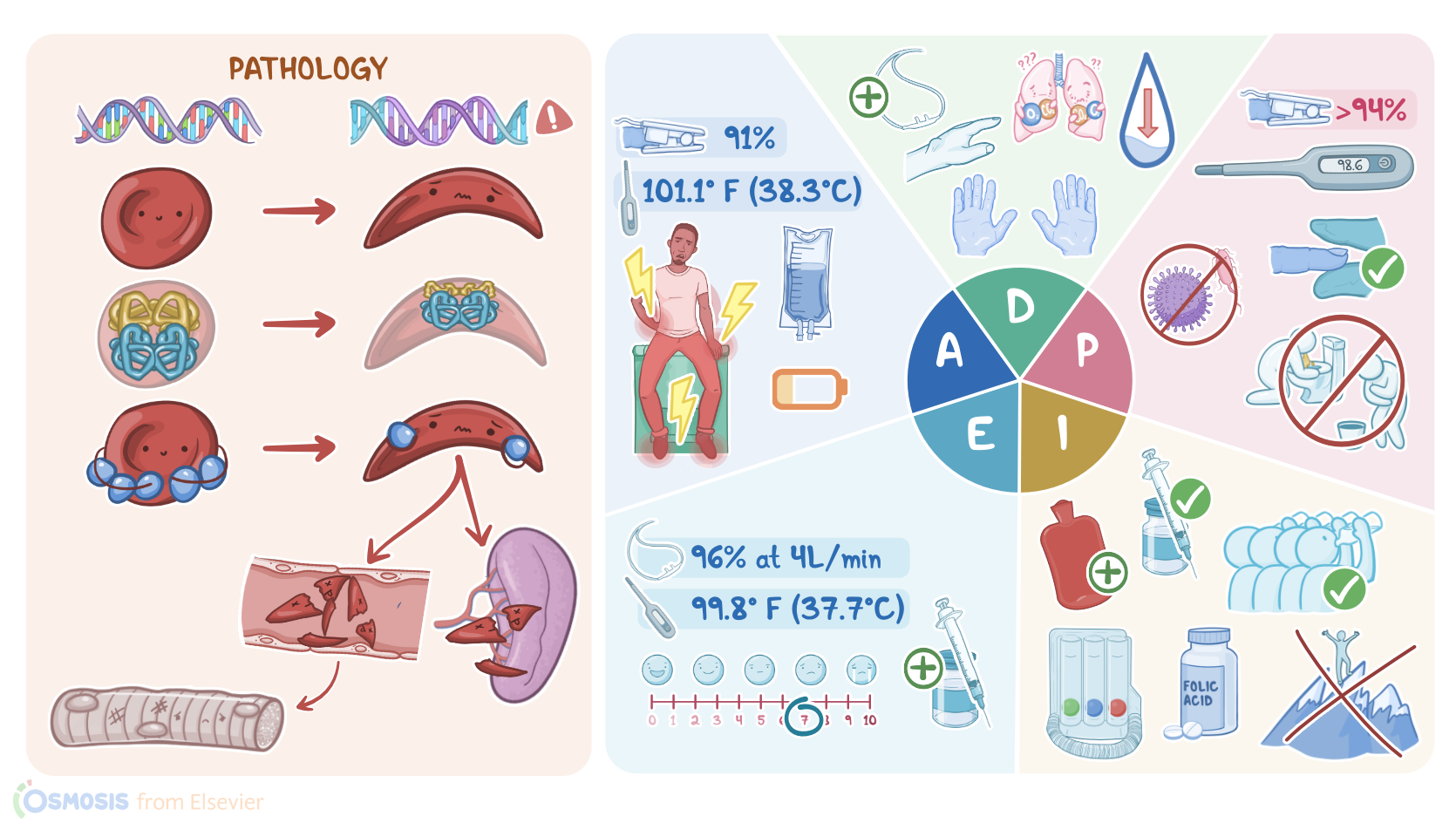
  • Temperature: 101.1 F (38.3 C)
  • Heart rate: 110
  • Respiratory rate: 20
  • Clear breath sounds
  • Blood pressure: 112/78 mmHg
  • Oxygen saturation: 91% room air
  • Pain: 9/10
  • IV fluids infusing
  • 1+ edema to hands
  • Skin turgor decreased
  • Dry mucous membranes
  • Folic acid and hydroxyurea at home
  • Hemoglobin: 10.9 mg/dL (6.76 mmol/L)
  • Hematocrit: 38%
  • Red blood cells: 4.0 million/mm3 (4.0 x 10¹²/L)
  • White blood cells: 18,000/mm3 (18 x 109/L)
  • Reticulocytes: 12%

NURSING DIAGNOSES
  • Impaired gas exchange related to decreased oxygen-carrying capacity
  • Ineffective peripheral tissue perfusion related to decreased oxygen-carrying capacity
  • Acute pain related to intravascular sickling 
  • Deficient fluid volume related to infection, fever, nausea, and vomiting

PLANNING
  • Increase oxygen saturation
  • Adequate perfusion and oxygenation to peripheral tissues
  • Manage pain
  • Adequate fluid balance
  • Resolve infection
  • Normalize temperature
  • Free of nausea and vomiting

IMPLEMENTATION
  • Administer medications as prescribed
  • Apply warm compresses
  • Demonstrate incentive spirometer
  • Titrate oxygen as needed
  • Remind how to prevent exacerbations

EVALUATION
  • Temperature: 99.8 F (37.7 C)
  • Heart rate: 86
  • Respiratory rate: 16
  • Clear breath sounds
  • Blood pressure: 118/78 mmHg
  • Oxygen saturation: 96% 4L nasal cannula
  • Pain: 7/10
  • Increase analgesic, reapply warm compresses

Transcript

Watch video only

Darnell Tyler is a 24-year-old Black male client with a history of sickle cell disease who presents to the emergency department, or ED, with a report of sudden, severe pain, rated a 9/10 that started late last night in his back, hands and feet.

He says he has been nauseous and vomiting for the last few days. After blood is drawn for culture, IV fluids and antibiotics are started. Then Darnell is admitted to the medical unit for further treatment and evaluation.

Sickle cell disease is a group of genetic conditions that affect hemoglobin, which can cause red blood cells to take the shape of a sickle or crescent. As a result, these red blood cells are more fragile and can be destroyed more easily, which can cause anemia.

Normally, red blood cells are able to carry oxygen from the lungs to peripheral tissues because they contain hemoglobin A, or HbA for short. Now, hemoglobin A is made up of two α-globin and two β-globin peptide chains, giving red blood cells a characteristic flexible biconcave shape that allows them to travel easily through blood vessels.

With this in mind, sickle cell disease is caused by a mutation in the HBB gene, which almost always results in the 6th amino acid of beta globin being a valine instead of glutamic acid.

As a result, two normal α-globin and two mutated β-globin peptide chains give rise to an abnormal hemoglobin called hemoglobin S for sickle, or HbS for short.

Now, under normal conditions, HbS is also able to carry oxygen quite well. However, under conditions such as hypoxia, acidosis, or dehydration, HbS forms long chains within the red blood cells.

This ultimately distorts the red blood cells into a rigid and fragile crescent shape that looks like a sickle. Now, sickle cell disease is autosomal recessive, so both parents must pass the mutated HBB gene to their child, so they will be homozygous for HbS.

This is especially common in individuals whose ancestors came from Sub-Saharan Africa, as well as South America, the Caribbean, and Central America. The mutated gene is also quite common among individuals of Mediterranean, Middle Eastern, Indian, and Asian descent.

On the other hand, if a client has one mutated HBB gene and one normal HBB gene, then they’re heterozygous for HbS, which makes them sickle cell carriers, also called sickle trait.

These clients usually have no health problems unless they are exposed to extreme conditions like dehydration or high altitude.Now, some of these fragile sickle cells get prematurely destroyed in blood vessels, a process often referred to as intravascular hemolysis; while others get destroyed by the spleen, which is also known as extravascular hemolysis.

Increased red blood cell breakdown leads to anemia and symptoms such as fatigue, pallor, shortness of breath, and jaundice. Less red blood cells stimulate bone marrow erythropoiesis, leading to new bone formation, and extramedullary hematopoiesis leading to hepatomegaly.

Finally, sickle cells can't travel easily through blood vessels, so they may get stuck and clump together in smaller blood vessels, causing vaso-occlusion, meaning they block the blood flow, eventually leading to tissue ischemia and pain, as well as infarction and necrosis.

This is especially common in the long bones and the back, as well as hands, and feet. So these clients typically present with bone or joint pain without a history of trauma, as well as swelling and pain in the fingers and toes.

Vaso-occlusion can result in many complications, which is known as a vaso-occlusive or sickle cell crisis. An important complication is avascular necrosis of the hips, which can cause tiny breaks in the bone and eventually, the bone may collapse.

In the brain, vaso-occlusion can lead to headaches, seizures, and even ischemic stroke. Vaso-occlusion in the lungs and cause a pulmonary infarction, which is often referred to as acute chest syndrome, and may present with chest pain, dyspnea, and cough.

Another important complication in the lungs is pulmonary hypertension, which can even lead to cor pulmonale, often referred to as right-side heart failure. In the kidneys, vaso-occlusion can cause sickle cell nephropathy, which is associated with hematuria and proteinuria; as well as chronic kidney disease.

Next, red blood cells can clog up the spleen and cause splenic infarcts; and since the spleen plays an important role in immunity against encapsulated bacteria, a client with sickle cell disease will be susceptible to infections by encapsulated bacteria, including Streptococcus pneumoniae, Neisseria meningitidis, and Haemophilus influenzae.

Finally, clogging of small blood vessels of the retina can lead to retinopathy and vision loss. To prevent these complications, it’s important to diagnose sickle cell disease as early as possible.

Diagnosis of sickle cell disease can be done prenatally with DNA testing, as well as with routine newborn screening. Hemoglobin electrophoresis can be performed to identify HbS.

Another important diagnostic study is a peripheral blood smear, which shows the characteristic sickle cells. Additionally, since there’s hemolysis, the blood levels of unconjugated bilirubin are often increased, while the hemoglobin levels are decreased.

To compensate, the bone marrow revs up and starts pumping out immature red blood cells called reticulocytes, therefore the reticulocyte count is usually elevated. In clients with bacterial infection, white blood cell count can also rise.