
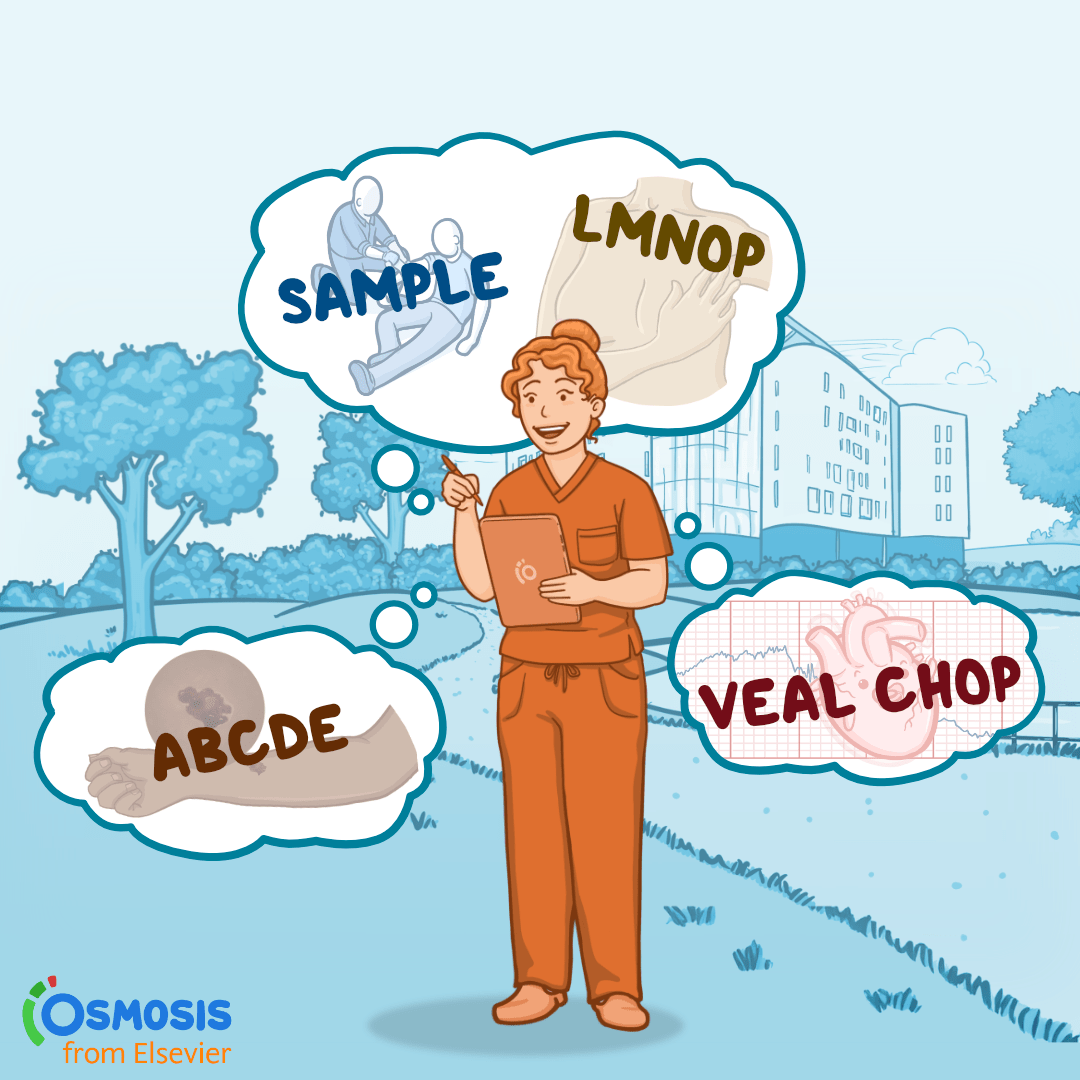
A typical day for a nursing student is a whirlwind of packed classes, clinicals, and seemingly endless paperwork. You might start the morning learning about pharmacology, spend the afternoon practicing skills in the lab, and finish the day writing up care plans or studying late into the evening.
With so little time and so much information to learn, nursing school can feel understandably overwhelming. That’s where clever tools like mnemonics can help! They turn a flood of details into simple, retrievable knowledge that you can apply at the patient’s bedside or during your exams.
Let’s look at the top ten Osmosis mnemonics every nursing student should have at the ready to sharpen their practice, improve recall, and prepare for success, both in the classroom and during clinicals.
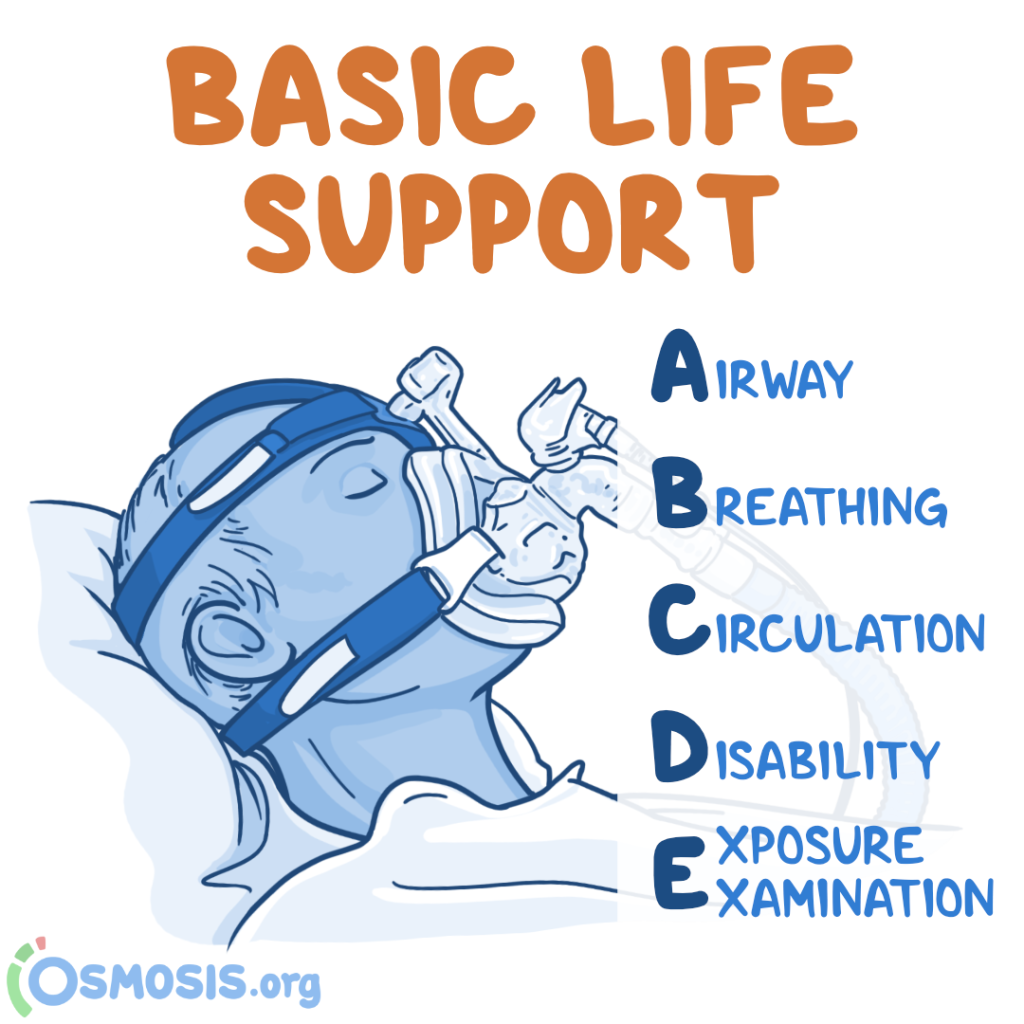
1. ABCDE: Airway, Breathing, Circulation, Disability, Exposure
In acute and emergency nursing, the ABCDE approach is foundational to assessing trauma:
- A – Airway: Is the airway open? Are there obstructions?
- B – Breathing: Assess rate, depth, effort, and oxygenation.
- C – Circulation: Check pulse, perfusion, blood pressure, and signs of hemorrhage.
- D – Disability: Quickly evaluate neurological status (level of consciousness, pupils, motor response).
- E – Exposure: Expose the patient enough to check for hidden injuries or issues while maintaining dignity and temperature control.
When a patient enters crisis mode, such as during trauma, code situations, or rapid deterioration, you should immediately run through the ABCDE steps. Even in more stable situations, like postoperative care, thinking, “Are airway, breathing, circulation, disability, and exposure okay?” reinforces the systematic approach that underpins every nurse’s daily practice.

2. SAMPLE: Patient History
When you’re taking a patient’s history (especially in urgent or triage settings), using SAMPLE ensures you don’t omit key details:
- S: Symptoms associated with illness or injury (What’s the patient experiencing?)
- A: Allergies
- M: Medications (What are they currently taking?)
- P: Past health history / Pregnancy (If relevant)
- L: Last oral intake (Food, drink)
- E: Events leading to illness or injury (What were they doing when the issue began?)
In nursing, you often act as the bedside “information collector.” Using SAMPLE helps structure your questions, especially when the patient is anxious, in pain, or time is short.
Tip: Use SAMPLE in conjunction with OLDCARTS or COLDSPA (see below) when evaluating symptoms or pain.

3. OPQRST: Pain Assessment
Pain is one of the most common complaints from patients, and comprehensively assessing it is crucial for safety and patient comfort. The OPQRST mnemonic guides how you question the patient:
- O: Onset (When did it start?)
- P: Provocation / Palliation (What makes it worse? Better?)
- Q: Quality (Sharp, dull, burning, etc.)
- R: Region & Radiation (Does it move or radiate?)
- S: Severity (0–10 scale)
- T: Time (How long, is it constant or intermittent?)
By using OPQRST, you get a clear, structured portrait of a patient’s pain, which helps diagnose the cause, determine suitable interventions, and evaluate their response.
Clinical Example
Patient: “I’ve got this burning in my chest.”
Nurse: “Okay, when did it start? Does anything make it better or worse? Can you point to where it is? On a scale of 1–10, how bad is it? Has it moved anywhere else? Is it constant or does it come and go?”

4. PRICE: Soft Tissue Injury Treatment
When patients present with sprains, strains, bruises, or other soft tissue injuries, PRICE is a first-aid mnemonic many nurses use (especially in outpatient, urgent care, or nursing triage settings):
- P: Pressure (can also refer to Protect)
- R: Rest
- I: Ice
- C: Compression
- E: Elevation
It’s a quick checklist to guide your immediate intervention (or patient education) when soft tissue damage is suspected.
Tip: Always assess for “red flags” (e.g., fracture signs, neurovascular compromise) even when applying the PRICE method. You should use it as a bridge to a more comprehensive evaluation or referral.
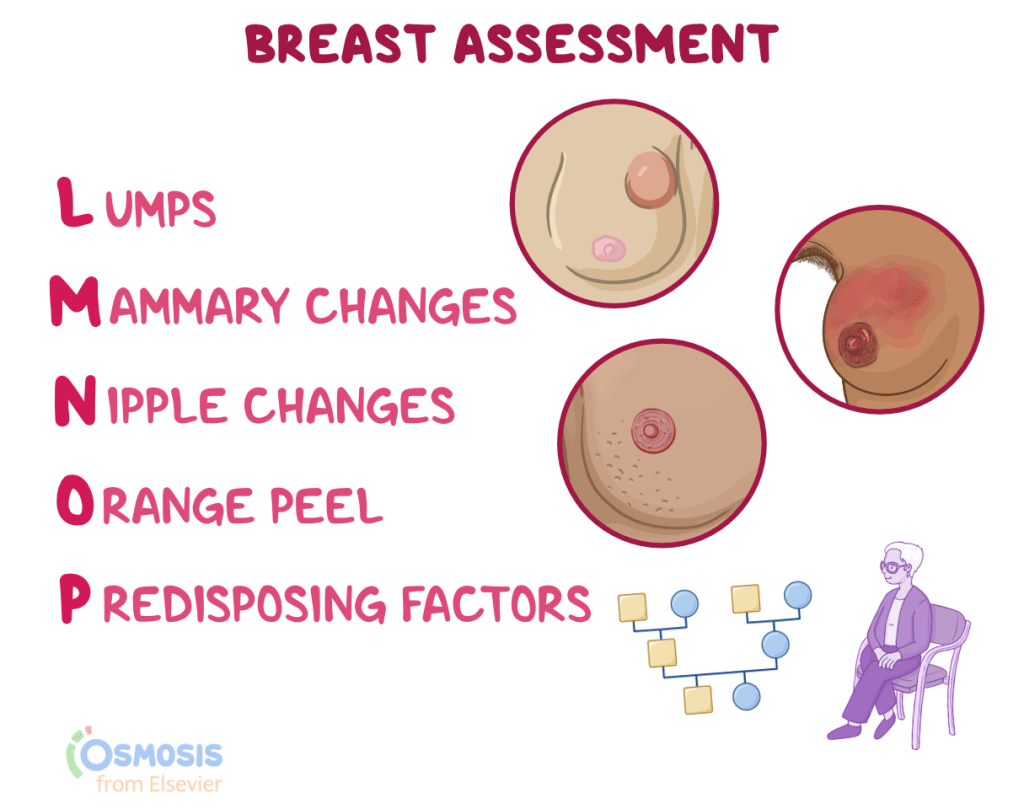
5. LMNOP: Breast Assessment
In nursing education, one of the ways LMNOP gets used is as a structured guide for breast assessment:
- L – Lumps: Palpate for any masses or nodules.
- M – Mammary changes: Note size, symmetry, or unusual alterations in breast tissue.
- N – Nipple changes: Assess for inversion, discharge, or lesions.
- O – Orange peel: Look for peau d’orange texture, dimpling, or puckering of the skin.
- P – Predisposing factors: Consider risk factors such as family history, genetics, or a history of previous breast conditions.
Using LMNOP during breast exams helps you perform consistent, thorough assessments and identify potential warning signs that may require further evaluation.
Tip: Document symmetry, mass characteristics (size, shape, mobility), and any discharge. Always compare both breasts.

6. ADPIE: Nursing Process
ADPIE is the core framework around which nurses plan and deliver care:
- A: Assessment (collect data)
- D: Diagnosis (RN diagnosis)
- P: Planning (set goals/outcomes and plan interventions)
- I: Implementation (carry out interventions)
- E: Evaluation (assess outcomes, revise plan)
Every nursing student, and nearly every practicing nurse, lives by ADPIE. It’s your roadmap for delivering safe, patient-centered care.
Tip: At each phase, ask yourself: “Do I have all the evidence/data? Am I clear on goals? Are my interventions measurable? Did the patient improve?” In documentation and handoffs, reflecting this structure helps clarity.
7. COLDSPA: Symptom Analysis & History Taking
COLDSPA is another mnemonic for symptom-focused history-taking (especially useful in nursing assessments):

- C: Character (What does it feel like?)
- O: Onset (When did it start?)
- L: Location (Where is it?)
- D: Duration (How long has it lasted?)
- S: Severity (Intensity on a scale)
- P: Pattern (What makes it better or worse?)
- A: Additional associated factors (Other symptoms)
COLDSPA often complements SAMPLE: once you know what the patient’s issue is, you can use COLDSPA to explore how it behaves. It’s especially effective for respiratory, gastrointestinal, or neurological symptoms.
Clinical Example
“Tell me about your headache (using COLDSPA to guide your questions): What does it feel like? When did it begin? Where is it? How severe? Does anything make it better or worse? Do you have nausea or light sensitivity with it?”

8. VEAL CHOP: Fetal Heart Rate Patterns
In obstetrical nursing, particularly during labor and fetal monitoring, VEAL CHOP helps you rapidly interpret deceleration patterns:
- V: Variable decelerations → C: Cord compression
- E: Early decelerations → H: Head compression
- A: Accelerations → O: Oxygen good (or okay)
- L: Late decelerations → P: Placental insufficiency
When monitoring fetal heart rate (FHR) strips, you can mentally map changes to likely causes. For example, a late deceleration indicates placental insufficiency, a condition that warrants immediate intervention.
Tip: Always correlate FHR patterns with uterine contractions, maternal status, and fetal movements. VEAL CHOP is a quick interpretive aid, rather than being a substitute for full clinical judgment.

9. SBAR: Handoff Communication
Effective communication is vital, especially during shift changes or patient transfers. SBAR is the gold standard for structured handoff reports:
- S: Situation (What’s going on now?)
- B: Background (Relevant history/context)
- A: Assessment (What you found / your interpretation)
- R: Recommendation (What you propose or ask for)
By using SBAR, you ensure clarity, brevity, and safety in your conversations with colleagues (oncoming nurse, physicians, transport teams, etc.).
Clinical Example
“Situation: Ms. Jones is having increased shortness of breath. Background: She’s a 65-year-old with CHF. Assessment: SpO₂ has dropped to 88%, crackles in both lungs, and edema is worsening. Recommendation: I suggest we increase the diuretic and get a chest X-ray. Can you review?”

10. NURSE: Empathy in Nursing
Caring isn’t just about the technical steps; emotional support matters. The mnemonic NURSE helps guide empathetic responses:
- N: Name and mirror the emotion (e.g., “I can see you’re frustrated.”)
- U: Understand / Empathize (e.g., “I understand this is hard.”)
- R: Respect (e.g., “You’re doing your best.”)
- S: Support (e.g., “I’m here to help.”)
- E: Explore (e.g., “Tell me more about how you’re feeling.”)
When patients are anxious, scared, in pain, or upset, N.U.R.S.E. helps you verbally acknowledge their emotional experience, which builds trust, rapport, and improves patient satisfaction.
Clinical Example
Patient: “I feel scared about going into surgery.”
Nurse: “I see you’re anxious (Name). It’s totally understandable — surgeries are stressful (Understand). You’re brave to express this (Respect). I’ll stay by your side and answer any questions you may have (Support). Can you tell me more about what worries you most? (Explore)”
A Few Additional Thoughts & Recommendations
- Combine and layer mnemonics wisely: For example, you might begin your shift with ABCDEs, gather history with SAMPLE → COLDSPA / OPQRST, plan care with ADPIE, communicate via SBAR, and use NURSE in emotional interactions.
- Practice in simulation: Mnemonics become reflexive only when you practice using them during simulations, labs, or roleplay.
- Write them out: Post abbreviated versions in your clinical notebook or as part of your nursing cheat sheet.
- Reflect on their limitations: Mnemonics are memory aids; they don’t replace critical thinking, clinical judgment, or tailoring care to individual patients.
Used thoughtfully, mnemonics transform a case of knowledge overload into structured, memorable steps that help you think critically and act quickly in patient care, while also supporting safe and effective nursing practices.
Key Takeaways
- Use ABCDE for emergency patient assessment.
- Employ SAMPLE and OPQRST for thorough history-taking.
- Apply PRICE for soft tissue injury care.
- Leverage SBAR to communicate effectively during handoffs.
- Practice NURSE to provide empathetic patient support.

Access your free trial to find out why millions of current and future clinicians and caregivers love learning with us.
Leave a Reply