
Today’s USMLE® Step 1 question of the day features a 57-year-old man post–myocardial infarction who develops palpitations and lightheadedness. He’s treated with a medication that decreases the slope of phase 0 depolarization. Can you figure it out?
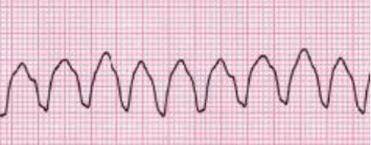
A 57-year-old man is admitted to the coronary care unit after an acute myocardial infarction and placement of a drug-eluting stent in the left main coronary artery. While in the post-operative suite, the patient begins experiencing palpitations and lightheadedness. His rhythm strip is demonstrated below. He is immediately given a medication that decreases the slope of phase 0 of depolarization. The medication helps terminate the arrhythmia.
Which of the following best describes the mechanism of action of this medication?
A. Selective blockade of fast sodium channels
B. Decrease in SA and AV nodal activity
C. Blockade of potassium rectifier currents
D. Blockade of voltage dependent calcium channels
E. Increase in potassium efflux via blockade of the AV node
Scroll down for the correct answer!
The correct answer to today’s USMLE® Step 1 Question is…
A. Selective blockade of fast sodium channels
Correct: See Main Explanation.
Incorrect Answer Explanations
B. Decrease in SA and AV nodal activity
Incorrect: ꞵ-blockers work via selective ꞵ-blockade, decreasing intracellular cAMP, and subsequently decreasing Ca2+ current. This mechanism ultimately decreases the slope of the phase 4 action potential.
C. Blockade of potassium rectifier currents
Incorrect: Class III antiarrhythmic medications inhibit potassium channels responsible for repolarization of the cardiac membrane. These medications increase action potential duration, effective refractory period, and QT interval prolongation.
D. Blockade of voltage dependent calcium channels
Incorrect: Class IV antiarrhythmic medications work by inhibiting voltage-dependent calcium channels and subsequently decreasing conduction velocity, increasing the PR interval, and increasing the effective refractory period.
E. Increase in potassium efflux via blockade of the AV node
Incorrect: Adenosine works via blockade of A1 adenosine receptors, which increases potassium efflux and blocks the AV node. It is not used to treat ventricular tachycardia.
Main Explanation
This patient presents with ventricular tachycardia after having an acute myocardial infarction. He is given a medication that decreases the slope of phase 0 of depolarization, which leads to termination of the arrhythmia. This mechanism of action is consistent with that of class I antiarrhythmics. These medications work primarily via selective blockade of fast sodium channels.
Class I antiarrhythmics are divided into three major classes: A, B, and C. However, all of them work via the same mechanism of action. Sodium channel blockade slows the upstroke of the sodium-dependent action potential (phase 0) and prolongs the QRS duration. However, each group has a different affinity for the fast sodium channel, resulting in group 1A prolonging the action potential duration, 1B shortening the actional potential duration, and 1C having no effect on the action potential duration.
These medications have a predilection to slow conduction in ischemic and depolarized cells. For this reason, class I antiarrhythmics are said to exhibit “state-dependent” action, meaning that they bind to sodium channels when they are open or inactivated and much less readily when they are fully repolarized and resting. This phenomenon means these medications will selectively depress tissue that is frequently depolarized, making them useful in treating reentrant tachycardias and ventricular tachycardias.

Major Takeaway
Class I antiarrhythmics block fast sodium channels and slow the upstroke of the sodium-dependent action potential (phase 0). These medications exhibit state-dependent action, meaning they will selectively depress tissue that is frequently depolarized.
Want to learn more about this topic?
Watch this Osmosis video: Class I antiarrhythmics: Sodium channel blockers
References
- Arnsdorf, M.F. (199) The cellular basis of cardiac arrhythmias. A matrical perspective. Annals of the New York Academy of Sciences. 601, 263-280. Doi: 10.1111/j.1749-6632.1990.tb37306.x.
- Dan, G.A., Martinez-Rubio, A., Agewall, S., et al. (2018) Antiarrhythmic drugs-clinical use and clinical decision making: a consensus document from the European Heart Rhythm Association (EHRA) and European Society of Cardiology (ESC) Working Group on Cardiovascular Pharmacology, endorsed by the Heart Rhythm Society (HRS), Asia-Pacific Heart Rhythm Society (APHRS) and International Society of Cardiovascular Pharmacotherapy (ISCP). Europace. 20(5), 731-732. Doi: 10.1093/europace/eux373.
- Trevor, A., Katzung, B., Knuidering-Hall, M. (2015) Katzung & Trevor’s pharmacology: Examination & board review (11th ed.). New York, NY: McGraw-Hill. ISBN: 978-0071826358.

Want more USMLE® Step 1 practice questions? Try Osmosis from Elsevier today! Access your free trial and discover why millions of current and future clinicians and caregivers love learning with us.
Leave a Reply