Breast cancer: Nursing process (ADPIE)
Client Report0:00–0:53
Linda Davis is a 54 year old female client recently diagnosed with ductal carcinoma in situ or DCIS. Because Ms.
Davis's mother had breast cancer, she was concerned when she felt a painless lump in her left breast during her monthly self-breast exam.
A mammogram shows linear and branching areas of microcalcifications, so a percutaneous core needle biopsy is performed. Pathology reveals pleomorphic high grade nuclei, areas of central necrosis in the ducts without invasion of the basement membrane.
And ER+ PR+ HER2 negative cells. Ms.
Davis presents to the oncology office for consultation. Breast cancer is the uncontrolled growth of epithelial cells within the breast tissue.
Pathology0:53–6:49
It is the 2nd most common cancer worldwide and is also the 2nd leading cause of cancer deaths in females, but on rare occasion it may affect males.
Now the female breasts are typically made up of glandular tissue which consists of lobes containing numerous milk producing lobules with a network of lactiferous ducts that transport milk to the nipple during lactation.
On the other hand, male breasts have ducts, and some may have a few lobules that don't produce milk. Now this glandular tissue is surrounded by stroma, which is made of adipose and fibrous connective tissue.
Located throughout the breasts are blood vessels, as well as lymphatic vessels that mainly drain into a group of lymph nodes in the axilla.
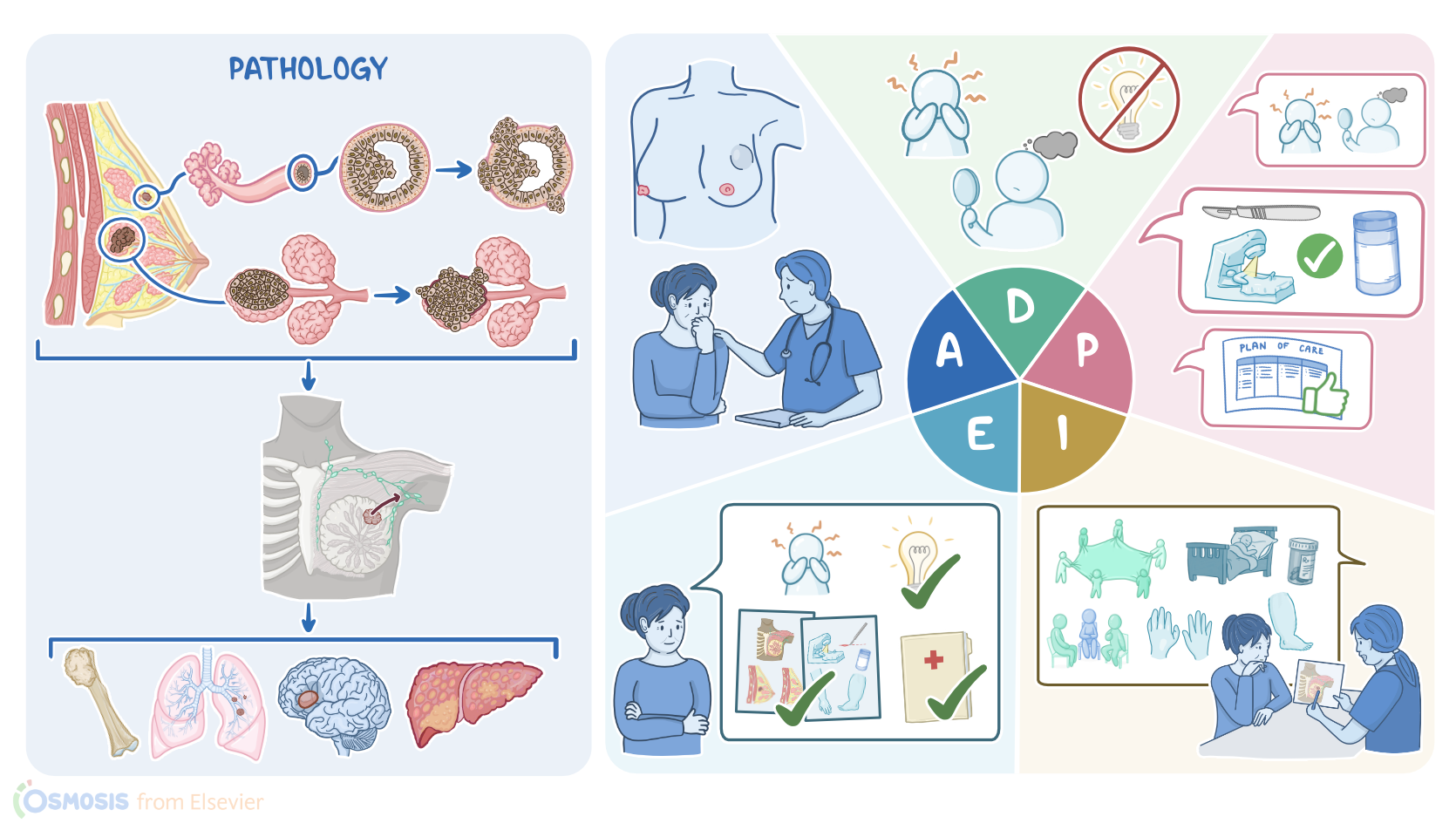
All right, now, most breast cancers are adenocarcinomas originating from the ducts or lobules and can be categorized by whether or not they have invaded surrounding tissue.
Non-invasive, also called in situ breast cancers, are confined to the ducts called ductal carcinoma in situ or DCIS for short, or lobules called lobular carcinoma in situ or LCIS for short.
Some non-invasive breast cancers can become invasive breast cancers, which infiltrate the basement membrane and spread to surrounding tissue where they can reach the blood and lymphatic vessels, ultimately leading to metastasis.
The most common invasive breast cancers include invasive ductal carcinoma, which starts from the ducts, and invasive lobular carcinoma, which starts from the lobules.
Now, the exact cause of breast cancer is not fully understood, but it is thought to be influenced by a variety of risk factors.
The most common risk factors include age over 50 and family history of breast or ovarian cancer. Other risk factors include hereditary genetic mutations in tumor suppressor genes, such as BRCA1, BRCA2, and less frequently TP53 or CHECK 2, which normally controls cell proliferation.
There's also increased risk of breast cancer with increased estrogen exposure like nulliparity, first pregnancy after the age of 30, early monarchy before the age of 12, and late menopause after the age of 55.
Other risk factors include absence of breastfeeding and obesity, as well as smoking, heavy alcohol consumption, and exposure to radiation.
Finally, Caucasian individuals seem to be at the highest risk of breast cancer. Generally, the first symptom of breast cancer is a hard, irregular, fixed, or non-mobile, painless lump or swelling, most often located in the upper outer quadrant of the breast.
Skin may appear reddened, swollen, and be warm to touch or present with ulceration. If the cancer cells obstruct the lymphatics, they can cause swelling and thickened skin around exaggerated hair follicles, giving the skin the appearance of an orange peel, also referred to as po de range.
Paget disease occurs when cancer cells migrate along the lactiferous duct and through the pore onto the skin over the nipple and can cause itching, redness, crusting, and clear or bloody discharge from the nipple.
If not promptly treated, breast cancer can lead to complications like metastasis. Metastases often occur through the axillary lymph nodes, so clients may present with swelling and palpable nodes under the armpit.
Other common sites for metastasis include bones, lungs, brain, and liver. Unfortunately, most cases of metastatic breast cancer can't be cured, so they eventually lead to death.
Diagnosis of breast cancer often begins with history and physical examination followed by mammography. In addition, other imaging techniques like ultrasound and MRI may be done to detect the tumor and determine the TNM stage, which stands for tumor size, nodal involvement, and metastasis.
Finally, a biopsy of suspicious tissues or lymph nodes must be done to confirm the diagnosis, and testing for the expression of hormone receptors such as estrogen and progesterone receptors, or ER and PR for short, as well as human epidermal growth factor 2 or HER2 receptors.
In terms of screening, according to the American Cancer Society guidelines, females aged 45 to 54 years of age should undergo screening mammography every year.
Treatment for breast cancer is based on the type and TNM stage. Surgery is the mainstay of treatment whenever possible.
Depending on their size, non-invasive tumors are removed surgically by either lumpectomy or partial or total mastectomy.
In addition, nearby structures like lymph nodes may also be removed if the cancer has metastasized to them. Surgery can be followed by other local treatments like radiotherapy.
As well as systemic therapy with chemotherapy or immunotherapy, other systemic therapies include hormonal therapy with tamoxifen, exemestane, or an aromatase inhibitor for clients that are positive for ER or PR, as well as targeted therapy with transtuzumab for HER2 positive clients.
Finally, most cases of metastatic breast cancer can't be cured, but may benefit from local or systemic therapy, as well as supportive care to help prevent or treat symptoms in some cases.
All right, let's begin Ms. Davis's assessment.
Assessment6:49–8:36
You start by asking Ms. Davis how she is feeling, and she replies that she is overwhelmed about her new diagnosis.
As you collect information about her history, you learn her mother was treated for breast cancer at 40 years of age, and that Ms.
Davis tested negative for being a BRCA mutation carrier. Ms.
Davis does not have any children, began menopause 2 years ago, and is not taking hormone replacement therapy. You note her skin is warm, dry, intact, has good turgor, and her oral mucous membranes are moist.
Heart sounds are normal and lung sounds are clear. Bowel sounds are active, and Ms.
Davis denies changes in her appetite or bowel movements. You palpate a firm, irregular shaped, non-mobile mass in her left breast.
No abnormalities are palpated in the right breast, and both nipples are free of discharge, inversion, or skin changes. Axillary and supraclavicular lymph nodes are non-palpable.
Her vital signs are oral temperature 97.8 °F or 36.6 °C, heart rate 80 BPM, respirations 16 breaths per minute, BP 118/70 millimeters of mercury, SPO 2 100% on room air, and pain 0 out of 10.
You document assessment findings and let Ms. Davis know the oncologist will be in shortly to discuss plans to perform breast conserving surgery with sentinel lymph node biopsy, followed by radiation and hormone therapy.
Diagnosis8:36–8:54
With Ms. Davis's assessment findings in mind, you establish the following nursing diagnoses anxiety related to change in health status, disturbed body image related to anticipated change in body structure, and deficient knowledge related to new diagnosis and treatment plan.
OK, it's time to plan goals specific to Ms. Davis's needs.
Planning8:54–9:24
By the end of today's visit, Ms. Davis will verbalize understanding of ways to manage anxiety and how to utilize support from family, healthcare providers, and support groups.
She will share feelings about her new diagnosis and anticipated changes in her physical appearance, and she will verbalize understanding of her diagnosis and treatment plan.
Now that your plan is in place, you are ready to implement your nursing interventions. To begin, you let Miss Davis know you understand that a breast cancer diagnosis is very overwhelming, and it's normal to feel anxious.
Implementation9:24–12:11
You encourage her to express her feelings about her diagnosis if and when she is ready. You establish an open and safe environment by encouraging her to ask questions and express her fears about treatment so you can provide additional support as needed.
You schedule Ms. Davis with the clinic's behavioral health provider so she can receive counseling and support for anxiety management and dealing with perceptions of body image, and you suggest anxiety coping mechanisms, provide information about local support groups, and discuss how family members may be supported so they can also support her.
Next, you go over information in a packet of educational resources. You explain what DCIS is and show her on a diagram where it is on the breast and how it forms.
Then you discuss why the surgery, sentinel lymph node biopsy, radiation therapy, and hormone therapy work together to address the cancer.
You provide an overview about how she can manage treatment side effects and actions she can take to maintain her health during treatment, explaining how mild to moderate pain and fatigue is expected after surgery, and how rest and pain medications can be helpful until she can resume normal activities.
You discuss post-operative incision care and explain how to manage radiation side effects like fatigue, pain, skin changes, and localized swelling.
You stress the importance to immediately report problems like fever, chest pain, shortness of breath, bleeding, warmth, redness, swelling, or foul smelling drainage around the incision.
Because lymphedema is a potential side effect from lymph node biopsy, you explain what lymphedema is, list ways to manage the swelling, and emphasize the importance of immediately reporting unexpected arm swelling, tightness, or pain.
Then you teach her about the aromatase inhibitor anastrozole. Explain that she will be taking the drug for up to 5 years postoperatively to lower the risk of cancer recurrence, and list some potential side effects such as muscle pain, joint stiffness, and osteoporosis.
Lastly, you tell her you understand that she has a lot of information to absorb, you answer her questions and make sure she takes her packet of information with her along with the office contact number and her counseling appointment dates.
Having implemented your care, you're ready to evaluate the effectiveness of your nursing intervention so far. Miss Davis says she is glad to receive so much helpful information and that she will utilize the provided resources and counseling to help manage her anxiety and her feelings about the ways her treatment will affect how she feels about her body.
Evaluation12:11–12:45
She tells you she remains anxious and overwhelmed, but that knowing more about her diagnosis, treatment plan, and self-care measures is helpful.
You ensure your nursing interventions and Ms. Davis's response to them are documented.
Summary12:45–13:29
All right, as a quick recap, your client, Ms. Davis was recently diagnosed with DCIS, a type of breast cancer.
She will be treated with breast-conserving surgery with sentinel lymph node biopsy followed by radiation and hormone therapy.
Your nursing assessment reveals Ms. Davis has a palpable mass in her left breast, and she is experiencing anxiety about her new diagnosis.
Nursing diagnoses include anxiety, disturbed body image, and deficient knowledge. Care is planned and implemented alongside the interdisciplinary team to prepare Ms.
Davis for treatment. Ms.
Davis's care will continue to be evaluated and adjusted to best meet her needs.
| BREAST CANCER | ||
| KEY POINTS | NOTES | |
| PATIENT REPORT |
| |
| PATHOPHYSIOLOGY |
| |
| DIAGNOSIS AND TREATMENT |
| |
| ASSESSMENT |
| |
| NURSING DIAGNOSES |
| |
| PLANNING |
| |
| IMPLEMENTATION |
| |
| EVALUATION |
| |
- "Ackley and Ladwig’s Nursing Diagnosis Handbook: An Evidence-Based Guide to Planning Care, 13th edition" Mosby (2022)
- "Customizing local and systemic therapies for women with early breast cancer: the St. Gallen International Consensus Guidelines for treatment of early breast cancer 2021" Ann Oncol (2021)
- "Overcoming Endocrine Resistance in Breast Cancer" Cancer Cell (2020)
- "Global Increase in Breast Cancer Incidence: Risk Factors and Preventive Measures" Biomed Res Int (2022)
- "Harrison’s Principles of Internal Medicine, 21st edition" McGraw Hill / Medical (2022)
- "Molecular Classification of Breast Cancer" Adv Anat Pathol (2020)
- "Critical Care Nursing: Diagnosis and Management, 9th edition" Elsevier (2021)
No notes for this video yet
Try adding a note below