Coronary artery disease (CAD) and angina pectoris: Nursing process (ADPIE)

3,278views

Coronary artery disease (CAD) and angina pectoris: Nursing process (ADPIE)

Watch later

Watch later

Hypokalemia: Clinical
Movement of water between body compartments
The role of the kidney in acid-base balance
Blood histology
Blood components
Respiratory acidosis
Metabolic acidosis
Respiratory alkalosis
Metabolic alkalosis
Metabolic and respiratory alkalosis: Clinical
Metabolic and respiratory acidosis: Clinical
Bronchodilators: Beta 2-agonists and muscarinic antagonists
Chronic obstructive pulmonary disease (COPD): Clinical
Chronic obstructive pulmonary disease (COPD): Nursing process (ADPIE)
Adrenergic antagonists: Alpha blockers
Sympatholytics: Alpha-2 agonists
Alpha-2 adrenergic agonists: Nursing pharmacology
Adrenergic receptors
Adrenergic antagonists: Beta blockers
Diabetes mellitus: Clinical
Diabetes mellitus (DM): Nursing process (ADPIE)
Diabetes mellitus
Diabetes mellitus: Pathology review
Stroke: Nursing process (ADPIE)
Stroke: Clinical
Ischemic stroke
Intracerebral hemorrhage
Peptic ulcers and stomach cancer: Clinical
GERD, peptic ulcers, gastritis, and stomach cancer: Pathology review
Sickle cell disease (NORD)
Sickle cell disease: Nursing process (ADPIE)
Sickle cell disease: Clinical
Blood groups and transfusions
Erythropoietin
Blood products: Nursing pharmacology
Oxygen binding capacity and oxygen content
Blood products and transfusion: Clinical
Hemophilia
Hemophilia: Nursing process (ADPIE)
Leukemia: Nursing process (ADPIE)
Chronic leukemia
Leukemias: Pathology review
Acute leukemia
Leukemia: Clinical
Lymphomas: Pathology review
Lymphoma: Clinical
Non-Hodgkin lymphoma
Hodgkin lymphoma
Lymphatic system anatomy and physiology
Anatomy of the abdominal viscera: Liver, biliary ducts and gallbladder
Liver anatomy and physiology
Cirrhosis
Cirrhosis: Pathology review
Cirrhosis: Clinical
Cirrhosis: Nursing process (ADPIE)
Hepatitis C virus
Hepatitis A and Hepatitis E virus
Liver cancer: Nursing
Cholestatic liver disease
Non-alcoholic fatty liver disease
HIV (AIDS)
HIV and AIDS: Pathology review
Antiretrovirals for HIV/AIDS - Protease inhibitors: Nursing pharmacology
Antiretrovirals for HIV/AIDS - NRTIs and NNRTIs: Nursing pharmacology
Antiretrovirals for HIV/AIDS - Integrase strand transfer inhibitors: Nursing pharmacology
Anatomy of the abdominal viscera: Pancreas and spleen
Pancreatitis: Nursing process (ADPIE)
Glaucoma: Nursing process (ADPIE)
Glaucoma
Eye conditions: Refractive errors, lens disorders and glaucoma: Pathology review
Acute respiratory distress syndrome (ARDS): Nursing
Anatomy of the coronary circulation
Coronary artery disease: Pathology review
Coronary artery disease: Clinical
ECG basics
ECG normal sinus rhythm
ECG rate and rhythm
ECG axis
ECG intervals
ECG QRS transition
ECG cardiac infarction and ischemia
Cardiac cycle
Arterial disease
Delirium
Dementia and delirium: Clinical
Vascular dementia
Frontotemporal dementia
Dementia with Lewy bodies
Dementia: Pathology review
Tumor lysis syndrome (TLS): Nursing Process (ADPIE)
Cholelithiasis: Nursing
Coronary artery disease (CAD) and angina pectoris: Nursing process (ADPIE)
Breast cancer: Nursing process (ADPIE)
Ovarian cancer: Nursing
Cervical cancer: Nursing
Hormones and hormone modulators for cancer: Nursing pharmacology
Endometriosis: Nursing
Heart failure
Left-sided heart failure: Nursing process (ADPIE)
Heart failure: Pathology review
Pneumonia: Pathology review
Pneumonia
Bacterial pneumonia: Nursing process (ADPIE)
Respiratory stimulants: Nursing pharmacology
Corticosteroids - Inhaled: Nursing pharmacology
Pneumothorax and hemothorax: Nursing
Chest trauma: Clinical
Pleural effusion: Nursing
Tuberculosis (TB): Nursing
Parkinson disease: Nursing process (ADPIE)
Huntington disease
Multiple sclerosis (MS): Nursing
Multiple sclerosis
Guillain-Barré syndrome: Nursing
Guillain-Barre syndrome
Myasthenia gravis: Nursing
Acute kidney injury (AKI): Nursing process (ADPIE)
Acute kidney injury: Clinical
Chronic kidney disease (CKD): Nursing
Chronic kidney disease
Chronic kidney disease: Clinical
Polycystic kidney disease (PKD): Nursing
Renin-angiotensin-aldosterone system
Osteoarthritis: Nursing
Osteoarthritis
Rheumatoid arthritis (RA): Nursing process (ADPIE)
Rheumatoid arthritis: Clinical
Rheumatoid arthritis
Rheumatoid arthritis and osteoarthritis: Pathology review
Systemic lupus erythematosus
Systemic lupus erythematosus (SLE): Pathology review
Systemic lupus erythematosus (SLE): Clinical
Systemic lupus erythematosus (SLE): Nursing
Mycobacterium tuberculosis (Tuberculosis)
Peripheral venous disease (PVD): Nursing process (ADPIE)
Peripheral arterial disease (PAD): Nursing process (ADPIE)
Buerger disease: Nursing
Raynaud phenomenon: Nursing
Aortic dissections and aneurysms: Pathology review
Aortic aneurysms and dissections: Clinical
Aortic dissection
Aortic aneurysm: Nursing process (ADPIE)
Venous thromboembolism (VTE): Nursing process (ADPIE)
Benign prostatic hyperplasia (BPH): Nursing process (ADPIE)
Benign prostatic hyperplasia
Prostate cancer: Nursing
Prostate cancer
Testicular cancer: Nursing
Testicular cancer
Diabetic ketoacidosis (DKA): Nursing process (ADPIE)
Endocrine system anatomy and physiology
Vitamin B12 deficiency
Thalassemia: Nursing
Anemia - Iron-deficiency: Nursing
Anemia - Macrocytic: Nursing
Anemia - Aplastic: Nursing
Thyroid hormones
Medications for thyroid disorders: Nursing pharmacology
Hyperthyroidism: Nursing process (ADPIE)
Hypothyroidism: Nursing process (ADPIE)
Hypoparathyroidism: Nursing
Hyperparathyroidism: Nursing
Anxiety disorders: Nursing process (ADPIE)
Spinal cord injury (SCI): Nursing
Cluster A personality disorders
Smoke inhalation injury: Nursing process (ADPIE)
Shock - Anaphylactic: Nursing
Shock - Obstructive: Nursing
Shock - Neurogenic: Nursing
Shock - Hypovolemic: Nursing
Shock - Cardiogenic: Nursing
Shock - Septic: Nursing
Pulmonary edema: Nursing
Burn injury: Nursing

Notes

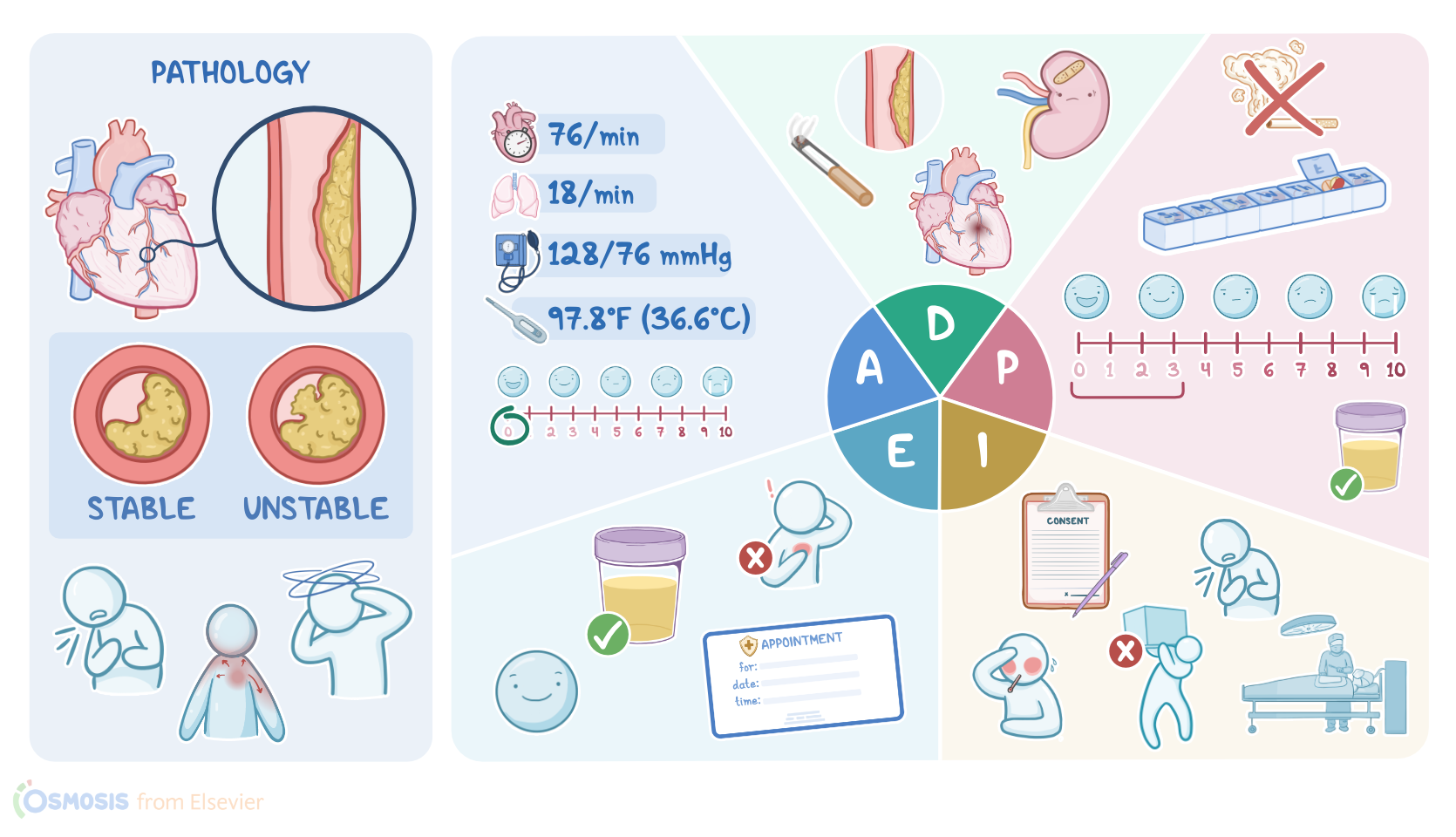
CORONARY ARTERY DISEASE (CAD) AND ANGINA PECTORIS

KEY POINTS
NOTES
PATIENT REPORT
  • 52-year-old man
  • Undergoing percutaneous coronary intervention (PCI)
  • Diagnosis of coronary artery disease, chronic stable angina, hyperlipidemia
  • Smoker, 20-pack-year history

PATHOPHYSIOLOGY
  • CAD
    • Narrowing or obstruction of coronary arteries
    • Caused by atherosclerosis
    • Myocardial perfusion reduced
    • Ischemia occurs
    • Leads to angina
      • Stable
      • Unstable
    • OPQRST
  • Risk factors
    • Non-modifiable
      • Advanced age
      • Assigned male at birth
      • Family history of hypercholesterolemia
      • Black, Native American, Native Hawaiian, or South Asian 
    • Modifiable
      • Smoking
      • Hypertension
      • Dyslipidemia
      • Diabetes
      • Obesity
      • Physical inactivity

TREATMENT
  • Lifestyle modifications
  • Medications
  • Coronary revascularization procedures

ASSESSMENT
  • Anxious
  • Warm, dry, intact skin with good turgor
  • Temperature: 97.8 F (36.6 C)
  • Lungs clear
  • Respiratory rate: 18
  • Oxygen saturation: 98% room air
  • Heart sounds normal
  • Heart rate: 76
  • Blood pressure: 128/76 mmHg
  • Bowel sounds active
  • NPO since midnight
  • No peripheral edema
  • Pedal pulses normal
  • Pain: 0/10
  • ECG: normal sinus rhythm
  • BUN: 15 mg/dL (5.35 mmol/L)
  • Creatinine: 0.8 mg/dL (70 μmol/L)
  • Sodium: 140 mEq/dL (140 mmol/L)
  • Potassium 3.5 mEq/dL (3.5 mmol/L)
  • Cholesterol: 275 mg/dL (7.12 mmol/L)
  • LDL: 190 mg/dL (4.93 mmol/L)
  • HDL: 30 mg/dL (0.78 mmol/L)
  • Triglycerides: 200 mg/dL (2.26 mmol/L)
  • Atorvastatin, propranolol, aspirin, nitroglycerin

NURSING DIAGNOSES
  • Risk for vascular trauma related to PCI
  • Risk for bleeding related to PCI
  • Risk for infection related to invasive procedure
  • Pain related to invasive procedure
  • Risk for injury related to contrast dye
  • Risk for decreased cardiac perfusion 
  • Hyperlipidemia
  • Procedure-related vasospasm and arrhythmias
  • Deficient knowledge related to post-PCI care
  • Ineffective health maintenance related to hyperlipidemia and smoking

PLANNING
  • Show no signs or symptoms of complications
  • Manage pain
  • Output will be within normal limits
  • Verbalize understanding of post-procedure care
  • Decreased episodes of angina

IMPLEMENTATION
  • Ensure informed consent signed
  • Administer medications as prescribed
  • Monitor vital signs, pain, ECG, catheter, pulses, level of consciousness, mobility, urinary output, and labs
  • Education on incision site care, activity restrictions, and symptoms that warrant medical attention
  • Review lifestyle changes
  • Advise to drink plenty of fluids
  • Provide smoking cessation resources
  • Document interventions and assessment findings

EVALUATION
  • Blood pressure: 120/70 mmHg
  • Heart rate: 70
  • Respiratory rate: 12
  • Oxygen saturation: 98% on room air
  • Temperature: 97.0 F (36.1 C)
  • Pain: 2/10
  • ECG: normal sinus rhythm
  • Voided 1,000 mL
  • BUN: 17 mg/dL (6.07 mmol/L)
  • Creatinine: 0.9 mg/dL (79.6 μmol/L)
  • Alert, oriented
  • Ambulates with assistance
  • No chest pain
  • Skin warm, dry, and intake
  • Pedal pulses normal
  • Verbalizes understanding of discharge instructions
  • Follow-up appointment scheduled 

Transcript

Watch video only

Dwayne Harris is a 52 year old African American male client presenting to the cardiac catheterization lab to undergo a percutaneous coronary intervention, also known as PCI.

Mr. Harris has a diagnosis of coronary artery disease, chronic stable angina, hyperlipidemia, and is a current smoker with a 20 pack year history.

Because his angina is no longer responding to treatment, his cardiologist recommended PCI for Mr. Harris.

Coronary artery disease, or CAD, is the narrowing or obstruction of coronary arteries.

This narrowing is caused by atherosclerosis, a lipid containing plaque that accumulates on artery walls.

Over time, the plaque build up reduces myocardial perfusion and causes ischemia as the demand for oxygen exceeds the supply.

Myocardial ischemia leads to a type of chest pain called angina, which can be either stable or unstable.

Stable angina usually occurs when atherosclerotic plaque is fixed to the artery wall and occludes at least 75 percent of the coronary artery, whereas with unstable angina, the plaque ruptures and almost completely occludes the artery lumen.

The clinical presentation helps to differentiate stable and unstable angina using the acronym OPQRST.

O stands for onset, which for stable angina is during activity or emotional stress, due to increased oxygen demand, whereas for unstable angina, onset can be sudden or even at rest.

P is for palliation. Stable angina is relieved by re st or vasodilators like nitroglycerin, whereas unstable angina is not relieved.

Q stands for the quality of pain, which often involves pressure, crushing, squeezing, or tightness. Pain is more severe with unstable angina.

R stands for radiation of pain, because it often radiates to the shoulders, arms, jaw, neck, or back.

S is for site, which is deep, substernal, and sometimes hard to localize, meaning the client is unable to point to the site of pain with a single finger.

T stands for time. With stable angina, pain can last 15 seconds to 15 minutes, whereas in unstable angina, the pain will last longer than 20 minutes.

Besides causing angina, the myocardial oxygen supply and demand imbalance from CAD can also lead to dyspnea, diaphoresis, palpitations, dizziness, pallor, and digestive disturbances.

Now, there are several non-modifiable and modifiable risk factors contributing to CAD and its complications.

Advanced age is the greatest risk factor, with men over 45 and women over 55 years of age being at most risk.

Other non-modifiable risk factors include biological male sex, family history of hypercholesterolemia, and belonging to African American, Native American, Native Hawaiian, and South Asian demographic groups.

Modifiable risk factors include smoking tobacco, hypertension, dyslipidemia, diabetes mellitus, obesity, and physical inactivity.

Psychosocial factors, such as stress and depression can be risk factors for CAD too, due to their association with factors like smoking, physical inactivity, and obesity as well as their association with elevated systemic inflammation which contributes to atherosclerosis.

OK, treating CAD centers around lifestyle modifications, medication management and, if needed, coronary revascularization procedures.

Lifestyle modifications involve controlling modifiable risk factors.

Several medications are used to treat CAD as well.

Nitrates, like nitroglycerin, and calcium channel blockers, such as amlodipine, work by dilating coronary arteries.

Beta blockers like propranolol reduce myocardial oxygen demand by decreasing heart rate and contractility.

Antiplatelet medications, like aspirin, are used to reduce platelet aggregation in coronary arteries.

Cholesterol lowering medications are prescribed to reduce atheroscleoritc plaque formation, including statins like atorvastatin, fibric acid derivatives such as fenofibrate, omega 3 fatty acids, bile acid sequestrants like colestipol, cholesterol absorption inhibitors such as ezetimibe, and PCSK9 inhibitors like evolocumab.

If stable angina isn’t effectively treated by lifestyle modifications and medication therapy, coronary revascularization procedures may be necessary.

PCI is a minimally invasive procedure that involves inserting a catheter through the radial or femoral artery and injecting contrast dye to locate the blockage.

After the blockage is located, a tiny balloon is inserted in the obstructed coronary artery to compress plaque against the artery wall.

If needed, a stent can be placed during PCI to keep the artery patent.

Alternatively, atherectomy devices are used to remove the plaque.

Coronary bypass grafting, or CABG, can be done instead of PCI.

This is a major surgical procedure that involves using a vein or artery from elsewhere in the body to bypass the blockage and improve myocardial blood flow.

OK, let’s get back to Mr. Harris and begin his assessment.

You introduce yourself, perform hand hygiene, and confirm his identity.

After asking if he feels ready for his procedure, he says he is anxious but hopeful it will help him have less chest pain when taking his daily walks.

Your assessment reveals warm, dry, intact skin with good turgor.

His oral temperature is 97.8°F, or 36.6°C.

Lungs are clear with a respiratory rate of 18 breaths per minute and SpO2 is 98% on room air.

Heart sounds are normal, and he has a regular heart rate of 76 beats per minute and blood pressure of 128/76 mmHg.

Bowel sounds are active, and Mr. Harris confirms he hasn’t had anything to eat or drink since midnight.

Sources

  1. "Epidemiology of Coronary Artery Disease" Surg Clin North Am (2022)
  2. "Angina: contemporary diagnosis and management" Heart (2020)
  3. "Predictive utility of stress tests in the detection of asymptomatic coronary artery disease in atherosclerotic stroke patients" J Stroke Cerebrovasc Dis (2023)
  4. "Harrison’s Principles of Internal Medicine, 21st edition" McGraw Hill / Medical (2022)
  5. "Gender in cardiovascular medicine: chest pain and coronary artery disease" Eur Heart J (2019)
  6. "Critical Care Nursing: Diagnosis and Management, 9th edition" Elsevier (2021)