Diabetes insipidus: Nursing process (ADPIE)
Client Report0:00–1:03
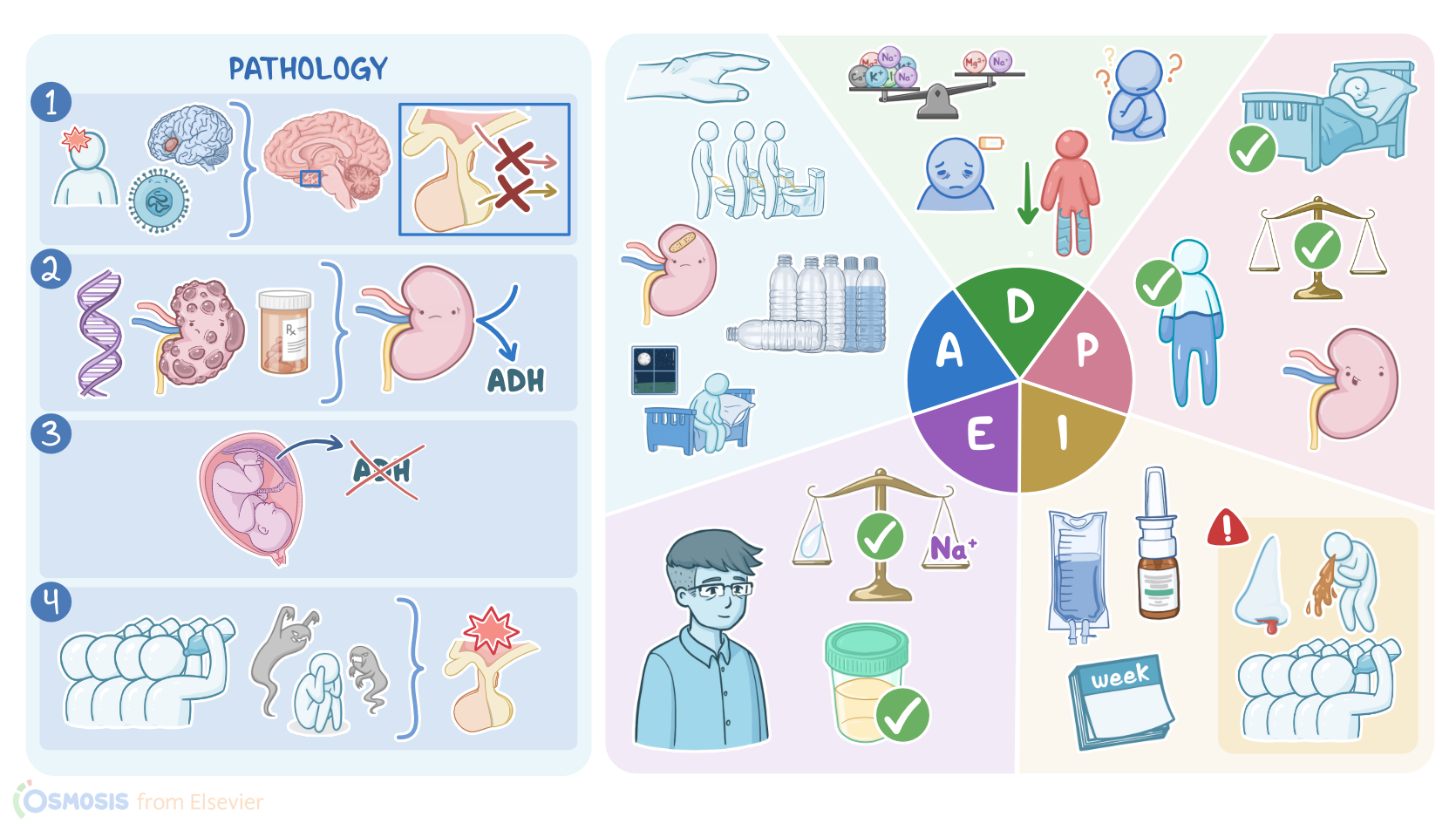
Harvey Nguyen is a 30-year-old male client who suffered a traumatic brain injury during a skiing accident 4 months ago. He presents to his primary care physician, or PCP with a report of increased thirst, increased urine output, and frequent nighttime urination.
He says he doesn't go anywhere without a water bottle, and always needs to know where the restroom is when he is away from home.
He says that he's tired all the time because he has to make frequent trips to the bathroom during the night. His laboratory results are serum sodium 147 milliequivalents per liter, serum glucose 100 mg per deciliter, serum osmolarity, 312 milliosmoles per kilogram, urine specific gravity, 1.001, and urine osmolarity, 248 milliosmoles per kilogram.
His PCP refers him to an endocrinologist who admits Harvey to the medical unit for a water deprivation test, which confirms the diagnosis of central diabetes insipiditus.
Diabetes insipidis is a condition characterized by excessive water loss through urine, because the kidneys don't reabsorb enough water.
Pathology1:03–6:57
Now, the primary hormone that regulates water reabsorption and balance in the body is ADH, also called vasopressin. ADH is normally produced by the hypothalamus and is stored in the posterior pituitary, which are both located within the brain.
To do this, the hypothalamus contains osmoreceptors, which are able to sense the osmoality of the blood. The normal osmolarity value is between 285 and 295 milliosmos per kilogram.
Now, when a person is dehydrated, osmolarity increases, so osmoreceptors sense this, and in response, stimulate the pituitary to release the stored ADH into the blood.
ADH then travels to the kidneys to decrease water excretion in the urine and increase water reabsorption back into the blood, which ultimately helps restore normal blood osmolarity.
In addition, osmo receptors trigger the sensation of thirst. After the person drinks water, the osmoality returns to normal, and ADH secretion stops.
There are 4 types of diabetes insipidus. The first type is central diabetes insipiditus, which is caused by a problem in the hypothalamus or pituitary gland, preventing ADH production or ADH release.
This can be due to a head injury, neurosurgery, brain tumor, vascular lesions like aneurysms, as well as due to an infection like meningitis or encephalitis, autoimmune conditions, or sometimes the cause can be idiopathic.
The second type is nephrogenic diabetes insipiditus, which is caused by a problem with the kidneys themselves, making them unresponsive to ADH.
This may be due to a genetic defect of the vasopressin receptors, or kidney disorders like polycystic kidney disease, as well as medications like lithium.
The third type is gestational diabetes insipiditus, which occurs during pregnancy, because the placenta releases an enzyme called vasopressinase that breaks down ADH.
In other cases, pregnant clients generally produce more prostaglandins, which reduce kidney sensitivity to ADH. Finally, the fourth type is dipsogenic diabetes insipiditus, also called psychogenic or primary polydipsia, which is caused by drinking far too much water, and it is often associated with a psychiatric disorder such as schizophrenia, but can also be caused by damage to the hypothalamic osmoreceptors that regulate the feeling of thirst.
A client with diabetes insipiditus typically makes over 3 L of dilute urine each day. As a consequence, plasma osmolarity increases, so osmo receptors trigger thirst, causing the client to drink excessive amounts of water, which is called polydipsia.
Despite this, the kidneys remain unable to reabsorb water. As a result, diabetes insipiditus can quickly lead to complications like dehydration and low BP.
Clients may also develop electrolyte imbalances, such as hypernatremia or high blood sodium. Now, acute hypernatremia causes neurological symptoms that range from lethargy, weakness, altered mental status, and irritability to severe symptoms like seizures and coma.
In addition, acute hypernatremia rapidly pulls water out of brain cells, so the brain as a whole shrinks. As a result, blood vessels within the brain may rupture and cause intracerebral and subarachnoid hemorrhages.
The diagnosis of diabetes insipiditus typically starts with history and physical examination. In addition, a blood test would show an increased blood osmoality in central, nephrogenic, and gestational diabetes insipiditus.
On the other hand, dipsogenic diabetes insipiditus generally shows normal blood osmoality. So diagnosis should be confirmed by assessing if the person is drinking excessive amounts of water.
In addition, a fluid deprivation test can be done to measure the change in the client's urine osmolarity after restricting fluid intake for a period of 8 to 12 hours.
In a client with central, nephrogenic, or gestational diabetes insipiditus, urine osmoality should remain low, despite fluid deprivation.
On the other hand, with dipsogenic diabetes insipiditus, urine osmolality should go back to normal. Now, if there's no change in urine osmoality after fluid deprivation, the client can be given the ADH analog desmopressin to distinguish between nephrogenic and central or gestational diabetes insipiditus.
If the urine osmoality goes back to a normal level, it means that the cause is a deficiency of ADH which points to either central or gestational diabetes insipiditus.
While in nephrogenic diabetes insipiditus, the urine osmoality would remain low. Finally, brain imaging can help diagnose the underlying cause of central diabetes insipiditus.
Treatment of both central and gestational diabetes insipiditus relies on the medication desmopressin to make up for the ADH deficiency.
For nephrogenic diabetes insipiditus, medications like thiazide diuretics can be given to increase sodium excretion via urine, which reduces blood osmolarity.
Finally, for clients with dipsogenic diabetes insipiditus, behavioral therapy and management of the underlying condition can help reduce compulsive water intake.
Now, you meet Harvey after his water deprivation test is complete, and you begin your assessment. His vital signs are tympanic temperature, 98.6 °F or 37 °C, heart rate, 88 BPM, respiratory rate, 14 breaths per minute, BP, 105/75 millimeters of mercury, and SPO2, 95% on room air.
Assessment6:57–7:38
You observe that he has dry mucous membranes and poor skin turgid. You provide him with PO fluids as ordered, document your assessment findings, and continue to monitor Harvey's vital signs, fluid, and electrolyte balance throughout your shift.
Diagnosis7:38–8:01
Based on your assessment findings, you developed the following nursing diagnoses. Deficient fluid volume related to inability to conserve fluid, risk for electrolyte imbalance related to compromised endocrine regulatory mechanism, disturbed sleep pattern related to nocturia, and ineffective health maintenance related to deficient knowledge regarding management of disease.
Next, you collaborate with Harvey and the endocrinologist to start planning goals for his care. By the time of discharge, Harvey will maintain adequate fluid balance.
Planning8:01–8:32
He will also maintain normal electrolyte balance, and Harvey will verbalize an understanding of diabetes insipiditus management and identify symptoms that indicate a need for medical attention.
You also establish a long-term goal that Harvey's sleep pattern will normalize within one week of beginning medication therapy.
Implementation8:32–9:30
OK, now you're ready to implement your interventions. First, you administer the ordered IV fluids and electrolytes.
The endocrinologist prescribes desmopressin in the form of a nasal spray. And as you administer the medication, you teach Harvey about self-administration and explain that it replaces the hormone needed to concentrate his urine.
While he's taking this medication at home, you urge him to seek medical attention right away if he experiences side effects, like a stuffy or runny nose, nosebleed, or signs of a low sodium level, such as headache, confusion, nausea, vomiting, or unexplained weakness.
He should also report if he continues to experience unusual thirst, or if he continues to need to use the bathroom frequently, especially at night.
Lastly, you let Harvey know that he will be returning to his endocrinologist's office one week after discharge to monitor laboratory tests and evaluate the effectiveness of the drug therapy.
Evaluation9:30–10:10
Now, let's check in and evaluate how Harvey is doing so far. Harvey's fluid and electrolyte levels are beginning to return to normal.
Urine output has decreased, and the urine appears more concentrated. His urine-specific gravity is now 1.020.
Urine osmoality is 720 milliosmos per kilogram. Serum sodium is 144 milliequivalents per liter, and serum osmolarity is 297 milliosmos per kilogram.
You document your assessment findings and continue to reassess and re-evaluate Harvey's response to interventions until discharge.
Summary10:10–10:59
All right, here's a quick recap. Your client, Harvey, was experiencing polydipsia, polyuria, and nocturia, and was diagnosed with diabetes insipidis, where the kidneys can't reabsorb enough water.
Your assessment revealed increased urine output, resulting in signs of dehydration and disturbed sleep. You developed nursing diagnoses to address his deficient fluid volume, risk for electrolyte imbalance, disturbed sleep, and ineffective health maintenance.
The goals you identified when planning care included restoration and maintenance of adequate fluid and electrolyte balance, improved sleep, and the ability to manage his condition.
Along with the endocrinologist, you implemented actions to help him achieve these goals, and you will continue to evaluate and adapt his plan of care as needed to achieve positive
| DIABETES INSIPIDUS | ||
| KEY POINTS | NOTES | |
| PATIENT REPORT |
| |
| PATHOPHYSIOLOGY |
| |
| ASSESSMENT |
| |
| NURSING DIAGNOSES |
| |
| PLANNING |
| |
| IMPLEMENTATION |
| |
| EVALUATION |
| |
- "Ackley and Ladwig’s Nursing Diagnosis Handbook: An Evidence-Based Guide to Planning Care, 13th edition" Mosby (2022)
- "Diabetes Insipidus: New Concepts for Diagnosis" Neuroendocrinology (2020)
- "Diabetes insipidus related to sedation in the intensive care unit: A review of the literature" J Crit Care (2023)
- "Harrison’s Principles of Internal Medicine, 21st edition" McGraw Hill / Medical (2022)
- "Diabetes Insipidus: Pathogenesis, Diagnosis, and Clinical Management" Cureus (2021)
- "Critical Care Nursing: Diagnosis and Management, 9th edition" Elsevier (2021)
- "Diabetes Insipidus" Pediatr Rev (2020)
No notes for this video yet
Try adding a note below