Dialysis care: Nursing

2,044views

Dialysis care: Nursing

Acute Final

Acute Final

Endocrine system anatomy and physiology
Antepartum assessment - Fetus: Nursing
Assessment of gestational age: Nursing
Fetal circulation: Nursing
Fetal development: Nursing
Group B streptococcus (GBS) infection in pregnancy: Nursing
Hepatitis B virus (HBV) infection in pregnancy: Nursing
Hyperemesis gravidarum: Nursing
Large for gestational age (LGA) infant: Nursing
Preeclampsia and eclampsia: Nursing
Prenatal screening: Nursing
Placenta previa: Nursing process (ADPIE)
Placental abruption: Nursing process (ADPIE)
Birth-related procedures: Nursing
Cesarean birth: Nursing
Intrapartum assessment - Fetal heart rate patterns: Nursing
Intrapartum assessment - Uterine activity: Nursing
Premature rupture of membranes (PROM): Nursing
Shoulder dystocia: Nursing
Prolapsed umbilical cord: Nursing process (ADPIE)
Stages of labor: Nursing
Assessment - Postpartum: Nursing
Perinatal depression: Nursing
Physiology of lactation: Nursing
Postpartum infections: Nursing
Postpartum hemorrhage: Nursing
Biliary atresia: Nursing
Cleft lip and palate: Nursing
Congenital diaphragmatic hernia: Nursing
Congenital heart defects - Acyanotic: Nursing
Congenital heart defects - Cyanotic: Nursing
Esophageal atresia and tracheoesophageal fistula: Nursing
Craniosynostosis: Nursing
Hemolytic disease of the fetus and newborn: Nursing
Hyperbilirubinemia: Nursing process (ADPIE)
Infant of a diabetic mother (IDM): Nursing
Meconium aspiration syndrome: Nursing
Neonatal respiratory distress syndrome (NRDS): Nursing
Neonatal sepsis: Nursing
Neural tube defects: Nursing
Newborn adaptation to extrauterine life: Nursing
Persistent pulmonary hypertension of the newborn (PPHN): Nursing
Physical assessment - Neonate: Nursing
Small for gestational age (SGA) infant: Nursing
Postterm infant: Nursing
Thermoregulation - Neonate: Nursing
Arterial blood gas (ABG) - Overview: Nursing
Arterial blood gas (ABG) - Metabolic acidosis: Nursing
Arterial blood gas (ABG) - Metabolic alkalosis: Nursing
Arterial blood gas (ABG) - Respiratory acidosis: Nursing
Arterial blood gas (ABG) - Respiratory alkalosis: Nursing
Adrenal insufficiency (Addison disease): Nursing
Anemia - Iron-deficiency: Nursing
Anemia - Aplastic: Nursing
Anemia - Macrocytic: Nursing
Case study - Hypothyroidism: Nursing
Case study - Iron-deficiency anemia: Nursing
Case study - Sickle cell anemia: Nursing
Complete blood count (CBC) - Hemoglobin and hematocrit: Nursing
Complete blood count (CBC) - Red blood cells (RBC): Nursing
Complete blood count (CBC) - Platelets: Nursing
Complete metabolic panel (CMP) - Blood urea nitrogen (BUN) and creatinine (Cr): Nursing
Complete metabolic panel (CMP) - Estimated glomerular filtration rate (eGFR): Nursing
Complete metabolic panel (CMP) - Liver function tests (LFT): Nursing
Cushing syndrome and Cushing disease: Nursing
Hematopoietic growth factors: Nursing pharmacology
Hyperparathyroidism: Nursing
Hyperthyroidism: Nursing process (ADPIE)
Hypoparathyroidism: Nursing
Hyperpituitarism: Nursing
Hypopituitarism: Nursing
Hypothyroidism: Nursing process (ADPIE)
Medications affecting the parathyroid glands: Nursing pharmacology
Medications for growth hormone disorders: Nursing pharmacology
Medications for thyroid disorders: Nursing pharmacology
Neutropenia: Nursing
Polycythemia: Nursing
Thrombocytopenia: Nursing
Acute kidney injury (AKI): Nursing process (ADPIE)
Benign prostatic hyperplasia (BPH): Nursing process (ADPIE)
Case study - Cholecystitis: Nursing
Case study - Cirrhosis: Nursing
Case study - Chronic kidney disease (CKD): Nursing
Case study - Benign prostatic hyperplasia (BPH): Nursing
Case study - Gastroesophageal reflux disease (GERD): Nursing
Case study - Pediatric appendicitis: Nursing
Case study - Pyelonephritis: Nursing
Cholecystitis: Nursing
Cholelithiasis: Nursing
Chronic kidney disease (CKD): Nursing
Cirrhosis: Nursing process (ADPIE)
Diverticular disease: Nursing
Gastroesophageal reflux disease (GERD): Nursing process (ADPIE)
Hemolytic uremic syndrome: Nursing
Hirschsprung disease: Nursing
Intestinal obstruction: Nursing
Irritable bowel syndrome (IBS): Nursing
Nephrotic syndrome: Nursing
Pyloric stenosis: Nursing process (ADPIE)
Renal and urinary calculi: Nursing
Urinary incontinence - Stress: Nursing process (ADPIE)
Diabetes insipidus: Nursing process (ADPIE)
Dialysis care: Nursing
Case study - Diabetic ketoacidosis (DKA): Nursing
Case study - Pediatric diabetes mellitus type 1: Nursing
Diabetes mellitus (DM): Nursing process (ADPIE)
Hyperosmolar hyperglycemic state (HHS): Nursing process (ADPIE)
Diabetic ketoacidosis (DKA): Nursing process (ADPIE)
Case study - Epilepsy: Nursing
Case study - Head injury: Nursing
Epidural and subdural hematoma: Nursing
Case study - Stroke: Nursing
Hemorrhagic stroke - Intracranial hemorrhage (ICH) and subarachnoid hemorrhage (SAH): Nursing
Increased intracranial pressure (ICP): Nursing
Hydrocephalus: Nursing process (ADPIE)
Intracranial aneurysm: Nursing
Seizure disorder: Nursing process (ADPIE)
Stroke: Nursing process (ADPIE)
Jaundice: Nursing
Nutrition - Enteral: Nursing skills
Nutrition - Newborn: Nursing
Nutrition - Parenteral: Nursing skills
Phenylketonuria (PKU): Nursing
Arterial embolism: Nursing
Disseminated intravascular coagulation (DIC): Nursing
Hemophilia: Nursing process (ADPIE)
Acute respiratory distress syndrome (ARDS): Nursing
Asthma: Nursing process (ADPIE)
Atelectasis: Nursing
Bacterial pneumonia: Nursing process (ADPIE)
Bronchiolitis and respiratory syncytial virus (RSV): Nursing process (ADPIE)
Case study - Acute respiratory distress syndrome (ARDS): Nursing
Care of an intubated client: Nursing skills
Case study - Chronic obstructive pulmonary disease (COPD): Nursing
Case study - Impaired gas exchange: Nursing
Case study - Pediatric asthma: Nursing
Chest tube care: Nursing
Chronic obstructive pulmonary disease (COPD): Nursing process (ADPIE)
Cystic fibrosis: Nursing
Epiglottitis: Nursing process (ADPIE)
Flail chest: Nursing
Intraoperative care: Nursing
Pleural effusion: Nursing
Pneumothorax and hemothorax: Nursing
Pulmonary edema: Nursing
Smoke inhalation injury: Nursing process (ADPIE)
Tracheostomy: Nursing
Venous thromboembolism (VTE): Nursing process (ADPIE)
Arrhythmias - Asystole: Nursing
Arrhythmias - Atrial flutter (Aflutter): Nursing
Arrhythmias - Premature atrial contractions (PACs): Nursing
Arrhythmias - Heart blocks: Nursing
Arrhythmias - Atrial fibrillation (Afib): Nursing
Arrhythmias - Premature ventricular contractions (PVCs): Nursing
Arrhythmias - Sinus tachycardia and sinus bradycardia: Nursing
Arrhythmias - Supraventricular tachycardia (SVT): Nursing
Arrhythmias - Ventricular fibrillation (Vfib): Nursing
Arrhythmias - Ventricular tachycardia (Vtach): Nursing
Cardiac biomarkers - Troponin: Nursing
Case study - Acute coronary syndrome (ACS): Nursing
Case study - Atrial fibrillation (Afib): Nursing
Case study - Heart failure with reduced ejection fraction (HFrEF): Nursing
Case study - Deep vein thrombosis (DVT): Nursing
Case study - Hypertension: Nursing
Case study - Hypovolemic shock: Nursing
Coronary artery disease (CAD) and angina pectoris: Nursing process (ADPIE)
Electrocardiogram (ECG) - Normal sinus rhythm (NSR): Nursing
Heart defects that decrease pulmonary blood flow - Nursing considerations & client education: Nursing
Hypertension: Nursing process (ADPIE)
Left-sided heart failure: Nursing process (ADPIE)
Myocardial infarction (MI): Nursing process (ADPIE)
Pericardial effusion and cardiac tamponade: Nursing process (ADPIE)
Peripheral arterial disease (PAD): Nursing process (ADPIE)
Rheumatic heart disease: Nursing process (ADPIE)
Shock - Cardiogenic: Nursing
Shock - Neurogenic: Nursing
Shock - Obstructive: Nursing
Shock - Septic: Nursing
Sickle cell disease: Nursing process (ADPIE)
Valvular heart disease: Nursing

Notes

DIALYSIS CARE

KEY POINTS
NOTES
DEFINITION
  • Type of kidney replacement therapy
    • Hemodialysis
    • Peritoneal dialysis

PHYSIOLOGY
  • Nephron: functional unit of kidney
    • Renal corpuscle
      • Blood filtration
      • Ultrafiltrate of blood created
    • Renal tubules
      • Electrolytes and water secreted or reabsorbed
  • Regulation of acid-base balance
  • Clears blood of wastes and toxins
  • Creates urine

INDICATIONS
  • End-stage chronic disease
  • Pulmonary edema
  • Life-threatening hyperkalemia
  • Unresponsive acidosis
  • Uremia
  • Intoxications and overdoses

TYPES OF DIALYSIS ACCESS
  • Types of access
    • Vascular access for hemodialysis
    • Peritoneal access for peritoneal dialysis
  • Hemodialysis
    • Acute/temporary access
      • Subclavian, internal jugular, femoral vein
    • Chronic hemodialysis
      • AV fistula
  • Peritoneal dialysis
    • Catheter in peritoneal cavity

PRINCIPLES OF DIALYSIS
  • Diffusion
    • Movement of solutes from greater to lesser  concentration until equal
  • Osmosis
    • Movement of fluid from area of lesser solute concentration to greater solute concentration
  • Ultrafiltration
    • Water and fluid removal according to pressure gradient across the membrane
  • Dialyzer
    • Dialysis machine
    • Two tubules connected
    • Dialysate 
    • Blood pumps
    • Arterial pressure monitor
    • Air trap
    • Heparin pump
  • Peritoneal dialysis
    • Uses peritoneal membrane as dialyzer

MANAGEMENT OF CARE
  • Goals of care
    • Prepare patient for hemodialysis
    • Monitor for complications
    • Provide psychosocial support
  • Assess
    • Pretreatment laboratory test results
    • Level of consciousness
    • Weight
    • Heart and lung sounds
    • Edema
    • Vital signs
      • Avoid blood pressure at access site
      • Place alert above bed
  • AV fistula or graft
    • Check patency
    • Report to HCP
      • Signs of infection
      • Decreased pulses, sluggish capillary refill, cool extremities
      • Bruit or thrill absence
  • Before dialysis
    • Administer fluids
    • Hold medications that affect BP
    • Administer anticoagulants
  • During dialysis
    • Report to HCP
      • Hypotension
    • For hypotension
      • Slow ultrafiltration rate
      • Place in Trendelenburg
      • IV bolus
      • Supplemental oxygen
    • Monitor for dialysis disequilibrium
    • For disequilibrium
      • Report to HCP
        • Restlessness
        • Nausea
        • Vomiting
        • Headache
        • Blurred vision
        • Altered LOC
        • Muscle cramps
      • Slow ultrafiltration
      • Comfort measures
  • After hemodialysis
    • Flush access device
    • Apply pressure
    • Monitor vital signs, heart and lung sounds, weight
    • Check post-dialysis laboratory tests
    • Administer hepatitis B vaccine
  • Provide psychosocial support
    • Coordinate ongoing care needs

PATIENT AND FAMILY TEACHING
  • Explain condition, plan of care, and how to safely self-administer medications
  • Encourage rest
  • Monitor for bleeding for at least 6 hours
  • How to care for dialysis access site
  • Avoid tight clothes or jewelry
  • Avoid activities that compress extremity
  • Feel for vibration
  • Avoid blood draws and blood pressure measurement on that arm
  • Clean access site and change dressing
  • Monitor for changes
  • Report to HCP
    • Signs of infection
    • Bleeding
    • Absence of thrill
    • Hands become cold or pale
  • Work with renal dietician
  • Take prescribed vitamin and mineral supplements
  • Inform other HCP of dialysis
  • Encourage follow-up appointments
  • Adhere to dialysis schedule

Transcript

Watch video only

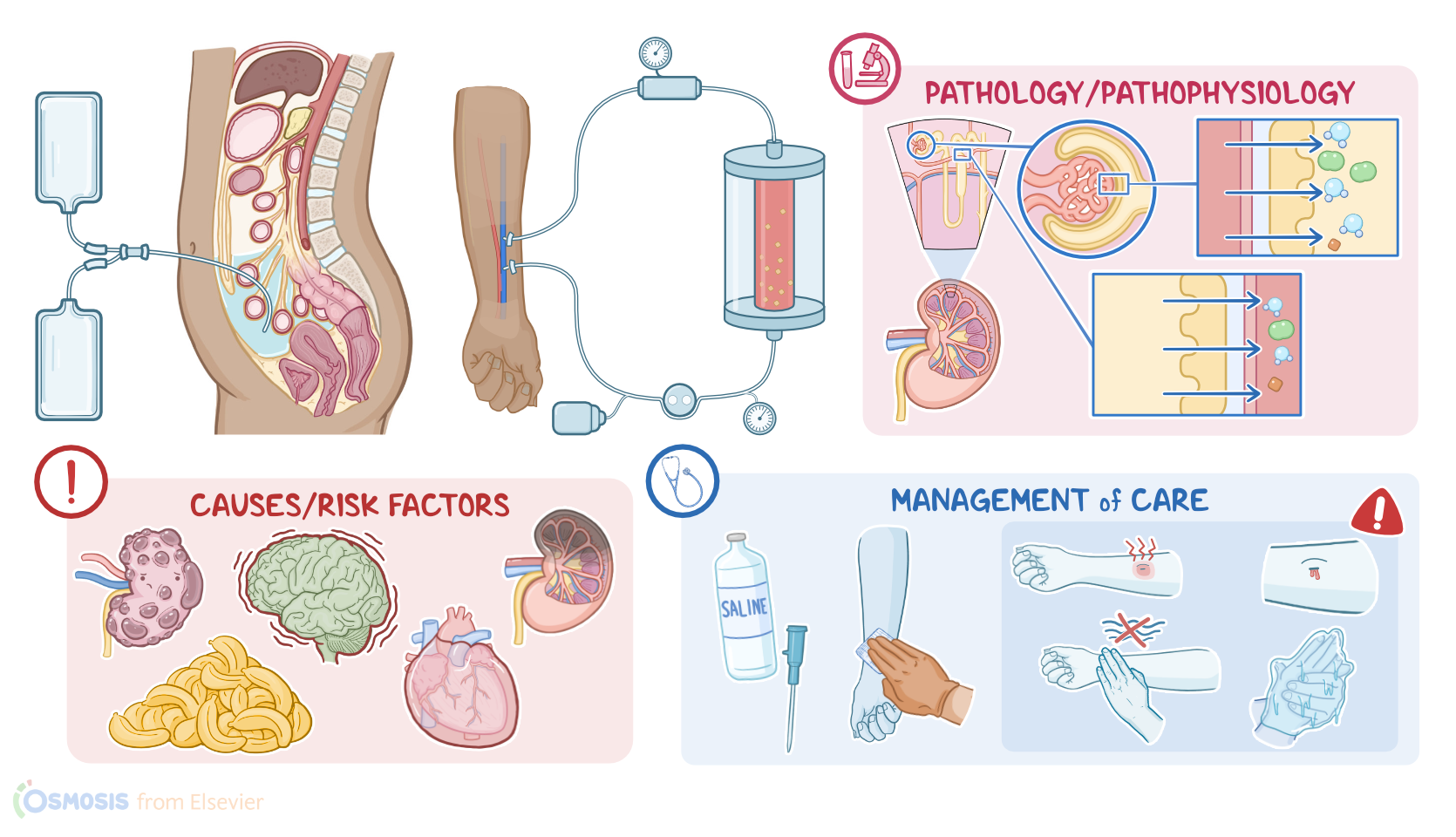
Dialysis is a type of kidney replacement therapy that removes toxic byproducts of protein metabolism, like urea, uric acid, and creatinine; waste products from the blood; as well as excess fluid. Additionally, through dialysis, electrolyte levels and acid-base imbalances can be corrected. There are two types of dialysis: hemodialysis and peritoneal dialysis. Now, let’s review some renal physiology. Each kidney is made up of millions of tiny functional units called nephrons, each of which consist of a renal corpuscle and the renal tubules. The renal corpuscle is where blood filtration happens, and it’s made up of the glomerulus, which is a tiny bundle of capillaries and the Bowman’s capsule, which is a cup-shaped structure surrounding the glomerulus. Blood flows through the glomerulus and then water and small solutes are filtered into Bowman’s capsule, creating an ultrafiltrate of blood. Then this ultrafiltrate goes through the renal tubules, where electrolytes and water can be secreted or reabsorbed.

In addition, they are important in regulating acid-base balance. The kidneys also clear blood of metabolic wasteful substances and toxins. Finally, what leaves the tubules becomes the urine, which flows into the bladder and is excreted during micturition. Okay, now, let’s look at some situations when dialysis is indicated. Most often, clients who require dialysis have end-stage chronic kidney disease, which means the kidneys have lost almost all their function. In this case, both hemodialysis and peritoneal dialysis are adequate long-term options. However, there are some urgent conditions that benefit from dialysis, and hemodialysis is usually preferred in these situations. These clients also usually have associated acute kidney injury.

Indications for urgent dialysis include pulmonary edema unresponsive to conventional treatment; life-threatening hyperkalemia, when potassium levels are over 6.5 mEq/L and there are associated electrocardiographic abnormalities; acidosis unresponsive to conventional treatment; signs of uremia, like encephalopathy or pericarditis; as well as intoxications, especially with methanol or ethylene glycol and certain medication overdoses, like lithium. Now, to perform dialysis on a client, first, you’ll need either vascular access for hemodialysis, or peritoneal access for peritoneal dialysis. Let’s start with hemodialysis, which requires venous access. In an acute setting, a temporary venous access is obtained through a temporary catheter in the subclavian, internal jugular or femoral vein. Clients on chronic hemodialysis need a more permanent access, such as an arterio-venous or AV fistula, where a connection between a small artery and a vein in the arm or less often the leg, is made surgically. Another semi-permanent access is a so-called permanent catheter that can be located in the same veins as the temporary catheter, but it can be used for a long time, is more comfortable for the client, and there’s a lower risk for infection than with the temporary access.

Finally, peritoneal access can be obtained by inserting a silicon rubber catheter in the peritoneal cavity Okay, now let’s look at the principles of dialysis, which are diffusion, osmosis, and ultrafiltration. Diffusion is the movement of solutes from a greater concentration to a lesser concentration until the two solutions have the same concentration of solutes. Osmosis is the health education platform that makes learning easy and fun, but in this case, it refers to the movement of fluid from an area of lesser solute concentration to an area of greater solute concentration. For example, glucose creates an osmotic gradient across the membrane and is able to pull excess fluid through that gradient. Finally, ultrafiltration refers to water and fluid removal according to a pressure gradient across the membrane, so water typically goes from where there’s more of it, like the body of a client with fluid overload, to where there’s less of it, like the other side of the dialysis membrane. Now, to understand how this works, let’s look at the dialysis machine. One of the most important components of the dialysis machine is the dialyzer, through which the client’s blood is filtered. The client will be connected to the dialysis machine using the venous access or the AV fistula using two tubules. One tubule will be responsible for taking the client’s blood and leading it to the dialyzer and the other one will return the filtered blood from the dialyzer.

The dialysis machine also has other important components, like the dialysate which is a type of solution used in the dialyzer to create a pressure gradient that makes diffusion happen. Other components include the blood pumps to help draw blood to the client, an arterial pressure monitor, an air trap or a sensor to detect air bubbles so that we can stop them from getting into the circulation. Finally, the dialysis machine also contains a heparin pump. That’s because anticoagulation is necessary during dialysis due to the risk of blood clots. In clients with a high risk for bleeding, a lower dose of heparin, citrate or no anticoagulation can be used. Finally, let’s look at peritoneal dialysis, which uses the peritoneal membrane as a dialyzer. Through the abdominal catheter, certain solutions can be introduced in the abdominal cavity and dwell in the peritoneal space for a certain amount of time, usually 4 hours. During this time, toxins are filtered through the peritoneal membrane. Afterwards, the fluid is drained and a new solution is introduced into the peritoneal cavity.

Okay, let’s look at the care you’ll provide for a client receiving hemodialysis. Your nursing priorities are to prepare your client for hemodialysis; monitor for complications, and provide psychosocial support. Now, to begin preparing your client for hemodialysis, check their pretreatment laboratory test results and assess their LOC, weight, heart and lung sounds. Also look for the presence of edema. When assessing their vital signs, remember to avoid checking their blood pressure in the extremity with the hemodialysis access site, and place a sign above your client’s bed alerting other care providers which limb has the access site. Then, closely examine their access site, checking for skin breakdown and infection; skin color and temperature; as well as capillary refill and pulses distal to the access site. If your client has an arteriovenous fistula or graft, also be sure to check the site’s patency by auscultating for a bruit, and palpating for a vibration or thrill. Immediately report signs of infection, such as redness, swelling, tenderness, or drainage; decreased pulses, sluggish capillary refill, or cool extremities; or if a bruit or thrill are absent. Then, prepare for additional assessment and interventions to support the function of the hemodialysis access site.