Huntington disease: Nursing
Huntington disease, or HD for short, is a rare hereditary progressive neurodegenerative condition that’s characterized by motor, psychiatric, and cognitive problems. Okay, first, let’s focus on some anatomy and physiology of the brain; specifically, the basal ganglia, which are a collection of nuclei located deep in the brain. These structures help initiate, fine-tune, and complete voluntary movements. To do this, the basal ganglia receive information from the cerebral cortex, and respond by sending information to the thalamus through two pathways: the direct pathway, which is excitatory; and the indirect pathway, which is inhibitory. And there are two main neurotransmitters involved in these pathways: the excitatory neurotransmitter glutamate, and the inhibitory neurotransmitter GABA. A third neurotransmitter, called dopamine, can play both an excitatory and inhibitory role. By using the excitatory and inhibitory pathways, the basal ganglia controls what signals the thalamus sends to the motor cortex, which results in the initiation of voluntary movement.
Now, Huntington disease is caused by a mutation of the HTT gene, which is located on chromosome 4 and is responsible for the synthesis of the huntingtin protein. This mutation is inherited through the autosomal dominant pattern, meaning that one affected copy of a gene is enough to cause the disease. In other words, a person with Huntington disease has a 50% chance of passing on the affected gene to their child, so the most important risk factors are a family history of Huntington disease. The pathology of Huntington disease results from the mutated HTT gene, which codes for a defective huntingtin protein. This defective protein aggregates in the neurons of the basal ganglia, ultimately causing cell death, especially of GABAergic inhibitory neurons. As the disease progresses over time, more neurons continue to die, and eventually, the basal ganglia undergoes significant atrophy. At the same time, there are also increased levels on dopamine, and decreased levels of acetylcholine, and these neurotransmitter imbalances result in aberrant stimulation and inhibition of movement.
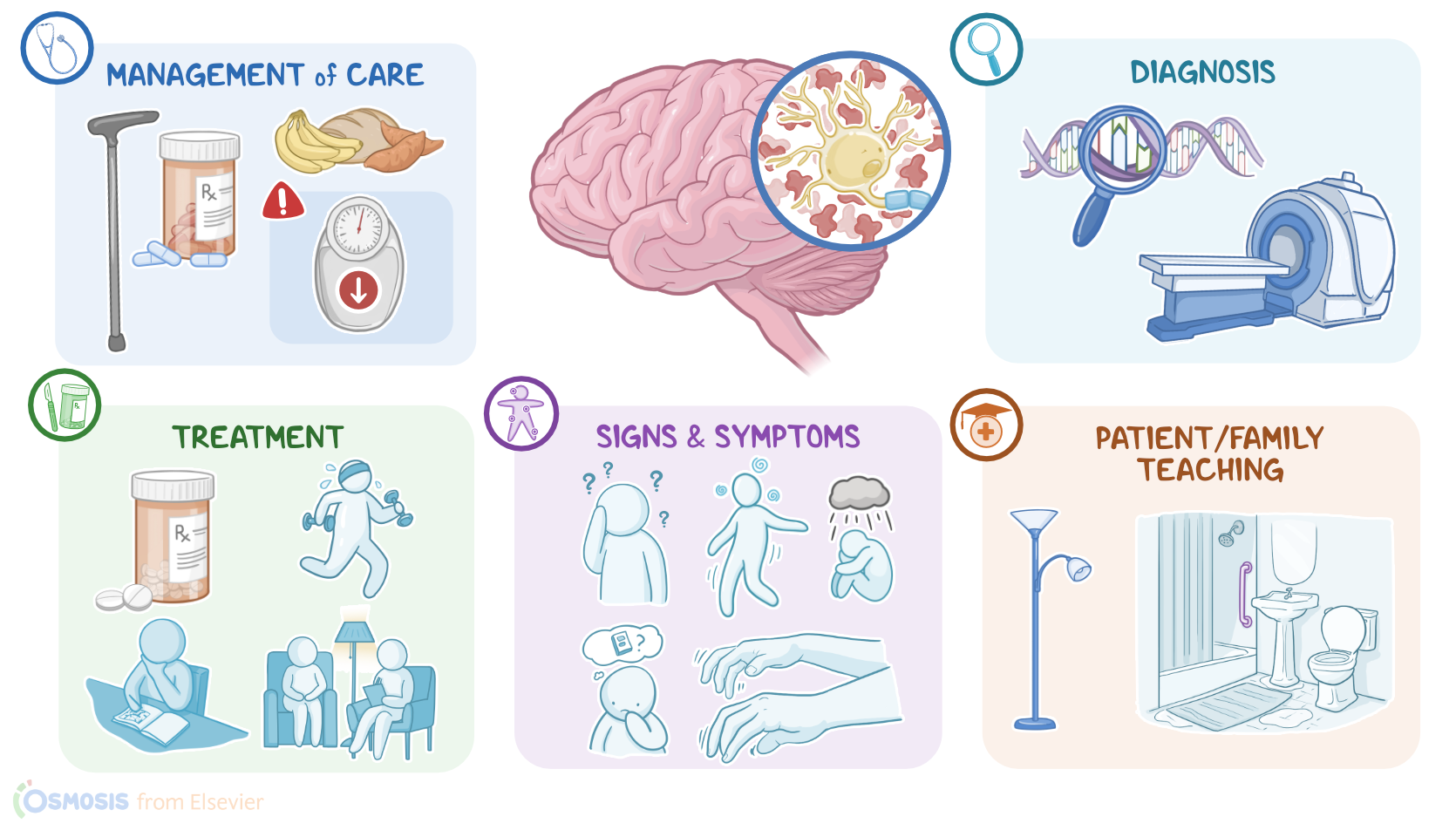
Clinical manifestations of Huntington disease usually occur around 40 years of age, and they include progressive motor, psychiatric, and cognitive manifestations. Motor manifestations include chorea, or involuntary, purposeless, dance-like jerking movements of the limbs and torso; athetosis, or slow, “snake-like” movements that mainly affect the hands; dystonia, which is involuntary muscle contractions that lead to repetitive jerking or twisting movement; dysphagia or trouble swallowing; dysarthria or difficulty speaking; piano playing which involves fidgeting with their hands and wrists with their arms extended; as well as abnormal eye movements, poor coordination, and unsteady gait. On the other hand, psychiatric manifestations include depression, anxiety, and paranoia; while cognitive manifestations include problems with attention, learning, poor impulse control, memory, and even dementia.
| HUNTINGTON DISEASE | ||
| KEY POINTS | NOTES | |
| DEFINITION |
| |
| PHYSIOLOGY |
| |
| CAUSES AND RISK FACTORS |
| |
| PATHOPHYSIOLOGY |
| |
| SIGNS AND SYMPTOMS |
| |
| DIAGNOSIS |
| |
| TREATMENT |
| |
| MANAGEMENT OF CARE |
| |
| PATIENT AND FAMILY TEACHING |
| |
No notes for this video yet
Try adding a note below