Hyperbilirubinemia: Nursing process (ADPIE)

1,107views

Hyperbilirubinemia: Nursing process (ADPIE)

Acute Final

Acute Final

Endocrine system anatomy and physiology
Antepartum assessment - Fetus: Nursing
Assessment of gestational age: Nursing
Fetal circulation: Nursing
Fetal development: Nursing
Group B streptococcus (GBS) infection in pregnancy: Nursing
Hepatitis B virus (HBV) infection in pregnancy: Nursing
Hyperemesis gravidarum: Nursing
Large for gestational age (LGA) infant: Nursing
Preeclampsia and eclampsia: Nursing
Prenatal screening: Nursing
Placenta previa: Nursing process (ADPIE)
Placental abruption: Nursing process (ADPIE)
Birth-related procedures: Nursing
Cesarean birth: Nursing
Intrapartum assessment - Fetal heart rate patterns: Nursing
Intrapartum assessment - Uterine activity: Nursing
Premature rupture of membranes (PROM): Nursing
Shoulder dystocia: Nursing
Prolapsed umbilical cord: Nursing process (ADPIE)
Stages of labor: Nursing
Assessment - Postpartum: Nursing
Perinatal depression: Nursing
Physiology of lactation: Nursing
Postpartum infections: Nursing
Postpartum hemorrhage: Nursing
Biliary atresia: Nursing
Cleft lip and palate: Nursing
Congenital diaphragmatic hernia: Nursing
Congenital heart defects - Acyanotic: Nursing
Congenital heart defects - Cyanotic: Nursing
Esophageal atresia and tracheoesophageal fistula: Nursing
Craniosynostosis: Nursing
Hemolytic disease of the fetus and newborn: Nursing
Hyperbilirubinemia: Nursing process (ADPIE)
Infant of a diabetic mother (IDM): Nursing
Meconium aspiration syndrome: Nursing
Neonatal respiratory distress syndrome (NRDS): Nursing
Neonatal sepsis: Nursing
Neural tube defects: Nursing
Newborn adaptation to extrauterine life: Nursing
Persistent pulmonary hypertension of the newborn (PPHN): Nursing
Physical assessment - Neonate: Nursing
Small for gestational age (SGA) infant: Nursing
Postterm infant: Nursing
Thermoregulation - Neonate: Nursing
Arterial blood gas (ABG) - Overview: Nursing
Arterial blood gas (ABG) - Metabolic acidosis: Nursing
Arterial blood gas (ABG) - Metabolic alkalosis: Nursing
Arterial blood gas (ABG) - Respiratory acidosis: Nursing
Arterial blood gas (ABG) - Respiratory alkalosis: Nursing
Adrenal insufficiency (Addison disease): Nursing
Anemia - Iron-deficiency: Nursing
Anemia - Aplastic: Nursing
Anemia - Macrocytic: Nursing
Case study - Hypothyroidism: Nursing
Case study - Iron-deficiency anemia: Nursing
Case study - Sickle cell anemia: Nursing
Complete blood count (CBC) - Hemoglobin and hematocrit: Nursing
Complete blood count (CBC) - Red blood cells (RBC): Nursing
Complete blood count (CBC) - Platelets: Nursing
Complete metabolic panel (CMP) - Blood urea nitrogen (BUN) and creatinine (Cr): Nursing
Complete metabolic panel (CMP) - Estimated glomerular filtration rate (eGFR): Nursing
Complete metabolic panel (CMP) - Liver function tests (LFT): Nursing
Cushing syndrome and Cushing disease: Nursing
Hematopoietic growth factors: Nursing pharmacology
Hyperparathyroidism: Nursing
Hyperthyroidism: Nursing process (ADPIE)
Hypoparathyroidism: Nursing
Hyperpituitarism: Nursing
Hypopituitarism: Nursing
Hypothyroidism: Nursing process (ADPIE)
Medications affecting the parathyroid glands: Nursing pharmacology
Medications for growth hormone disorders: Nursing pharmacology
Medications for thyroid disorders: Nursing pharmacology
Neutropenia: Nursing
Polycythemia: Nursing
Thrombocytopenia: Nursing
Acute kidney injury (AKI): Nursing process (ADPIE)
Benign prostatic hyperplasia (BPH): Nursing process (ADPIE)
Case study - Cholecystitis: Nursing
Case study - Cirrhosis: Nursing
Case study - Chronic kidney disease (CKD): Nursing
Case study - Benign prostatic hyperplasia (BPH): Nursing
Case study - Gastroesophageal reflux disease (GERD): Nursing
Case study - Pediatric appendicitis: Nursing
Case study - Pyelonephritis: Nursing
Cholecystitis: Nursing
Cholelithiasis: Nursing
Chronic kidney disease (CKD): Nursing
Cirrhosis: Nursing process (ADPIE)
Diverticular disease: Nursing
Gastroesophageal reflux disease (GERD): Nursing process (ADPIE)
Hemolytic uremic syndrome: Nursing
Hirschsprung disease: Nursing
Intestinal obstruction: Nursing
Irritable bowel syndrome (IBS): Nursing
Nephrotic syndrome: Nursing
Pyloric stenosis: Nursing process (ADPIE)
Renal and urinary calculi: Nursing
Urinary incontinence - Stress: Nursing process (ADPIE)
Diabetes insipidus: Nursing process (ADPIE)
Dialysis care: Nursing
Case study - Diabetic ketoacidosis (DKA): Nursing
Case study - Pediatric diabetes mellitus type 1: Nursing
Diabetes mellitus (DM): Nursing process (ADPIE)
Hyperosmolar hyperglycemic state (HHS): Nursing process (ADPIE)
Diabetic ketoacidosis (DKA): Nursing process (ADPIE)
Case study - Epilepsy: Nursing
Case study - Head injury: Nursing
Epidural and subdural hematoma: Nursing
Case study - Stroke: Nursing
Hemorrhagic stroke - Intracranial hemorrhage (ICH) and subarachnoid hemorrhage (SAH): Nursing
Increased intracranial pressure (ICP): Nursing
Hydrocephalus: Nursing process (ADPIE)
Intracranial aneurysm: Nursing
Seizure disorder: Nursing process (ADPIE)
Stroke: Nursing process (ADPIE)
Jaundice: Nursing
Nutrition - Enteral: Nursing skills
Nutrition - Newborn: Nursing
Nutrition - Parenteral: Nursing skills
Phenylketonuria (PKU): Nursing
Arterial embolism: Nursing
Disseminated intravascular coagulation (DIC): Nursing
Hemophilia: Nursing process (ADPIE)
Acute respiratory distress syndrome (ARDS): Nursing
Asthma: Nursing process (ADPIE)
Atelectasis: Nursing
Bacterial pneumonia: Nursing process (ADPIE)
Bronchiolitis and respiratory syncytial virus (RSV): Nursing process (ADPIE)
Case study - Acute respiratory distress syndrome (ARDS): Nursing
Care of an intubated client: Nursing skills
Case study - Chronic obstructive pulmonary disease (COPD): Nursing
Case study - Impaired gas exchange: Nursing
Case study - Pediatric asthma: Nursing
Chest tube care: Nursing
Chronic obstructive pulmonary disease (COPD): Nursing process (ADPIE)
Cystic fibrosis: Nursing
Epiglottitis: Nursing process (ADPIE)
Flail chest: Nursing
Intraoperative care: Nursing
Pleural effusion: Nursing
Pneumothorax and hemothorax: Nursing
Pulmonary edema: Nursing
Smoke inhalation injury: Nursing process (ADPIE)
Tracheostomy: Nursing
Venous thromboembolism (VTE): Nursing process (ADPIE)
Arrhythmias - Asystole: Nursing
Arrhythmias - Atrial flutter (Aflutter): Nursing
Arrhythmias - Premature atrial contractions (PACs): Nursing
Arrhythmias - Heart blocks: Nursing
Arrhythmias - Atrial fibrillation (Afib): Nursing
Arrhythmias - Premature ventricular contractions (PVCs): Nursing
Arrhythmias - Sinus tachycardia and sinus bradycardia: Nursing
Arrhythmias - Supraventricular tachycardia (SVT): Nursing
Arrhythmias - Ventricular fibrillation (Vfib): Nursing
Arrhythmias - Ventricular tachycardia (Vtach): Nursing
Cardiac biomarkers - Troponin: Nursing
Case study - Acute coronary syndrome (ACS): Nursing
Case study - Atrial fibrillation (Afib): Nursing
Case study - Heart failure with reduced ejection fraction (HFrEF): Nursing
Case study - Deep vein thrombosis (DVT): Nursing
Case study - Hypertension: Nursing
Case study - Hypovolemic shock: Nursing
Coronary artery disease (CAD) and angina pectoris: Nursing process (ADPIE)
Electrocardiogram (ECG) - Normal sinus rhythm (NSR): Nursing
Heart defects that decrease pulmonary blood flow - Nursing considerations & client education: Nursing
Hypertension: Nursing process (ADPIE)
Left-sided heart failure: Nursing process (ADPIE)
Myocardial infarction (MI): Nursing process (ADPIE)
Pericardial effusion and cardiac tamponade: Nursing process (ADPIE)
Peripheral arterial disease (PAD): Nursing process (ADPIE)
Rheumatic heart disease: Nursing process (ADPIE)
Shock - Cardiogenic: Nursing
Shock - Neurogenic: Nursing
Shock - Obstructive: Nursing
Shock - Septic: Nursing
Sickle cell disease: Nursing process (ADPIE)
Valvular heart disease: Nursing

Notes

HYPERBILIRUBINEMIA

KEY POINTS
NOTES
PATIENT REPORT
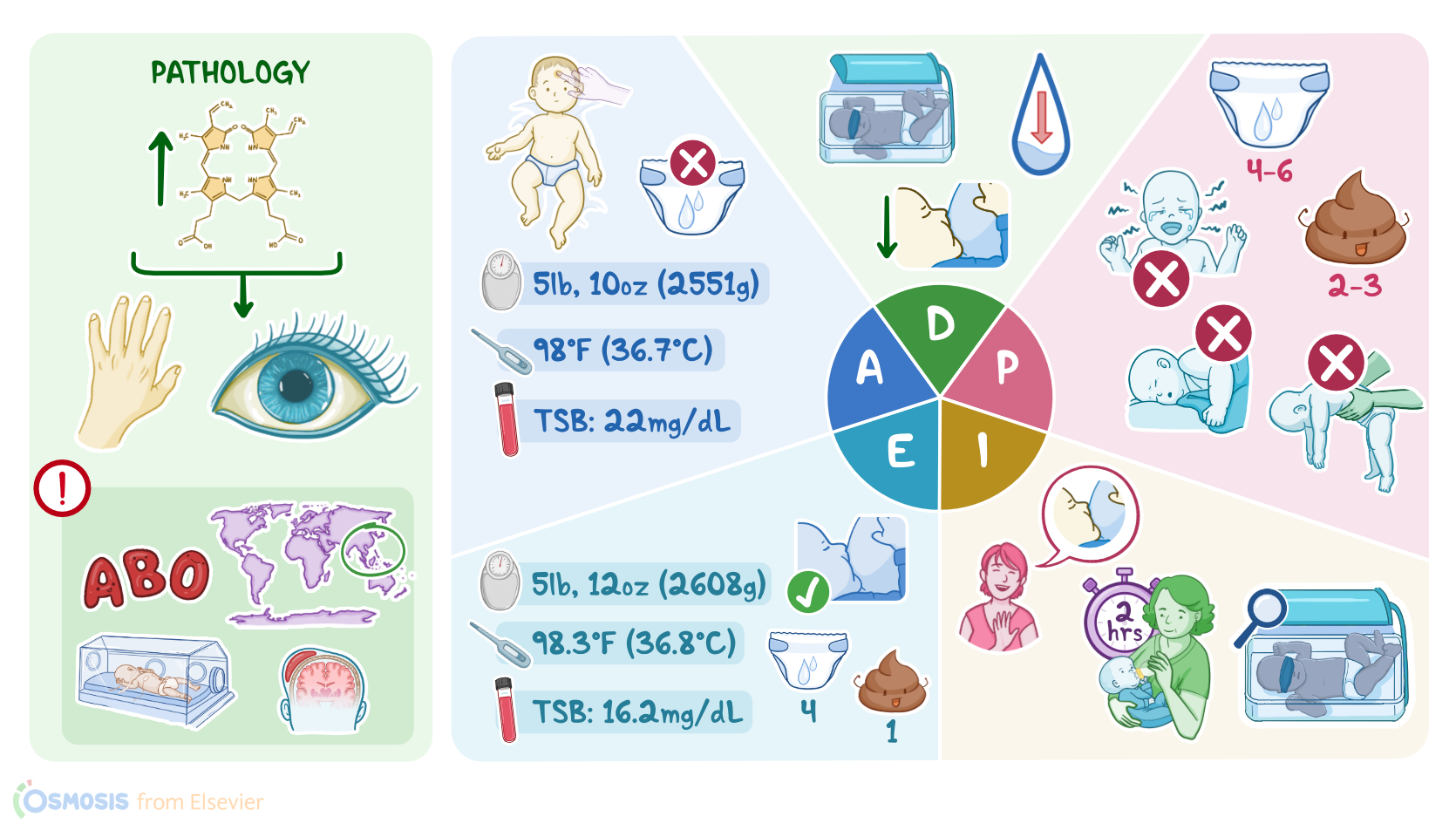
  • 4-day-old girl
  • Breastfed
  • Less time suckling, falls asleep during feedings
  • Less active
  • 1 stool/day x2 days
  • Yellow tongue to sclerae 
  • Total serum bilirubin (TSB): 18.2 mg/dL
  • Diagnosis: hyperbilirubinemia

PATHOPHYSIOLOGY
  • Hyperbilirubinemia
    • Increase in TSB
    • Bilirubin deposits in skin, sclerae, and mucous membranes causing jaundice
    • Unconjugated
      • Increased breakdown of red blood cells or liver unable to conjugate bilirubin that's produced
    • Conjugated 
      • Liver unable to excrete bile
  • Risk factors
    • Gestational diabetes
    • ABO or Rh incompatibility 
    • Preterm birth
    • Low birth weight
    • East Asian race
    • Genetic disorders
    • Birth injuries
  • Bilirubin
    • Conjugated
      • Excreted as bile by the liver
    • Unconjugated
      • Waste product of red blood cell breakdown
      • Conjugated to glucuronic acid

DIAGNOSIS AND TREATMENT
  • Diagnosis
    • History
    • Physical assessment
    • TSB 
  • Treatment
    • Phototherapy
    • Exchange transfusion

ASSESSMENT
  • Generalized yellow hue
  • Sleepy
  • Wakes for feeding with prompting
  • Few wet/dirty diapers
  • Warm
  • Strong pulses
  • Soft, flat fontanelles
  • Unlabored respirations
  • Lungs clear
  • Temperature: 98.0 F (36.7 C)
  • Heart rate: 126
  • Respiratory rate: 45
  • Blood pressure: 71/42 mmHg
  • Oxygen saturation: 98% room air
  • 10 ounces (2551 g)
  • Pain: 0/10
  • Hemoglobin: 19.8 g/dL
  • Hematocrit: 55%
  • Platelets: 310,000/mm3
  • TSB: 22 mg/dL
  • O+ 
  • DAT negative

NURSING DIAGNOSES
  • Neonatal hyperbilirubinemia related to deficient breastfeeding patterns
  • Risk for fluid volume deficit related to inadequate oral intake
  • Risk for injury related to exposure to phototherapy lights
  • Ineffective breastfeeding related to sleepy infant and impaired milk transfer

PLANNING
  • TSB will decrease
  • Remain neurologically intact
  • Receive breast milk and supplemental formula as needed
  • Increase wet/dirty diapers
  • Stabilize weight
  • Maintain temperature
  • No rash or skin breakdown
  • Eyes remain free of damage

IMPLEMENTATION
  • Place under phototherapy lights
  • Observe neurological status, temperature, and TSB
  • Ensure eyes remain covered
  • Monitor skin
  • Prompt diaper changes
  • Consult lactation consultant
  • Encourage caregiver participation
  • Provide discharge teaching

EVALUATION
  • More alert
  • TSB: 16.2 mg/dL
  • Increase in wet/dirty diapers
  • 5 lbs, 12 ounces (2608 g)
  • Temperature: 98.3 F (36.8 C)
  • No skin breakdown or rash
  • Mother confidently breastfeeding

Transcript

Watch video only

Charlotte Simpson is a 4-day-old female born by spontaneous vaginal delivery at 36 weeks of gestation, weighing 6 pounds, 11 ounces, or 3034g.

At the time of discharge, Mrs. Simpson, G1P1, was breastfeeding well and Charlotte had no evidence of jaundice.

Two days later Mrs. Simpson brings Charlotte to the pediatrician’s office. She reports that Charlotte had been spending less time suckling during feedings and would fall asleep after nursing only a couple of minutes.

She says that Charlotte has been less active, and has had just one stool per day for the past two days. She also noticed that the whites of her eyes have developed a yellowish tinge.

A total serum bilirubin, or TSB, of 18.2 mg/dL confirms a diagnosis of hyperbilirubinemia and Charlotte is admitted to the pediatric unit for phototherapy. Hyperbilirubinemia refers to the increase in total serum bilirubin levels.

This often results in the deposition of bilirubin in the skin, sclera, and mucous membranes, causing a yellowish pigmentation known as jaundice.

Now, there are some risk factors that can make hyperbilirubinemia more likely to occur.

These include gestational diabetes, an ABO blood group or Rh incompatibility between mother and baby, as well as preterm birth before 37 weeks, low birth weight below 1,500 grams, and being of East Asian race.

Other factors that increase the risk of hyperbilirubinemia include genetic disorders like glucose-6-phosphate disease, as well as birth injuries like bruising or cephalohematoma, which is when blood accumulates under the scalp caused by pressure during labor.

Now, there’s two types of bilirubin: unconjugated and conjugated. Unconjugated or indirect bilirubin is a waste product that results from the breakdown of red blood cells.

Unconjugated bilirubin is later linked or conjugated with glucuronic acid to produce conjugated or direct bilirubin, which can be excreted as bile by the liver into the small intestines.

So, what’s causing the hyperbilirubinemia largely depends on whether too much bilirubin is being produced, or too little is being excreted.

Unconjugated hyperbilirubinemia in newborns occurs when there’s an increased breakdown of red blood cells or the liver is unable to conjugate all the bilirubin that is produced.

The most common cause of unconjugated hyperbilirubinemia is physiologic jaundice of the newborn, also called benign neonatal hyperbilirubinemia.

This may occur because newborns have a great turnover and breakdown of red blood cells, but the liver is still relatively immature and inefficient at conjugating and excreting bilirubin.

This typically manifests after the first 24 hours from birth, and resolves within one to two weeks.

Another common cause of unconjugated hyperbilirubinemia is breast milk jaundice. The exact cause is unclear, but it is thought to be caused by substances within the milk itself, which inhibits the enzyme glucuronyl transferase, that converts unconjugated to conjugated bilirubin in the liver.

Breast milk jaundice usually occurs after 7 to 10 days of life, and eventually resolves, so continued breastfeeding is recommended.

There’s also breastfeeding jaundice, which instead is caused by decreased or poor intake of breast milk.

As a result, there is inadequate stooling and thus decreased elimination of bilirubin by stool, so the bilirubin gets reabsorbed into the blood.

Breastfeeding jaundice typically occurs during the first week of life, and is associated with mild dehydration and weight loss. This can usually be managed by increasing frequency and duration of breastfeeding.

Finally, a less frequent cause of unconjugated hyperbilirubinemia is hemolytic disease of the newborn, which occurs when the baby’s red blood cells are attacked by maternal antibodies that cross the placenta during pregnancy and attack the baby’s red blood cells either due to ABO blood group or Rh incompatibility.

Unconjugated hyperbilirubinemia is usually benign, but it can cause complications if the amount of unconjugated bilirubin rises a lot.

Since unconjugated bilirubin is fat-soluble, it can cross the blood brain barrier and deposit in the brain, leading to kernicterus.

Kernicterus can cause damage to the brain, resulting in symptoms like lethargy and poor feeding, and can progress to stupor, hypotonia, seizures, and even death.

On the other hand, conjugated hyperbilirubinemia is way less frequent in newborns. This occurs when the liver is unable to excrete bilirubin.

This typically happens in genetic conditions like Dubin-Johnson or Rotor syndrome, as well as infections like hepatitis or TORCH infections, and obstructions of the biliary tract.

Diagnosis of hyperbilirubinemia begins with history and physical examination of a newborn with jaundice.

A transcutaneous bilirubinometer or TcB can be used to measure the bilirubin levels. To confirm the diagnosis, a total serum bilirubin, or TSB, blood test should be done.

The TSB or TsB is plotted on an age-specific, percentile-based nomogram, referred to as the Bhutani nomogram.

Infants with hour-specific values equal or above the 95th percentile are at increased risk for developing severe hyperbilirubinemia that can evolve to bilirubin-induced neurologic dysfunction.

TSB also allows us to distinguish between unconjugated and conjugated hyperbilirubinemia, as well as a complete blood count, which may reveal anemia if there’s hemolysis, and elevated liver enzymes if there’s liver dysfunction.

Finally, a direct Coombs test, also known as the direct antiglobulin test, or DAT, can be done to check for blood incompatibility. Treatment of hyperbilirubinemia depends on the cause, and often self-resolves.

Newborns with severe unconjugated hyperbilirubinemia may benefit from non-UV phototherapy, which converts unconjugated bilirubin into a more water-soluble form that can be excreted by the body.

If phototherapy fails, then an exchange transfusion is indicated to remove the excess bilirubin from blood.