Hyperosmolar hyperglycemic state (HHS): Nursing process (ADPIE)

Last updated: January 26, 2022

Hyperosmolar hyperglycemic state (HHS): Nursing process (ADPIE)

Watch later

Watch later

Multiple sclerosis
Disseminated intravascular coagulation (DIC): Nursing
Post-transplant lymphoproliferative disorders (NORD)
Antirejection immunosuppressants: Nursing pharmacology
Hypersensitivity reactions - Type IV: Nursing
Type III hypersensitivity
Acid-base disturbances: Pathology review
Adrenal insufficiency (Addison disease): Nursing
Hyperparathyroidism: Nursing
Hyperpituitarism: Nursing
Hypoparathyroidism: Nursing
Hypopituitarism: Nursing
Infant of a diabetic mother (IDM): Nursing
Phenylketonuria (PKU): Nursing
Diabetes insipidus: Nursing process (ADPIE)
Diabetes mellitus (DM): Nursing process (ADPIE)
Diabetic ketoacidosis (DKA): Nursing process (ADPIE)
Hyperosmolar hyperglycemic state (HHS): Nursing process (ADPIE)
Hyperthyroidism: Nursing process (ADPIE)
Hypothyroidism: Nursing process (ADPIE)
Syndrome of inappropriate antidiuretic hormone (SIADH): Nursing process (ADPIE)
Glucocorticoids and mineralocorticoids: Nursing pharmacology
Insulin: Nursing pharmacology
Medications affecting the parathyroid glands: Nursing pharmacology
Medications for antidiuretic hormone (ADH) disorders: Nursing pharmacology
Medications for thyroid disorders: Nursing pharmacology
Medications for growth hormone disorders: Nursing pharmacology
Non-insulin injectable antidiabetic drugs - GLP-1 agonists and amylinomimetics: Nursing pharmacology
Oral antidiabetic medications - Alpha-glucosidase inhibitors: Nursing pharmacology
Oral antidiabetic medications - Biguanides and thiazolidinediones: Nursing pharmacology
Oral antidiabetic medications - DPP-4 inhibitors: Nursing pharmacology
Oral antidiabetic medications - Sodium-glucose co-transporter-2 (SGLT-2) inhibitors: Nursing pharmacology
Oral antidiabetic medications - Sulfonylureas and meglitinides: Nursing pharmacology
Adaptive teaching
Cushing syndrome and Cushing disease: Nursing
Chest tube care: Nursing

Notes

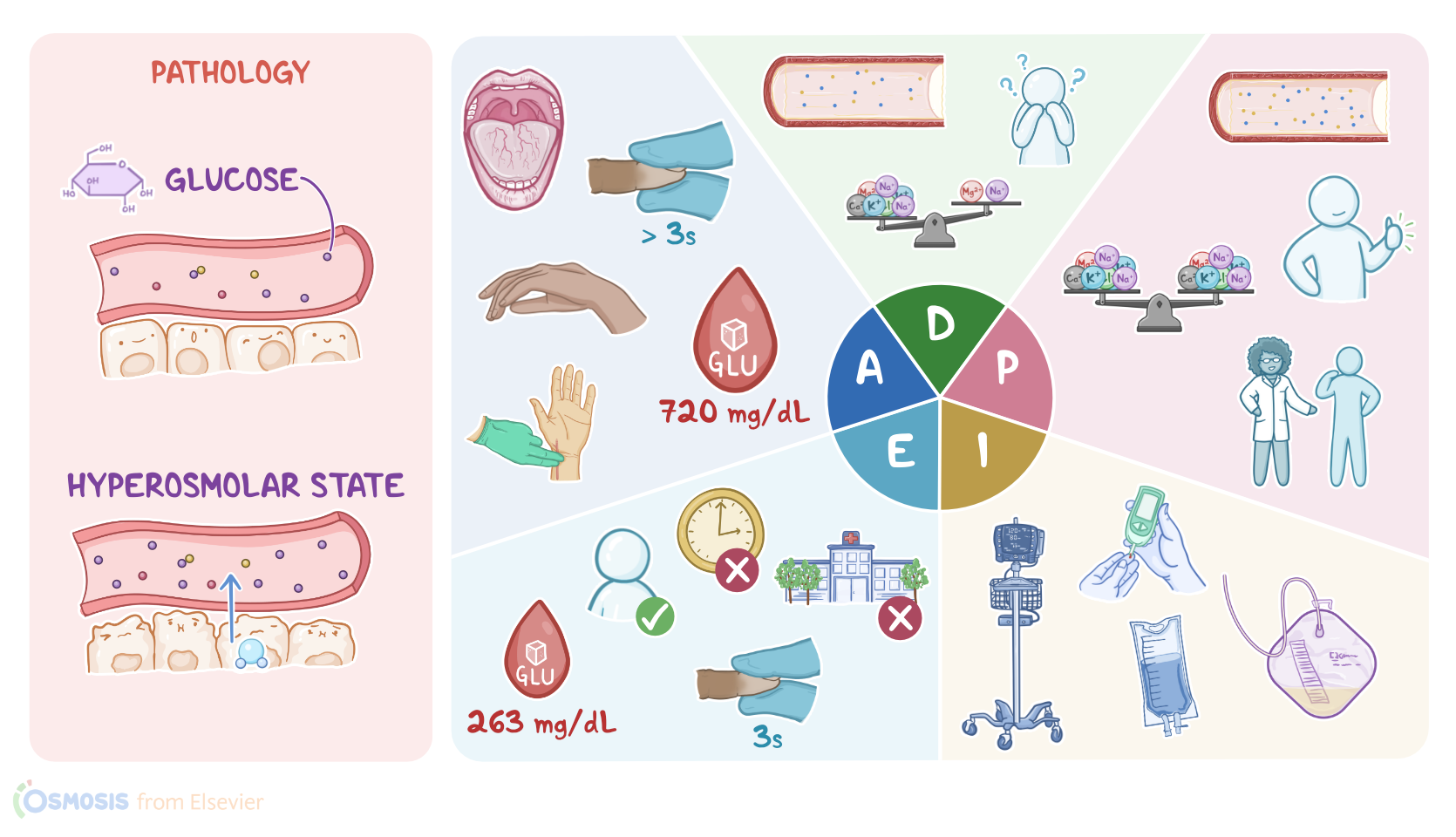
HYPEROSMOLAR HYPERGLYCEMIC STATE (HHS)

KEY POINTS
NOTES
PATIENT REPORT
  • 68-year-old man
  • History poorly controlled type 2 diabetes
  • Recent viral pneumonia
  • Increased thirst and urination
  • Fatigue
  • Confused
  • Glucose: >600 mg/dL (33.3 mmol/L)
  • Diagnosis: HHS

PATHOPHYSIOLOGY
  • HHS
    • Type 2 more often than type 1
    • Glucose >600 mg/dL (> 33.3 mmol/L)
    • Blood osmolarity > 320 mOsm/kg
  • Osmolality
    • Concentration of dissolved particles in blood
      • Example: glucose
    • 285-295 mOsm/kg
  • Glucose
    • Fasting: <100 mg/dL (5.6 mmol/L)
    • 2 hours post-meal: <140 mg/dL (<78.8 mmol/L)
    • Polar molecule
    • Needs insulin to enter cells
    • Draws water into blood vessels if remains in circulation
  • Risk factors
    • Type 2 diabetes
    • Older age
    • Impaired cognition
    • Impaired thirst perception
    • Non-adherence
    • Acute conditions
    • Certain medication use
    • Surgery
  • Signs and symptoms
    • Extreme thirst
    • Dry mouth
    • Decreased skin turgor
    • Anhidrosis
    • Poor capillary refill
    • Hypotension
    • Tachycardia
  • Complications
    • Seizures
    • Cerebral edema
    • Myocardial infarction
    • Stroke
    • Death

DIAGNOSIS AND TREATMENT
  • Diagnosis
    • History
    • Physical assessment
    • Laboratory tests
  • Treatment
    • IV fluids
    • Electrolyte replacement
    • IV insulin

ASSESSMENT
  • Fatigued
  • Sunken eyes
  • Confused
  • Dry mucous membranes
  • Warm, dry skin with poor turgor
  • Capillary refill > 3 seconds
  • Heart sounds normal
  • Rapid, +2 peripheral pulses
  • Crackles
  • Bowel sounds active
  • Difficulty recalling words
  • Drowsy
  • Temperature: 99.9 F (37.7 C)
  • Heart rate: 110
  • Respirations: 18
  • Blood pressure: 97/68 mmHg
  • Oxygen saturation: 96%
  • Glucose: 720 mg/dL (40 mmol/L)
  • A1C: 10.5%
  • Serum osmolarity: 360 mOsm/kg
  • Serum and urine ketones: negative
  • pH: 7.42
  • Bicarbonate: 23 mEq/L (23 mmol/L)
  • Sodium: 135 mEq/L (135 mmol/L)
  • Potassium: 3.8 mEq/L (3.8 mmol/L)
  • BUN: 28 mg/dL (10 mmol/L)
  • Creatinine: 1.8 mg/dL (159.1 μmol/L)
  • Glyburide

NURSING DIAGNOSES
  • Deficient fluid volume related to unstable glucose
  • Risk for electrolyte imbalance related to dehydration
  • Acute confusion related to dehydration
  • Ineffective health maintenance related to non adherence

PLANNING
  • Restore fluid balance
  • Maintain electrolyte balance
  • Improve mental status
  • Follow plan for maintenance 

IMPLEMENTATION
  • Delegate care appropriate to patient care technician
  • Administer medications as prescribed 
  • Insert catheter
  • Construct teaching plan for discharge

EVALUATION
  • Less drowsy
  • Oriented to person
  • Peripheral pulses 3+
  • Capillary refill 3 seconds
  • Glucose: 263 mg/dL (14.6 mmol/L)
  • Sodium: 139 mEq/L (139 mmol/L)
  • Potassium: 3.5 mEq/L (2.5 mmol/L)
  • Temperature: 99.0 F (37.2 C)
  • Heart rate: 86
  • Respirations: 16
  • Blood pressure: 110/70 mmHg
  • Oxygen saturation: 96% room air
  • Pain: 0/10

Transcript

Watch video only

Malcolm Johnson is a 68-year-old male client with a history of poorly controlled type 2 diabetes mellitus who recently recovered from viral pneumonia.

Over the past few days, he has felt more thirsty than usual, has been urinating frequently, and has felt fatigued.

This morning his son, Kyrone, noticed his father seemed confused, so he checked Mr. Johnson’s blood sugar and the reading was 685 mg/dL.

Kyrone promptly brought Mr. Johnson to the emergency department. Lab results revealed elevated serum glucose, elevated serum osmolarity, and negative serum ketones.

Mr. Johnson is being admitted to the medical intensive care unit for hyperosmolar hyperglycemic state.

Hyperosmolar hyperglycemic state, or HHS for short, is a metabolic complication of diabetes mellitus, more often in type 2 than type 1 diabetes.

HHS occurs when the blood glucose levels go really high, over 600 mg/dL, which leads to extremely increased urination, or polyuria.

This ultimately causes severe dehydration, resulting in a blood osmolarity of over 320 mOsm/kg.

Now, osmolality is the concentration of dissolved particles in the blood, and one of the major particles is glucose.

Normally, blood glucose levels should be lower than 100 mg/dL while fasting for over 8 hours, and lower than 140 mg/dL 2 hours after eating; so normal blood osmolality is maintained between 285 and 295 mOsm/kg.

Glucose is a polar molecule, which means it cannot passively diffuse across cell membranes, so it needs insulin to regulate its membrane transport into the cells.

As a consequence, when it is increased, it remains in the blood vessels and causes a hyperosmolar state that draws water into the blood.

As a result, water begins to leave the body’s cells and enter the blood vessels, leaving the cells relatively dry and shriveled.

The excess of water within blood vessels is eliminated via urination, which leads to polyuria and severe total body dehydration.

Now, HHS mainly occurs in clients with uncontrolled type 2 diabetes, leading to hyperglycemia,

There’s a higher risk of HHS in older clients, especially those with impaired cognitive function or thirst perception, as well as those who do not adhere to their treatment regimen for diabetes.

Other risk factors include acute conditions, such as an infection, a stroke, or myocardial infarction.

Finally, there’s increased risk of HHS among clients who take medications like glucocorticoids, which impair glucose tolerance, or diuretics, which increase urination, as well as having surgery, which puts the body under metabolic stress.

Okay, now HHS typically presents with polyuria associated with symptoms of severe dehydration, like extreme thirst, dry mouth, decreased skin turgor, anhidrosis or decreased sweating, and poor capillary refill. In addition, clients may develop hypotension and tachycardia.

If not promptly treated, severe dehydration can affect the brain, causing neurological symptoms that range from lethargy, weakness, confusion, and hallucinations, to severe complications, like seizures, and may quickly deteriorate to cerebral edema, potentially leading to coma.

Other complications of HHS include myocardial infarction, stroke, and even death.Okay, now the diagnosis of HHS typically starts with history and physical examination.

In addition, a blood test would show severe hyperglycemia and an increased blood osmolality. BUN and creatinine are also markedly elevated.

On the other hand, electrolytes like sodium and potassium can be decreased, and there’s usually no acidosis, and no or minimal ketone bodies in urine.

Treatment of HHS includes aggressive IV fluids and electrolyte replacement, followed by IV insulin to reduce glucose levels.

Okay, you’re ready to begin Mr. Johnson’s assessment. Mr. Johnson appears fatigued with sunken eyes and is looking around the room asking where he is.

His oral mucous membranes are dry; he has warm, dry skin with poor turgor; capillary refill is more than 3 seconds.