Infant of a diabetic mother (IDM): Nursing
Introduction0:00–0:20
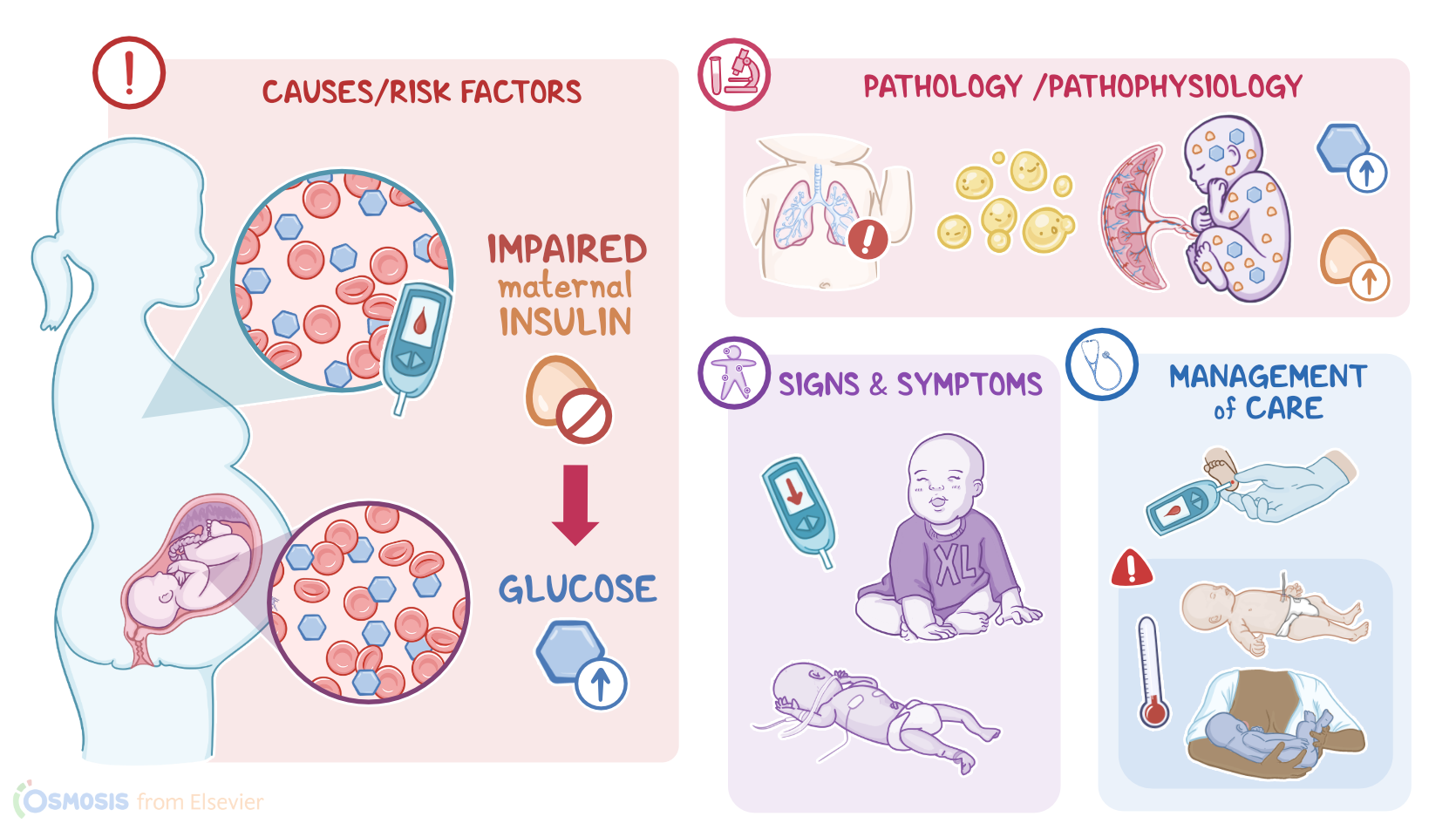
Infants of mothers with diabetes, or IDMs for short, have a higher risk of developing fetal and neonatal complications, including growth abnormalities, respiratory distress, and metabolic complications, in addition to preterm delivery.Alright, let’s take a look at the physiology of glucose metabolism during pregnancy.
Physiology0:20–1:12
During fetal development, all of the nutrients the fetus receives come directly from the mother's blood through the placenta.
Glucose is the primary source used by the fetus for growth and development. Fetal insulin reduces blood glucose by binding to insulin receptors embedded in the cell membrane.
When activated, the insulin receptors allow glucose to be transported into the cell, thereby moving glucose from the blood and into the tissues.
During pregnancy, hormones released by the placenta increase the mother’s body’s resistance to insulin, resulting in higher levels of maternal blood glucose.
These metabolic changes allow the fetus to receive a steady supply of glucose necessary for fetal growth and development.Now, diabetes occurs when the body’s ability to produce or respond to the hormone insulin is impaired, resulting in higher blood glucose levels.
Causes & risk factors1:12–1:48
Diabetes in pregnancy can be either pregestational, which is where diabetes is diagnosed before pregnancy; or gestational, which is where mothers without previously diagnosed diabetes have high blood glucose levels during pregnancy, especially during their third trimester.
The risk of fetal and neonatal complications increases with higher maternal glucose levels or BMI. Now, pathology-wise, poor glucose control at the time of conception and during the first trimester can interfere with organogenesis in the embryo, resulting in major birth defects and spontaneous abortions early in pregancy; and this most common with pregestational diabetes, because blood glucose is more likely to be elevated around the time of conception and during the first trimester when the fetal organs are being formed.
Pathology1:48–5:02
On the other hand, with gestational diabetes, glucose control isn’t usually impaired until the second or third trimester.
By that time, fetal organs are almost fully developed and congenital birth defects are much more rare.Now, regardless of the type of diabetes, large amounts of glucose from the mother are transferred to the fetus.
High levels of insulin interferes with normal lung development and decreases surfactant production. Hyperinsulinemia also increases the metabolic rate of the fetus which increases the need for oxygen, increasing the risk of fetal hypoxia.
Hypoxia stimulates erythropoiesis, increased production of RBCs, which ultimately leads to polycythemia.The excess glucose in the fetal blood also increases fat deposits in the subcutaneous tissues and other organs like the liver, heart, and muscle.
This causes the fetus to grow much larger than normal, resulting in neonatal macrosomia, meaning that the newborn weighs 4,000 g or more.
On the flip side, mothers who have diabetic-related vascular disease tend to have poorly functioning placentas, and this results in placental insufficiency, which means the flow of oxygen-rich blood through the placenta and to the developing fetus is impaired, resulting in intrauterine growth restriction, or IUGR for short.Now, after delivery, the newborn’s insulin level remains high, but the supply of glucose is abruptly cut off when the umbilical cord is cut.
So, the most common complication in the neonatal period is hypoglycemia. Other complications include birth injuries due to macrosomia, since the larger body size makes vaginal delivery more difficult, and increases the risk for trauma during birth, including brachial plexus or facial nerve injury, clavicular or humeral fractures, cephalohematoma, or subdural hemorrhage.
Respiratory distress is a common complication due to lung immaturity; as well as polycythemia-related problems like hyperbilirubinemia caused by the breakdown of an increased number of circulating red blood cells; as well as hyperviscosity, which can lead to a sluggish blood flow, ischemia, and thrombosis of vital organs.
There are also complications related to congenital birth defects like heart or neural tube defects; and lastly, infants of diabetic mothers are at increased risk of preterm delivery and associated complications.Alright, in terms of clinical manifestations, most infants of mothers with diabetes have a macrosomic appearance, with a round puffy face, plethoric or ruddy skin, a larger body, and a higher than normal birth weight.
On the other hand, infants with IUGR typically present with low birthweight, decreased subcutaneous fat and muscle mass, and a thin umbilical cord.
Now, in cases where there’s newborn hypoglycemia, clinical manifestations may include irritability, jitteriness, lethargy, difficulty feeding, and seizures.
Clinical manifestations5:02–5:59
In the case of hyperbilirubinemia, the infant’s skin and mucous membranes can take on a yellowish color, a condition known as neonatal jaundice.
Finally, newborns with impaired lung development may exhibit signs of respiratory distress, like tachypnea, respiratory retractions, and nasal flaring shortly after birth.Alright, the diagnosis of infants of mothers with diabetes starts with prenatal history and physical assessment of both mother and baby.
During pregnancy, maternal blood glucose levels and intrauterine fetal growth is part of the diagnosis. Newborn assessment focuses on identifying any problems that may require immediate attention, including measuring blood glucose levels to screen for hypoglycemia; hematocrit levels to check for polycythemia; measuring bilirubin levels; as well as assessing for any electrolyte imbalances, such as hypocalcemia and hypomagnesemia.
Diagnosis5:59–6:48
A chest X-ray is usually performed to identify birth trauma and an echocardiogram can identify congenital heart anomalies.Now, in cases where preterm birth is expected, treatment includes giving maternal steroids before birth to help the fetal lungs mature and reduce the risk of respiratory distress.
In cases of fetal macrosomia, plans are put in place for cesarean birth if vaginal delivery is not possible. Newborns with hypoglycemia are given glucose orally, by gavage tube, or by IV.
If no other significant complications are found, then routine newborn care should be provided. Finally, prevention of fetal and newborn complications is aimed at controlling the mother’s blood glucose levels throughout pregnancy.Alright, let’s take a look at the nursing care you’ll be providing for an infant of a diabetic mother.
Treatment6:48–7:28
Your priority goals are to maintain stable blood glucose levels and provide supportive care.Now, once the infant has been stabilized after delivery, quickly check the glucose level.
If the infant is asymptomatic with glucose levels within normal limits, place the infant skin-to-skin with the mother, cover them with a warm blanket, assist with breastfeeding, and continue to closely monitor the infant.
Management and care7:28–9:20
On the other hand, if glucose levels are low, but the infant is asymptomatic, follow your facility’s protocol for feeding and glucose monitoring.
But, if the infant’s blood glucose is low and the infant is also symptomatic, which may include lethargy, poor tone, or jitteriness, immediately report these findings to the healthcare provider, and administer IV glucose, as prescribed.
Next, support thermoregulation to prevent cold stress, because this can increase the infant’s metabolism, increase the infant’s need for oxygen and glucose, and increase the risk of hypoglycemia and respiratory distress.
Place the infant under a radiant warmer and slowly rewarm the infant according to your facility’s protocol. Continue to monitor their temperature until thermal stability is achieved, and begin the process of weaning the infant to an open crib.Okay, moving on to client and family teaching.
Begin by explaining to the infant’s parents or caregivers how diabetes can affect the fetus and newborn. Explain that hypoglycemia, respiratory difficulties, and other problems are temporary and can resolve with treatment.
Review the plan of care for their baby, including the frequency of glucose measurements and feedings, and stress the importance of keeping their infant warm to avoid chilling and hypoglycemia.
Then, teach them to recognize signs of hypoglycemia, and to call for assistance if their infant is lethargic, jittery, having trouble feeding, or increased respirations.Finally, when their baby is ready for discharge, review teaching for newborn care, including their baby’s feeding schedule.
General client and family teaching9:20–10:26
Emphasize the importance of keeping all follow up appointments with their pediatrician to monitor their child’s growth and development.
Also teach them about postpartum care at home, including diabetes self-care, especially during future pregnancies.Alright, as a quick recap… Infants of mothers with diabetes are at risk of developing fetal and neonatal complications that include growth abnormalities, respiratory distress, metabolic complications, and preterm delivery.
Diabetes in pregnancy can be pregestational, where diabetes is diagnosed before pregnancy, and gestational, where diabetes is diagnosed during pregnancy.
In both types of diabetes, large amounts of glucose are transferred from the mother to the fetus, which can cause congenital malformations, along with hyperinsulinemia, impaired lung development, polycythemia, fetal macrosomia, or IUGR.
Complications include an increased risk of birth injuries and neonatal hypoglycemia, respiratory distress, and hyperbilirubinemia.
Review10:26–12:28
Clinical manifestations include a macrosomic, ruddy appearance, with a higher than normal birth weight. In the case of IUGR, the infant will present with decreased subcutaneous fat and muscle mass, a thin umbilical cord, and low birthweight.
Irritability, jitteriness, and lethargy, are often present with hypoglycemia; and hyperbilirubinemia presents as jaundice.
Lastly, newborns with impaired lung development may exhibit signs of respiratory distress, like tachypnea, respiratory retractions, and nasal flaring.Diagnosis starts with prenatal history and physical assessment of both mother and baby; measuring blood glucose, hematocrit, and electrolyte levels; as well as chest X-ray to identify birth trauma and an echocardiogram identify congenital heart anomalies.
Treatment primarily involves glucose stabilization, as well as addressing respiratory or metabolic problems. Priority nursing goals include maintaining stable blood glucose levels and providing supportive care.
Client and family education focuses on newborn care and when to seek medical attention. retractions and nasal flaring.
Diagnosis starts with prenatal, history and physical assessment of both mother and baby measuring blood glucose, and adequate and electrolyte levels as well as chest x-ray to identify birth trauma and an echocardiogram to identify congenital.
Heart anomalies treatment, primarily involves glucose stabilization, as well as addressing respiratory, or metabolic problems.
Priority nursing goals include maintaining stable, blood glucose levels and providing supportive care client and family, education focuses on newborn care.
And when to seek medical
| INFANT OF A DIABETIC MOTHER | ||
| KEY POINTS | NOTES | |
| PHYSIOLOGY |
| |
| CAUSES AND RISK FACTORS |
| |
| PATHOPHYSIOLOGY |
| |
| SIGNS AND SYMPTOMS |
| |
| DIAGNOSIS |
| |
| TREATMENT |
| |
| MANAGEMENT OF CARE |
| |
| PATIENT AND FAMILY TEACHING |
| |
No notes for this video yet
Try adding a note below