Large for gestational age (LGA) infant: Nursing
Introduction0:00–0:35
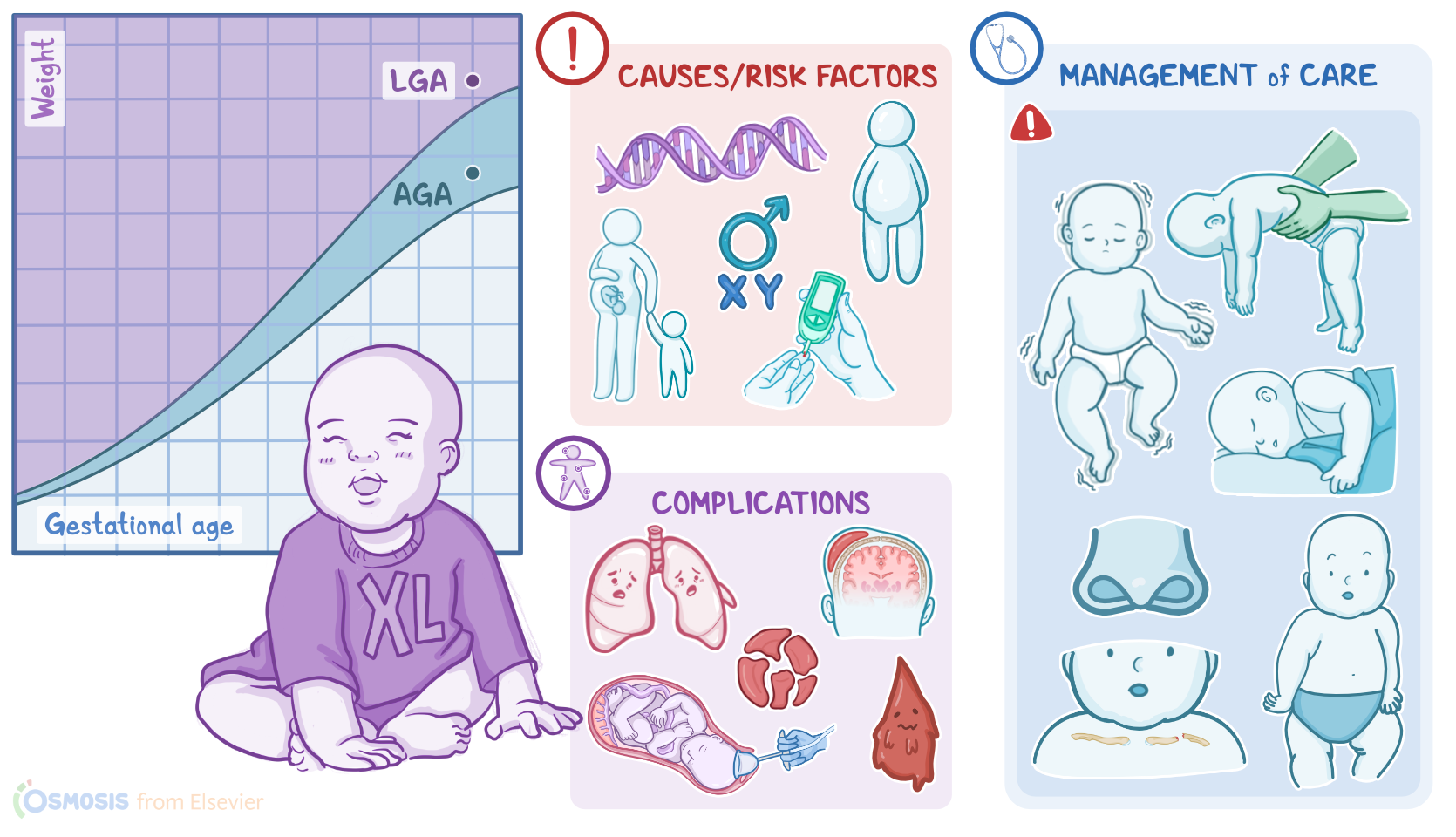
Large for gestational age or LGA for short, is a term used to describe an infant, whose weight is over the 90th percentile for gestational age.
In other words, the infant weighs more than 90% of infants of the same gestational age. Large for gestational age is not a synonym for macrosomia, which is a term used to describe an infant's birth weight over 4000 grams regardless of gestational age.
Infants who are LGA can be preterm, term, or postterm.Now, first, let’s cover some basic physiology. Gestation refers to the period between conception and birth, which typically lasts for 40 weeks.
Physiology0:35–1:43
During these 40 weeks, the embryo, and later fetus, grows and develops within the uterus. On the other hand, gestational age is a term used to describe a newborn based on their physical and neuromuscular characteristics.Now, based on the gestational age and the infant’s birth weight, we can determine birth weight percentiles.
The birth weight percentile helps us evaluate the infant’s intrauterine growth and development, which is considered normal when the value is between the 10th and 90th percentile.
For example, an infant weighing around 3350 grams is within the 40th percentile, and is considered appropriate for gestational age, or AGA.
On the other hand, an infant weighing around 2700 grams is within the 3rd percentile, and therefore SGA. Finally, an infant weighing around 4200 grams is within the 95th percentile and is considered large for gestational age, or LGA for short.Ok, now, when it comes to causes, some LGA infants can be genetically predisposed to be physiologically large; while others have impaired fetal development due to some other fetal or maternal condition.
Causes & risk factors1:43–2:21
Important risk factors can be either fetal or maternal risk factors. A fetal risk factor is male sex.
Also, LGA infants are more common in Asian, Black, and Hispanic ethnic groups. Maternal risk factors include diabetes mellitus, large stature; obesity or excessive weight gain during pregnancy; advanced age; multiparity; and birth of a previous LGA infant.Now, let’s switch our focus to pathology.
Pathology2:21–4:59
With maternal diabetes, large amounts of glucose are transferred from the mother to the fetus. Unlike glucose, maternal insulin does not cross the placental barrier, so the excessive glucose in the fetal blood signals the fetal pancreas to release more and more insulin, resulting in hyperinsulinemia.High levels of insulin interfere with normal lung development and decreases surfactant production.
Hyperinsulinemia also increases the metabolic rate of the fetus which increases the need for oxygen, increasing the risk of fetal hypoxia.Hypoxia stimulates erythropoiesis or increased production of RBCs, which ultimately leads to polycythemia.
The excess glucose in the fetal blood also increases fat deposits in the subcutaneous tissues and other organs like the liver, heart, and muscle.
This causes the fetus to grow much larger than normal, resulting in neonatal macrosomia, meaning that the newborn weighs 4,000 g or more.Next up are complications, which can be neonatal, maternal, or delivery complications.
Now, for neonatal complications hypoglycemia is one of the most common. This is because, after delivery, the newborn’s insulin level remains high, but the supply of glucose is abruptly cut off when the umbilical cord is cut, leading to hypoglycemia.
Other complications include birth injuries due to macrosomia, since the larger body size makes vaginal delivery more difficult, and increases the risk for trauma during birth, including brachial plexus or facial nerve injury; clavicular, humeral, or skull fractures; cephalohematoma, which is a collection of blood between the periosteum and the skull; as well as subdural hemorrhage.
Respiratory distress is another common complication, which can occur because of lung immaturity; and polycythemia-related problems can also occur, like hyperbilirubinemia, caused by the breakdown of an increased number of circulating red blood cells; as well as hyperviscosity, which can lead to a sluggish blood flow, ischemia, and thrombosis of vital organs.
In some cases, perinatal asphyxia and meconium aspiration may occur. There are also maternal complications, the most common of which include uterine rupture; perineal and vaginal tears; and postpartum hemorrhage.
Finally, delivery complications primarily include the use of operative delivery methods such as vacuum extraction, forceps, or Cesarean birth; and there is a higher risk of shoulder dystocia, meaning the fetal shoulders can’t progress past the maternal pubic bone after the fetal head has been delivered.Now, let’s switch gears and move on to clinical manifestations.
Clinical manifestations4:59–5:52
Large for gestational age infants are typically lethargic, obese, have a plethoric appearance, and often feed poorly.The infant could be jittery due to hypoglycemia; and they often have signs of respiratory distress like tachypnea.
If a cephalohematoma is present, there will be a soft swelling on the skull with defined margins that don’t cross suture lines.
Injury to the facial nerve can be noted if there are asymmetrical facial movements, or if the eye on the affected side doesn’t close completely when the infant cries.
Other clinical manifestations include a limp, adducted, and internally rotated arm if brachial plexus injury is present; decreased movement of the affected side if there’s a humeral; or crepitus, which is a grinding feeling on palpation, if there’s a clavicular fracture.
Diagnosis is based on the assessment of gestational age, which can be made prenatally, meaning before birth, or postnatally, meaning after birth.
Diagnosis5:52–6:30
Prenatal gestational age is determined by the length of pregnancy after the first day of the mother’s last menstrual period, expressed in weeks and days.Additionally, an ultrasound can be used to evaluate the fetal size and weight.
On the other hand, postnatal gestational age is primarily assessed using the New Ballard Score, which assesses the infant’s maturity rating by evaluating physical and neuromuscular characteristics.Treatment is primarily based on the management of complications.
Treatment6:30–6:44
Hypoglycemia may require IV glucose administration; breathing problems can be treated with supplemental oxygen and respiratory support; and birth injuries should be addressed.
Okay, now let’s talk about the care you’ll be providing for an infant that is large for gestational age. Your priority nursing goal is to monitor for complications.Now, for a newborn who is large for gestational age, you’ll be monitoring for several possible complications.
Management and care6:44–8:47
For birth trauma injuries, observe the infant’s face, palpate the clavicles, and observe the arms for position and movement.
Report to the healthcare provider if you notice clavicular crepitus, limited limb movement, or a limp, adducted, and internally rotated arm; or asymmetric facial movements.
If a clavicle is broken, swaddle the infant with the affected arm across the chest to restrict movement and promote healing.
For brachial plexus injury, consult with the pediatric physical therapist to provide gentle range of motion to prevent contracture formation.
Also monitor them closely for pain and provide comfort measures. Next, watch the infant closely for respiratory problems.
Institute pulse oximetry monitoring and assess their respiratory status. Report to the healthcare provider if there’s tachypnea, decreased SpO2, retraction, nasal flaring, grunting on exhalation, or apnea with bradycardia, and administer supplemental oxygen to keep their SpO2 at 94% or more.Also be sure to check their blood glucose, and assess for symptoms of hypoglycemia.
Report the presence of jitteriness or tremors, weak cry, decreased muscle tone, or if the blood glucose is less than 40 mg/dL.
If the infant is able to tolerate oral feedings, initiate early and frequent feedings. Alternately, administer buccal dextrose gel or IV dextrose as ordered.Finally, monitor the infant’s laboratory test results to check for polycythemia and jaundice.
Report high hemoglobin, hematocrit, and bilirubin levels to the healthcare provider and institute phototherapy, as ordered.Okay, let’s move on to client and family teaching.
General client and family teaching8:47–9:45
First, explain to the infant’s caregivers that their baby is larger than expected for their gestational age; and will need close monitoring to prevent complications.
Emphasize the importance of keeping all scheduled follow-up appointments with healthcare providers for growth assessment and monitoring.Then, teach them how to care for their infant after discharge.
Review safe handling practices if their infant has an injury, and talk about feeding guidelines to prevent over- or under feeding.Then, review steps they can take for healthy future pregnancies.
For future pregnancies, talk about the importance of controlling chronic diseases like diabetes, and discuss proper nutrition, healthy weight gain, and receiving prenatal care.Finally, instruct them to stress the importance of seeking immediate medical care if their baby is lethargic, jittery, febrile, or has difficulty breathing.All right, as a quick recap… An infant who is large for gestational age weighs more than the 90th percentile for their gestational age.
Review9:45–10:46
Risk factors can be fetal or maternal. Large for gestational age infants are typically lethargic, have a plethoric appearance, and may feed poorly.
They are at a higher risk for certain complications, such as birth trauma injuries, hypoglycemia, and neonatal respiratory distress syndrome.
An accurate weight, gestational age, and birth weight assessment graph are used to determine if the infant is large for gestational age, and complications are treated if and when they occur.
The priority nursing care goals are to determine the infant’s size for their gestational age and to monitor for complications, and the client and family education centers on explaining the condition, describing the risk for complications and measures taken to monitor for them, how to reduce the risk of having a large for gestational age infant in future pregnancies, and the importance of follow-up care after returning home.
| LARGE FOR GESTATIONAL AGE (LGA) INFANT | ||
| KEY POINTS | NOTES | |
| DEFINITION |
| |
| PHYSIOLOGY |
| |
| CAUSES AND RISK FACTORS |
| |
| PATHOPHYSIOLOGY |
| |
| SIGNS AND SYMPTOMS |
| |
| DIAGNOSIS |
| |
| TREATMENT |
| |
| MANAGEMENT OF CARE |
| |
| PATIENT AND FAMILY TEACHING |
| |
No notes for this video yet
Try adding a note below