Laryngotracheobronchitis (LTB) and croup: Nursing process (ADPIE)

1,078views

Laryngotracheobronchitis (LTB) and croup: Nursing process (ADPIE)

Watch later

Watch later

Infection prevention and control - Precautions and personal protective equipment (PPE): Nursing skills
Urinary tract infections (UTIs): Nursing process (ADPIE)
Modes of infectious disease transmission
Epstein-Barr virus (Infectious mononucleosis)
Pneumonia
Wound healing
Palliative and hospice care: Nursing
Postoperative care: Nursing
Biology of cancer: Nursing
Biliary atresia: Nursing
Cholecystitis: Nursing
Cholelithiasis: Nursing
Colorectal cancer: Nursing
Diarrhea: Nursing
Diverticular disease: Nursing
Esophageal cancer: Nursing
Gastric cancer: Nursing
Hepatitis: Nursing
Inflammatory bowel disease - Crohn disease and ulcerative colitis: Nursing
Intestinal obstruction: Nursing
Irritable bowel syndrome (IBS): Nursing
Jaundice: Nursing
Laryngeal cancer: Nursing
Liver cancer: Nursing
Pancreatic cancer: Nursing
Esophageal atresia and tracheoesophageal fistula: Nursing
Geriatric considerations - Gastrointestinal: Nursing
Hirschsprung disease: Nursing
Hyperemesis gravidarum: Nursing
Necrotizing enterocolitis: Nursing
Omphalocele and gastroschisis: Nursing
Appendicitis: Nursing process (ADPIE)
Celiac disease: Nursing process (ADPIE)
Cirrhosis: Nursing process (ADPIE)
Gastroesophageal reflux disease (GERD): Nursing process (ADPIE)
Hiatal hernia: Nursing process (ADPIE)
Pancreatitis: Nursing process (ADPIE)
Peptic ulcer disease (PUD): Nursing process (ADPIE)
Antacids: Nursing pharmacology
Antidiarrheals: Nursing pharmacology
Antiemetics: Nursing pharmacology
Antispasmodics (GI): Nursing pharmacology
Gallstone-dissolving agents: Nursing pharmacology
Gastric mucosal protective agents: Nursing pharmacology
Histamine H2 antagonists: Nursing pharmacology
Laxatives: Nursing pharmacology
Medications for hepatic encephalopathy: Nursing pharmacology
Pancreatic enzyme replacements: Nursing pharmacology
Proton pump inhibitors (PPIs): Nursing pharmacology
Treatment for Helicobacter pylori: Nursing pharmacology
Weight loss medications: Nursing pharmacology
Bladder tumors: Nursing
Chronic kidney disease (CKD): Nursing
Dialysis care: Nursing
Epididymitis: Nursing
Glomerulonephritis: Nursing
Nephrotic syndrome: Nursing
Polycystic kidney disease (PKD): Nursing
Prostate cancer: Nursing
Pyelonephritis: Nursing
Renal and urinary calculi: Nursing
Renal cancer: Nursing
Testicular cancer: Nursing
Urinary retention: Nursing
Bladder exstrophy: Nursing
Circumcision: Nursing
Cryptorchidism: Nursing
Enuresis: Nursing
Geriatric considerations - Urinary: Nursing
Hypospadias and epispadias: Nursing
Acute kidney injury (AKI): Nursing process (ADPIE)
Benign prostatic hyperplasia (BPH): Nursing process (ADPIE)
Urinary incontinence - Stress: Nursing process (ADPIE)
Antispasmodics (GU): Nursing pharmacology
Cholinergic therapy (GU): Nursing pharmacology
Diuretics - Osmotic and carbonic anhydrase inhibitors: Nursing pharmacology
Diuretics - Thiazide, thiazide-like, loop, and potassium-sparing diuretics: Nursing pharmacology
Anemia - Aplastic: Nursing
Anemia - Iron-deficiency: Nursing
Anemia - Macrocytic: Nursing
Arterial blood gas (ABG) - Overview: Nursing
Arterial blood gas (ABG) - Metabolic acidosis: Nursing
Arterial blood gas (ABG) - Metabolic alkalosis: Nursing
Arterial blood gas (ABG) - Respiratory acidosis: Nursing
Arterial blood gas (ABG) - Respiratory alkalosis: Nursing
Blood cultures: Nursing
Cardiac biomarkers - Creatine kinase (CK): Nursing
Cardiac biomarkers - Troponin: Nursing
Coagulation studies - Partial thromboplastin time (PTT): Nursing
Complete blood count (CBC) - Hemoglobin and hematocrit: Nursing
Complete blood count (CBC) - Platelets: Nursing
Complete blood count (CBC) - Red blood cells (RBC): Nursing
Complete blood count (CBC) - White blood cells (WBC) and differential: Nursing
Complete metabolic panel (CMP) - Blood urea nitrogen (BUN) and creatinine (Cr): Nursing
Complete metabolic panel (CMP) - Chloride: Nursing
Complete metabolic panel (CMP) - Estimated glomerular filtration rate (eGFR): Nursing
Complete metabolic panel (CMP) - Glucose: Nursing
Complete metabolic panel (CMP) - Liver function tests (LFT): Nursing
Complete metabolic panel (CMP) - Potassium: Nursing
Complete metabolic panel (CMP) - Sodium: Nursing
Complete metabolic panel (CMP) - Total protein: Nursing
Disseminated intravascular coagulation (DIC): Nursing
Multiple myeloma: Nursing
Neutropenia: Nursing
Polycythemia: Nursing
Thalassemia: Nursing
Thrombocytopenia: Nursing
Leukemia: Nursing process (ADPIE)
Anticoagulants - Direct thrombin and factor Xa inhibitors: Nursing pharmacology
Anticoagulants - Heparin: Nursing pharmacology
Anticoagulants - Warfarin: Nursing pharmacology
Antihyperlipidemics - Bile acid sequestrants and cholesterol absorption inhibitors: Nursing pharmacology
Antihyperlipidemics - Fibrates: Nursing pharmacology
Antihyperlipidemics - Miscellaneous: Nursing pharmacology
Antihyperlipidemics - Statins: Nursing pharmacology
Antiplatelet agents: Nursing pharmacology
Blood products: Nursing pharmacology
Hematopoietic growth factors: Nursing pharmacology
Hemostatics: Nursing pharmacology
Iron preparations: Nursing pharmacology
Thrombolytics: Nursing pharmacology
Autoimmunity: Nursing
Human immunodeficiency virus (HIV) and acquired immunodeficiency syndrome (AIDS): Nursing
Hypersensitivity reactions - Type I: Nursing
Hypersensitivity reactions - Type II: Nursing
Hypersensitivity reactions - Type III: Nursing
Hypersensitivity reactions - Type IV: Nursing
Immune response - Adaptive: Nursing
Immune response - Innate: Nursing
Immunodeficiency disorders - Primary: Nursing
Immunodeficiency disorders - Secondary: Nursing
Inflammatory process: Nursing
Scleroderma: Nursing
Shock - Anaphylactic: Nursing
Sjögren syndrome: Nursing
Systemic lupus erythematosus (SLE): Nursing
Toxic shock syndrome (TSS): Nursing
Erythema infectiosum (Fifth disease): Nursing
Fever: Nursing
Infectious mononucleosis: Nursing
Mumps (Parotitis): Nursing
Neonatal sepsis: Nursing
Pertussis: Nursing
Poliomyelitis: Nursing
Postpartum infections: Nursing
Roseola (Exanthem subitum): Nursing
Rubella (German measles): Nursing
Rubeola (Measles): Nursing
Smallpox: Nursing
Zika virus: Nursing
Anaphylaxis: Nursing process (ADPIE)
Lyme disease: Nursing process (ADPIE)
Rheumatoid arthritis (RA): Nursing process (ADPIE)
Antirejection immunosuppressants: Nursing pharmacology
Biologic agents: Nursing pharmacology
Disease-modifying therapy for multiple sclerosis: Nursing pharmacology
Immunoglobulins: Nursing pharmacology
Immunomodulators: Nursing pharmacology
Immunosuppressants for autoimmune diseases: Nursing pharmacology
Non-biologic disease-modifying antirheumatic drug (DMARD) therapy: Nursing pharmacology
Vaccines: Nursing pharmacology
Acne: Nursing
Animal and snake bites: Nursing
Burn injury: Nursing
Cutaneous fungal infections: Nursing
Erysipelas and cellulitis: Nursing
Folliculitis, carbuncles, and furuncles: Nursing
Herpes simplex virus (HSV): Nursing
Herpes zoster: Nursing
Impetigo: Nursing
Insect stings and bites: Nursing
Pediculosis and scabies: Nursing
Psoriasis: Nursing
Rocky Mountain spotted fever (RMSF): Nursing
Skin cancer - Basal cell carcinoma, squamous cell carcinoma, and melanoma: Nursing
Urticaria: Nursing
Geriatric considerations - Integumentary: Nursing
Atopic dermatitis: Nursing process (ADPIE)
Frostbite: Nursing process (ADPIE)
Methicillin-resistant Staphylococcus aureus (MRSA): Nursing process (ADPIE)
Pressure injury: Nursing process (ADPIE)
Antibiotics - Topical: Nursing pharmacology
Antifungals - Topical: Nursing pharmacology
Corticosteroids - Topical: Nursing pharmacology
Debridement agents: Nursing pharmacology
Keratolytics: Nursing pharmacology
Medications for acne vulgaris: Nursing pharmacology
Osteoarthritis: Nursing
Osteomyelitis: Nursing
Osteoporosis: Nursing
Hip fractures: Nursing
Developmental dysplasia of the hip: Nursing
Acute compartment syndrome: Nursing process (ADPIE)
Fractures: Nursing process (ADPIE)
Gout: Nursing process (ADPIE)
Musculoskeletal injuries: Nursing process (ADPIE)
Buerger disease: Nursing
Raynaud phenomenon: Nursing
Peripheral arterial disease (PAD): Nursing process (ADPIE)
Peripheral venous disease (PVD): Nursing process (ADPIE)
Atelectasis: Nursing
Geriatric considerations - Respiratory: Nursing
Venous thromboembolism (VTE): Nursing process (ADPIE)
Asthma: Nursing process (ADPIE)
Bacterial pneumonia: Nursing process (ADPIE)
Bronchiolitis and respiratory syncytial virus (RSV): Nursing process (ADPIE)
Carbon monoxide poisoning: Nursing process (ADPIE)
Chronic obstructive pulmonary disease (COPD): Nursing process (ADPIE)
Epiglottitis: Nursing process (ADPIE)
Foreign body aspiration and upper airway obstruction: Nursing process (ADPIE)
Laryngotracheobronchitis (LTB) and croup: Nursing process (ADPIE)
Smoke inhalation injury: Nursing process (ADPIE)
Papulosquamous and inflammatory skin disorders: Pathology review

Notes

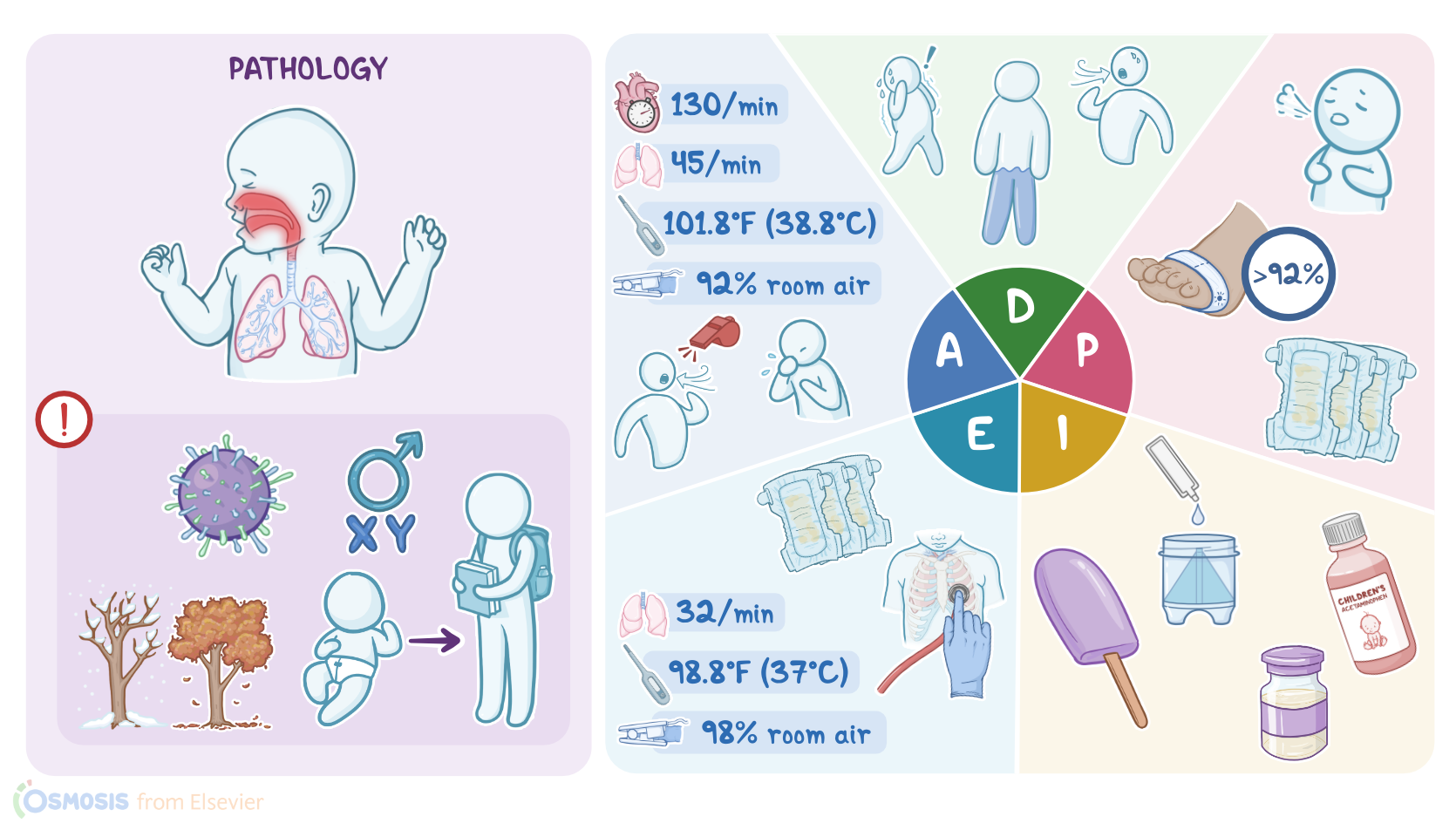
LARYNGOTRACHEOBRONCHITIS (LTB) AND CROUP

KEY POINTS
NOTES
PATIENT REPORT
  • 2-year-old 
  • Emergency department
  • High-pitched, barking cough
  • Previous cold symptoms
  • Not eating or drinking
  • Anxious at night, difficult to soothe
  • Wheezing
  • Diagnosis: LTB (croup)

PATHOPHYSIOLOGY
  • Inflammation of upper airway 
  • Common causative viruses
    • Parainfluenza
    • Adenovirus 
    • Influenza A or B 
    • Respiratory syncytial virus (RSV)  
  • Occurs seasonally 
    • Most often in late fall 
    • Also common in early winter 
  • Risk factors 
    • Children ages 3 months to 6 years
    • Biological males
    • Family history  
    • Recurrent croup 
  • Transmission methods 
    • Airborne respiratory droplets 
    • Saliva contact 
    • Physical contact with infected person 
    • Contact with contaminated surfaces 
  • Pathophysiology
    • Starts in nasal passages and pharynx 
    • Spreads to larynx trachea and bronchi 
    • Inflammation and edema 
    • Mucus secretion 
    • Narrowing of subglottic area and airway
  • Symptoms of airway narrowing 
    • Hoarseness 
    • Inspiratory stridor 
    • Seal like barking cough 
    • Nasal flaring 
    • Substernal retractions 
    • Subcostal retractions 
    • Intercostal retractions 
  • Aggravating factors 
    • Crying increases oxygen demand 
    • Agitation worsens airway obstruction 
  • Complications
    • Dehydration
    • Hypoxia 
    • Cyanosis 
    • Respiratory acidosis 
    • Respiratory failure

DIAGNOSIS AND TREATMENT
  • Diagnosis
    • History
    • Physical assessment
    • Diagnostic imaging 
      • Chest X-ray
        • Steeple sign
    • Laboratory testing
  • Treatment
    • Airway management
    • Bronchodilators
    • Corticosteroid
    • Antipyretics
    • Humidified oxygen
    • Intubation
    • Mechanical ventilation

ASSESSMENT
  • Audible inspiratory stridor 
  • Barking cough present
  • Lungs clear to auscultation
  • Substernal retractions 
  • Mucous membranes appear dry
  • Skin turgor appears normal
  • Capillary refill < 3 seconds
    • Vital signs
      • Respiratory rate 45/min
      • Oxygen saturation 92 % room air 
      • Heart rate 130/min
      • Axillary temperature 101.8 ℉ (38.8 ℃)

NURSING DIAGNOSES
  • Ineffective breathing pattern related to upper airway inflammation and obstruction
  • Fluid volume deficit related to decreased fluid intake, fever, and increased respiratory rate
  • Fear related to difficulty breathing and unfamiliar surroundings
  • Deficient parental knowledge related to unfamiliarity with the disease process and treatments

PLANNING
  • By end of shift, patient will
    • Have an effective breathing pattern as evidenced by respiratory rate within the normal range, unlabored breathing, absence of stridor and barking cough, and a SpO2 above 92%
    • Display adequate fluid volume as evidenced by moist mucous membranes and wet diapers
    • Have decreased fear as evidenced by a calm appearance and calm, easy respirations
  • The patient's mother will verbalize an understanding of croup, home management of mild symptoms, and when to seek medical attention

IMPLEMENTATION
  • Keep patient on mother’s lap 
  • Monitor  
    • Respiratory status 
    • Vital signs 
    • Oxygen saturation 
  • Administer
    • Humidified oxygen 
    • Racemic epinephrine via nebulizer 
    • Dexamethasone IM  
    • Acetaminophen  
  • Provide supportive care 
    • Offer flavored ice pops as tolerated 
    • Encourage fluid intake 
    • Ask patient's mother to report wet diaper 
  • Provide discharge teaching  
    • Emphasize importance of fluid intake 
    • Give acetaminophen as directed for fever 
    • Keep patient's head elevated at night 
    • Allow breathing cool air to ease symptoms 
    • Seek medical attention if symptoms worsen or return

EVALUATION
  • Patient alert and sitting comfortably 
  • Playing with stuffed bear 
  • Breathing comfortably 
  • Respiratory rate 32/min
  • No stridor 
  • No respiratory retractions 
  • No nasal flaring 
  • No cough 
  • Oxygen saturation 98 % room air 
  • Clear breath sounds 
  • Consumed 3 ice pops 
  • Had 2 wet diapers 
  • Mucous membranes appear moist 
  • Temperature normal
  • Patient's mother verbalizes understanding of home care 
    • Plans follow up with pediatrician in 24 hours

Transcript

Watch video only

Two year old Sara Little is brought to the Emergency Department, or ED, by her mother.

She has a high-pitched, barking cough that started in the evening and worsened throughout the night.

Mrs. Little explains that Sara has had “cold symptoms” for about 3 days.

She initially had a runny nose and slight cough but began running a fever yesterday.

She hasn’t been eating or drinking well and seems more anxious and difficult to soothe at night.

When Mrs. Little noticed wheezing, she called the pediatrician who directed her to bring Sara to the ED.

Upon arrival, Sara has a barking cough, inspiratory stridor, and a respiratory rate of 42 per minute.

Sara will be treated for laryngotracheobronchitis, or LTB, also known as croup.

Croup is an inflammation of the upper airway, typically caused by a virus, such as parainfluenza, adenovirus, influenza A or B, or respiratory syncytial virus, or RSV.

Cases of croup are seen seasonally, most often in late fall and early winter.

It affects children ages 3 months to 6 years and is most common in boys and in children where there is a family history of croup or recurrent croup.

Croup is spread through airborne respiratory droplets, saliva and physical contact with an infected person or contaminated surface.

The droplets enter the body, initially infecting the nasal passages and pharynx, subsequently spreading to the larynx, trachea and bronchi.

The infection causes inflammation, edema and mucus secretion, leading to narrowing of the subglottic area, which is composed of the lower part of the vocal cords and the upper trachea.

Not only is this area the narrowest portion of a child’s upper airway, but it has a complete ring of cartilage around it which doesn’t expand.

When the airway becomes significantly narrowed, it results in hoarseness, a harsh high-pitched sound during inspiration referred to as inspiratory stridor, and a distinctive seal-like barking cough.

Nasal flaring, substernal, subcostal or intercostal retractions occur as the child works hard to breathe past the narrowed airway.

Crying and agitation causes increased oxygen demand and further airway obstruction.

In addition, dehydration may result due to reluctance to drink fluids, fever, and breathing through the mouth.

Signs of severe croup include fatigue and inability to keep up with the needed respiratory effort resulting in diminished breath sounds, hypoxia, and cyanosis.

Eventually, inadequate ventilation can lead to respiratory acidosis and respiratory failure.

A diagnosis of croup is based on the client’s history and clinical findings.

Other diagnostic studies such as labs and radiological studies are not indicated unless there is concern for other serious problems such as pneumonia.

A chest X-ray, if done, will often reveal a pattern known as a steeple sign, which is an inverted V shape resembling a church steeple, visualized below the vocal cords.

Treatment of croup is focused on airway management and is guided by the severity of symptoms.

Commonly prescribed treatments include inhaled bronchodilators such as racemic epinephrine and albuterol; a corticosteroid like dexamethasone to decrease inflammation; and antipyretics such as acetaminophen to reduce fever.

Other treatments include humidified supplemental oxygen, and in the case of respiratory impending failure, intubation and mechanical ventilation.

OK, now that we understand croup, let’s get back to Sara and her mother.

You wash your hands and don a mask and gloves as you enter Sara’s room.

After introducing yourself and confirming Sara’s identity, you begin your assessment by asking Mrs. Little about how Sara has been feeling before coming to the ED.

Mrs. Little states Sara started to have a runny nose a few days ago and her fever started yesterday.

She hasn’t felt like eating or drinking and has had fewer wet diapers than normal.

The barking cough started this evening.

You gently approach Sara, keeping in mind agitation can further compromise her airway.

You can easily hear stridor with inspiration and the distinctive barking cough that characterizes croup.