Postpartum infections: Nursing
Introduction0:00–0:15
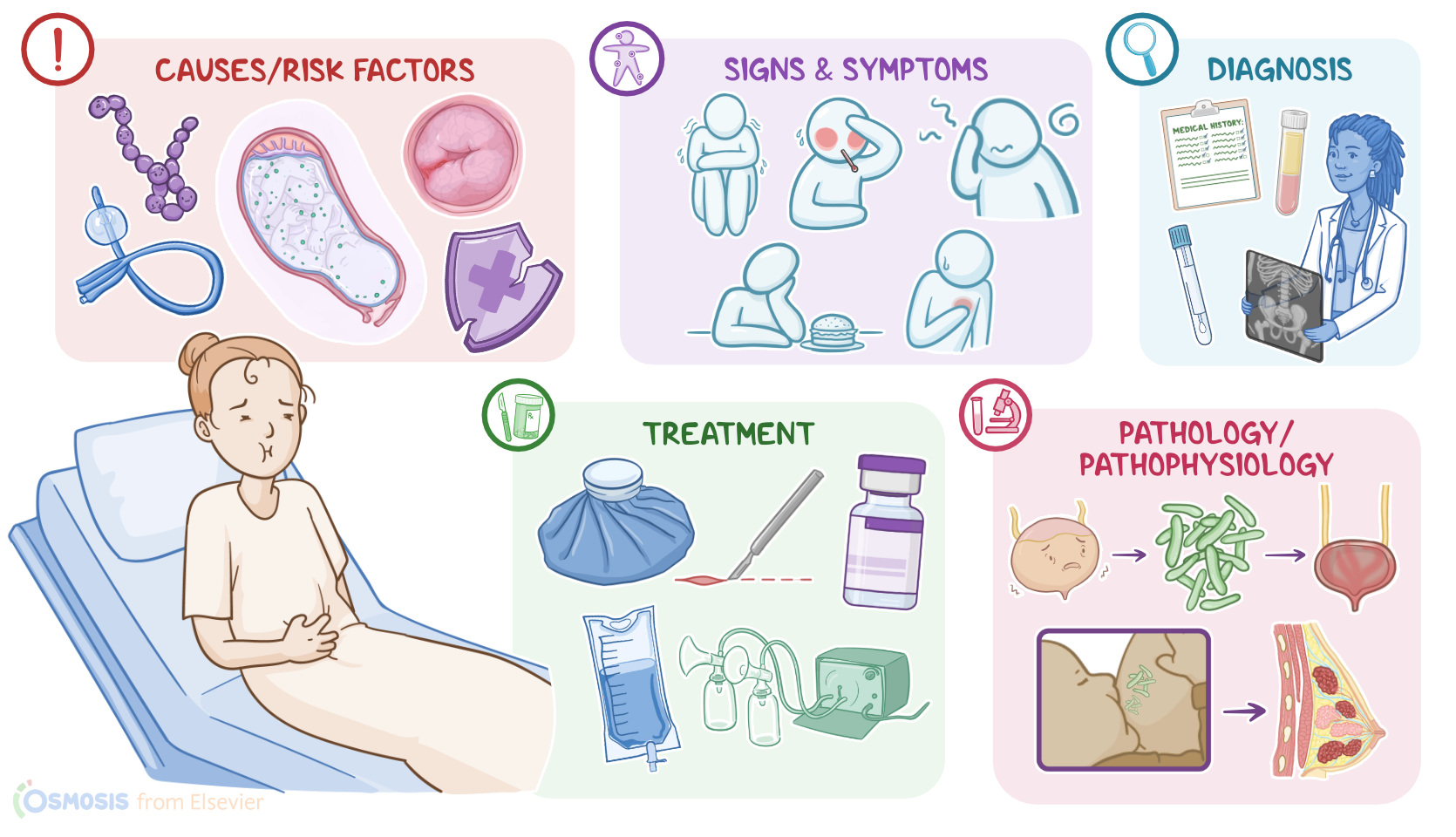
Postpartum, or puerperal infections are infections of the genitourinary tract, surgical wounds, urinary tract, and breast that develop after the first 24 hours and on any two of the first 10 days postpartum.
Physiology0:15–1:08
The uterus is a hollow, pear-shaped organ that has an inner layer called endometrium and muscular layer called myometrium.
During conception, the reproductive system undergoes changes that help support the fetus until birth, such as increased blood flow to the reproductive organs, increased uterine volume, weight, and fundal height, and increased activity of cervical mucus glands.
After giving birth the uterus tends to regress back to its normal, pre-conception size and resume its pre-birth position, a process known as involution.
The thick superficial layer of the endometrium also sloughs off, and there is a discharge of lochia from the endometrium, cervix, and vagina.
Okay, so postpartum infections are typically caused by aerobic or anaerobic bacteria, such as Eschericia coli, Proteus spp, Enterobacter spp, Klebsiella spp, Clostridium spp, Staphylococcus aureus, and Streptococci spp.
Causes & risk factors1:08–3:22
Other less frequent pathogens include Chlamydia trachomatis, Ureaplasma, Mycoplasma, and Gardnerella vaginalis. Risk factors for postpartum infections of the genitourinary tract include colonization of the vagina with group A and B Streptococcus, chorioamnionitis, prolonged rupture of membranes, prolonged labor, as well as retained placenta tissue.
In addition, internal fetal monitoring, like fetal scalp electrodes or intrauterine pressure catheters, and repeated vaginal examinations, seem to also increase the risk for postpartum infections.
Another important risk factor is trauma, which may involve abdominal wall trauma, as well as perineal tears, or lacerations to the endometrium, cervix, or vaginal mucosa.
These may occur during normal childbirth, also known as physiological trauma, or while providing medical care, which is referred to as iatrogenic trauma.
Next are risk factors for developing a postpartum urinary tract infection, which include the placement of a urinary catheter and urinary retention.
Risk factors for developing postpartum mastitis include milk stasis, which can be caused by blocked milk ducts or inadequate breast emptying.
Finally, clients who are immunocompromised, including those with HIV infection, cancer, malnutrition, diabetes, or those taking immunosuppressant medications like corticosteroids are at higher risk for all types of postpartum infections.
Pathology3:22–5:20
Once the bacteria reach the uterus, they can infect the endometrium and myometrium, causing endometritis. In other cases, there’s trauma to the abdominal wall or perineum, which allows bacteria from the skin, vagina, or bowel flora to penetrate deeper into the subcutaneous tissue, abdominal and pelvic cavities.
At the same time, after delivery, there’s commonly urinary retention in the bladder, which gives bacteria time to multiply and cause cystitis.
In addition, mastitis can develop while breastfeeding. That’s because trauma to the nipple and areola, such as small skin cracks, enables bacteria from the skin or a newborn's mouth and nose to penetrate the breast itself.
Okay, in terms of complications, in the case of postpartum endometritis, bacteria can make their way to the fallopian tubes, causing salpingitis, the ovaries, causing oophoritis, or the peritoneum, causing peritonitis.
Bacteria can also invade the pelvic venous system causing inflammation and damage of the venous wall that leads to thrombus formation, which is referred to as septic pelvic thrombophlebitis.
This is a life-threatening complication that results in bacteremia and sepsis, which can progress to septic shock and death.
Now, surgical wound infections can lead to the formation of an abdominal or pelvic abscess, and in severe cases, necrotizing fasciitis, where the infection involves the subcutaneous tissues and fascia.
In the case of cystitis, bacteria can then make their way up the ureters and kidneys, causing pyelonephritis. And finally, mastitis can lead to breast abscess formation.
Okay, so clinical manifestations of postpartum infections generally include chills and a fever with an oral temperature of 100.4° F or 38° C or higher on any two of the first 10 days postpartum; or 101.6° F 38.7° C or higher during the first 24 hours.
Clinical manifestations5:20–6:59
Other clinical manifestations include malaise, loss of appetite, and tachycardia, with additional signs and symptoms varying based on the type of the infection.
So, clients with endometritis usually present with abdominal pain, and foul smelling discharge. The uterus is typically tender and enlarged, due to an inability to return to its normal size after delivery, often referred to as uterine subinvolution.
Next are surgical wound infections, where clients experience swelling, tenderness, redness, and warmth of the region. Incisions may sometimes burst open with purulent discharge.
Septic pelvic thrombophlebitis should be suspected when the client presents with groin, abdominal or flank pain, along with palpable pelvic veins.Urinary tract infections commonly present with dysuria or painful urination, increased urination frequency, suprapubic tenderness, costovertebral angle tenderness, cloudy and foul-smelling urine, and hematuria.
Lastly, mastitis usually presents with a localized hard lump, that’s accompanied by redness, warmth, tenderness, and swelling, in addition to fever and flu-like symptoms Diagnosis of postpartum infections typically begins with the client’s history and physical assessment, followed by lab tests, including complete blood count, which may show leukocytosis with neutrophilia, and coagulation studies when septic pelvic phlebitis is suspected.
Diagnosis6:59–7:32
Treatment of postpartum infections usually involves supportive measures, including IV fluids, antipyretics and analgesics, along with broad-spectrum antibiotics, such as cephalosporins.
Treatment7:32–8:17
Once the culture results are available the antibiotic choice can be narrowed down to a specific one. In the case of septic pelvic thrombophlebitis, anticoagulation therapy might be needed.
Wound infections and abscesses often require surgical incision and drainage, while necrotizing fasciitis requires surgical debridement.
Finally, in the case of mastitis, emptying of the breasts might be necessary, either by breastfeeding or breast pump, along with breast support and application of moist heat or ice packs.All right, as a quick recap… Postpartum infections, or puerperal infections, are bacterial infections that occur after the first 24 hours or on any two of the first 10 days after labor.
Review8:17–10:21
They are usually caused by either anaerobic and aerobic bacteria that cause infections in the genitourinary tract, surgical wounds, urinary tract, and breast.
Risk factors for postpartum infections include being positive for group A or group B streptococcus, chorioamnionitis, prolonged rupture of membranes, prolonged labor, retained placental tissue, internal fetal monitoring, frequent vaginal exams, trauma during delivery, urinary catheterization, milk stasis, and nipple trauma; or being immunocompromised.
General symptoms of infection include fever, malaise, and increased pulse rate. Clients with endometritis have abdominal pain, foul-smelling discharge, and uterine subinvolution.
Surgical wound infections are red, tender, swollen, and may have purulent discharge. Clients with septic pelvic thrombophlebitis will have groin, abdominal, or flank pain, and palpable pelvic veins.
Symptoms of urinary tract infections include dysuria, increased urination frequency, and cloudy, foul-smelling, or bloody urine.
Clients with mastitis will have a localized hard lump, redness, warmth or swelling in the breast. Diagnosis is based on history and physical assessment, and laboratory tests including a CBC, coagulation studies, and cultures.
Imaging can be used including ultrasound, X-ray, and CT scan. Treatment involves supportive measures such as IV fluids, oxygen, antipyretics, analgesics, and antibiotics.
| POSTPARTUM INFECTIONS | ||
| KEY POINTS | NOTES | |
| DEFINITION |
| |
| PHYSIOLOGY |
| |
| CAUSES AND RISK FACTORS |
| |
| PATHOPHYSIOLOGY |
| |
| SIGNS AND SYMPTOMS |
| |
| DIAGNOSIS |
| |
| TREATMENT |
| |
No notes for this video yet
Try adding a note below