Mumps (Parotitis): Nursing
Notas
| MUMPS | ||
| KEY POINTS | NOTES | |
| DEFINITION |
| |
| PHYSIOLOGY |
| |
| CAUSES AND RISK FACTORS |
| |
| PATHOPHYSIOLOGY |
| |
| SIGNS AND SYMPTOMS |
| |
| DIAGNOSIS |
| |
| TREATMENT |
| |
| MANAGEMENT OF CARE |
| |
| PATIENT AND FAMILY TEACHING |
| |
Transcripción
Revisores de contenido
Colaboradores/as
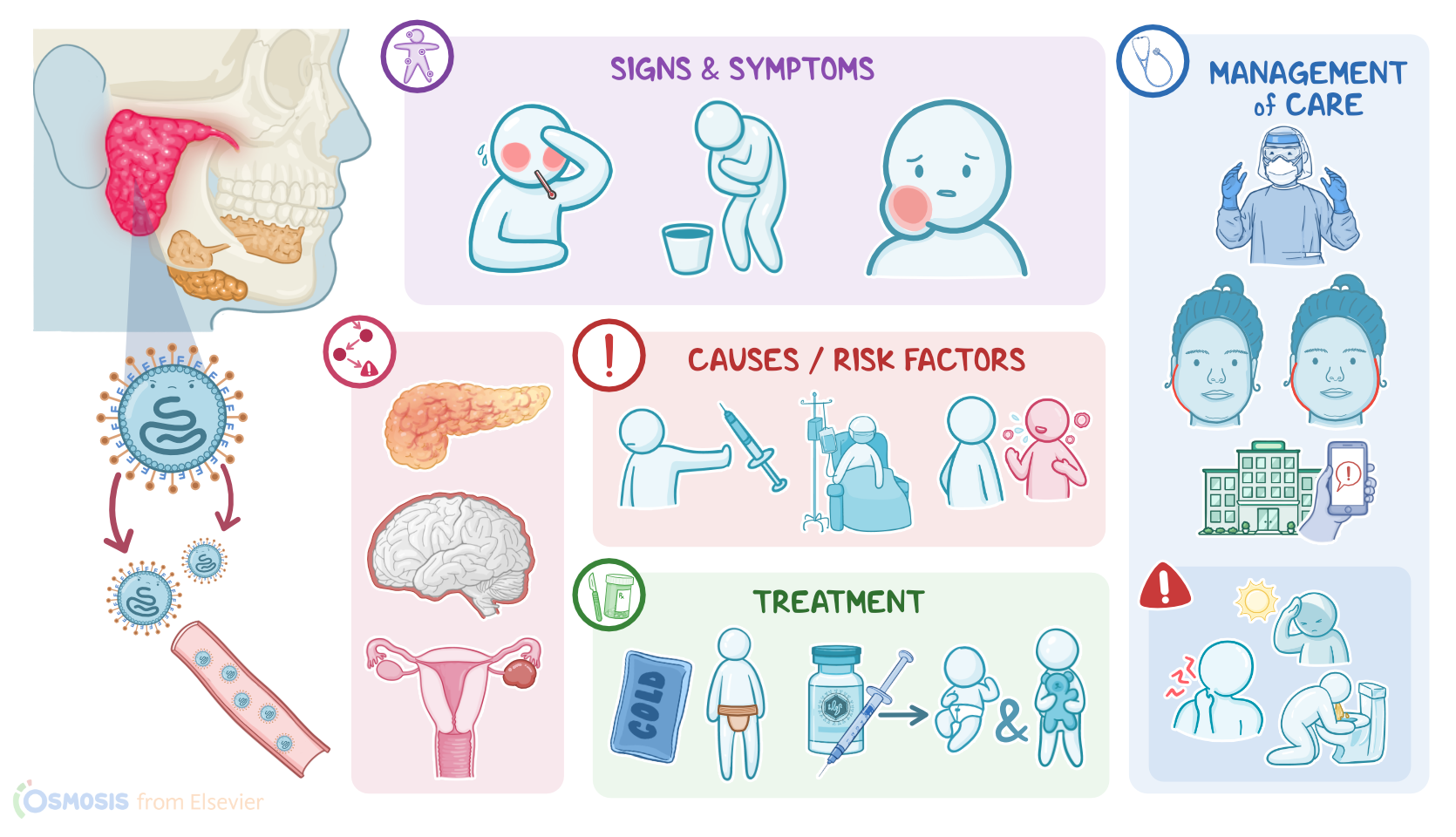
Mumps is a highly contagious, systemic viral infection caused by the mumps virus and is usually associated with fever, swelling and inflammation of the parotid glands, or parotitis. Thanks to vaccination, there are fewer cases of mumps, but in some parts of the world where the population is not immunized, it’s still possible to see outbreaks.
Let’s start by discussing the physiology of the immune response. Now, after a foreign antigen enters the body, it runs into antigen-presenting cells, like macrophages and dendritic cells, which ingest it and break it into fragments. These antigen fragments are then presented on their surface and recognized by T helper cells, which help activate B cells to produce antibodies against that antigen. These antibodies will then bind to the pathogen and attract other immune cells to attack it.
Now, the cause of mumps is the mumps rubulavirus, or just mumps virus. This is an RNA enveloped virus that belongs to the Paramyxoviridae family.
Important risk factors for mumps include immunodeficiency; being unvaccinated or undervaccinated; coming in contact with an infected person; and traveling or living in an endemic area.
Moving on to pathology. Mumps virus is an airborne virus, meaning it spreads via small virus-containing droplets that get flung in the air when an infected client coughs or sneezes.
If another client breathers in these droplets, or they get in contact with infected surfaces and then touch their mouth, they can become infected.
Once the virus enters the body, it enters epithelial cells that line the nasopharynx where they replicate. The new viruses are released to infect other nearby cells.
Some of the mumps virus is picked up by the macrophages and dendritic cells, and carried to the local lymph nodes.
The virus continues to replicate inside the lymph node and mucus membrane and eventually, they’ll get into the bloodstream where they can spread to other organs throughout the body. The salivary glands, especially the parotid glands, are the most commonly affected, leading to parotitis.
Mumps virus may also spread to other glands, such as the pancreas, mammary glands, ovaries, and testes. Less commonly, it can also infect other organs such as the heart, lung, brain, and kidneys.
Now, some complications of mumps include orchitis, or inflammation of testicles, and this is more common in adults. Orchitis may even result in testicular atrophy resulting in decreased sperm count and impaired sperm motility. Inflammation of ovaries, or oophoritis, and mammary glands, or mastitis, may also develop.
Other complications include pancreatitis, which can cause diabetes; nephritis, and rarely myocarditis, thyroiditis, viral pneumonia and polyarthritis.
In the central nervous system, mumps can cause encephalitis, or meningitis, which are associated with headache, neck stiffness and altered mental status.
The virus can also infect the auditory nerve of the inner ear, causing mumps related hearing loss which can be permanent.
Finally, the mumps virus can indirectly cause Guillain-Barre syndrome. This is an autoimmune disease that’s often triggered by viral infections where the immune system attacks the myelin sheath of neurons, causing muscle weakness or paralysis.
Okay, clinical manifestations of mumps might be absent and the client remains asymptomatic. In other cases, after an incubation period of 12 to 25 days, signs and symptoms start to show up. This includes flu-like symptoms such as fever, headache, myalgia, malaise, loss of appetite and non-specific respiratory symptoms.
This is followed by parotitis which presents with swelling between the ear and jaw angle that spreads towards the cheeks, causing pain and tenderness that is aggravated by chewing. Orchitis can present as pain and swelling of the testis, while meningitis can present with headache, neck stiffness, nausea, and vomiting. The infection is usually self-limiting and resolves within a few weeks.
Diagnosis of mumps is typically based on the client’s history and physical assessment, followed by detection of mumps-specific IgM and IgG antibodies. Additionally, a reverse transcriptase polymerase chain reaction, or RT PCR, can be used to detect viral RNA in saliva, blood, urine or cerebrospinal fluid. Also, samples of these bodily fluids can be used to prepare viral cultures and look for infected cells.
Treatment of mumps is mainly supportive and aims at reducing symptoms, which includes rest and increased fluid intake to prevent dehydration, analgesics for pain and acetaminophen or ibuprofen for fever.