
Adynamic Ileus · What Is It, Symptoms, Treatment, and More

Published: Dec 03, 2025
Author: Nikol Natalia Armata, MD
Editor: Ahaana Singh
Editor: Ian Mannarino, MD, MBA
Editor: Kelsey LaFayette, DNP, ARNP, FNP-C
Editor: Józia McGowan, DO
Illustrator: Jillian Dunbar
7-day free trial

Go deeper with Osmosis

Osmosis is a learning platform with videos, questions, and AI tools to help you master topics like this.

4.8 · 12,000+ reviews
Watch quick, visual videos
Practice with Qbank-style questions
Use AI to explain, quiz, and review
Study anytime with the mobile app
Start free trial

No credit card · Cancel anytime

What is an adynamic ileus?

Adynamic ileus, also known as paralytic ileus, is when there is a temporary loss or reduction of peristalsis, the series of waves created by the smooth muscle of the intestine which propels solids and liquids forward. In an adynamic ileus, there is no mechanical obstruction, or physical blockage, such as a mass, and therefore is considered a functional paralysis.  When this occurs, solids or liquids do not pass through the bowel properly. This can lead to build up of contents in the intestines causing various symptoms of bowel inactivity.  

Learn deeper with Osmosis

Master this topic faster with videos, questions, and AI.

Used by 8M+ healthcare learners.

Start free trial

No credit card · Cancel anytime

Is an adynamic ileus an emergency?

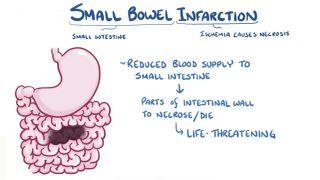
In most cases, an adynamic ileus is not considered an emergency if treated appropriately. However, medical attention should be sought in order to avoid further complications. If left untreated, an adynamic ileus could possibly lead to extended bowel dilation, which is an emergent condition called toxic megacolon. It can also lead to ischemia (i.e., lack of blood flow), necrosis (i.e., death of tissue) and perforation, which can lead to peritonitis, an infection of the abdominal cavity. All are considered medical emergencies and can potentially be fatal. 

What causes an adynamic ileus?

The most common cause of an adynamic ileus is undergoing surgery, especially abdominal or pelvic surgery. Surgery can activate a stress response that can immobilize the digestive tract. As a result, the bowel typically takes about 24 to 72 hours after surgery to resume its normal function.  

 Other causes include severe illness, such as sepsis or trauma. Electrolyte imbalances can impair intestinal motility, such as low potassium, low sodium, and low magnesium, and are associated with causing an ileus. Additionally, medications such as opioids and anticholinergics, which slow down the GI tract, can be associated with ileus.

Is there a difference between an ileus and a bowel obstruction?

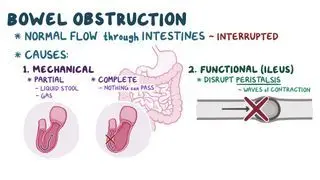
Most of the time when one hears the term bowel obstruction, they are thinking of a mechanical, or physical, obstruction of the intestines. However, bowel obstructions can be divided into two subcategories: mechanical or functional 

An ileus is an interruption in the normal flow of contents through the intestine without a mechanical or physical blockage, so it falls into the category of a functional obstruction. Meanwhile, a mechanical obstruction is caused by a physical blockage in the small or large intestine. Mechanical obstructions are often complete blockages, and they are typically the result of conditions that cause sliding (i.e., intussusception) or twisting (i.e., volvulus) of the intestines onto itself, ultimately cutting off blood vessels and causing tissue death. Other physical blockages in the digestive tract can include masses, such as tumors, hernias, or gallstones, as well as adhesions that can form while healing from surgery. 

What are the signs and symptoms of an adynamic ileus?

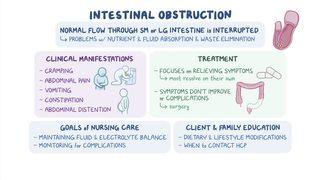
Often, individuals with an adynamic ileus present with clinical features like abdominal distension, discomfort, bloating, constipation or obstipation (i.e., no passage of stool or flatus), nausea, and vomiting. Physical examination will reveal absent or hypoactive bowel sounds on auscultation. However, in contrast to a mechanical obstruction, an ileus usually will not have high-pitched tinkling bowel sounds on auscultation. 

In some cases, when complications have occurred, there may be continuous and persistent abdominal pain and tenderness. This could be due to peritonitis, peritoneal irritation, or inflammation of the membrane covering the abdominal wall and organs.  

How is an adynamic ileus diagnosed?

To diagnose an adynamic ileus, a detailed review of medical history, especially focused on if there has been a recent surgery, and physical examination are necessary. Assessment of the abdomen can reveal reduced or absent bowel sounds. Additionally, to confirm the diagnosis and assess for a cause, blood tests may be performed to examine electrolyte levels and imaging studies, such as X-rays, computerized tomography (CT) scans, or abdominal ultrasounds, may be helpful. Imaging in an ileus will reveal dilated loops of intestine with no clear evidence of mechanical obstruction, as indicated by a transition point. 

How is an adynamic ileus treated?

The treatment of an adynamic ileus is mostly conservative and supportive. It focuses on relieving the present symptoms. Most resolve within a few days when the underlying cause is addressed. 

Bowel rest, through restriction of food consumption and intravenous (IV) fluid therapy is often suggested. A severe or prolonged ileus with continuous vomiting and abdominal distension often requires insertion of a tube extending from the nose to the stomach (i.e., nasogastric tube [NG] tube) to remove gastrointestinal contents and thus relieve pressure. If the individual is at high nutritional risk, and enteral feeding attempts have been tried and failed, then total parenteral nutrition (TPN), which is a feeding method that bypasses the gastrointestinal tract, may be necessary. 

Additionally, diagnosing and treating the underlying cause can potentially minimize the duration of an ileus. This can include correcting electrolyte abnormalities, reviewing for offending medications and discontinuing them, if possible, as well as preventative measures such as early ambulation after surgery.  

If symptoms do not improve or there are complications, such as rupture of the bowel, surgery might be required. 

What are the most important facts to know about an adynamic ileus?

Adynamic ileus, also known as paralytic ileus, is when there is a temporary loss or reduction of peristalsis, the series of waves created by the smooth muscle of the intestine which propels solids and liquids forward. In an adynamic ileus, there is no mechanical obstruction, or physical blockage, such as a mass, and therefore is considered a functional paralysis. The causes of ileus vary and include abdominal surgery, electrolyte imbalance, and the use of certain medications, among other things. Abdominal pain, abdominal distension, bloating, nausea, and vomiting are common clinical features of individuals with an adynamic ileus. Blood tests and imaging studies are suggested to confirm the diagnosis and help to establish a cause. The treatment of an adynamic ileus is rather conservative, focusing on restricted food and drink consumption and treatment of the underlying causes. In rare instances, surgery may be required.  

Key Takeaways

Definition 

Temporary loss or reduction of peristalsis in the absence of a mechanical obstruction, also known as paralytic ileus 

Complications 

- Usually not an emergency if treated, but can lead to:  

     - Toxic megacolon 

     - Ischemia 

     - Necrosis  

     - Perforation  

Causes 

- Abdominal or pelvic surgery  

- Severe illness (e.g., sepsis, trauma)  

- Electrolyte imbalances  

- Drugs (opioids, anticholinergics 

Bowel Obstruction 

- Bowel obstruction can be:  

     - Mechanical → intussusception, volvulus, masses, adhesions 

     - Functional → adynamic ileus 

Signs and Symptoms 

 Abdominal distention 

- Bloating 

- Constipation 

- Nausea 

- Vomiting 

- Absent or hypoactive bowel sounds  

- Abdominal pain and tenderness (if complicated)  

Diagnosis 

- Medical history (recent surgeries?)  

- Physical examination 

- Blood tests (electrolytes 

- Abdominal X-ray  

- Abdominal CT scan  

- Abdominal ultrasound 

Treatment 

- Bowel rest  

     - Food restriction 

     - IV fluids  

     - Nasogastric tube  

     - Total parenteral nutrition  

- Treat underlying cause  

- Surgery if complications require it  

Students say Osmosis is 100% worth it

Because Osmosis saves them time. Lowers stress. And actually helps them remember when it counts.

I used Osmosis to prepare for my first medical school licensing exam! Super helpful and interactive for people who may not do great with just pages of text info!

Cecilia Ruiz

Cecilia Ruiz

MD student

Sayan Misra

I have used Osmosis for about four years. Best thing I have ever used for my medical studies.

Sayan Misra

Sayan Misra

Med student

Osmosis videos are superior because they define simple concepts, tell a story with a clear progression, and provide context.

Jay Pate

Jay Pate

Dental student

References


Batke M, Cappell MS. Adynamic ileus and acute colonic pseudo-obstruction. Med Clin North Am. 2008;92(3):649-ix. doi:10.1016/j.mcna.2008.01.002


Erratum: Toxic megacolon: background, pathophysiology, management challenges and solutions [corrigendum]. Clin Exp Gastroenterol. 2021;14:309-310. Published July 19, 2021. doi:10.2147/CEG.S329394 


McClave SA, DiBaise JK, Mullin GE, Martindale RG. ACG clinical guideline: nutrition therapy in the adult hospitalized patient. Am J Gastroenterol. 2016;111(3):315-335. doi:10.1038/ajg.2016.28


Naveed M, Jamil LH, Fujii-Lau LL, et al. American Society for Gastrointestinal Endoscopy guideline on the role of endoscopy in the management of acute colonic pseudo-obstruction and colonic volvulus [published correction appears in Gastrointest Endosc. 2020;91(3):721. doi:10.1016/j.gie.2020.01.042]. Gastrointest Endosc. 2020;91(2):228-235. doi:10.1016/j.gie.2019.09.007