
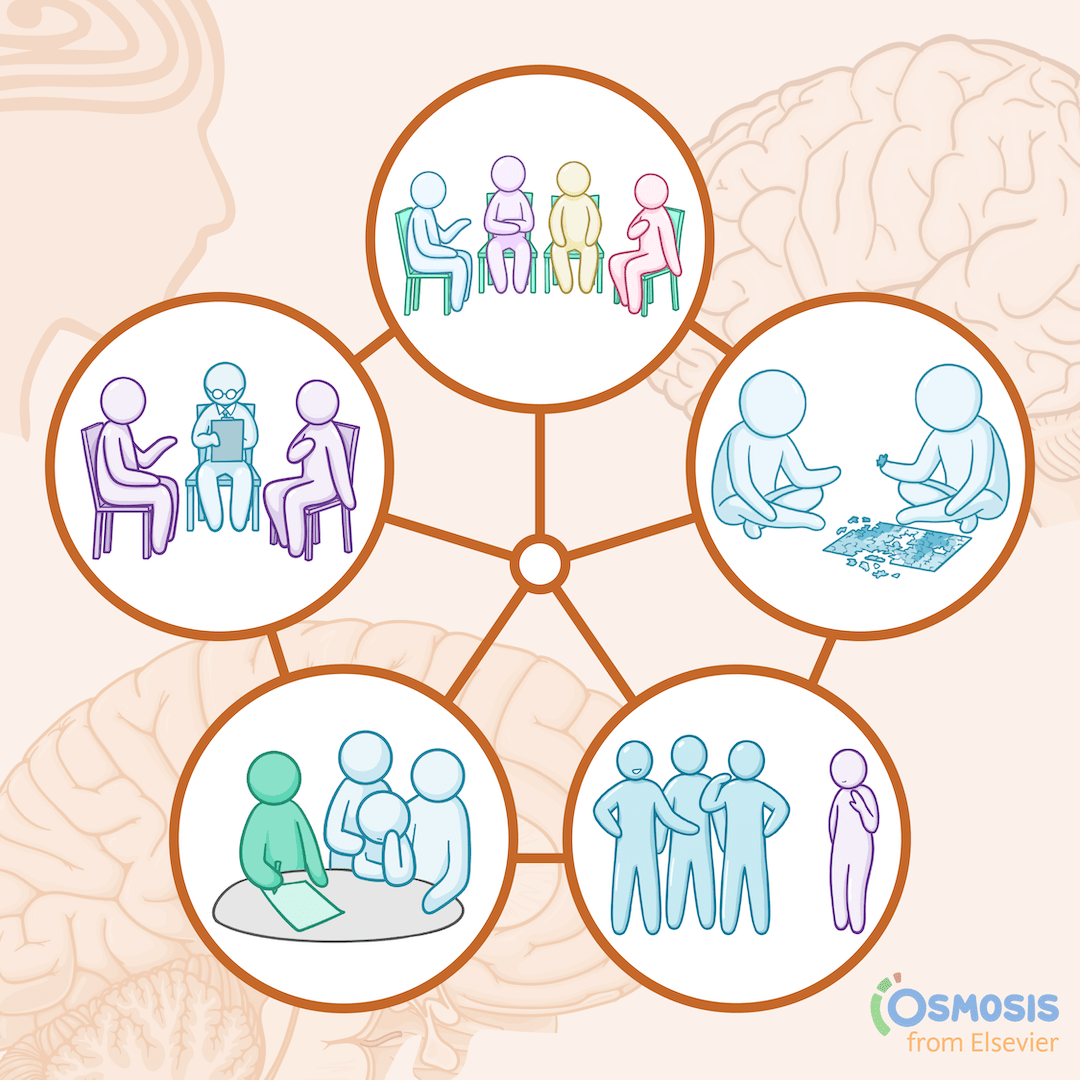
As the need for mental health care increases, it’s wonderful to share that a variety of treatment options are available. Depending on a patient’s needs, treatment can be done in an individual setting or include more than one person. In this clinician guide, we’ll delve into learning about multi-person therapies and how they can help us guide our patients to better mental health.
Did you know that multi-person therapy is just as effective at reducing symptoms as individual psychotherapy is? It also decreases stigma and fosters a sense of community, hope, and purpose among patients. In addition to being effective, multi-person therapy provides therapists with the opportunity to assist multiple patients simultaneously. If multi-person treatment were more readily available in the US, it would reduce the need for new therapists, enabling more than 3.5 million people to receive treatment. Through this treatment guide, we’ll explore the different types of multi-person therapies available and learn how they can be helpful mental health interventions.
Types of Therapies Involving More Than One Person
Group Therapy
Let’s start with Group therapy. With a wide variety of options for individual mental health treatment available, meeting with a group of strangers to discuss mental health difficulties may not be at the top of your patient’s list. However, many people who participate in Group therapy find it helpful and impactful.
Through Group therapy, patients can connect with a group of people with diverse personalities and backgrounds, navigating similar challenges. This type of therapy also helps patients feel supported, gain new strategies to tackle their concerns, and realize that they’re not alone. These sessions are typically led by one or more clinicians who also guide the management of symptoms and implement strategies to address mental health concerns.
Each therapy group tends to focus on a specific type of traumatic event, diagnosis, interpersonal issue, or skill building. They can either be open-ended, with ongoing sessions, or closed-ended, with a predetermined number of sessions.
Confidentiality, cohesion, and participation are fundamental in Group therapy, making it’s imperative to confirm that everyone’s suitable for the group. The selection process may include individual interviews, psychological testing, or small group sessions.
It’s also important to note that support groups and Group therapy can both be beneficial in mental healthcare, but they differ in how they’re facilitated. Group therapy is clinician-led and can focus on discussions, building skills, or often follows a treatment plan. Whereas support groups are generally led by a peer who’s dealt with a similar experience, but a clinician may also lead them.
Keep in mind, support groups are not a form of treatment. They provide a safe space for patients to discuss their feelings and experiences, with the overall goal to gain support as they navigate their mental health journey.
When considering any therapeutic approach, it’s essential to be aware of both the benefits and challenges.
The benefits of Group therapy include:
- Increased accessibility to care
- Affordability
- Social support
- The opportunity to relate to others with a shared experience
- Enhanced individual therapy
While the challenges of Group therapy include:
- Specific group schedules may not work for all members
- Confidentiality is not ensured
- May not address each member’s specific concern
- Members may not feel comfortable sharing with others
- There may be conflicts among members

Couples Therapy
Next, let’s discuss Couples therapy. Couples therapy aims to decrease relationship distress and improve the quality of the relationship. In this form of multi-person treatment, a couple sees a therapist together, with some sessions held individually. Couples therapy typically lasts between three and twelve months, although some couples may participate in sessions for as long as a few years.
While there are many therapeutic approaches used in Couples therapy, the most common approaches include the Gottman Method and Emotionally-Focused therapy.
The Gottman Method was developed to improve intimacy, connection, friendship quality, and peace within relationships, emphasizing that couples require between five times more positive interactions than negative ones to build an enduring relationship and repair issues. Throughout the sessions, there’s a focus on helping partners become more positive, affectionate, understanding, and less defensive towards one another. This shift in attitude is accomplished by creating love maps (learn more about this method).
With Emotionally-focused therapy, there’s an additional focus on relieving distress between couples and strengthening the emotional bond, utilizing techniques from Gottman’s Method. The therapist explores each individual’s attachment style and identifies how insecure attachment leads to dysfunction, defensiveness, and criticism of their partner.
Therapists also help couples develop a more secure attachment by encouraging them to express their primary feelings (e.g., inadequacy, shame, or sadness) often hidden behind their secondary feelings (e.g., contempt, anger, or emotional withdrawal).
Using Emotionally-Focused therapy, couples deepen their bond by embracing vulnerability, cultivating increased self-awareness, and working together to resolve their issues.
Let’s take a quick look at the indications and contraindications for this treatment tool.
The indications include:
- Relationship distress
- Desire to rebuild the bond
- Determining the future of the relationship
- Communication difficulties
- To develop problem-solving skills
The contraindications are:
- Intimate partner violence
- Untreated mental illness
- No motivation to attend therapy
- Already decided to divorce
- Ongoing substance use
Family Therapy
Last, but not least, is Family therapy, which focuses on how families interact with each other and how their interaction patterns contribute to interpersonal difficulties. The goals of this type of therapy are to decrease distress and conflict and preserve a healthy family dynamic by improving communication among family members.
Overall, family therapists identify behavioral patterns, review previous conflicts, and suggest alternate paths to conflict resolution. It’s also useful for family members who have a family member living with a medical issue, mental health concerns, such as mood disorders, eating disorders, or substance use, or who are experiencing significant life transitions, since therapy can provide support, improve communication, and foster understanding. Family therapists employ a range of methods and psychotherapy techniques; however, today we’ll focus on structural, strategic, and Bowenian methods.
The goals of the structural method are to help patients establish healthy boundaries, enhance communication, and strengthen the family structure through reframing, mapping, enactment, and unbalancing. The therapist works to restructure the family system and address the causes of familial discord. Using this method allows each family member to hear one another’s perspective while the therapist observes the family’s interactions and dynamics in real time. It’s particularly useful in families with teenagers, families dealing with divorce, blended families, substance use, mood disorders, behavioral disorders, and those experiencing significant life changes.
The strategic method is a short-term therapy that typically targets adolescent behavioral problems, changes in family interaction patterns, and provides enhancement to how the family functions. This form of Family therapy addresses issues such as substance use, high-risk sexual behavior, violence, and delinquency, while addressing problematic family interactions and engaging the entire family in addressing the core issues. The therapist establishes a therapeutic alliance with the family, identifying the family’s behavior patterns and implementing various strategies to strengthen communication, parenting skills, behavior management, and conflict resolution.
The Bowenian method examines how intergenerational behavioral patterns in families may lead to the persistence of comparable conflicts. The goals are to foster effective communication among family members, promote individuality and autonomy, and break toxic patterns within the family.
A variety of techniques are used, including the creation of a genogram, which provides a visual representation of family history, patterns, and relationships. The use of I-statements is also implemented to avoid blaming other family members and instead focus on communicating the individual’s feelings. Families develop emotional triangles, examining intergenerational patterns while equipping family members to handle conflict in a healthy manner.
Key Principles Across Multi-Person Therapies
Now that we’ve had an overview of several forms of Group therapy, let’s take a closer look at how to provide care ethically and efficiently.
When establishing a therapeutic alliance with multiple clients, it’s imperative to clarify your role as a clinician, explain any limitations to confidentiality, and establish cohesion within the group.
Effective communication, a well-designed group structure, and fostering strong relationships with each client all contribute to establishing the therapeutic alliance. Groups that aren’t cohesive can negatively impact the therapeutic alliance and overall treatment.
Confidentiality is often challenging in group therapy. The rules vary by state, with differences in the required level of confidentiality, so it’s essential to explain them to each client during the informed consent process. It’s also essential to clarify to children and teens what information may be shared with their caregivers.
Finally, it’s crucial to ensure that all clients understand the potential consequences of violating group confidentiality. The therapist needs to document each client’s problems and interventions without disclosing identifying information about other group members.
When working to establish a healthy group dynamic, there are specific therapeutic factors to consider that contribute to successful Group therapy, including:
- Catharsis
- Altruism
- Cohesiveness
- Effective communication techniques
- Accepting responsibility and consequence for decisions
- Finding different ways to interact with group members
- Gaining insights
- Recognizing that other group members have similar feelings
- Sharing information with the clinician and other members
Lastly, as a clinician, you should be aware of the ethical considerations and guidelines that you must uphold.
Practical Tips for Clinicians
As we continue to learn about the clinician’s role in multi-person therapy, let’s discuss some practical tips that you can implement during sessions.
To begin, it’s incredibly important to set clear goals and boundaries in collaboration with each group member. During individual intake sessions, take some time to discuss what each patient expects from Group therapy, how they expect the sessions to go, and how quickly they think they’ll experience change to ensure that they have realistic expectations. Taking some time to address any false ideas about Group therapy can also help patients feel more comfortable.
Facilitating communication and conflict resolution is paramount when working with multiple clients simultaneously. As the group leader, it’s vital to work through disagreements, concerns, and challenges during therapy sessions. When addressing those difficult moments, be direct, willing to listen to feedback, and able to work collaboratively with individuals or the group to address any concerns.
Tracking progress throughout treatment also improves outcomes. Assessment tools such as the Outcome Questionnaire, Group Questionnaire, and Group Climate Questionnaire offer therapists insight into which members aren’t making progress, who’s at risk for quitting therapy, and in measuring the therapeutic alliance. Monitoring progress and adapting interventions when needed are also crucial to being an impactful group leader.
If you’d like to explore training and supervision, check out the opportunities offered through the American Group Psychotherapy Association and the Society for Group Psychology and Group Psychotherapy.
Case Examples
Are you interested in the evidence of efficacy for each of these therapeutic approaches? Check out the studies below that showcase how they benefit patients:
Each study provides valuable research on each approach, along with suggestions for future studies.
Conclusion
There are numerous benefits to multi-person therapies, including improved communication, strengthened bonds, new conflict resolution and problem-solving skills, as well as healthier relationships. There’s always room to grow as a clinician, and through training in these treatment approaches, you can deliver exceptional care to even more patients.
Key Takeaways
- Group, couples, and family therapies provide shared support and foster healing.
- Confidentiality and group cohesion are essential for effective therapy.
- Clear goals and boundaries help manage group dynamics.
- Ongoing assessment and feedback optimize treatment outcomes.
- Training enhances clinicians’ skills in multi-person therapy facilitation.
References
- https://www.apa.org/monitor/2023/03/continuing-education-group-therapy
- https://www.sciencedirect.com/topics/psychology/group-therapy
- https://pmc.ncbi.nlm.nih.gov/articles/PMC9893048/
- https://www.apa.org/topics/psychotherapy/group-therapy
- https://www.sciencedirect.com/science/article/pii/S2666915324001422
- https://www.sciencedirect.com/topics/nursing-and-health-professions/group-therapy
- https://www.ncbi.nlm.nih.gov/books/NBK549812/
- https://adaa.org/learn-from-us/from-the-experts/blog-posts/consumer/understanding-group-therapy-and-support-groups
- https://pmc.ncbi.nlm.nih.gov/articles/PMC10087549/#famp12824-sec-0005
- https://www.nimh.nih.gov/health/topics/psychotherapies
- https://pmc.ncbi.nlm.nih.gov/articles/PMC6037577/
- https://www.psychologytoday.com/us/therapy-types/the-gottman-method
- https://pmc.ncbi.nlm.nih.gov/articles/PMC9645475/
- https://www.psychologytoday.com/us/therapy-types/emotionally-focused-therapy
- https://www.archivespp.pl/Marital-Therapy-Couples-Therapy-Indications-and-Contraindications,153317,0,2.html
- https://networks.aamft.org/arizona/why-mfts/new-item2
- https://pmc.ncbi.nlm.nih.gov/articles/PMC7001353/
- https://www.psychologytoday.com/us/therapy-types/structural-family-therapy
- https://pmc.ncbi.nlm.nih.gov/articles/PMC3737065/
- https://www.verywellmind.com/strategic-family-therapy-definition-types-techniques-and-efficacy-5216431
- https://www.verywellmind.com/bowenian-family-therapy-definition-and-techniques-5214558
- https://www.apa.org/ethics/code?item=7#402
- https://agpa.org/get-certified-cgp/
- https://www.apadivisions.org/division-49/about/resources/training
- https://www.sciencedirect.com/science/article/pii/S0005791623000757
- https://pmc.ncbi.nlm.nih.gov/articles/PMC6479931/#sec5-ijerph-16-01255
- https://www.sciencedirect.com/topics/psychology/group-therapy
- https://pmc.ncbi.nlm.nih.gov/articles/PMC11579155/pdf/10597_2024_Article_1304.pdf
- https://www.apa.org/ed/graduate/specialize/family

Try Osmosis from Elsevier today! Access your free trial and discover why millions of current and future clinicians and caregivers love learning with us.


Leave a Reply