

Medicine is often associated with healing, innovation, and scientific progress, but its history reveals a foundational contradiction: many of medicine’s most notable advances are also intertwined with a history of racism, inequality, and unethical experimentation in which Black people were denied autonomy, informed consent, and basic dignity in the name of scientific progress.
This history can be uncomfortable to revisit, but understanding the historical context is essential for anyone involved in healthcare. For generations, Black patients were harmed, excluded, and deceived by medical institutions, and those experiences continue to shape how many Black people engage with healthcare systems, clinicians, and research studies today. The development of modern gynecology, the Tuskegee Syphilis Study, the nonconsensual use of Henrietta Lacks’ cells, and the forced sterilization of Black women were not isolated incidents, but part of broader patterns of medical racism and exploitation that have had lasting consequences. Understanding this history helps explain why medical mistrust persists in many Black communities, why Black patients remain underrepresented in some areas of clinical research, and why ethical accountability remains critical in medicine. Confronting these histories honestly is essential to understanding the human cost of unethical medical advancement and ensuring those harms are never repeated.
Foundations: Slavery, Pseudoscience, and Control
To understand the history of medical exploitation in Black communities, it’s important to first understand how slavery shaped early American medicine.
Between the 16th and 19th centuries, 12.6 million Africans were forcibly abducted and transported across the Atlantic through the transatlantic slave trade, with approximately 1.8 million men, women, and children dying during the voyage. They endured severe violence, forced labor, family separation, and physical abuse under a system that denied them autonomy and basic human rights.
Racist pseudoscientific theories were used to justify slavery and the exploitation of Black people, with some physicians and scientists inventing inaccurate biological claims to rationalize forced labor, violence, and unequal treatment. Figures within the medical establishment, including Dr. Samuel Cartwright, Dr. Thomas Hamilton, and Dr. Benjamin Moseley, further reinforced these ideas by falsely claiming that Black people experienced pain differently than white people because of supposedly “primitive” nervous systems.
Despite these claims being entirely untrue, their legacy persists. Researchers at the University of Virginia found that, as of 2016, many white medical students and residents still believe that there are biological differences between Black and white patients, including the misconception that Black people feel less pain. These unabashedly racist beliefs continue to contribute to disparities in pain management for Black patients and their overall healthcare treatment.
Designated as property, enslaved people were frequently subjected to medical experimentation without consent, with physicians practicing surgical techniques on Black individuals and using their bodies for medical research. After the Civil War and the dissolution of slavery, this pattern persisted; Black bodies continued to be disproportionately exploited for anatomical study and dissection in medical schools. For example, from 1898 to 1904, approximately two-thirds of the cadavers dissected at Johns Hopkins University were African American, many of whom were obtained through grave robbing or other exploitative practices targeting Black communities. In some cases, medical institutions also acquired bodies through arrangements involving impoverished Black patients or donations from slave owners. These practices helped to establish patterns of medical exploitation and dehumanization that would continue after slavery was outlawed.

Dr. James Marion Sims and Experimentation on Enslaved Women
Often referred to as the “father of modern gynecology,” Dr. J. Marion Sims is a key figure whose legacy remains deeply controversial because many of his advances were developed through experimentation on enslaved Black women. His contributions include well-known instruments still in use today, including the vaginal speculum, uterine scissors, vaginal retractors, uterine curettes, uterine sound, and rectal speculums, along with the Sims’ position.
In the 1840s, Sims developed a surgical repair for vesicovaginal fistulas, a serious childbirth complication that can cause chronic pain and incontinence. To refine his techniques, Sims repeatedly operated on enslaved women Lucy, Anarcha, and Betsey, performing extremely painful experiments without anesthesia, despite its availability. Historical accounts describe Sims using morphine not to relieve the women’s pain, but at times to quiet their screams during procedures.
The surgeries were physically and emotionally traumatic, with many procedures initially unsuccessful. Historical accounts describe Lucy enduring an hour-long operation without anesthesia while other physicians observed; she later developed serious complications and required months to recover. Anarcha reportedly underwent approximately 30 procedures over the course of four years before Sims successfully refined his surgical technique. Once he standardized the procedure, he began performing it on white women using anesthesia.
Although Dr. Sims’ contributions significantly influenced the future of gynecology, his work must also be questioned through an ethical lens. While Sims claimed the women sought treatment to relieve their suffering (note that there’s no record of this), the enslaved women on whom he operated were denied anesthesia because of racist and scientifically false beliefs about pain tolerance in Black individuals, without their consent, in a system in which enslaved people had little control over what was done to their bodies. Today, his legacy remains deeply controversial and is often discussed as a reminder that medical innovation should never come at the expense of human dignity, informed consent, or ethical treatment.
Sarah Baartman and Scientific Objectification
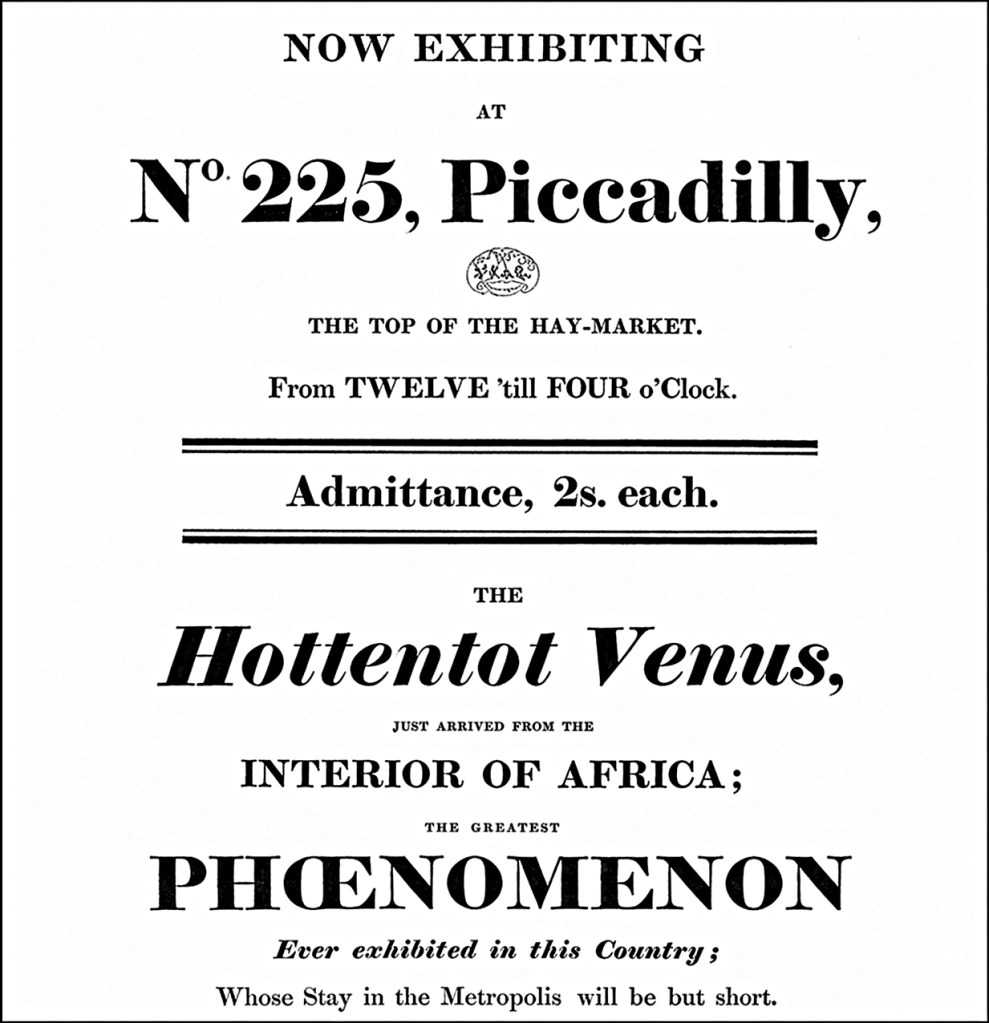
Another stark example of medical and scientific exploitation is the story of Sarah Baartman, a young Khoikhoi woman from South Africa, enslaved in Cape Town after her husband was killed by Dutch colonists. In 1810, she was taken to London under the promise of performing with a theater group, but was instead trafficked and publicly exhibited as the “Hottentot Venus,” placed on display nude in Piccadilly Circus. After being sold to an animal trainer and taken to Paris in 1814, she continued to be exploited in public exhibitions, subjected to degrading portrayals that framed her as hypersexual and primitive while being sexually abused and trafficked by her captors. Baartman was constantly dehumanized by both the public and the scientific community, who used her appearance to reinforce racist ideologies.
European depictions of Baartman frequently portrayed her as hypersexual, primitive, and biologically inferior, reinforcing racist assumptions about Black people throughout Europe. Images and descriptions of Baartman circulated widely and were used to support the growing field of scientific racism, which used pseudoscience to justify racial hierarchy by portraying Black people as less civilized and biologically inferior to their white counterparts. These harmful and inaccurate beliefs later developed into the more formal theory of eugenics, illustrating how science and medicine were often manipulated to legitimize racism, reinforce prejudice, and justify the unequal treatment of Black people.
Disturbingly, the exploitation of Sarah Baartman continued even after her death in 1815. French anatomist Georges Cuvier performed an autopsy on her in an attempt to draw comparisons between humans and animals. A nude cast of her body was also displayed at the Museum of Man and throughout Paris for decades. Other scientists and anthropologists, including Julien-Joseph Virey, used her image to support racist theories, portraying Black women as sexually primitive and inherently inferior.
Even though these heavily biased theories have long been scientifically disproven, the harm they caused hasn’t faded. Many of the assumptions used to dehumanize Black people throughout history continue to shape healthcare experiences and contribute to disparities in pain treatment, maternal health outcomes, and overall quality of care for Black people today.

The Tuskegee Syphilis Study
The Tuskegee Syphilis Study remains one of the most well-known examples of unethical medical research in the US.
In 1932 in Macon County, Alabama, researchers from the US Public Health Service enrolled 600 Black men in a long-term research study, recruiting them with promises of free medical care, free meals, and burial insurance. Of those participants, 399 had syphilis, and 201 did not. The men were told they were receiving treatment for “bad blood,” and researchers chose not to inform them of their diagnosis or the true purpose of the study.
The actual goal of the study was to observe the natural progression of untreated syphilis. Study participants were monitored and given placebos, despite penicillin becoming the recommended treatment for syphilis in the late 1940s. In addition to withholding treatment from participants, researchers also reached out to local doctors, asking them not to treat the infected men.
The study continued for forty years until it was publicly exposed in 1972 by whistleblower Peter Buxton. A lawsuit was filed and won on behalf of the victims. However, forty years of damage from syphilis was irreversible. A total of 128 participants died of syphilis or complications associated with it, nineteen children were born with congenital syphilis, and forty of the participants’ wives were infected.
Public exposure of the Tuskegee Syphilis Study prompted major changes in US research ethics and oversight. In 1974, Congress passed the National Research Act, which helped establish stronger protections for human research participants, including Institutional Review Boards (IRBs) and formal informed consent requirements for clinical studies.
Despite the profound harm caused by the study, no researchers ever faced criminal charges, and a formal federal apology wasn’t issued until 1997, when then-President Bill Clinton publicly acknowledged the US government’s role in the abuse and deception of the men involved.
The effects of the Tuskegee study extended far beyond the participants themselves. Research suggests the study contributed to increased medical mistrust in Black communities and reduced participation in healthcare and medical research, with some studies linking its exposure to poorer health outcomes and shorter life expectancy among Black men in the decades that followed.

Henrietta Lacks and HeLa Cells
Henrietta Lacks’ story highlights a major ethical issue in medicine and medical research: informed consent.
In 1951, Lacks sought treatment for vaginal bleeding, which was soon diagnosed as cervical cancer. During her care, physicians collected cells from her tumor. Without her knowledge or permission, Lacks’ biopsy was sent to leading cancer researcher, Dr. George Gey, who discovered that Lacks’ cells could survive and reproduce indefinitely in a laboratory setting, creating the first immortal human cell line: HeLa cells.
For decades, her family was unaware that Henrietta’s cells were being distributed worldwide for research and commercial use, becoming one of the most important tools in modern biomedical research. HeLa cells have contributed to advances in chemotherapy, cloning, gene mapping, in vitro fertilization, and the development of both the polio and COVID-19 vaccines, as well as to studies of hormones, viruses, and cancer cell growth.
Neither Henrietta Lacks nor her family gave consent for her cells to be collected or used in research, and despite the enormous scientific and commercial impact, her family remained unaware of their widespread use until 1976. Although the Lacks family later reached legal agreements related to the use of Henrietta’s cells, her story continues to raise difficult ethical questions about informed consent, patient autonomy, and who benefits from the commercialization of medical research and scientific discovery.
Henrietta Lacks’ legacy also forces medicine to confront an uncomfortable reality: groundbreaking scientific advances can still come from unethical practices. While Lacks’ cells helped transform modern medicine, that progress came without her knowledge or permission. Her story remains part of a broader chronology in which Black bodies were often used to advance medical knowledge without autonomy, transparency, or protection. And that history continues to shape conversations about equity, accountability, and trust in medical research today.

The Forced Sterilization of Black Women
Another painful chapter in the history of medicine is the uninformed and coerced sterilizations of Black women and other marginalized people throughout the 20th century.
In 1927, the Supreme Court’s decision in Buck v. Bell upheld the forced sterilization of Carrie Buck, a young woman falsely labeled “feebleminded,” legitimizing compulsory sterilization laws across the US and helping pave the way for the forced or coercive sterilization of more than 70,000 people. Although the eugenics movement had been widely challenged by the 1930s due to advances in genetics, many physicians, lawmakers, and public health officials continued using its racist and ableist ideologies to justify controlling the reproductive rights of Black women, poor women, immigrants, disabled individuals, and people with mental illness.
Thousands of women underwent unnecessary hysterectomies or tubal ligations without informed consent or without fully understanding that the procedures would permanently prevent them from having children. The practice became so widespread in the South that sterilization procedures were commonly referred to as the “Mississippi appendectomy.” These surgeries were used as training opportunities for medical students, reflecting broader efforts to control the reproductive autonomy of Black women and other marginalized communities under the fraudulent guise of public health and social improvement.
Recognizing the Patterns and Lasting Impact of Unethical Research
While these abuses happened during different eras of scientific understanding, they share common themes: lack of informed consent, unequal power dynamics between doctor and patient, scientific racism based on false biological assumptions, the prioritization of research goals over patient welfare, and the dehumanization of Black patients in the name of medical progress.
The effects of this history continue to shape healthcare today, contributing to lasting medical mistrust, trauma, unequal pain treatment, disparities in maternal health outcomes, underrepresentation in clinical trials, and other adverse health outcomes experienced by Black communities. These inequities reflect longstanding patterns of racism, discrimination, and exclusion within the healthcare system, demonstrating that the consequences of medical racism aren’t simply historical but ongoing.
Acknowledging this history isn’t about rejecting medical progress. It’s about recognizing that some scientific advancements came alongside profound ethical failures, racism, and the dehumanization of Black patients, and that medicine must continue working to earn and maintain public trust. Understanding this history can help clinicians provide more culturally responsive care, recognize implicit bias, and better understand why some patients approach healthcare systems with caution. While history cannot be rewritten, confronting these injustices honestly is an important step toward greater ethical accountability and ensuring they are never repeated.
As medicine continues to celebrate scientific breakthroughs and innovation, it’s equally important to acknowledge the hidden history that shaped many of those advancements. From experimental surgeries on enslaved women to the Tuskegee Syphilis Study and forced sterilization programs, Black communities have repeatedly experienced exploitation, discrimination, and unethical treatment in the name of medical progress. Recognizing this history is not about rejecting medicine, but about strengthening it through greater ethical accountability, transparency, and respect for patient autonomy. While these injustices cannot be undone, acknowledging their impact and understanding their effects on patients remains essential to rebuilding trust, improving equity in healthcare, and ensuring that scientific advancement is guided by ethics, informed consent, and humanity.
Key Takeaways
- Medical progress has historically included unethical experimentation and exploitation of Black individuals.
- Scientific racism and false biological beliefs contributed to harmful healthcare practices and disparities.
- Cases like Tuskegee, Henrietta Lacks, and forced sterilizations continue to shape medical mistrust today.
- Ethical principles such as informed consent and patient autonomy emerged partly in response to these abuses.
- Understanding this history is essential for advancing healthcare equity, accountability, and culturally responsive care.
Resources
- https://www.pbs.org/newshour/nation/family-of-henrietta-lacks-whose-cells-were-taken-for-medical-advancement-settles-with-company-that-profited
- https://www.amherst.edu/campuslife/our-community/wgc/-re-defining-gender-a-wgc-column/node/898067
- https://encyclopediavirginia.org/entries/slave-ships-and-the-middle-passage/
- https://www.thirteen.org/wnet/slavery/experience/living/history.html
- https://pubmed.ncbi.nlm.nih.gov/17226823/
- https://www.mcgill.ca/oss/article/history/40-years-human-experimentation-america-tuskegee-study
- https://www.pnas.org/doi/10.1073/pnas.1516047113
- https://link.springer.com/article/10.1186/s12939-025-02665-2
- https://www.smithsonianmag.com/history/in-need-cadavers-19th-century-medical-students-raided-baltimores-graves-180970629/
- https://pmc.ncbi.nlm.nih.gov/articles/PMC11480236/
- https://pmc.ncbi.nlm.nih.gov/articles/PMC12587519/
- https://www.history.com/articles/the-father-of-modern-gynecology-performed-shocking-experiments-on-slaves
- https://academic.oup.com/edited-volume/61663/chapter-abstract/553395614
- https://pmc.ncbi.nlm.nih.gov/articles/PMC6905121/
- https://www.kff.org/racial-equity-and-health-policy/racial-disparities-in-maternal-and-infant-health-current-status-and-key-issues/
- https://www.history.com/articles/the-infamous-40-year-tuskegee-study
- https://www.sciencedirect.com/science/article/pii/S0027968425000021
- https://www.britannica.com/event/Tuskegee-syphilis-study
- https://www.congress.gov/bill/93rd-congress/house-bill/7724
- https://www.sciencedirect.com/science/article/pii/S1555415523004129
- https://pmc.ncbi.nlm.nih.gov/articles/PMC3516052/
- https://www.pbs.org/newshour/science/novartis-settles-with-henrietta-lacks-estate-over-use-of-her-cancer-cells-to-advance-medicine
- https://www.pbs.org/independentlens/blog/unwanted-sterilization-and-eugenics-programs-in-the-united-states/
- https://supreme.justia.com/cases/federal/us/274/200/
- https://nationalpartnership.org/wp-content/uploads/2023/02/past-as-present-americas-sordid-history-of-medical-reproductive-abuse-and-experimentation.pdf
- https://tcf.org/content/report/racism-inequality-health-care-african-americans/
- https://en.wikipedia.org/wiki/Sims%27_position
- https://en.wikipedia.org/wiki/Medical_exploitation_of_Black_women_in_the_United_States
- https://www.hopkinsmedicine.org/henrietta-lacks

Try Osmosis from Elsevier today! Access your free trial and find out why millions of current and future clinicians and caregivers love learning by Osmosis.
Leave a Reply