
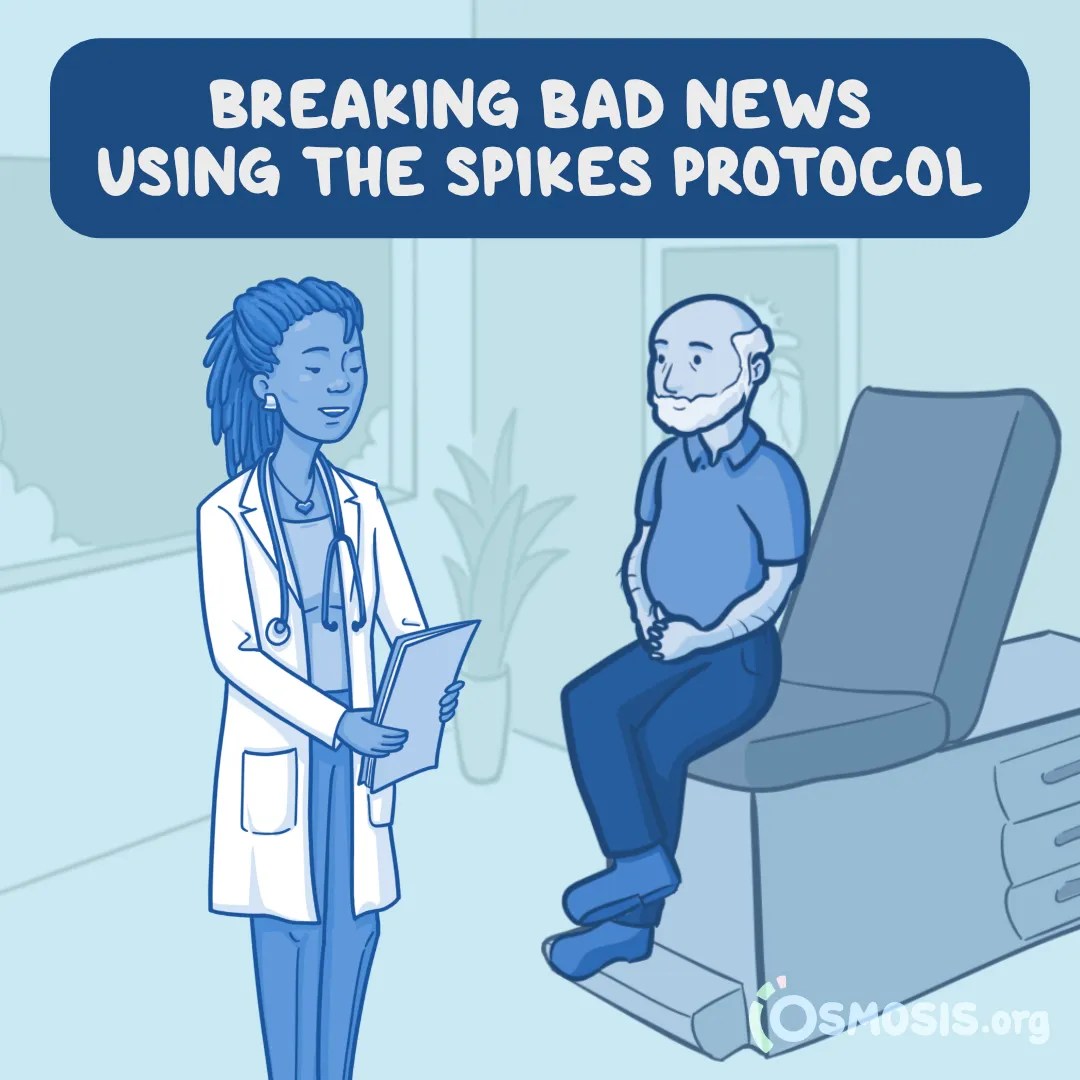
Delivering bad news is one of the hardest skills in medicine. This quick guide compares the SPIKES and BREAKS protocols, explains their key differences, and shows how to apply each framework in real clinical conversations so you can communicate difficult news with clarity and empathy. Make sure to save this quick guide so that you can refer to it when you need it!
Practicing medicine is exhilarating and fulfilling when you’re able to help patients recover from life-altering illnesses. However, there will be times when you need to tell a patient some negative information about their prognosis. Are you prepared to be the bearer of bad news?
There are ways to equip yourself to do your best in this difficult situation. Two tested methods are the SPIKES protocol and the BREAKS protocol. These methods can help you share news with patients in a way that is helpful and empathetic.
So what is the SPIKES protocol, and how does it differ from BREAKS? Read on for more details about these methods for breaking bad news in healthcare.

What is the SPIKES Protocol for breaking bad news in healthcare?
The SPIKES protocol is a six-part method that sets out a straightforward process for sharing difficult-to-hear and difficult-to-deliver news.
The SPIKES process acknowledges that the situation challenges both the doctor and the patient. For the doctor, it’s clearly hard to be in the position of shattering your patient’s hope for their recovery. On the other hand, nothing compares to the harsh reality that the patient must face.
The four main objectives of the SPIKES protocol include:
- Sharing information with the patient
- Gathering responses from them
- Providing vital support
- Creating a plan to move forward
Underpinning all of these objectives is the necessity of direct empathy for the patient and the shock they may be feeling. Studies have shown that patients respond best to direct and emotionally honest doctor-patient communication of even the most difficult news.
Who created the SPIKES protocol for breaking bad news?
The SPIKES method was developed by three doctors in the oncological field: Dr. Robert Buckman of Toronto-Sunnybrook Regional Cancer Centre, Dr. Michael Levy of the Fox Chase Cancer Center, and Dr. Walter Baile of the MD Anderson Cancer Center.
Dr. Buckman first presented the SPIKES method in 1998 at a meeting of the American Society of Clinical Oncology (ASCO). Their paper was published in 2000 under Dr. Baile’s name.
The main idea the three doctors started with was, “Before you tell, ask.” By creating a comfortable environment and eliciting permission from the patient, doctors can help their patients feel more in control of the amount of information they want to know and how they want to proceed with the new knowledge.
Sign up for a free trial and get more helpful healthcare content from Osmosis!!
The SPIKES Protocol Steps
The SPIKES protocol for sharing bad news consists of six distinct parts. Let’s take a look at each section in more detail. Since each situation will be different, take some time to picture how you would approach each step of the process.
1. Setting
The set-up of the meeting is important. You should create a warm and welcoming space that does not seem cold or clinical. If the patient wants family or close friends to be there in support, make sure that these people are included as well. It’s not necessary to rush into the news like dropping a bomb on an enemy; take a moment to connect and build rapport with your patient. Whether you understand it or not, you are about to change your patient’s life. Take time to show empathy and emotional connection.
2. Perception
Perception refers to the patient’s current level of knowledge about their medical issue and their thoughts about their status on the road to recovery. At this stage, it’s important to listen more than talk; there’s no need to challenge the patient on inaccurate or hopeful beliefs.
3. Invitation
At this stage, ask your patient if they want to know the details of their condition or the treatment they might face. Meet your patients where they’re at; if they are not ready for the details, it’s not necessary to force them to listen. The SPIKES method acknowledges that each patient has a right not to know the details if they’re not ready for them. Wait for permission from your patient before sharing.
4. Knowledge
At this stage, you’re sharing knowledge and information with your patient. Again, it’s important to ask the patient how much they understand and meet them there. Your patient often will need you to speak using plain terms, not medical jargon. Consider the individual; have they understood what you said? Do not rush this part of the medical protocol.
5. Emotion
Sharing bad news is emotional for both the doctor and the patient. Create space for your patients to express their emotions and practice deep empathy. Put yourself in their shoes by identifying their reaction—sadness, shock, denial—and helping them identify it, too.
6. Strategy and Summary
End the meeting on an intentional note: what will come next? Summarize your thoughts and your understanding of the patient’s reaction, and set expectations for the next appointment.

What is the BREAKS protocol for breaking bad news?
The BREAKS protocol is an alternate process for sharing difficult news. Doctors Narayanan, Bista, and Koshy from India and Nepal developed the BREAKS method in 2010. These doctors practice oncological and palliative care and they emphasize that how you share bad news can have either a positive or negative therapeutic effect. They designed the BREAKS method to ensure the best outcome for the patient while also supporting doctors through difficult situations.
The BREAKS Protocol Steps
Here’s a breakdown of the six parts of the BREAKS protocol. As you read, consider similarities and differences with the SPIKES method.
1. Background
The physician should make sure they know the patient’s situation; not only their diagnosis and outlook but also their socio-economic and educational status as well as their support system. Be ready to answer questions as fully as possible from both the patient and the loved ones who accompany them. While you won’t have every answer, confident assurance that you can research open questions will help alleviate a patient’s uncertainty.
2. Rapport
This step is sometimes easier said than done, but with practice, it can become second nature. As a physician, you’ll be the face a patient associates with their diagnosis and recovery. This is a fundamentally important relationship, and doctors need to approach it with humanity and care.
Explore
Start with what the patient knows and explore from there. Sometimes, your patient will be well-informed, but others may be misinformed and need more guidance. The patient’s family dynamic may also need exploration and clarification of caregivers’ roles.
3. Announce
The exploration stage should set you up for the right way to announce the news. If the patient is already emotional, mirror their emotions and proceed with empathy. If the patient already appears to know a lot about their situation, you can be more direct.
4. Kindle
Either way, at the end of the announcement, you should confirm that the patient understands what you’ve told them. This happens in the “kindling” step. Be clear about the new knowledge the patient has absorbed about their diagnosis and what it really means for them. If things are still murky or some misinformation remains, take time to work through those issues with the patient.
5. Summarize
Use the summarization stage to review the key points of the meeting and develop a plan for moving forward. Consider having a coworker present to document the meeting in writing and share it with the patient. Assess your patient’s emotional state and ensure they have the necessary support.
What Are the Key Differences Between the SPIKES vs BREAKS Protocols?
SPIKES Protocol:
- Most common, regularly taught in medical schools.
- Starts with managing the setting.
- Assesses patient understanding first.
- Explicitly asks permission to provide information.
- Emphasizes pacing and clarity of information.
BREAKS Protocol:
- Emphasizes preparation and emotional support.
- Starts with knowledge prep.
- Focuses on building rapport first.
- Encourages exploration and discussion.
- Emphasizes direct announcement with support.
Both protocols focus on empathy, and end with summary and planning, but BREAKS recommends extra focus on continued support.
The SPIKES Protocol vs the BREAKS Protocol: Which is better for breaking bad news?
The answer to this question lies with you. Though the SPIKES protocol has been around longer, many doctors feel the BREAKS method is what works for them.
Practice each method and find which one feels right for you. Remember that while there’s suggested language for each step, there’s no script, and each meeting will go differently. Some will go well, and some will feel extremely difficult; take time after each one to note what worked and what went wrong so that you can be ready for the next time.
Learning to be the bearer of bad news will take time, so be patient with yourself! With time and practice, you will be able to guide a patient through difficult times with empathy and humanity.
| Feature | SPIKES Protocol | BREAKS Protocol |
|---|---|---|
| Acronym Meaning | Setting Perception Invitation Knowledge Emotions Strategy/Summary | Background Rapport Explore Announce Kindling Summarize |
| Origin | Developed in oncology Baile et al., 2000 | Developed as a structured alternative communication model |
| Primary Focus | Structured delivery of bad news with an emphasis on assessing patient understanding and responding to emotions | Emphasizes preparation, relationship building, gradual disclosure |
| First Step | Set up the interview Carefully consider privacy, time, and setting | Review background and clinical details before the conversation |
| Assessment of Patient Understanding | Explicitly assesses patient perception before sharing information | Explores what the patient knows and what the patient expects |
| Information Delivery | Provides knowledge in small, clear segments | Announces the news directly, sensitively |
| Emotional Support | Responds to emotions with empathy | Focuses on addressing emotions and offering support |
| Closing the Conversation | * Strategy * Summary * Next steps | Summarize plan and ensure understanding |
| Strengths | Highly structured Widely taught Strong evidence base in oncology | Emphasizes preparation and the therapeutic relationship |
| Best Used When | Delivering serious diagnoses, prognosis discussions in oncology settings | Situations requiring strong rapport and careful emotional pacing |
Additional Reading
- Healthcare practitioners’ experiences of breaking bad news: A critical interpretative meta synthesis
- Self-assessment of residents in breaking bad news; skills and barriers
- Characteristics affecting the attitude and approach of physicians to breaking bad news: Uncertain medical situations
Key Takeaways
- SPIKES and BREAKS offer structured approaches to deliver bad news.
- Prioritize empathy, patient readiness, and clear doctor-patient communication skills.
- Adapt your approach based on patient’s understanding and emotional state.
- Practice and reflection improve confidence in difficult conversations.
- No script fits all; flexibility and compassion are essential.
Do you have a preference on how to deliver tough news to your patients? Share your thoughts in the comments!

Try Osmosis from Elsevier today! Sign up for a free trial today and find out why millions of new and practicing clinicians and caregivers love learning by Osmosis.
Leave a Reply