Anemia - Aplastic: Nursing

1,509views

Anemia - Aplastic: Nursing

Watch later

Watch later

Hypokalemia: Clinical
Movement of water between body compartments
The role of the kidney in acid-base balance
Blood histology
Blood components
Respiratory acidosis
Metabolic acidosis
Respiratory alkalosis
Metabolic alkalosis
Metabolic and respiratory alkalosis: Clinical
Metabolic and respiratory acidosis: Clinical
Bronchodilators: Beta 2-agonists and muscarinic antagonists
Chronic obstructive pulmonary disease (COPD): Clinical
Chronic obstructive pulmonary disease (COPD): Nursing process (ADPIE)
Adrenergic antagonists: Alpha blockers
Sympatholytics: Alpha-2 agonists
Alpha-2 adrenergic agonists: Nursing pharmacology
Adrenergic receptors
Adrenergic antagonists: Beta blockers
Diabetes mellitus: Clinical
Diabetes mellitus (DM): Nursing process (ADPIE)
Diabetes mellitus
Diabetes mellitus: Pathology review
Stroke: Nursing process (ADPIE)
Stroke: Clinical
Ischemic stroke
Intracerebral hemorrhage
Peptic ulcers and stomach cancer: Clinical
GERD, peptic ulcers, gastritis, and stomach cancer: Pathology review
Sickle cell disease (NORD)
Sickle cell disease: Nursing process (ADPIE)
Sickle cell disease: Clinical
Blood groups and transfusions
Erythropoietin
Blood products: Nursing pharmacology
Oxygen binding capacity and oxygen content
Blood products and transfusion: Clinical
Hemophilia
Hemophilia: Nursing process (ADPIE)
Leukemia: Nursing process (ADPIE)
Chronic leukemia
Leukemias: Pathology review
Acute leukemia
Leukemia: Clinical
Lymphomas: Pathology review
Lymphoma: Clinical
Non-Hodgkin lymphoma
Hodgkin lymphoma
Lymphatic system anatomy and physiology
Anatomy of the abdominal viscera: Liver, biliary ducts and gallbladder
Liver anatomy and physiology
Cirrhosis
Cirrhosis: Pathology review
Cirrhosis: Clinical
Cirrhosis: Nursing process (ADPIE)
Hepatitis C virus
Hepatitis A and Hepatitis E virus
Liver cancer: Nursing
Cholestatic liver disease
Non-alcoholic fatty liver disease
HIV (AIDS)
HIV and AIDS: Pathology review
Antiretrovirals for HIV/AIDS - Protease inhibitors: Nursing pharmacology
Antiretrovirals for HIV/AIDS - NRTIs and NNRTIs: Nursing pharmacology
Antiretrovirals for HIV/AIDS - Integrase strand transfer inhibitors: Nursing pharmacology
Anatomy of the abdominal viscera: Pancreas and spleen
Pancreatitis: Nursing process (ADPIE)
Glaucoma: Nursing process (ADPIE)
Glaucoma
Eye conditions: Refractive errors, lens disorders and glaucoma: Pathology review
Acute respiratory distress syndrome (ARDS): Nursing
Anatomy of the coronary circulation
Coronary artery disease: Pathology review
Coronary artery disease: Clinical
ECG basics
ECG normal sinus rhythm
ECG rate and rhythm
ECG axis
ECG intervals
ECG QRS transition
ECG cardiac infarction and ischemia
Cardiac cycle
Arterial disease
Delirium
Dementia and delirium: Clinical
Vascular dementia
Frontotemporal dementia
Dementia with Lewy bodies
Dementia: Pathology review
Tumor lysis syndrome (TLS): Nursing Process (ADPIE)
Cholelithiasis: Nursing
Coronary artery disease (CAD) and angina pectoris: Nursing process (ADPIE)
Breast cancer: Nursing process (ADPIE)
Ovarian cancer: Nursing
Cervical cancer: Nursing
Hormones and hormone modulators for cancer: Nursing pharmacology
Endometriosis: Nursing
Heart failure
Left-sided heart failure: Nursing process (ADPIE)
Heart failure: Pathology review
Pneumonia: Pathology review
Pneumonia
Bacterial pneumonia: Nursing process (ADPIE)
Respiratory stimulants: Nursing pharmacology
Corticosteroids - Inhaled: Nursing pharmacology
Pneumothorax and hemothorax: Nursing
Chest trauma: Clinical
Pleural effusion: Nursing
Tuberculosis (TB): Nursing
Parkinson disease: Nursing process (ADPIE)
Huntington disease
Multiple sclerosis (MS): Nursing
Multiple sclerosis
Guillain-Barré syndrome: Nursing
Guillain-Barre syndrome
Myasthenia gravis: Nursing
Acute kidney injury (AKI): Nursing process (ADPIE)
Acute kidney injury: Clinical
Chronic kidney disease (CKD): Nursing
Chronic kidney disease
Chronic kidney disease: Clinical
Polycystic kidney disease (PKD): Nursing
Renin-angiotensin-aldosterone system
Osteoarthritis: Nursing
Osteoarthritis
Rheumatoid arthritis (RA): Nursing process (ADPIE)
Rheumatoid arthritis: Clinical
Rheumatoid arthritis
Rheumatoid arthritis and osteoarthritis: Pathology review
Systemic lupus erythematosus
Systemic lupus erythematosus (SLE): Pathology review
Systemic lupus erythematosus (SLE): Clinical
Systemic lupus erythematosus (SLE): Nursing
Mycobacterium tuberculosis (Tuberculosis)
Peripheral venous disease (PVD): Nursing process (ADPIE)
Peripheral arterial disease (PAD): Nursing process (ADPIE)
Buerger disease: Nursing
Raynaud phenomenon: Nursing
Aortic dissections and aneurysms: Pathology review
Aortic aneurysms and dissections: Clinical
Aortic dissection
Aortic aneurysm: Nursing process (ADPIE)
Venous thromboembolism (VTE): Nursing process (ADPIE)
Benign prostatic hyperplasia (BPH): Nursing process (ADPIE)
Benign prostatic hyperplasia
Prostate cancer: Nursing
Prostate cancer
Testicular cancer: Nursing
Testicular cancer
Diabetic ketoacidosis (DKA): Nursing process (ADPIE)
Endocrine system anatomy and physiology
Vitamin B12 deficiency
Thalassemia: Nursing
Anemia - Iron-deficiency: Nursing
Anemia - Macrocytic: Nursing
Anemia - Aplastic: Nursing
Thyroid hormones
Medications for thyroid disorders: Nursing pharmacology
Hyperthyroidism: Nursing process (ADPIE)
Hypothyroidism: Nursing process (ADPIE)
Hypoparathyroidism: Nursing
Hyperparathyroidism: Nursing
Anxiety disorders: Nursing process (ADPIE)
Spinal cord injury (SCI): Nursing
Cluster A personality disorders
Smoke inhalation injury: Nursing process (ADPIE)
Shock - Anaphylactic: Nursing
Shock - Obstructive: Nursing
Shock - Neurogenic: Nursing
Shock - Hypovolemic: Nursing
Shock - Cardiogenic: Nursing
Shock - Septic: Nursing
Pulmonary edema: Nursing
Burn injury: Nursing

Notes

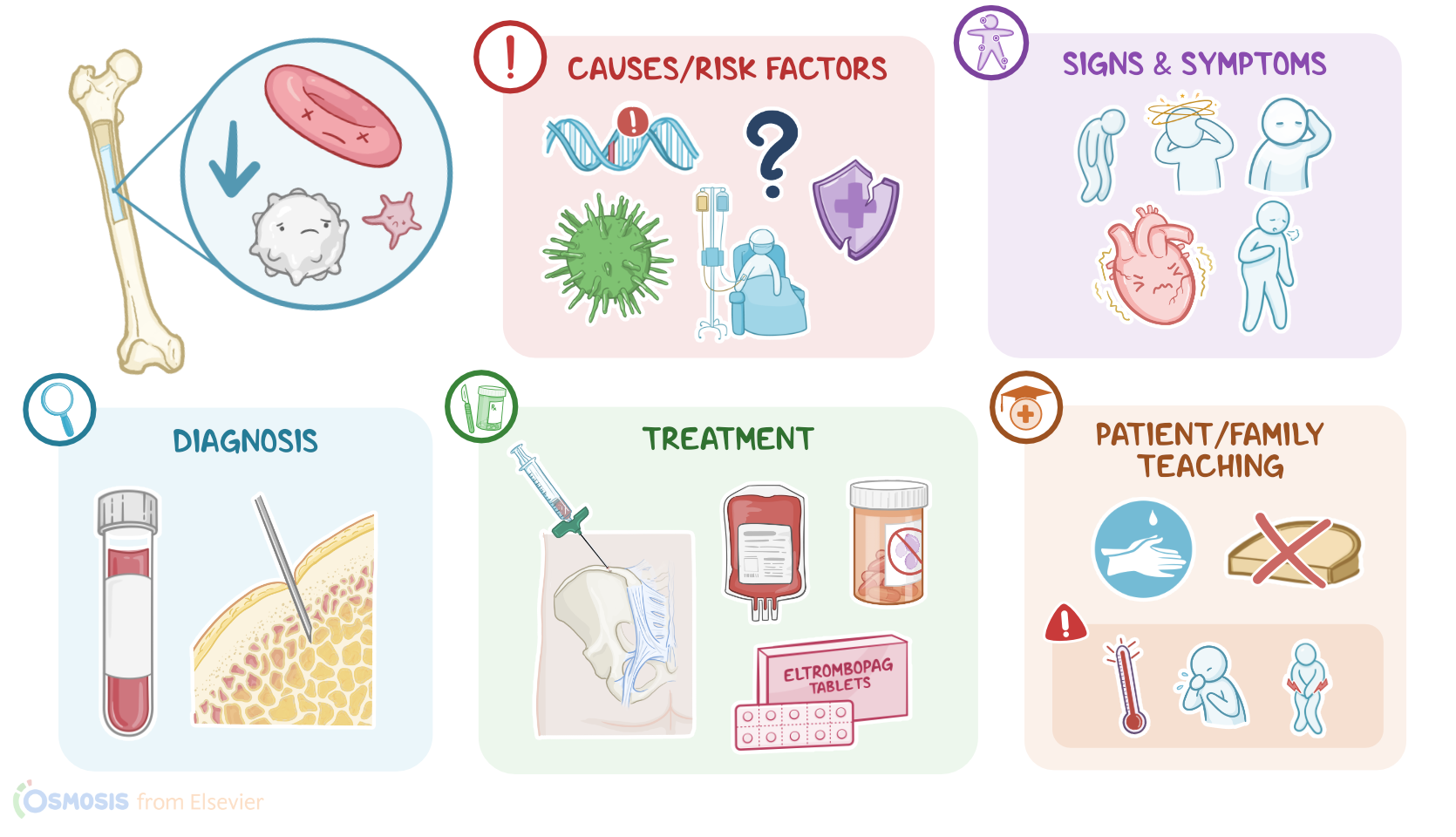
ANEMIA - APLASTIC

KEY POINTS
NOTES
DEFINITION
  • Decreased production of all blood cell lines

PHYSIOLOGY
  • Hematopoiesis
    • Begins in bone marrow
    • Stem cells
      • Red blood cells (RBCs)
      • White blood cells (WBCs)
      • Platelets
  • Erythropoietin
    • Stem cells differentiate into RBCs
  • Granulocyte-colony stimulating factor (G-CSF)
    • Stem cells differentiate into WBCs
  • Thrombopoietin
    • Stem cells differentiate into platelets

CAUSES AND RISK FACTORS
  • Causes
    • Inherited
      • Fanconi anemia
    • Acquired
      • Autoimmune disease
      • Chemotherapy
      • Radiation therapy
      • Idiopathic
      • Medications
      • Toxic chemicals
      • Infections

PATHOPHYSIOLOGY
  • Damage to bone marrow
  • Autoimmune reaction triggered 
    • Stem cells destroyed
  • Non-functional tissue replaces bone marrow
  • Insufficient stem cells to produce mature blood cells

SIGNS AND SYMPTOMS
  • Vary depending on disease severity
  • Fatigue
  • Dizziness
  • Pallor
  • Tachycardia
  • Chest pain
  • Dyspnea
  • Increased bleeding
  • Petechiae
  • Recurrent or severe infections

DIAGNOSIS
  • History
  • Physical assessment
  • Laboratory tests
  • Biopsy

TREATMENT
  • Depends on cause and patient's age and history
  • Supportive care
  • Bone marrow transplant
  • Immunosuppressive medications
  • Thrombopoietin receptor agonist

MANAGEMENT OF CARE
  • Goals of care
    • Prevent complications
    • Provide supportive care
  • Institute neutropenic precautions
  • Assess vitals and review laboratory results
    • Notify HCP
      • Signs of infection
  • Gentle oral care
  • Avoid rectal thermometers
  • Assess for signs of bleeding
    • Report to HCP
      • Bruising
      • Petechiae
      • Epistaxis
      • Gingival or IV oozing
      • Frank bleeding
  • Institute fall precautions
    • Notify HCP
      • Signs of decreased oxygen-carrying capability

PATIENT AND FAMILY TEACHING
  • Explain condition, plan of care, and how to safely administer medications
  • Instruct on infection control techniques
  • Review bleeding prevention precautions
  • Contact HCP
    • Fall
    • Prolonged bleeding
    • Chest pain
    • Palpitations
    • Signs of infection

Transcript

Watch video only

Aplastic anemia is a condition characterized by pancytopenia, meaning decreased production of all blood cell lines, so red and white blood cells, as well as platelets. This condition can be inherited, when it occurs because of genetic mutations, as well as acquired, when it occurs because of external factors.

Let’s start by looking at the physiology of blood cell production, or hematopoiesis. This process starts in the bone marrow, which is the innermost portion of bone, where hematopoietic stem cells reside. These serve as progenitor cells for all the different cell types found in the blood, including white blood cells, which primarily function as the defense mechanism against infections; as well as red blood cells, which are essential to carry oxygen to the tissues; and platelets, which play a key role in blood clotting.

Now, hematopoietic stem cells reach their final, mature form, when they receive the appropriate signals in the form of specific growth factors or stimulating factors. One of these growth factors is called erythropoietin, or EPO. This is a hormone released by the kidneys, that tells hematopoietic stem cells to differentiate into red blood cells. Another important factor is the granulocyte colony-stimulating factor, or G-CSF, which is produced by various cells and tissues, including the bone marrow itself, and it stimulates the production of a specific group of white blood cells called neutrophils. Finally, there’s thrombopoietin, a hormone produced by the liver and kidneys, which stimulates platelet production.

Alright, now the causes of aplastic anemia can be inherited or acquired. The most common cause of inherited aplastic anemia is Fanconi’s anemia, a rare genetic disorder characterized by progressive bone marrow failure.

On the other hand, acquired causes of aplastic anemia include any other factor that leads to suppression or destruction of the bone marrow, including other conditions like an autoimmune disease, or undergoing treatments like chemotherapy or radiation therapy. Additionally, many cases are idiopathic, meaning the exact cause is unknown.

Some medications can also cause bone marrow suppression, like antiepileptics such as anticonvulsants hydantoins or carbamazepine; antithyroid medications like propylthiouracil and methimazole; and certain antibiotics like chloramphenicol and sulfonamides.

There are also toxic chemicals associated with bone marrow destruction, like benzene and certain solvents. And last but not least, some viruses like EBV, HIV or hepatitis viruses can also be a cause.

Okay, so the pathology of aplastic anemia starts with an inherited defect or acquired damage to the bone marrow. In most cases, this triggers an autoimmune reaction that destroys hematopoietic stem cells, followed by subsequent replacement of the bone marrow by non-functional fatty tissue. Eventually, clients with aplastic anemia do not have enough hematopoietic stem cells to generate appropriate amounts of mature blood cells, and the end result is pancytopenia.

Now, clinical manifestations of aplastic anemia vary depending on the disease severity. A low red blood cell count can lead to fatigue, dizziness, and pallor. In severe cases, tissues cannot properly oxygenate, so the heart pumps harder to circulate the blood, which can lead to tachycardia, chest pain, and dyspnea.

Next, a low platelet count can lead to increased risk of bleeding due to minor injuries; as well as spontaneous mucosal bleeding, like epistaxis and bleeding gums; and petechiae, which are tiny red spots that appear on the skin because of broken capillaries.

Finally, low white blood cell count predisposes clients to develop recurrent or severe infections.

The diagnosis of aplastic anemia starts with the client’s history and physical assessment; followed by laboratory tests, including complete blood cell count that shows pancytopenia. Usually, the absolute neutrophil count, or ANC is less than 500/mm3, while platelet number is lower than 20,000/mm3. Other common findings include a hemoglobin level below 10g/dL and a decreased number of immature red blood cells, or reticulocytes, which demonstrates decreased red blood cell production; as well as increased levels of EPO, in an attempt to compensate and ramp up the production of red blood cells. In addition, bleeding time may also be increased.

Definitive diagnosis of aplastic anemia requires a bone marrow biopsy, which demonstrates profoundly low counts of hematopoietic stem cells with increased fat content, while at the same time ruling out other causes of bone marrow suppression, like malignancy or fibrosis.

Treatment of aplastic anemia depends on the cause, and can vary depending on the client's age and clinical history. If the condition is thought to be due to a medication or toxic agent, they should be removed immediately.

Supportive treatment includes blood transfusions to correct the anemia and antibiotics, as well as antifungal and antiviral medications to prevent or treat infections.

Key Takeaways

Aplastic anemia is a rare blood disorder caused by bone marrow failure to produce new blood cells. Even though it's referred to as aplastic anemia, it typically presents with pancytopenia, meaning that all three major blood cell lines - the red blood cells, white blood cells, and platelets are affected.

People with aplastic anemia may experience fatigue, shortness of breath, ecchymoses and mucosal bleeding, and frequent infections pallor Aplastic anemia can be caused by a variety of factors, including exposure to radiation or chemotherapy, viral infections, and autoimmune disorders.