Endometriosis: Nursing

Last updated: January 28, 2022

Endometriosis: Nursing

Watch later

Watch later

Hypokalemia: Clinical
Movement of water between body compartments
The role of the kidney in acid-base balance
Blood histology
Blood components
Respiratory acidosis
Metabolic acidosis
Respiratory alkalosis
Metabolic alkalosis
Metabolic and respiratory alkalosis: Clinical
Metabolic and respiratory acidosis: Clinical
Bronchodilators: Beta 2-agonists and muscarinic antagonists
Chronic obstructive pulmonary disease (COPD): Clinical
Chronic obstructive pulmonary disease (COPD): Nursing process (ADPIE)
Adrenergic antagonists: Alpha blockers
Sympatholytics: Alpha-2 agonists
Alpha-2 adrenergic agonists: Nursing pharmacology
Adrenergic receptors
Adrenergic antagonists: Beta blockers
Diabetes mellitus: Clinical
Diabetes mellitus (DM): Nursing process (ADPIE)
Diabetes mellitus
Diabetes mellitus: Pathology review
Stroke: Nursing process (ADPIE)
Stroke: Clinical
Ischemic stroke
Intracerebral hemorrhage
Peptic ulcers and stomach cancer: Clinical
GERD, peptic ulcers, gastritis, and stomach cancer: Pathology review
Sickle cell disease (NORD)
Sickle cell disease: Nursing process (ADPIE)
Sickle cell disease: Clinical
Blood groups and transfusions
Erythropoietin
Blood products: Nursing pharmacology
Oxygen binding capacity and oxygen content
Blood products and transfusion: Clinical
Hemophilia
Hemophilia: Nursing process (ADPIE)
Leukemia: Nursing process (ADPIE)
Chronic leukemia
Leukemias: Pathology review
Acute leukemia
Leukemia: Clinical
Lymphomas: Pathology review
Lymphoma: Clinical
Non-Hodgkin lymphoma
Hodgkin lymphoma
Lymphatic system anatomy and physiology
Anatomy of the abdominal viscera: Liver, biliary ducts and gallbladder
Liver anatomy and physiology
Cirrhosis
Cirrhosis: Pathology review
Cirrhosis: Clinical
Cirrhosis: Nursing process (ADPIE)
Hepatitis C virus
Hepatitis A and Hepatitis E virus
Liver cancer: Nursing
Cholestatic liver disease
Non-alcoholic fatty liver disease
HIV (AIDS)
HIV and AIDS: Pathology review
Antiretrovirals for HIV/AIDS - Protease inhibitors: Nursing pharmacology
Antiretrovirals for HIV/AIDS - NRTIs and NNRTIs: Nursing pharmacology
Antiretrovirals for HIV/AIDS - Integrase strand transfer inhibitors: Nursing pharmacology
Anatomy of the abdominal viscera: Pancreas and spleen
Pancreatitis: Nursing process (ADPIE)
Glaucoma: Nursing process (ADPIE)
Glaucoma
Eye conditions: Refractive errors, lens disorders and glaucoma: Pathology review
Acute respiratory distress syndrome (ARDS): Nursing
Anatomy of the coronary circulation
Coronary artery disease: Pathology review
Coronary artery disease: Clinical
ECG basics
ECG normal sinus rhythm
ECG rate and rhythm
ECG axis
ECG intervals
ECG QRS transition
ECG cardiac infarction and ischemia
Cardiac cycle
Arterial disease
Delirium
Dementia and delirium: Clinical
Vascular dementia
Frontotemporal dementia
Dementia with Lewy bodies
Dementia: Pathology review
Tumor lysis syndrome (TLS): Nursing Process (ADPIE)
Cholelithiasis: Nursing
Coronary artery disease (CAD) and angina pectoris: Nursing process (ADPIE)
Breast cancer: Nursing process (ADPIE)
Ovarian cancer: Nursing
Cervical cancer: Nursing
Hormones and hormone modulators for cancer: Nursing pharmacology
Endometriosis: Nursing
Heart failure
Left-sided heart failure: Nursing process (ADPIE)
Heart failure: Pathology review
Pneumonia: Pathology review
Pneumonia
Bacterial pneumonia: Nursing process (ADPIE)
Respiratory stimulants: Nursing pharmacology
Corticosteroids - Inhaled: Nursing pharmacology
Pneumothorax and hemothorax: Nursing
Chest trauma: Clinical
Pleural effusion: Nursing
Tuberculosis (TB): Nursing
Parkinson disease: Nursing process (ADPIE)
Huntington disease
Multiple sclerosis (MS): Nursing
Multiple sclerosis
Guillain-Barré syndrome: Nursing
Guillain-Barre syndrome
Myasthenia gravis: Nursing
Acute kidney injury (AKI): Nursing process (ADPIE)
Acute kidney injury: Clinical
Chronic kidney disease (CKD): Nursing
Chronic kidney disease
Chronic kidney disease: Clinical
Polycystic kidney disease (PKD): Nursing
Renin-angiotensin-aldosterone system
Osteoarthritis: Nursing
Osteoarthritis
Rheumatoid arthritis (RA): Nursing process (ADPIE)
Rheumatoid arthritis: Clinical
Rheumatoid arthritis
Rheumatoid arthritis and osteoarthritis: Pathology review
Systemic lupus erythematosus
Systemic lupus erythematosus (SLE): Pathology review
Systemic lupus erythematosus (SLE): Clinical
Systemic lupus erythematosus (SLE): Nursing
Mycobacterium tuberculosis (Tuberculosis)
Peripheral venous disease (PVD): Nursing process (ADPIE)
Peripheral arterial disease (PAD): Nursing process (ADPIE)
Buerger disease: Nursing
Raynaud phenomenon: Nursing
Aortic dissections and aneurysms: Pathology review
Aortic aneurysms and dissections: Clinical
Aortic dissection
Aortic aneurysm: Nursing process (ADPIE)
Venous thromboembolism (VTE): Nursing process (ADPIE)
Benign prostatic hyperplasia (BPH): Nursing process (ADPIE)
Benign prostatic hyperplasia
Prostate cancer: Nursing
Prostate cancer
Testicular cancer: Nursing
Testicular cancer
Diabetic ketoacidosis (DKA): Nursing process (ADPIE)
Endocrine system anatomy and physiology
Vitamin B12 deficiency
Thalassemia: Nursing
Anemia - Iron-deficiency: Nursing
Anemia - Macrocytic: Nursing
Anemia - Aplastic: Nursing
Thyroid hormones
Medications for thyroid disorders: Nursing pharmacology
Hyperthyroidism: Nursing process (ADPIE)
Hypothyroidism: Nursing process (ADPIE)
Hypoparathyroidism: Nursing
Hyperparathyroidism: Nursing
Anxiety disorders: Nursing process (ADPIE)
Spinal cord injury (SCI): Nursing
Cluster A personality disorders
Smoke inhalation injury: Nursing process (ADPIE)
Shock - Anaphylactic: Nursing
Shock - Obstructive: Nursing
Shock - Neurogenic: Nursing
Shock - Hypovolemic: Nursing
Shock - Cardiogenic: Nursing
Shock - Septic: Nursing
Pulmonary edema: Nursing
Burn injury: Nursing

Notes

ENDOMETRIOSIS

KEY POINTS
NOTES
DEFINITION
  • Endometrium tissue present in other parts of the body

PHYSIOLOGY
  • Uterine wall has 3 layers
    • Endometrium
    • Myometrium
    • Perimetrium
  • During menstrual cycle
    • Egg is released from ovaries
    • Estrogen and progesterone levels increase
    • Estrogen thickens the functional layer of the endometrium
  • If no fertilization
    • Hormone levels drop
    • Functional layers slough off

CAUSES AND RISK FACTORS
  • Cause
    • Unknown
    • Retrograde menstruation
    • Benign metastases
    • Genetics
    • Immunity and abnormal hormonal patterns
  • Risk factors
    • Family history
    • Never having been pregnant
    • Early menarche
    • Late menopause

PATHOPHYSIOLOGY
  • Proinflammatory factors released by migrated endometrial cells
  • Inflammation promotes grwoth of new blood vessels
  • Implant starts behaving like the endometrium of the endometrial tissue 
  • Sloughs off, bleeds, regenerates
  • Complications
    • Chronic inflammations and adhesions can damage reproductive structures
    • Infertility
    • Ectopic endometrial tissue on an ovary
      • Endometrioma / chocolate cyst
      • Can rupture
      • Ovarian torsion

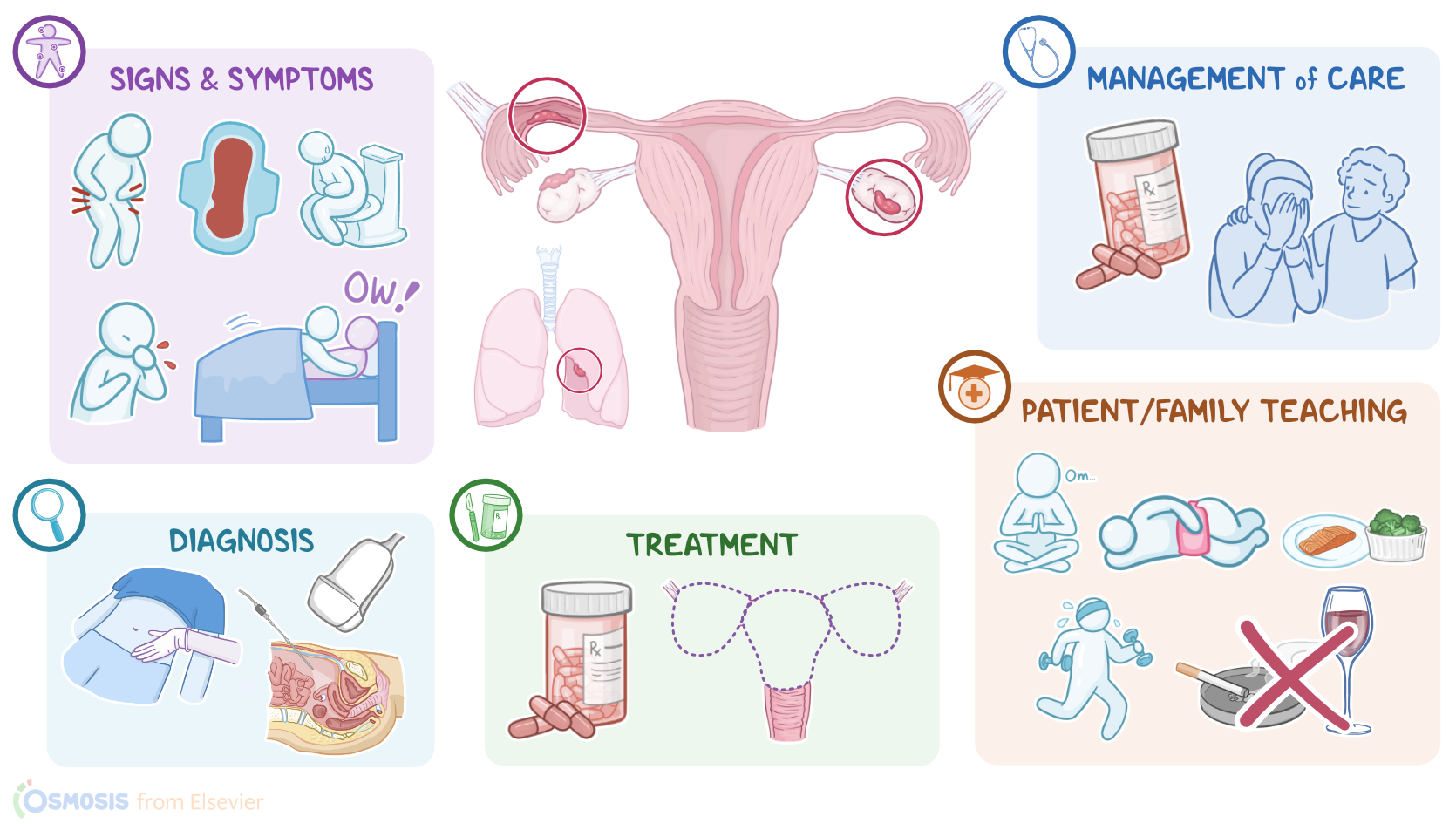
SIGNS AND SYMPTOMS
  • Vary depending on location o the tissue
  • Pain
  • Excessive menstrual bleeding
  • Painful menstruation
  • Dyspareunia
  • Painful urination and defecation
  • Abdominal pain
  • Lung endometriosis
    • Cough up blood
  • Tend to get worse during menstruation
  • Unilateral pelvic pain

DIAGNOSIS
  • History
  • Physical assessment
  • Pelvic examination
  • Ultrasound
  • MRI
  • Laparoscopy and biopsy

TREATMENT
  • Mild
    • Monitor 
  • Severe
    • Pain management
    • Hormonal medications
    • Surgical options
  • Menopause

MANAGEMENT OF CARE
  • Goals of care
    • Manage pain
    • Provide emotional support
  • Pain assessment
  • Encourage them to express their feelings
  • Provide reassurance
  • Report to HCP
    • Severe pain that is unrelieved by analgesics and interferes with daily life
  • Referrals for fertility counseling and psychosocial support

PATIENT AND FAMILY TEACHING
  • Explain condition, plan of care, and how to safely administer medications
  • Non-pharmacological therapies
  • Healthy lifestyle
  • Avoid smoking
  • Limit alcohol and caffeine
  • Prevent constipation
  • Report to HCP
    • New or worsening pain
    • Feeling anxious or sad
    • Symptoms of depression

Transcript

Watch video only

Endometriosis gets its name from the endometrium, which lines the inside of the uterine cavity. With endometriosis, there is ectopic endometrial tissue, which means endometrium can be present in other parts of the body, like the ovaries or fallopian tubes, or even as far as the lungs! Also, with endometriosis, the ectopic tissue behaves just like regular endometrium would, and it undergoes cyclic changes in response to the menstrual cycle.

Now, let’s look at the overall anatomy and physiology of the uterus. Remember that the uterine wall is comprised of three layers: the endometrium, which is the innermost, mucosal layer, and is itself made up of a basal layer, and a functional layer; the myometrium, which is the strong smooth muscle that gives the uterine wall its thickness; and the perimetrium, which is the outermost layer, and it’s basically a continuation of the peritoneal lining.

Now, during each menstrual cycle, an egg is released from the ovaries at ovulation, and estrogen and progesterone levels increase. Estrogen thickens the functional layer of the endometrium to prepare it for implantation. If there is no fertilization, hormone levels drop, and the functional layer sloughs off, and is eliminated along with a small amount of blood during menstruation. And after menstruation, the cycle repeats itself all over again!

Okay, now, the exact cause behind endometriosis is still unknown, but there are few theories that try to explain this phenomenon. One such theory is retrograde menstruation, which suggests that during menstruation, some blood and endometrial cells could flow backwards into a fallopian tube and implant into the nearby pelvic tissues.

Next, there is the benign metastases theory, which suggests that endometrial cells can travel to distant organs like the heart or lungs through lymph and blood, while some theories blame it on genetics, immunity and abnormal hormonal patterns. In addition to these proposed causes, there are some risk factors for developing endometriosis. These include a family history of endometriosis, never having been pregnant, early menarche, and late menopause.

Now, let’s discuss the pathophysiology of endometriosis. Once the migrated endometrial cells have implanted elsewhere, they begin to release proinflammatory factors. Inflammation promotes the growth of new blood vessels that deliver blood and oxygen to the ectopic endometrial tissue. As it grows, the implant starts behaving exactly like the endometrium of the uterus. So in response to estrogen, it thickens, and when hormone levels drop, it sloughs off and bleeds a little, only to regenerate with the next menstrual cycle. In some clients, chronic inflammations and adhesions can damage the reproductive structures, thus inhibiting the release of the egg or its movement through the fallopian tube. As a result, infertility may occur.

Finally, a particular scenario is when there is ectopic endometrial tissue on an ovary. This can cause the formation of an endometrioma, also called a chocolate cyst, because it contains old, dark blood, as well as shed tissue. When these get too large, they can rupture and spill their contents, causing inflammation and pain. Alternatively, a large endometrioma can cause ovarian torsion, which is when the ovary twists around its vascular support, blocking blood flow.

The clinical manifestations of endometriosis vary depending on the location of ectopic endometrial tissue, but the most common symptom is pain, which can sometimes be quite debilitating.

Endometriosis on the reproductive organs causes pelvic pain, excessive menstrual bleeding and painful menstruation, as well as painful sexual intercourse, which is called dyspareunia. Other manifestations include painful urination and defecation, as well as abdominal pain. In the rare case of lung endometriosis, clients may cough up blood during their monthly menstrual cycle. All of these manifestations often vary with the hormone changes throughout the menstrual cycle, and they tend to get worse during menstruation. Finally, endometriomas can be associated with unilateral pelvic pain, which can be acute and severe in case of ovarian torsion.

So, the diagnosis of endometriosis starts with the client’s history and physical assessment. Abnormal pelvic examination findings include tenderness on palpation, as well as focal pain or a palpable mass that could suggest an endometrioma. Other investigations can include an ultrasound or MRI. Finally, laparoscopy can be performed and the diagnosis can be confirmed with a biopsy of the implanted tissue.