Impetigo: Nursing
Introduction0:00–0:18
Impetigo is a superficial and highly contagious bacterial skin infection, most often affecting young children between the ages of 2 and 5 years, and is more common during warm, humid months of the year.Alright, let’s go over some physiology.
Physiology0:18–0:58
Normally, the skin surface is colonized by a huge number of microorganisms that make up the normal skin flora. This flora consists mostly of bacteria, such as Staphylococcus epidermidis, as well as certain fungi, such as Candida albicans.
The normal skin flora is typically non-pathogenic, meaning that these microorganisms don’t cause any disease. In fact, they are often beneficial, since they serve as a physical and competitive barrier that helps prevent pathogenic microorganisms from invading and infecting the skin.
Now, impetigo is a bacterial skin infection that’s typically caused by Gram positive pathogenic bacteria like Staphylococcus aureus or Streptococcus pyogenes.
Causes & Risk factors0:58–2:17
In addition, there’s an increasing number of impetigo cases caused by antibiotic-resistant strains, such as methicillin-resistant Staphylococcus aureus or MRSA for short, as well as gentamicin-resistant Staphylococcus aureus.
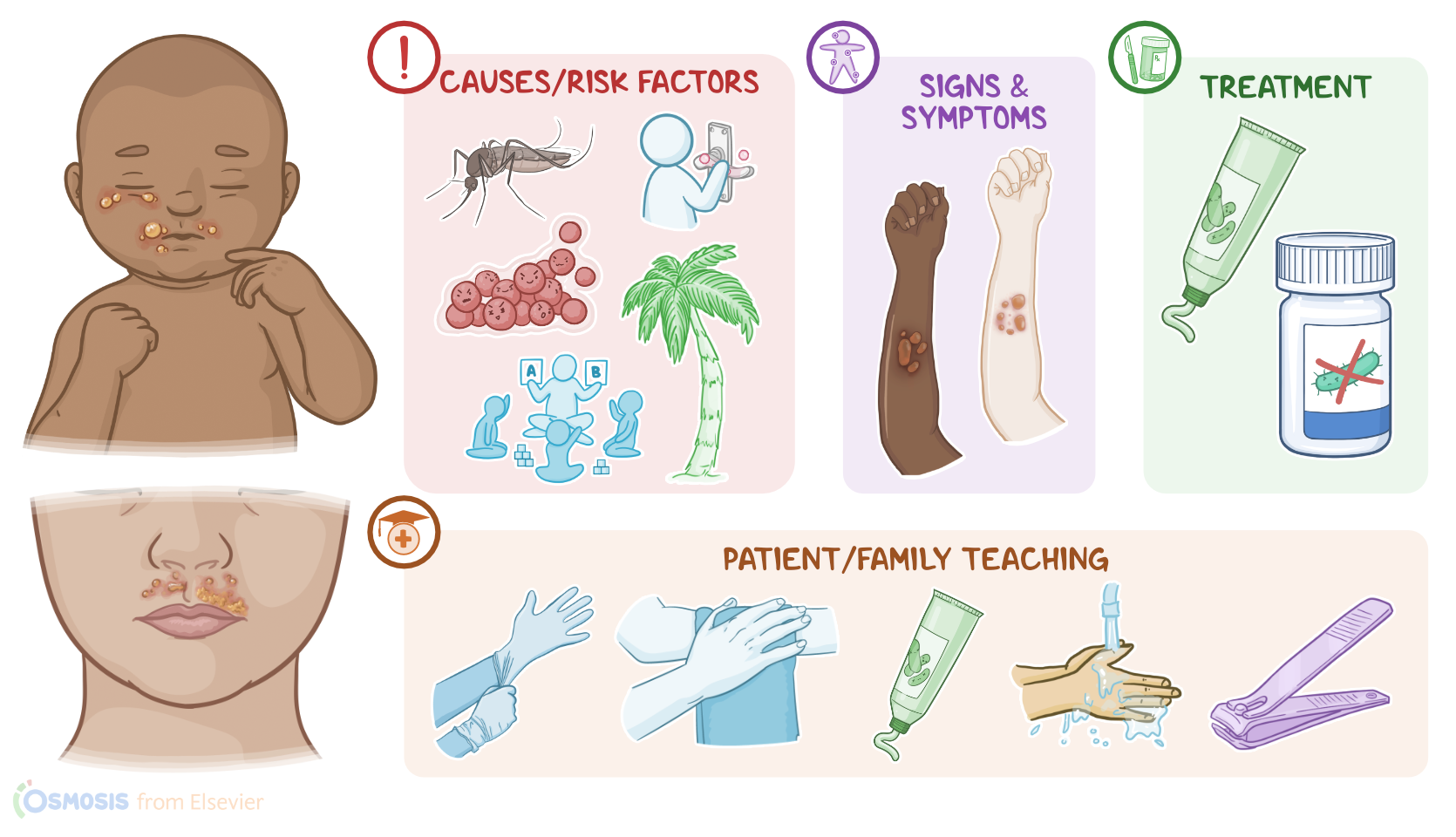
Typically, the infection is transmitted from person to person through direct contact with skin lesions. Less frequently, the infection can be transmitted indirectly when a client touches a contaminated surface, such as clothing or bed linens.
Common places where impetigo spreads include daycare centers, nursing homes, or schools. Now, risk factors that can disrupt the normal skin flora include living in a warm, humid climate, as well as having poor hygiene, and underlying conditions like diabetes or a weakened immune system.
Additional risk factors that can allow these bacteria to invade the skin include having previous damage due to insect bites, minor trauma, abrasions, or skin conditions like eczema or psoriasis.
Now, the infection can be classified as primary impetigo when it occurs on intact skin, or secondary impetigo when it occurs in previously damaged skin, like with insect bites, abrasions, or in infected chickenpox lesions.
Pathology2:17–2:56
Regardless of the type, pathogenic bacteria invade the skin and cause an infection. In addition, some of these bacteria can produce exfoliative toxins that further damage the skin, or a secondary infection can occur, potentially causing complications such as cellulitis, or rarely, acute glomerulonephritis.
Now, depending on its clinical manifestations, impetigo can be classified as non-bullous or bullous. The most common type is non-bullous impetigo, which usually occurs on areas of compromised skin integrity, most often involving the skin around the nose and mouth, as well as the neck and extremities.
Clinical manifestations2:56–4:13
These lesions appear as vesicles or pustules, which then rupture in 1 to 2 days and form characteristic honey-colored, or golden, crusts around an erythematous, moist base.
Clients may also experience itching or a burning sensation, and may present with regional lymphadenopathy. On the other hand, bullous impetigo usually appears on intact skin, most often involving the trunk, as well as moist intertriginous areas where two skin surfaces rub together, such as the axillae and groin folds.
These lesions appear as bullae filled with clear yellow fluid that develops into an opaque, dark yellow or purulent fluid.
Now, these bullae can rupture easily, leaving a thin brown crust behind. Less commonly, clients may also present with systemic symptoms like fever, chills, and malaise.Impetigo is typically diagnosed based on the client’s history and physical assessment.
Diagnosis4:13–4:29
Laboratory tests are not routinely performed, but in unclear cases, a Gram stain or culture of a lesion swab can confirm the diagnosis.Treatment for impetigo depends on the extent of the disease.
Treatment4:29–4:45
If only a small skin area is involved, clients can get topical antibiotics. On the other hand, clients with severe or widespread disease can be treated with oral antibiotics.Alright, now let’s talk about nursing care for a client with impetigo.
Management of Care4:45–5:26
Priority nursing goals include elimination of the infection and preventing it from spreading, as well as promoting comfort.
Start by instituting contact precautions, and assess the lesions and surrounding area, making note of the distribution and location; as well as the presence of erythema, crusting, and drainage.
Then, apply warm, wet compresses to remove any crusts, and apply the prescribed topical antibiotic ointment with a clean cotton swab, ensuring you avoid the mucous membranes, like the eyes and nose.
General client and family teaching5:26–6:45
Now, let’s move on to client and family teaching. Let them know that the infection spreads easily to other parts of the body, as well as to other people; and reassure them that the infection resolves with proper treatment.
Then, instruct them on the importance of frequent handwashing; be sure they understand that household members should not share linens, towels, and dishes with the client, and that the contaminated items should be washed separately in hot water.
Also, emphasize the importance of not touching or scratching the affected area, and keeping fingernails short and clean.
Next, instruct the client or caregiver to gently wash the lesions daily, and to apply warm, wet compresses to the affected areas to help remove the crusts.
Then, show them how to apply the antibiotic cream, and then loosely cover the open skin lesions with a clean, dry dressing.
Let them know that the client can return to school or work 24 hours after initiating antibiotic treatment, as long as the lesions are kept covered and hand hygiene measures are practiced.
Lastly, instruct the client or caregiver to report to their healthcare provider if the lesions continue to spread, don’t heal, or if the area becomes red, swollen, warm, or tender.
Review6:45–8:01
Alright, as a quick recap… Impetigo is a superficial and highly contagious bacterial skin infection, most often affecting young children between the ages of 2 and 5 years, and is typically caused by Gram positive pathogenic bacteria like Staphylococcus aureus or Streptococcus pyogenes.Impetigo can present as either bullous or non-bullous.
Bullous impetigo appears on intact skin, usually on the trunk and intertriginous areas, and forms purulent lesions that rupture, creating a thin brown crust.
Non-bullous impetigo is more common; it appears on damaged skin, and forms pustules or vesicles that rupture, leaving behind a honey-colored crust.
Treatment involves keeping the area clean, as well as applying topical antibiotic ointment for localized
| IMPETIGO | ||
| KEY POINTS | NOTES | |
| DEFINITION |
| |
| PHYSIOLOGY |
| |
| CAUSES AND RISK FACTORS |
| |
| PATHOPHYSIOLOGY |
| |
| SIGNS AND SYMPTOMS |
| |
| DIAGNOSIS |
| |
| TREATMENT |
| |
| MANAGEMENT OF CARE |
| |
| PATIENT AND FAMILY TEACHING |
| |
No notes for this video yet
Try adding a note below