Ovarian cancer: Nursing
Introduction0:00–0:19
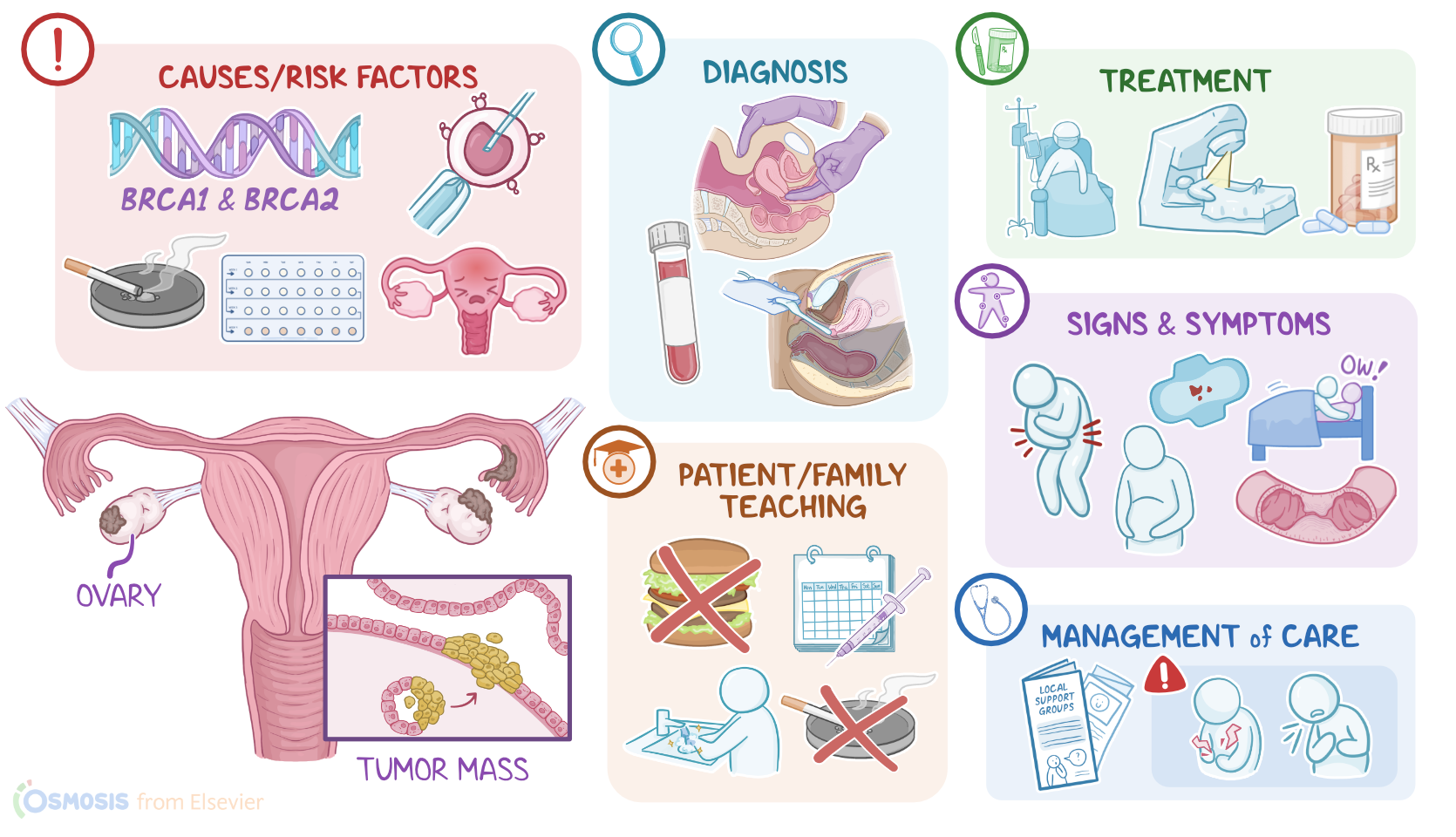
Ovarian cancer is a malignant cell growth that begins in the ovaries or the fallopian tube. It is often bilateral and spreads quickly to nearby organs through direct extension, to abdominal organs through abdominal seeding, and to distant organs through the blood and lymphatic vasculature.Now, let’s recap the anatomy and physiology of the ovaries, which are paired almond-shaped organs that lie within the pelvic cavity, on each side of the uterus.
Physiology0:19–1:15
The functions of the ovaries include producing and releasing oocytes through the process of oogenesis, in addition to producing estrogen and progesterone, which are responsible for maintaining pregnancy, growth, and development in assigned females at birth.
Now, let’s look at the microscopic structure of the ovaries. Each ovary is lined by a simple squamous epithelium called the germinal epithelium, which is then covered by a thick connective tissue capsule called the tunica albuginea.
The inside of the ovary is divided into two zones: cortex and medulla. The cortex houses small sacs of oocytes and supporting cells called the ovarian follicles, which are embedded in the outer layer of a unique type of connective tissue called the ovarian stroma.Now, the exact cause of ovarian cancer is unknown, but there’s typically a genetic mutation in a cell of the ovary or the fallopian tube, such as a mutation in breast cancer genes 1 and 2, also known as BRCA1 and BRCA2 genes.
Causes & risk factors1:15–2:09
These mutations may arise from a variety of risk factors. Nonmodifiable risk factors include middle or older age, family history, early menarche, late menopause, a history of polycystic ovarian syndrome or PCOS, endometriosis, breast, or colon cancer.
On the other hand, modifiable risk factors include smoking, obesity, hormone replacement therapy, and ovarian hyperstimulation from infertility treatments like in vitro fertilization, as well as pelvic inflammatory disease, nulliparity, and first pregnancy at an older age.
Pathology2:09–3:09
Now, all these risk factors can lead to dedifferentiation of the surface ovarian epithelium or the fallopian tube epithelium.This can be explained by the incessant ovulation theory, which suggests that the risk of ovarian cancer increases with each cycle of ovulation.
During ovulation, the follicle ruptures and releases the mature oocyte, which inadvertently causes damage to the surface epithelium.
This damage can lead to the formation of cortical inclusion cysts, which are invaginations of the ovarian surface epithelium.
And the epithelial cells of these cysts may then start dividing uncontrollably, forming a tumor mass. As the tumor keeps growing, it can start invading neighboring tissues, and may even spread to nearby lymph nodes, or metastasize to distant organs such as the brain.
Ovarian cancer can also spread to abdominal organs through abdominal seeding and thoracic organs through transdiaphragmatic passage.
Clinical manifestations3:09–3:44
Initially, clients with ovarian cancer can be completely asymptomatic or experience subtle and non-specific symptoms. Common early symptoms can include abdominal distension, bloating, abdominal or pelvic pain, in addition to urinary frequency and urgency.
Later on, ovarian tumors can cause unintentional weight loss, abdominal enlargement, bowel obstruction, menstrual changes, and dyspareunia, which is pain during sexual intercourse.
A classic finding is a “sister mary joseph nodule”, which happens when it metastasizes to the umbilicus. The diagnosis of ovarian cancer starts with the client’s history and physical assessment, including bimanual pelvic examination, which may show signs of enlarged ovaries, followed by additional diagnostic tests like transvaginal ultrasound to observe the tumor.
Diagnosis3:44–5:06
Laboratory test results are generally non-specific and may show elevated blood levels of tumor markers like CA125, inhibin, alpha-fetoprotein, or AFP, and beta-human chorionic gonadotropin, or hCG for short.
Additional imaging tests including CT scan, MRI, and positron emission tomography or PET can be used to stage the disease with the TNM classification, by defining the Tumor location and looking for lymph Node involvement or Metastasis.
Ovarian cancer can also be staged using the FIGO system into stage 0, or carcinoma in situ; stage I, which is confined to the organ of origin; stage II, where the tumor has extended to adjacent organs or tissues; stage III, where the tumor has spread to lymph nodes or nearby tissues within the pelvis; and lastly, stage IV, characterized by distant metastasis beyond the pelvis.
Finally, exploratory laparotomy with biopsy can be done in order to confirm the diagnosis.Now, the definitive treatment of ovarian cancer is total abdominal hysterectomy with bilateral salpingo-oophorectomy; this is a type of surgical procedure that involves the complete removal of the uterus, in addition to both fallopian tubes and ovaries.
Treatment5:06–5:54
In cases of lymph node involvement, they should also be removed. This surgical procedure is usually followed by chemotherapy and radiation therapy to kill any remaining cancer cells.
In addition, clients can also be given targeted therapy with medications called poly (ADP-ribose) polymerase or PARP inhibitors, which block the PARP enzyme that has a role in DNA repair; as a result, PARP inhibitors can prevent cancerous cells from repairing their DNA, ultimately causing these cells to die.Alright, let’s look at the nursing care you’ll provide for a client with ovarian cancer.
Management and care5:54–9:07
Your priority nursing goals are to provide postoperative care, administer the prescribed chemotherapeutic medications, and provide comfort and emotional support to promote quality of life.
Now, if your client has had a total abdominal hysterectomy with bilateral salpingo-oophorectomy, you should implement routine postoperative interventions, and monitor them closely for complications related to the procedure.
Assess your client’s level of pain, including the onset, quality, severity, location, and aggravating or relieving factors.
Be sure to assist your client into a comfortable position, provide comfort measures, and administer analgesic medications as prescribed.Okay, if your client is prescribed chemotherapy, administer the medication, and assess them for side effects like nausea, vomiting, myelosuppression, fatigue, and neuropathy, which may present with impaired memory and concentration.
Then, administer the prescribed antiemetics, provide comfort measures, and institute neutropenic precautions. Now, if your client is undergoing intraperitoneal chemotherapy, keep in mind that the chemotherapeutic medication is directly infused into the abdomen through a catheter or port, and dwells for 1 to 4 hours before being drained.
Before administration, prepare your client for an abdominal X-ray to check catheter placement. Then, assist them into a semi-Fowler position, and be sure to help them reposition frequently to evenly distribute the medication.
Monitor for nausea and vomiting from the increasing abdominal pressure, and be sure to report any indications of respiratory distress, as well as severe abdominal pain that can occur if the catheter migrates to another area.
In addition, report any signs of peritonitis, which can manifest as a fever, severe abdominal pain with rebound tenderness, abdominal rigidity, as well as a paralytic ileus, which includes a lack of bowel sounds, constipation, and nausea.
Now, if your client has advanced stage ovarian cancer, be sure to assess for the presence of ascites, as well as any indications of bowel dysfunction.
Administer IV fluids to help alleviate any fluid or electrolyte imbalances. Also, assess their nutritional status, and provide nutrition by administering the prescribed total parenteral nutrition, or TPN for short, enteral feedings, or oral nutrition, as tolerated.
Report any indications of a pleural effusion, which can manifest as shortness of breath, pleuritic chest pain, and cough; and be prepared to help assist with a thoracentesis to relieve the symptoms.
Finally, assess the psychosocial status of your client and their family or caregiver, as well as their ability to cope with their diagnosis.
Take time to talk to them about their feelings and provide emotional support. Additionally, collaborate with the oncology case manager to coordinate care and needed services, as well as resources like palliative and hospice care, as needed.Okay, let’s move onto client and family teaching after your client has had a total abdominal hysterectomy with a bilateral salpingo-oophorectomy.
General client and family teaching9:07–11:35
Begin by reviewing their diagnosis, treatments, and plan of care. Ensure they understand their fertility preservation options, if needed.
Also, review all prescribed medications, and ensure your client knows how to take them as directed. In addition, teach them how to care for their incision site; and explain that a small amount of drainage is normal, but they should contact their healthcare provider if there’s redness, swelling, bleeding, bad-smelling drainage, or increased pain around their surgical incisions.
Then, review lifestyle modifications to incorporate into their daily routine. Advise your client to get plenty of rest, but if they experience fatigue, advise them to pace their activities and rest as needed.
Instruct them to avoid sexual intercourse for at least 6 weeks while their incision heals. In addition, they should avoid heavy lifting and any activities that increase pelvic congestion, like dancing or walking swiftly, for a period of at least 2 months.
Also, teach your client to drink enough fluids each day to stay hydrated and keep their urine pale yellow, and to avoid constipation by including foods that are high in fiber in their diet, like whole grains, legumes, fruits and vegetables.
Remind them to limit foods that are high in fat, as well as processed sugars and fried foods; and recommend they eat smaller, more frequent meals if nausea is a problem.
In addition, stress the importance of avoiding all tobacco products. Lastly, remind your client to keep their appointments for maintenance therapy, as well as their follow up appointments to monitor their response to treatment.Additionally, review the importance of avoiding infection by practicing good hand hygiene, staying away from large crowds, avoiding undercooked foods, and keeping their immunizations up to date.
If they have a pet cat, instruct them to have someone else empty the litter box. Instruct them to immediately seek medical attention if they develop any signs of an infection such as a fever, chills, or sore throat, Finally, instruct your client to let their healthcare provider know right away if they notice increased pain, swelling, or bloating in their abdomen; if they have changes in their bowel or bladder habits; as well as if they are sad or anxious, or develop any new symptom that concerns them.Alright, as a quick recap… Ovarian cancer is malignancy of the ovaries that’s often bilateral and spreads quickly.
Review11:35–13:11
It can arise after a genetic mutation in ovarian or Fallopian tube cells, and can be caused by a variety of modifiable and nonmodifiable risk factors.
Early symptoms are usually subtle and include abdominal distension, bloating, abdominal or pelvic pain, and urinary frequency or urgency.
In later stages, symptoms can include unintentional weight loss, abdominal enlargement, bowel obstruction, menstrual changes, and dyspareunia.
Diagnosis involves a pelvic examination, followed by laboratory tests of tumor markers; as well as imaging studies including a transvaginal ultrasound, CT scan, MRI, and PET scan for tumor staging; and an exploratory laparotomy with biopsy to confirm the diagnosis.
Treatment for ovarian cancer is selected based on its extension and aggressiveness, and options include a total abdominal hysterectomy with bilateral salpingo-oophorectomy, chemotherapy, radiation therapy, and PARP inhibitors.
Nursing care is focused on providing postoperative care, administering the prescribed chemotherapeutic medications, and providing comfort and emotional support to promote quality of life.
Client and family teaching includes providing education on postoperative care at home, lifestyle modifications, and when to contact their healthcare
| OVARIAN CANCER | ||
| KEY POINTS | NOTES | |
| DEFINITION |
| |
| CAUSES AND RISK FACTORS |
| |
| SIGNS AND SYMPTOMS |
| |
| DIAGNOSIS |
| |
| TREATMENT |
| |
| MANAGEMENT OF CARE |
| |
| PATIENT AND FAMILY TEACHING |
| |
No notes for this video yet
Try adding a note below