Preeclampsia and eclampsia: Nursing
Introduction0:00–0:31
Preeclampsia is a pregnancy-specific condition characterized by new-onset hypertension and proteinuria after 20 weeks of gestation or during the postpartum period in a previously normotensive client; while eclampsia is when a client with preeclampsia develops generalized seizures.
These two conditions differ from gestational hypertension, which simply refers to new onset of hypertension during pregnancy, without proteinuria or seizures.Now, let’s quickly review the physiology of blood pressure regulation during pregnancy.
Physiology0:31–2:24
There are three key factors to keep in mind: cardiac output, which is the amount of blood that the heart pumps out to the systemic circulation in a minute; intravascular volume, which is the amount of blood in the client’s circulation; and peripheral vascular resistance, which is the resistance of blood flow in peripheral arteries, and is regulated via vasoconstriction or vasodilation as needed.
Remember that in pregnant clients, the cardiac output and intravascular volume increase, but the peripheral vascular resistance decreases.
That’s because during pregnancy, there’s a relative decrease in the response to vasoconstrictor molecules, like angiotensin II, and there are also higher levels of vasodilator molecules, like prostacyclin PGI2.
As a result, blood vessels dilate more to accommodate the increased blood volume, and this keeps blood pressure in the normal range, below 120 over 80 mmHg.This increased blood volume can come in pretty handy, especially since the placenta needs a lot of blood.
Remember that the placenta is a temporary organ that develops in the uterus during pregnancy, and connects the pregnant client with the fetus.
The way this works is that a type of endometrial arteries called the spiral arteries dilate during pregnancy, and open into the placenta to form little pools of blood.
On the fetal end, the umbilical vein connects to the placenta and also opens into those pools. This way the umbilical vein can get nutrient and oxygen-rich blood for the fetus without it being in direct contact with the spiral arteries.
In the same vein, pun intended, deoxygenated blood and waste products from the fetus are carried to the placenta by the umbilical arteries, and from there, they are picked up by the pregnant client’s veins to be eliminated.
That being said, while the exact cause of preeclampsia and eclampsia is unknown, some risk factors for developing these conditions have been identified.
Causes & risk factors2:24–2:50
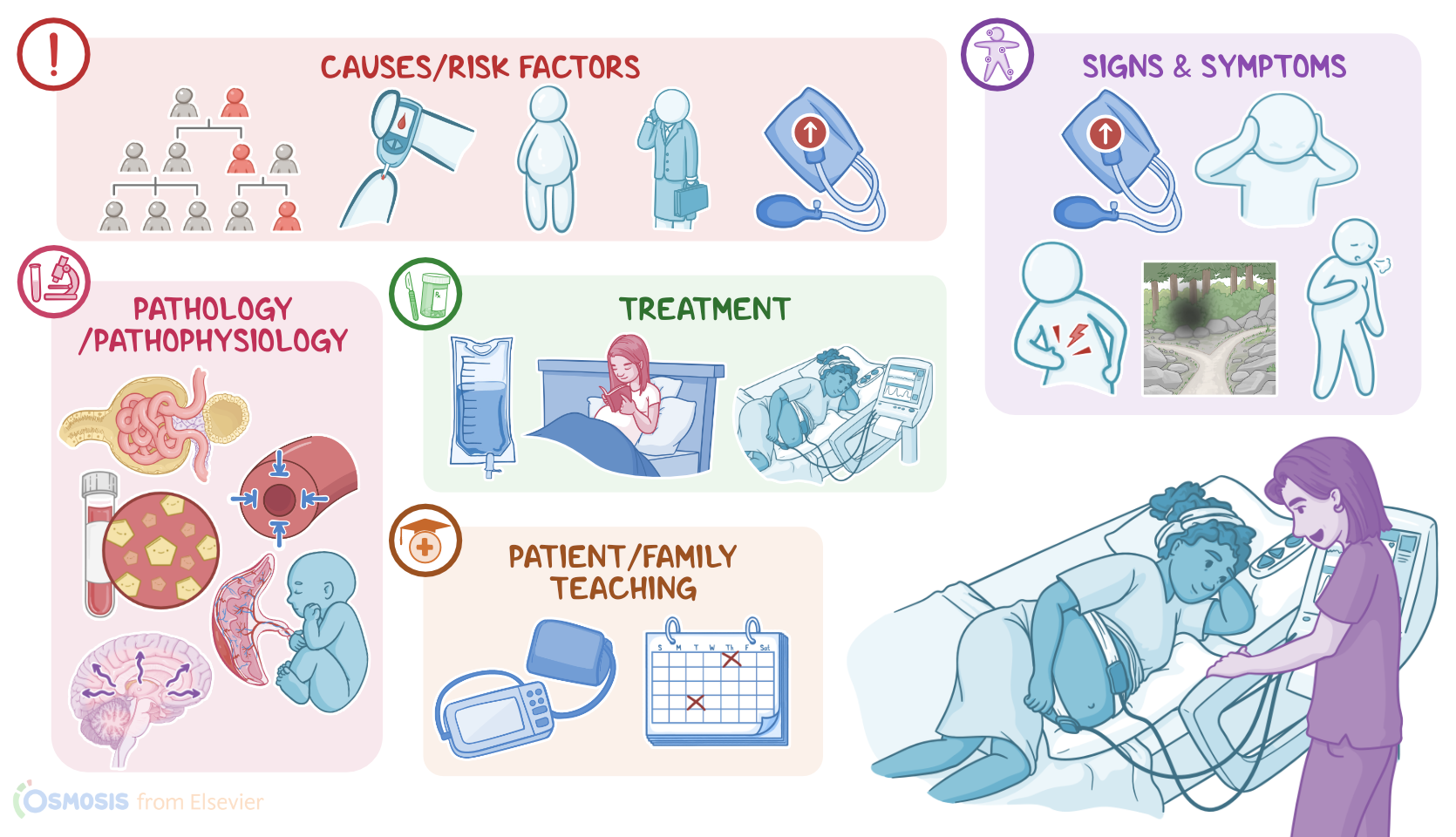
These include family history of preeclampsia, first pregnancy or being over 35 years of age, as well as obesity, chronic hypertension or diabetes before pregnancy, and Black race.Now, the pathology of preeclampsia and eclampsia is thought to develop in clients that are particularly sensitive to vasoconstrictor molecules like angiotensin II, and they also seem to have lower levels of vasodilating molecules like prostacyclin PGI2.
Pathology2:50–5:39
As a result, these clients have increased peripheral vascular resistance and low blood flow to target organs, like the placenta, as well as the kidneys, liver, and brain.On the placenta end, decreased perfusion can cause the release of proinflammatory cytokines and, as a consequence, systemic inflammation.
Another element that can play a role in decreased placental perfusion can be the aberrant development of spiral arteries, which also plays a role in systemic inflammation.
Either way, low blood flow to the placenta means low blood flow to the developing fetus, which can cause intrauterine growth restriction, low birth weight, preterm birth or even fetal death.
Additionally, with preeclampsia, there’s also an increased risk of placental abruption, meaning the placenta prematurely detaches from the uterine wall.On the kidney end, low blood flow can damage the tiny glomeruli that normally work to keep blood proteins from making their way into the urine; so this results in proteinuria.
As a consequence, less proteins in the blood can cause generalized or localized edema, like pulmonary edema. Additionally, over time, low renal blood flow can also lead to renal insufficiency.
On the liver end, decreased blood flow can cause liver damage and dysfunction. And because the liver is in charge of conjugating bilirubin to produce bile, some clients may develop hyperbilirubinemia.
In addition, the liver is full of enzymes for various metabolic processes, the damaged liver may release these enzymes into the blood.And let’s not forget about the brain!
Now, the exact mechanism of brain damage during preeclampsia is not understood, but it appears to be twofold. On the one hand, the vasoconstriction of cerebral blood vessels means they can’t withstand the increased blood pressure, so the tiniest of cerebral blood vessels are at risk of rupturing and causing cerebral hemorrhage and stroke.
On the other hand, inflammation and high blood pressure can alter the normal physiology of cerebral circulation, and cause cerebral edema and small areas of cerebral ischemia.
This could play a role in the development of seizures and the progression of preeclampsia to eclampsia. Okay, now, the clinical manifestations of preeclampsia and eclampsia can vary, but they include hypertension, defined as systolic blood pressure over 140 mmHg, diastolic blood pressure over 90 mmHg, or both.
Clinical manifestations5:39–6:55
Most clients also develop proteinuria, and some might develop dyspnea as a result of pulmonary edema. Now, features of severe disease are defined as having systolic blood pressure over 160 mmHg, or diastolic blood pressure over 110 mmHg; or signs of end-organ damage, such as decreased urinary output, which can indicate renal damage; jaundice and right upper quadrant or epigastric pain, which can indicate liver damage; and visual disturbances, such as blurry or double vision; scotomata, which means “seeing spots”, as well as headache, confusion, drowsiness, numbness and tingling, or hyperreflexia, which can indicate brain damage.
Finally, if preeclampsia progresses to eclampsia, the client can develop seizures, which can occur before, during, or sometimes even after labor.The diagnosis of preeclampsia and eclampsia starts with the client’s history and physical assessment confirming hypertension; followed by laboratory tests showing proteinuria.
Diagnosis6:55–7:41
In some cases, preeclampsia can be diagnosed in the absence of proteinuria if there is evidence of end-organ damage. Some laboratory cues for end-organ damage can include elevated creatinine blood levels, hyperbilirubinemia, elevated liver enzymes, and thrombocytopenia or low platelets.
When elevated liver enzymes and thrombocytopenia occur alongside hemolytic anemia, that could indicate a potentially life-threatening complication in pregnancy called HELLP syndrome, which stands for Hemolysis, Elevated Liver enzymes, and Low Platelets.
The ultimate treatment of preeclampsia and eclampsia is to deliver the baby and placenta. However, the decision to induce delivery depends heavily on both the gestational age and the severity of the disease.
Treatment7:41–8:50
Generally, for clients without features of severe disease before 37 weeks of gestation, expectant management with bed rest and fetal monitoring is recommended; whereas after 37 weeks of gestation, labor induction is recommended.
On the other hand, clients with features of severe disease warrant labor induction regardless of their gestational age, and some antihypertensive medications can be used including IV labetalol or hydralazine, or oral nifedipine.
Additionally, prophylactic medications like magnesium sulfate can be given to prevent seizures. Other measures include positioning the client in a left lateral position to increase fetal circulation until labor induction.
Finally, if gestational age is less than 34 weeks and delivery is imminent, antenatal corticosteroids can be given to accelerate fetal lung development.
Management and care8:50–11:01
Alright, let’s look at the nursing care you’ll be providing for a client with preeclampsia. Your priority goals of care are to control your client’s blood pressure, prevent complications, and provide emotional support.First, establish IV access and administer the prescribed IV fluids, antihypertensive medications, and magnesium sulfate.
Be sure to have calcium gluconate, which is the antidote for magnesium sulphate toxicity, readily available. Then, apply an external fetal monitor, insert an indwelling urinary catheter, and institute seizure precautions.
Closely monitor your client’s level of consciousness, vital signs, lung sounds, SpO2, as well as intake and output and the presence of edema.
Immediately report signs that their condition is progressing such as altered level of consciousness, decreased urine output, severe headache, epigastric pain, visual changes, as well as the presence of clonus or pulmonary edema.Now, be sure to monitor your client closely for magnesium toxicity by frequent checks of their deep tendon reflexes, respiratory rate, heart rate, and pulse oximetry.
If their respiratory rate drops below 12 breaths per minute, if their heart rate decreases, or if their deep tendon reflexes are decreased, stop the magnesium sulfate infusion, immediately report this to the healthcare provider, and administer IV calcium gluconate per protocol.
Also keep a close eye on the fetal heart rate. Immediately report to the healthcare provider if fetal heart rate changes result in indeterminate or abnormal patterns, assist your client into a left, lateral position, increase the IV flow rate, and provide supplemental oxygen.
Finally, be sure to provide emotional support to your client and their family by keeping them informed of your assessments and the status of their baby.OK, moving on to client and family teaching.
General client and family teaching11:01–12:08
Begin by explaining how preeclampsia affects them and their baby, and review the plan of care and measures that are being implemented to keep them safe.
During care, be sure to emphasize the importance of letting their nurse know if they develop any unusual symptoms like visual changes, headache, shortness of breath, or extreme weakness.As you prepare for discharge after delivery, explain how preeclampsia and its symptoms usually goes away after delivery, but let them know that their blood pressure can remain elevated for a few weeks.
Teach them about any discharge prescriptions to manage their blood pressure, teach them how to monitor their own blood pressure at home, and stress the importance of keeping all their postpartum appointments so their progress can be monitored.
Instruct them to seek medical care immediately if any symptoms of preeclampsia recur, including increased blood pressure; sudden weight gain or swelling of their face, hands or feet; visual changes; as well as nausea or belly pain.Alright, as a quick recap….
Review12:08–13:56
Preeclampsia is elevated blood pressure during pregnancy after 20 weeks of gestation or during the postpartum period, along with proteinuria or other evidence of end-organ damage.
Eclampsia is the progression of preeclampsia to generalized seizures not attributed to other causes. During preeclampsia, increased sensitivity to vasoconstrictor molecules and lower levels of vasodilating molecules result in increased peripheral vascular resistance and decreased perfusion to target organs, like the placenta, as well as the kidneys, liver, and brain.
Symptoms of preeclampsia include high blood pressure, defined as systolic blood pressure over 140 mmHg, diastolic blood pressure over 90 mmHg, or both, as well as other clinical manifestations like proteinuria, visual changes, peripheral and pulmonary edema, headache, confusion, decreased urinary output, and epigastric pain.
If preeclampsia progresses to eclampsia, seizures can occur before, during, or sometimes even after labor. Complications of preeclampsia can include placental abruption, HELLP syndrome, stroke, intrauterine growth restriction, low birth weight, preterm birth or even fetal death.The ultimate treatment is delivery of the baby and placenta.
Goals of nursing care are to control blood pressure, prevent complications, and provide emotional support. Client and family education includes understanding their condition and the plan of care, and what symptoms should be reported right
| PREECLAMPSIA AND ECLAMPSIA | ||
| KEY POINTS | NOTES | |
| DEFINITION |
| |
| PHYSIOLOGY |
| |
| CAUSES AND RISK FACTORS |
| |
| PATHOPHYSIOLOGY |
| |
| SIGNS AND SYMPTOMS |
| |
| DIAGNOSIS |
| |
| TREATMENT |
| |
| MANAGEMENT OF CARE |
| |
| PATIENT AND FAMILY TEACHING |
| |
No notes for this video yet
Try adding a note below