Renal cancer: Nursing
Introduction0:00–0:19
Renal cancer is a malignant tumor that arises from the cortex, pelvis, or the calyces of the kidneys. The most common type of renal cancer is renal cell carcinoma, which forms from the cells lining the proximal convoluted tubules of the kidney.
All right, let’s quickly review some kidney physiology! We can think of the kidneys as the body’s natural blood filter.
Physiology0:19–2:04
Their main function is to clear blood of metabolic wasteful substances and toxins by excreting them through urine. In addition, they secrete important hormones, and are essential in regulating the acid-base balance, pH, blood pressure, and electrolyte levels in the body.
So, if we take a cross-section of the kidney, there is an outside rim, known as the renal cortex, and an inner portion, which is the renal medulla.
The cortical tissue extends towards the medulla, forming renal columns that divide the medulla into pyramidal-shaped structures called the renal pyramids.
The tips of the pyramids, called the renal papilla, project into minor calyces which join together to form major calyces which funnel into the renal pelvis.
The renal corpuscle is made up of the glomerulus, a tiny bundle of capillaries, and the Bowman’s capsule, which is a cup-shaped structure that surrounds the glomerulus.
So, blood gets filtered through the glomerulus, and then travels through the renal tubules, which are, in order: the proximal convoluted tubule, loop of Henle, distal convoluted tubule and finally, collecting ducts which drain urine into the renal papillae and eventually empty into the renal pelvis.
Causes & risk factors2:04–3:12
Now, the exact cause of renal cancer is often unknown, but there’s typically a genetic mutation in a cell of the cortex, pelvis or calyces, such as a mutation in the Von Hippel–Lindau or VHL gene.
This is a tumor suppressor gene, so normally it suppresses the growth of tumor cells. And these mutations can be hereditary, meaning that the client inherits the mutation from one of their parents, or non-hereditary, also known as sporadic, which occur de novo or spontaneously.
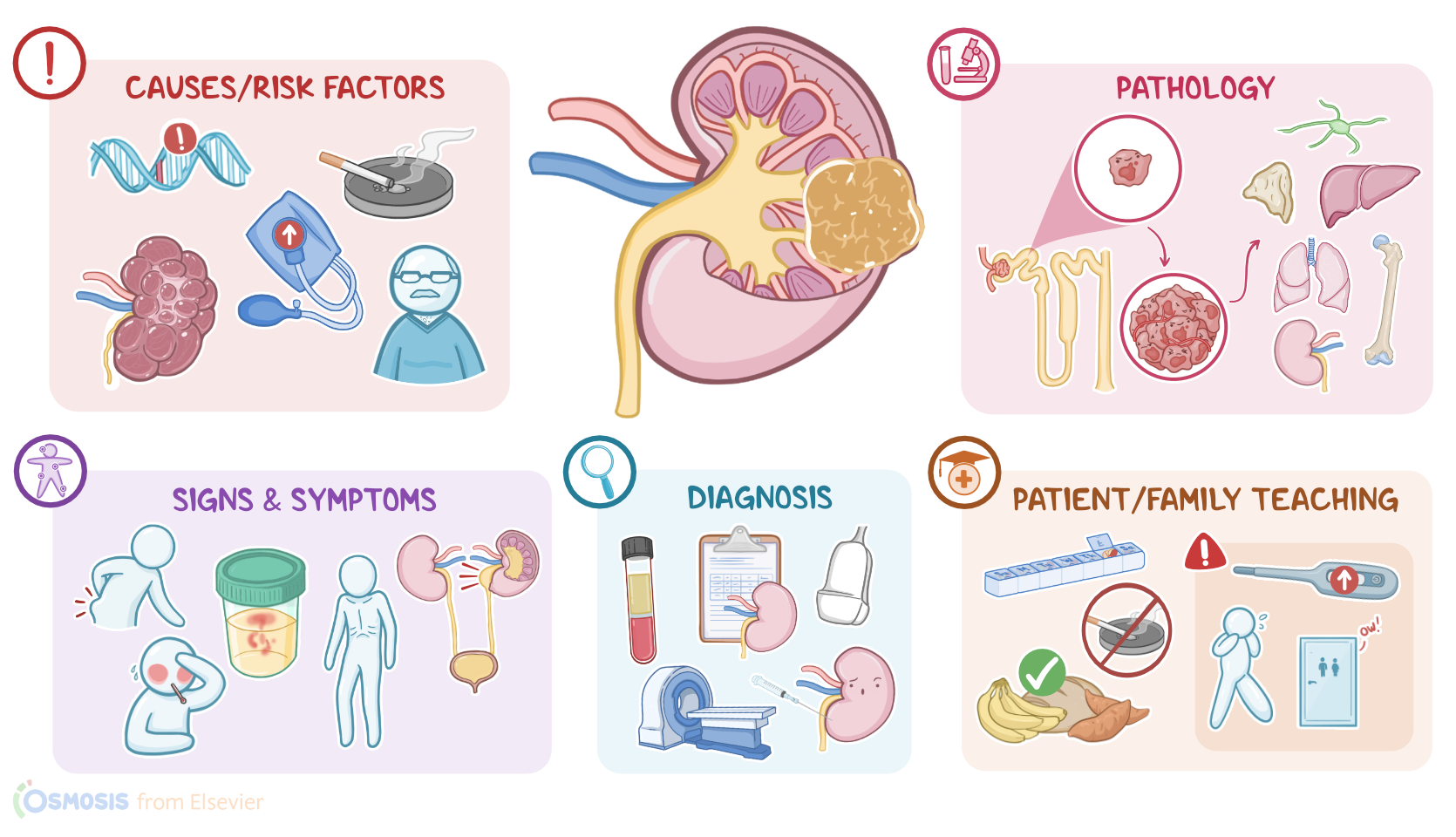
Whatever the cause is, the chance of developing renal cancer increases with certain risk factors. Modifiable risk factors include exposure to toxins like tobacco smoke, asbestos, cadmium, and gasoline; as well as obesity, hypertension, unopposed estrogen use, and acquired cystic kidney disease.
On the other hand, non-modifiable risk factors include age above 45 years, being assigned male at birth, and having a family history of renal cancer.All right, now, the most common type of renal cancer is renal cell carcinoma, which occurs when an epithelial cell in the proximal convoluted tubule of the kidney becomes mutated and cancerous, and begins dividing uncontrollably, forming a tumor mass.
Pathology3:12–5:18
As the tumor keeps growing, new blood vessels also develop via angiogenesis to supply it. Eventually, cancerous cells start invading neighboring tissues, and can spread to nearby lymph nodes or the adrenal gland on the same side; or even metastasize to other organs, like the liver, lungs, long bones, or to the other kidney.Renal cell carcinoma is also frequently responsible for causing various paraneoplastic syndromes, which is where the tumor cells generate a hormone that causes its own set of symptoms.
For example, these tumors can release the hormone erythropoietin which increases the production of new red blood cells, and this can lead to polycythemia or too many red blood cells, which can cause the blood to start sludging or slowing down its normal flow.
Another paraneoplastic syndrome involves the release of renin, which causes hypertension. Some other hormones that renal cell carcinomas are known for releasing include parathyroid hormone-related peptide or PTHrP and adrenocorticotropic hormone or ACTH.
PTHrP mimics parathyroid hormone or PTH, causing hypercalcemia, fatigue, and muscle weakness while ACTH secretion results in Cushing syndrome, which can cause hyperglycemia, hypertension, skin hyperpigmentation, osteoporosis, weight gain, easy bruising, and frequent infections from a weakened immune system.
This leads to dilation of the testicular veins and formation of a varicocele.Okay, so the clinical manifestations of renal cancer vary based on the size and location of the tumor.
Clinical manifestations5:18–6:13
Initially, clients are typically asymptomatic. As the disease progresses over time, clients may develop a palpable mass in the abdomen or lower back, and can experience symptoms like unintentional weight loss, fever, malaise, nausea, and vomiting.
If the tumor grows enough to physically obstruct the urinary flow, it can cause urine to build up inside the ureter, called hydroureter.
As the tumor invades the tissue and breaks through the basement membrane, clients can experience hematuria; while compression of nearby nerves can cause pain in the flank or near the hip bone.
Finally, with paraneoplastic syndromes, clinical manifestations depend on the secreted hormone.The diagnosis of renal cancer starts with the client's history and physical assessment.
Diagnosis6:13–7:25
Additionally, laboratory studies include a complete blood count or CBC which may show anemia and increased erythrocyte sedimentation rate, or ESR.
When the tumor secretes erythropoietin, clients can have an increased hematocrit and low ESR. If the tumor secretes PTHrP, calcium levels are also elevated.
Kidney function tests can show elevated serum creatinine and blood urea nitrogen, or BUN for short. Urinalysis is typically also performed to look for red blood cells in the urine.
Imaging tests like a pelvic or abdominal CT scan can be used to stage the tumor using the TNM classification, by defining the location and looking for lymph node involvement or metastasis.
Treatment7:25–8:38
Treatment for renal cancer depends on its aggressiveness and extension. Small, localized tumors can be treated with partial nephrectomy, which is when the affected part of the kidney is surgically removed.
On the other hand, for clients with larger tumors, the treatment of choice is radical nephrectomy, or removal of the entire kidney, along with the surrounding fat, the ipsilateral adrenal gland, and nearby lymph nodes.
This surgical procedure is sometimes followed by chemotherapy and radiation therapy to kill the remaining cancer cells.Now, for clients with unresectable metastatic tumors, as well as those who can’t have surgery, treatment can involve microwave ablation, or MWA, and cryoablation, which can slow tumor growth.
Biologic response modifiers, or BRMs, including interleukin 2, interferon, and tumor necrosis factor, or TNF, have also been shown to increase survival time.
Finally, targeted therapy or medications that target specific molecules involved in the growth of cancer cells has recently also been used to treat renal cancer.
Management and care8:38–11:18
Okay, let’s look at the nursing care you’ll provide for a client with renal cancer. Nursing priorities include providing postoperative care, supporting renal function, monitoring for complications, and providing psychosocial support.
Begin by assessing your client’s baseline vital signs as well as their pain level, fluid balance, intake and output, and review their most recent laboratory test results, including kidney function tests, CBC, electrolytes, and urinalysis.
As you care for your client, be alert for complications of renal cancer including paraneoplastic syndromes. Report to the healthcare provider if your assessments reveal problems like hypertension, hyperglycemia, or hypercalcemia; and administer medications as prescribed.
Now, if you are caring for a client after a nephrectomy, implement routine postoperative interventions to prevent complications and manage pain.
Assess the functioning of their remaining kidney by keeping a close eye on their fluid and electrolyte balance and renal laboratory test results.
Report to the healthcare provider immediately for signs of renal insufficiency, including urine output less than 30 mL/hour, edema; increased serum creatinine and potassium; or increased urine sodium.
Also monitor your client for signs of hemorrhage, and report to the healthcare provider if you notice increased blood in their surgical drain, soaked dressings, pooling of blood on bed linens under the client, abdominal distension, altered level of consciousness, and hypotension.
Increase the IV flow rate and send for a unit of packed red blood cells per protocol, and prepare the client for emergent surgery to stop the bleeding, as directed.
Be sure to watch closely for signs of adrenal insufficiency, including lethargy, hypotension, and decreased urine output, and report these findings to the healthcare provider.
Administer the prescribed IV fluids, corticosteroid replacement, and glucose.Finally, monitor your client for psychosocial concerns, such as anxiety, fear, or lack of a strong support system.
Offer active listening, and a caring attitude. Refer them to support groups, community resources and counseling, as needed.
Collaborate with the oncology nurse navigator to help ease your client’s cancer journey.Okay, let’s move on to client and family teaching.
General client and family teaching11:18–13:09
Begin by explaining how the removal of one of their kidneys will affect them, and review their individualized plan of care.
Go over each of their prescribed medications, and instruct them to take them exactly as directed. Counsel them on the importance of health maintenance, including maintaining a healthy weight, monitoring their blood pressure, getting adequate rest and sleep, avoidance of tobacco smoke, and reducing environmental exposure to toxins.
Remind them that it could take time for their healthy kidney to adjust, and stress the importance of adhering to dietary modifications that optimize kidney health, including eating a moderate-protein, high-carbohydrate, low-fat, and low sodium and potassium diet.
Also, advise them about nephrotoxic over-the-counter medications to avoid such as nonsteroidal anti-inflammatory drugs and the importance of making all healthcare providers aware of their condition prior to starting a new medication or undergoing imaging with contrast dye.
Lastly, remind them to keep all their follow-up appointments with their nutritionist and healthcare provider to monitor their progress.Finally, instruct them to contact their healthcare provider immediately if they experience problems such as decreased urine output, blood in their urine, pain with urination, weight gain, swelling in their legs or ankles, nausea, or fever of at least 100.4°F or 38°C or higher, blood pressure that’s not controlled by their medications, muscle weakness, palpitations, or abdominal pain.All right, as a quick recap….
Renal cancer is a malignant tumor located in the kidneys typically caused by a genetic mutation in the cells of the renal cortex, pelvis, or calyces, with renal cell carcinoma being the most common type of renal cancer.
Review13:09–14:45
Modifiable risk factors include exposure to toxins like tobacco smoke, asbestos, cadmium, and gasoline; as well as obesity, hypertension, unopposed estrogen use, and acquired cystic kidney disease.
Initially, clients may be asymptomatic, but as the disease progresses clinical manifestations include unintentional weight loss, fever, malaise, nausea, vomiting, hydroureter, hematuria, and flank pain.
Paraneoplastic syndromes can also cause problems such as polycythemia, hypertension, hyperparathyroidism, and Cushing syndrome.
Diagnosing renal cancer involves the client’s history and physical assessment; laboratory tests, and imaging tests, as well as a renal biopsy.
Treatment is based on the aggressiveness and extension of cancer, and can include partial or radical nephrectomy, potentially followed by chemotherapy or radiation therapy; MWA; cryoablation; BRMs; and targeted therapy.
Nursing priorities include providing postoperative care, supporting renal function, monitoring for complications, and providing psychosocial support.
Client and family teaching is focused on learning about their plan of care, and health maintenance measures. and health maintenance measures.
| RENAL CANCER | ||
| KEY POINTS | NOTES | |
| DEFINITION |
| |
| PHYSIOLOGY |
| |
| CAUSES AND RISK FACTORS |
| |
| PATHOPHYSIOLOGY |
| |
| SIGNS AND SYMPTOMS |
| |
| DIAGNOSIS |
| |
| TREATMENT |
| |
| MANAGEMENT OF CARE |
| |
| PATIENT AND FAMILY TEACHING |
| |
No notes for this video yet
Try adding a note below