Scleroderma: Nursing

Last updated: October 20, 2022

Scleroderma: Nursing

Watch later

Watch later

Infection prevention and control - Precautions and personal protective equipment (PPE): Nursing skills
Urinary tract infections (UTIs): Nursing process (ADPIE)
Modes of infectious disease transmission
Epstein-Barr virus (Infectious mononucleosis)
Pneumonia
Wound healing
Palliative and hospice care: Nursing
Postoperative care: Nursing
Biology of cancer: Nursing
Biliary atresia: Nursing
Cholecystitis: Nursing
Cholelithiasis: Nursing
Colorectal cancer: Nursing
Diarrhea: Nursing
Diverticular disease: Nursing
Esophageal cancer: Nursing
Gastric cancer: Nursing
Hepatitis: Nursing
Inflammatory bowel disease - Crohn disease and ulcerative colitis: Nursing
Intestinal obstruction: Nursing
Irritable bowel syndrome (IBS): Nursing
Jaundice: Nursing
Laryngeal cancer: Nursing
Liver cancer: Nursing
Pancreatic cancer: Nursing
Esophageal atresia and tracheoesophageal fistula: Nursing
Geriatric considerations - Gastrointestinal: Nursing
Hirschsprung disease: Nursing
Hyperemesis gravidarum: Nursing
Necrotizing enterocolitis: Nursing
Omphalocele and gastroschisis: Nursing
Appendicitis: Nursing process (ADPIE)
Celiac disease: Nursing process (ADPIE)
Cirrhosis: Nursing process (ADPIE)
Gastroesophageal reflux disease (GERD): Nursing process (ADPIE)
Hiatal hernia: Nursing process (ADPIE)
Pancreatitis: Nursing process (ADPIE)
Peptic ulcer disease (PUD): Nursing process (ADPIE)
Antacids: Nursing pharmacology
Antidiarrheals: Nursing pharmacology
Antiemetics: Nursing pharmacology
Antispasmodics (GI): Nursing pharmacology
Gallstone-dissolving agents: Nursing pharmacology
Gastric mucosal protective agents: Nursing pharmacology
Histamine H2 antagonists: Nursing pharmacology
Laxatives: Nursing pharmacology
Medications for hepatic encephalopathy: Nursing pharmacology
Pancreatic enzyme replacements: Nursing pharmacology
Proton pump inhibitors (PPIs): Nursing pharmacology
Treatment for Helicobacter pylori: Nursing pharmacology
Weight loss medications: Nursing pharmacology
Bladder tumors: Nursing
Chronic kidney disease (CKD): Nursing
Dialysis care: Nursing
Epididymitis: Nursing
Glomerulonephritis: Nursing
Nephrotic syndrome: Nursing
Polycystic kidney disease (PKD): Nursing
Prostate cancer: Nursing
Pyelonephritis: Nursing
Renal and urinary calculi: Nursing
Renal cancer: Nursing
Testicular cancer: Nursing
Urinary retention: Nursing
Bladder exstrophy: Nursing
Circumcision: Nursing
Cryptorchidism: Nursing
Enuresis: Nursing
Geriatric considerations - Urinary: Nursing
Hypospadias and epispadias: Nursing
Acute kidney injury (AKI): Nursing process (ADPIE)
Benign prostatic hyperplasia (BPH): Nursing process (ADPIE)
Urinary incontinence - Stress: Nursing process (ADPIE)
Antispasmodics (GU): Nursing pharmacology
Cholinergic therapy (GU): Nursing pharmacology
Diuretics - Osmotic and carbonic anhydrase inhibitors: Nursing pharmacology
Diuretics - Thiazide, thiazide-like, loop, and potassium-sparing diuretics: Nursing pharmacology
Anemia - Aplastic: Nursing
Anemia - Iron-deficiency: Nursing
Anemia - Macrocytic: Nursing
Arterial blood gas (ABG) - Overview: Nursing
Arterial blood gas (ABG) - Metabolic acidosis: Nursing
Arterial blood gas (ABG) - Metabolic alkalosis: Nursing
Arterial blood gas (ABG) - Respiratory acidosis: Nursing
Arterial blood gas (ABG) - Respiratory alkalosis: Nursing
Blood cultures: Nursing
Cardiac biomarkers - Creatine kinase (CK): Nursing
Cardiac biomarkers - Troponin: Nursing
Coagulation studies - Partial thromboplastin time (PTT): Nursing
Complete blood count (CBC) - Hemoglobin and hematocrit: Nursing
Complete blood count (CBC) - Platelets: Nursing
Complete blood count (CBC) - Red blood cells (RBC): Nursing
Complete blood count (CBC) - White blood cells (WBC) and differential: Nursing
Complete metabolic panel (CMP) - Blood urea nitrogen (BUN) and creatinine (Cr): Nursing
Complete metabolic panel (CMP) - Chloride: Nursing
Complete metabolic panel (CMP) - Estimated glomerular filtration rate (eGFR): Nursing
Complete metabolic panel (CMP) - Glucose: Nursing
Complete metabolic panel (CMP) - Liver function tests (LFT): Nursing
Complete metabolic panel (CMP) - Potassium: Nursing
Complete metabolic panel (CMP) - Sodium: Nursing
Complete metabolic panel (CMP) - Total protein: Nursing
Disseminated intravascular coagulation (DIC): Nursing
Multiple myeloma: Nursing
Neutropenia: Nursing
Polycythemia: Nursing
Thalassemia: Nursing
Thrombocytopenia: Nursing
Leukemia: Nursing process (ADPIE)
Anticoagulants - Direct thrombin and factor Xa inhibitors: Nursing pharmacology
Anticoagulants - Heparin: Nursing pharmacology
Anticoagulants - Warfarin: Nursing pharmacology
Antihyperlipidemics - Bile acid sequestrants and cholesterol absorption inhibitors: Nursing pharmacology
Antihyperlipidemics - Fibrates: Nursing pharmacology
Antihyperlipidemics - Miscellaneous: Nursing pharmacology
Antihyperlipidemics - Statins: Nursing pharmacology
Antiplatelet agents: Nursing pharmacology
Blood products: Nursing pharmacology
Hematopoietic growth factors: Nursing pharmacology
Hemostatics: Nursing pharmacology
Iron preparations: Nursing pharmacology
Thrombolytics: Nursing pharmacology
Autoimmunity: Nursing
Human immunodeficiency virus (HIV) and acquired immunodeficiency syndrome (AIDS): Nursing
Hypersensitivity reactions - Type I: Nursing
Hypersensitivity reactions - Type II: Nursing
Hypersensitivity reactions - Type III: Nursing
Hypersensitivity reactions - Type IV: Nursing
Immune response - Adaptive: Nursing
Immune response - Innate: Nursing
Immunodeficiency disorders - Primary: Nursing
Immunodeficiency disorders - Secondary: Nursing
Inflammatory process: Nursing
Scleroderma: Nursing
Shock - Anaphylactic: Nursing
Sjögren syndrome: Nursing
Systemic lupus erythematosus (SLE): Nursing
Toxic shock syndrome (TSS): Nursing
Erythema infectiosum (Fifth disease): Nursing
Fever: Nursing
Infectious mononucleosis: Nursing
Mumps (Parotitis): Nursing
Neonatal sepsis: Nursing
Pertussis: Nursing
Poliomyelitis: Nursing
Postpartum infections: Nursing
Roseola (Exanthem subitum): Nursing
Rubella (German measles): Nursing
Rubeola (Measles): Nursing
Smallpox: Nursing
Zika virus: Nursing
Anaphylaxis: Nursing process (ADPIE)
Lyme disease: Nursing process (ADPIE)
Rheumatoid arthritis (RA): Nursing process (ADPIE)
Antirejection immunosuppressants: Nursing pharmacology
Biologic agents: Nursing pharmacology
Disease-modifying therapy for multiple sclerosis: Nursing pharmacology
Immunoglobulins: Nursing pharmacology
Immunomodulators: Nursing pharmacology
Immunosuppressants for autoimmune diseases: Nursing pharmacology
Non-biologic disease-modifying antirheumatic drug (DMARD) therapy: Nursing pharmacology
Vaccines: Nursing pharmacology
Acne: Nursing
Animal and snake bites: Nursing
Burn injury: Nursing
Cutaneous fungal infections: Nursing
Erysipelas and cellulitis: Nursing
Folliculitis, carbuncles, and furuncles: Nursing
Herpes simplex virus (HSV): Nursing
Herpes zoster: Nursing
Impetigo: Nursing
Insect stings and bites: Nursing
Pediculosis and scabies: Nursing
Psoriasis: Nursing
Rocky Mountain spotted fever (RMSF): Nursing
Skin cancer - Basal cell carcinoma, squamous cell carcinoma, and melanoma: Nursing
Urticaria: Nursing
Geriatric considerations - Integumentary: Nursing
Atopic dermatitis: Nursing process (ADPIE)
Frostbite: Nursing process (ADPIE)
Methicillin-resistant Staphylococcus aureus (MRSA): Nursing process (ADPIE)
Pressure injury: Nursing process (ADPIE)
Antibiotics - Topical: Nursing pharmacology
Antifungals - Topical: Nursing pharmacology
Corticosteroids - Topical: Nursing pharmacology
Debridement agents: Nursing pharmacology
Keratolytics: Nursing pharmacology
Medications for acne vulgaris: Nursing pharmacology
Osteoarthritis: Nursing
Osteomyelitis: Nursing
Osteoporosis: Nursing
Hip fractures: Nursing
Developmental dysplasia of the hip: Nursing
Acute compartment syndrome: Nursing process (ADPIE)
Fractures: Nursing process (ADPIE)
Gout: Nursing process (ADPIE)
Musculoskeletal injuries: Nursing process (ADPIE)
Buerger disease: Nursing
Raynaud phenomenon: Nursing
Peripheral arterial disease (PAD): Nursing process (ADPIE)
Peripheral venous disease (PVD): Nursing process (ADPIE)
Atelectasis: Nursing
Geriatric considerations - Respiratory: Nursing
Venous thromboembolism (VTE): Nursing process (ADPIE)
Asthma: Nursing process (ADPIE)
Bacterial pneumonia: Nursing process (ADPIE)
Bronchiolitis and respiratory syncytial virus (RSV): Nursing process (ADPIE)
Carbon monoxide poisoning: Nursing process (ADPIE)
Chronic obstructive pulmonary disease (COPD): Nursing process (ADPIE)
Epiglottitis: Nursing process (ADPIE)
Foreign body aspiration and upper airway obstruction: Nursing process (ADPIE)
Laryngotracheobronchitis (LTB) and croup: Nursing process (ADPIE)
Smoke inhalation injury: Nursing process (ADPIE)
Papulosquamous and inflammatory skin disorders: Pathology review

Notes

SCLERODERMA

KEY POINTS
NOTES
DEFINITION
  • Connective tissue disease
  • Localized / limited
    • Skin of the face and fingers
  • Systemic / diffuse
    • Involves internal organs

PHYSIOLOGY
  • Connective tissue
    • Structural support and protection for body
    • Houses collagen proteins
    • Elasticity and tensile force

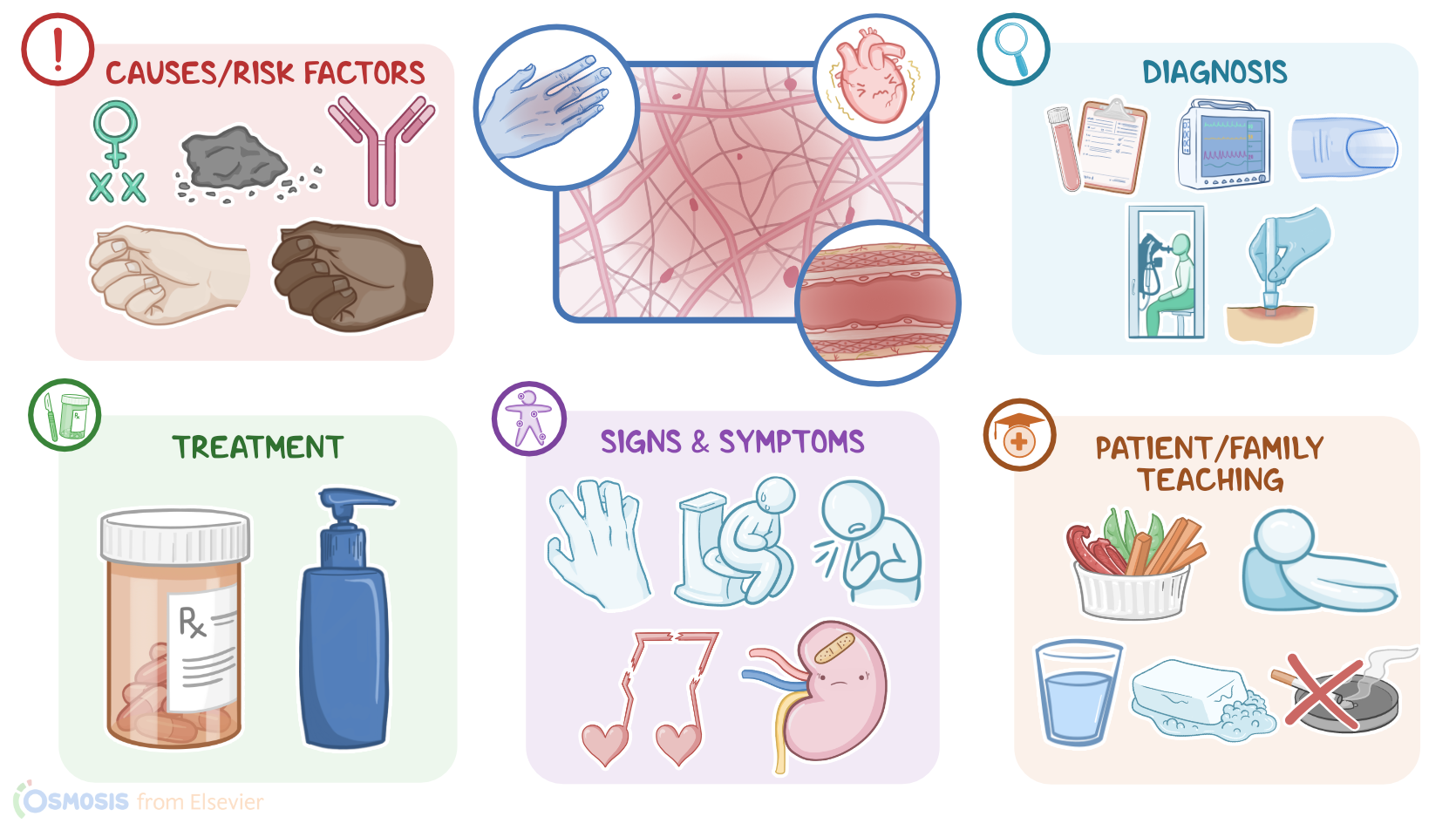
CAUSES AND RISK FACTORS
  • Causes
    • Unknown
  • Risk factors
    • Assigned female at birth
    • Exposure to coal, plastic, and silica dust
    • Localized scleroderma
      • Age below 40 years
      • White race
    • Systemic scleroderma
      • Age between 30-50 years
      • Black race

PATHOPHYSIOLOGY
  • Inflammatory response attacks connective tissue of the skin, blood vessels, and internal organs
  • Increased production of collagen fibers
  • Progressive connective tissue damage and fibrosis
  • Progressive sclerosis of the skin
  • Microvascular abnormalities and occlusion
  • Disruption of normal function of internal organs

SIGNS AND SYMPTOMS
  • Depend whether localized or systemic
  • Localized
    • CREST syndrome
    • Calcinosis
    • Raynaud phenomenon
    • Esophageal dysmotility
    • Sclerodactyly
    • Telangiectasia
  • Systemic
    • Rapid and widespread involvement of the skin and internal organs
    • Lose skin elasticity
    • Limited joint motion
    • Expressionless face
    • Reduced temporomandibular joint motion
    • Sclerodactyly and taught skin around wrist
    • Lightening or darkening of skin
    • Loss of limb hair
    • Decreased sweat production
    • Gastrointestinal involvement
    • Lung involvement
    • Heart involvement
    • Renal involvement

DIAGNOSIS
  • History
  • Physical assessment
  • Blood tests
  • ECG
  • Urinalysis
  • Pulmonary function tests
  • Chest X-ray
  • Nail bed capillary microscopy
  • Biopsy

TREATMENT
  • Corticosteroids
  • Calcium channel blockers
  • PDE5 inhibitors

MANAGEMENT OF CARE
  • Goals of care
    • Assist in decreasing symptoms
    • Provide psychosocial support
  • Keep room at comfortable temperature
  • Provide gloves
  • Administer prescribed medication
  • Collaborate with speech-language pathologist
  • Provide small, frequent meals
  • Keep head elevated for 1-2 hours after eating
  • Coordinate with occupational and physical therapy
  • Support them emotionally
  • Provide resources

PATIENT AND FAMILY TEACHING
  • Explain condition, plan of care, and how to safely administer medications
  • Keep follow-up appointments
  • Eat small, frequent meals
  • Avoid eating late
  • Avoid spicy foods, caffeine, and alcohol
  • Sit up for 1-2 hours after meals
  • Use additional pillows
  • Drink enough fluids
  • Diet
  • Maintain skin integrity
  • Avoid nicotine and tobacco
  • Report to HCP
    • Worsening symptoms
    • Finger or toe becomes painful, numb, or turns purple or black
    • Inability to swallow or breathe
    • Chest pain

Transcript

Watch video only

Scleroderma is a connective tissue disease characterized by chronic inflammation, sclerosis, and fibrosis of the skin, blood vessels, and internal organs. There are two types of scleroderma: localized or limited scleroderma, which is more common and typically involves the skin of the face and fingers; and systemic or diffuse scleroderma, which is less common but more severe, as it tends to involve the internal organs too. Let’s start by reviewing the physiology of connective tissue, which is the most abundant tissue type in the body. It provides structural support and protection throughout the body. This tissue houses the most abundant proteins in the body, called collagen, which are large, strong fibers that add elasticity to the connective tissue and helps it in bearing tensile force. Now, the exact cause of scleroderma is still unknown, with some experts suggesting there’s an inflammatory response against the connective tissue. This is often associated with the presence of autoantibodies, namely anticentromere antibodies in localized disease, and topoisomerase-1 antibodies in systemic disease.

Risk factors of scleroderma include being assigned female at birth, in addition to environmental or occupational exposure to coal, plastic, and silica dust. On the other hand, risk factors for localized scleroderma include ages below 40 and white race, whereas risk factors for systemic scleroderma include ages between 30 and 50 and black race. The pathology of scleroderma starts with an inflammatory response that mainly attacks the connective tissue of the skin, blood vessels, and in some cases even internal organs. This causes an increase in the production of collagen fibers, which leads to progressive connective tissue damage and fibrosis. As a result, there’s progressive sclerosis of the skin, as well as microvascular abnormalities and occlusion, and disruption of the normal function of internal organs, mainly the heart, lungs, kidneys, and gastrointestinal tract. Clinical manifestations of scleroderma differ between localized and systemic diseases. Clients with localized scleroderma typically present with CREST syndrome, which stands for calcinosis, Raynaud phenomenon, esophageal dysmotility, sclerodactyly, and telangiectasia.

Calcinosis is a painful deposition of calcium in the skin of the fingers, forearm, and pressure points. Raynaud phenomenon is the most common presentation, and describes decreased blood flow to the fingers caused by brief vasoconstriction of the small blood vessels supplying the fingers due to cold or stress; this results in pallor of the affected fingers, followed by cyanosis or blue discoloration, and finally reactive hyperemia or redness once blood flow is restored. Esophageal dysmotility may present with dysphagia and heartburn. Sclerodactyly refers to the tightening of the skin of the fingers and the toes that doesn’t extend beyond the elbow or the knee. And finally, telangiectasia is characterized by capillary dilation that results in red spots on the skin of hands, forearm, palms, face, and lips. Switching gears, systemic scleroderma usually manifests with rapid and widespread involvement of the skin and internal organs, making it more severe. Clients typically lose skin elasticity, so the skin looks taut, dry, and shiny. This limits joint motion and causes clients to have an expressionless face with tightly pursed lips.

Additionally, there’s reduced temporomandibular joint, or TMJ, motion; sclerodactyly and taut skin around the wrist; lightening or darkening of the skin; as well as loss of limb hair and decreased sweat production. Regarding the internal organs, involvement of the gastrointestinal tract can cause constipation or diarrhea, whereas involvement of the lungs causes cough, dyspnea, pleural thickening, abnormal pulmonary function, pulmonary arterial hypertension, pulmonary fibrosis, and interstitial lung disease. The heart can also be affected, leading to arrhythmias, pericarditis, and pericardial effusion. Lastly, involvement of the renal system causes rapid, progressive, and irreversible renal damage, leading to scleroderma renal crisis, which is characterized by acute renal failure and malignant hypertension. The diagnosis of scleroderma starts with the client’s history and physical assessment. This can be followed by blood tests to screen for anticentromere or topoisomerase-1 autoantibodies. Additional diagnostic tests may depend on the client’s symptoms. An electrocardiogram can be performed to detect cardiac involvement, urinalysis to detect renal involvement, and pulmonary function tests or a chest x-ray may show lung involvement.

Nail bed capillary microscopy can also be done to detect microvascular abnormalities, and in some cases, biopsy of affected skin or organs can help confirm the diagnosis. Unfortunately, there’s no cure for scleroderma, so the treatment aims at relieving symptoms and slowing the disease progression. This can include corticosteroids to ease the clinical manifestations of inflammation, in addition to calcium channel blockers like nifedipine or PDE5 inhibitors like sildenafil for Raynaud phenomenon. Additional treatment options are tailored to the client’s presentation. Okay, let’s look at the nursing care you’ll be providing for a client diagnosed with scleroderma. Your priority nursing goals are to assist in decreasing symptoms and provide psychosocial support. Begin by instituting measures to ease your client’s symptoms. Keep the room at a comfortable temperature to avoid triggering Raynaud phenomenon, and provide gloves to provide warmth, as needed. Then, administer the prescribed calcium channel blocker to promote vasodilation to the extremities.